Thank you for visiting SNEWPapers!
Sign up free
The New York Journal, And Daily Patriotic Register
New York, New York County, New York
What is this article about?
An anonymous contributor critiques the proposed US Constitution as a novel government form, argues the public lacked time for examination due to secretive deliberations, low voter turnout, and urges the Pennsylvania state convention to seek amendments or adjourn for further deliberation before ratification.
Merged-components note: The short letter to the editor encloses and introduces the editorial piece from the Pennsylvania Packet on the constitution and committee report, which continues seamlessly to the next page; merged into one coherent editorial component.
Clippings
1 of 2
OCR Quality
Full Text
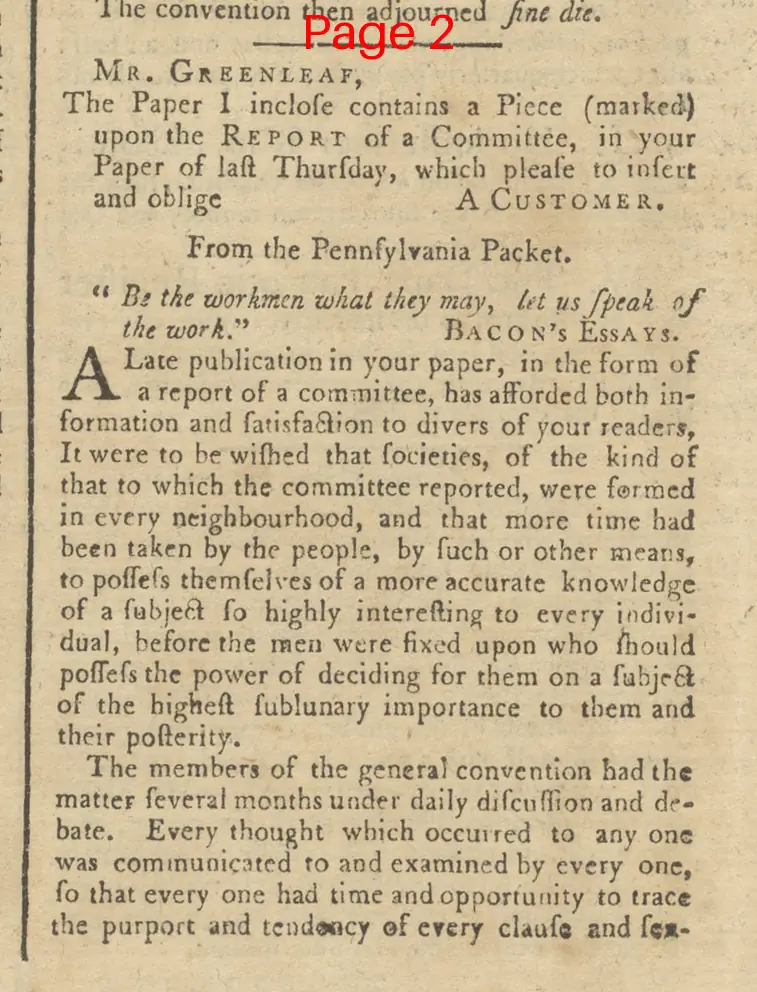
The Paper I enclose contains a Piece (marked) upon the Report of a Committee, in your Paper of last Thursday, which please to insert and oblige
A CUSTOMER.
From the Pennsylvania Packet.
"Be the workmen what they may, let us speak of the work."
Bacon's Essays.
Late publication in your paper, in the form of a report of a committee, has afforded both information and satisfaction to divers of your readers. It were to be wished that societies, of the kind of that to which the committee reported, were formed in every neighbourhood, and that more time had been taken by the people, by such or other means, to possess themselves of a more accurate knowledge of a subject so highly interesting to every individual, before the men were fixed upon who should possess the power of deciding for them on a subject of the highest sublunary importance to them and their posterity.
The members of the general convention had the matter several months under daily discussion and debate. Every thought which occurred to any one was communicated to and examined by every one, so that every one had time and opportunity to trace the purport and tendency of every clause and section. Separately considered, as well as the probable effects and influence of the combined whole; but these deliberations were kept within their own walls with the secrecy of a conclave. The people expected the result would be an amendment of the federal compact, on such points only as had been generally spoken of as defective. Their minds were prepared for such amendments as they could easily judge of, and come to a speedy decision upon. But instead of the old instrument being repaired and amended, we are called upon to consider it as totally dissolved, and its component parts reduced to a state of nature.
The constitution proposed in its stead is confessedly, even by the framers of it, a novelty in the practice of legislation, essentially different, both in principles and organization, from any system of government heretofore formed, either by force, fraud, accident, or the deliberate consent of a people. It may be, as some of its sanguine advocates have asserted, the best form that was ever offered to a people: but we shall remember, that what may be, may not be; and however ready we may be to adopt measures on the credit of others, in matters of lighter moment, the subject before us is certainly a matter of too much consequence to be decided upon without thorough examination, and more deliberation than the citizens of Pennsylvania have had an opportunity of exercising. For although a few individuals who were in the general convention may have given it a sufficient degree of investigation to satisfy their own minds, yet it may be fairly said of the people at large, that they could not possibly have given it a due degree of examination at the time that they were in a manner surprised into a kind of surrender of the right of farther deliberation, by the election of delegates to express their final decision. It has been said, that a small proportion only of the voters in this state (hardly a sixth part) gave their suffrages on this occasion; and it may fairly be presumed, circumstances considered, that a large proportion of those who did not vote declined it because they found themselves unqualified, from the mere want of such information as every citizen ought to possess, before he gives his weight on either side, on a question of so much importance.
Will the members of the state convention, thus possessed of the power, run hastily into the adoption, in toto, of a plan of government which, in the opinion of a large proportion of their constituents, cannot with safety be put in operation, without very essential amendments? Or will they not rather assent either to make the necessary amendments the condition of their agreeing to the plan, or to adjourn for a reasonable time, in order to obtain the deliberate sense of their constituents on a matter of so much importance. Those who mean to act fairly, can hardly withhold their assent to such an adjournment, except it be on the score of expense and the trouble of reassembling. But surely these are considerations too light, to be placed in opposition to the object. The delay can occasion no real loss of time as to the final event, because the accession of other states will be necessary to give operation to the plan; and we know that divers of the state conventions will not meet to deliberate upon it before May or June. Why then should we be denied a reasonable time for deliberation? If the system be a good one and calculated to promote the happiness of the people, the more it is examined and understood, the more generally will it be approved of; but if it should be otherwise, it can hardly be expected that the people would acquiesce in a determination, which they might suppose had been unfairly obtained.
What sub-type of article is it?
What keywords are associated?
What entities or persons were involved?
Editorial Details
Primary Topic
Critique Of Proposed Federal Constitution And Ratification Process
Stance / Tone
Critical Of Hasty Adoption, Advocating Deliberation And Amendments
Key Figures
Key Arguments