Thank you for visiting SNEWPapers!
Sign up free
Kentucky Gazette And General Advertiser
Lexington, Fayette County, Kentucky
What is this article about?
In 1806, reports from Natchitoches detail Spanish troop movements near the US border, including Col. Ezira's 600 cavalry at Nacogdoches and pursuits of a US exploring party led by Major Freeman up the Red River. Caddo chiefs affirm US access, amid ongoing boundary negotiations. A later account describes Spanish forces removing a US flag and threatening the explorers.
Merged-components note: These three components form a coherent section on U.S.-Spanish border tensions, with reflections directly referencing the preceding extract.
Clipping
OCR Quality
Full Text
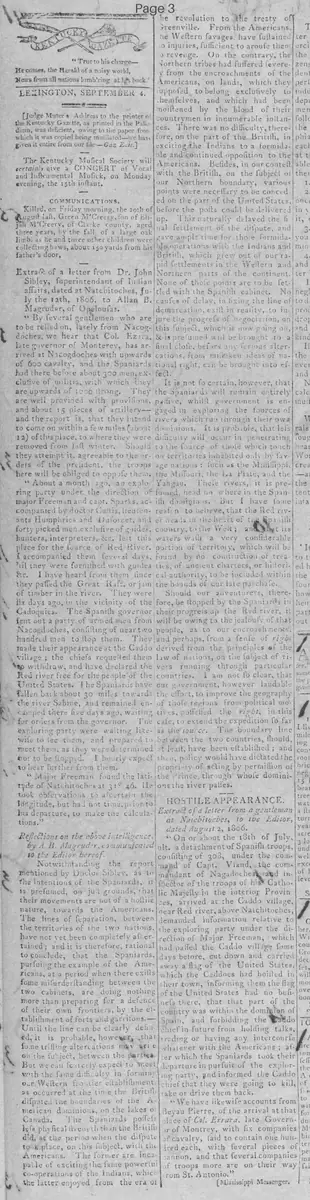
"By several gentlemen who are to be relied on, lately from Nacogdoches, we hear that Col. Ezira, late governor of Monterey, has arrived at Nacogdoches with upwards of 600 cavalry, and the Spaniards had there before about 300 men, exclusive of militia, with which they are upwards of 1000 strong. They are well provided with provisions, and about 15 pieces of artillery--and the report is, that they intend to come on within a few miles (about 12) of this place, to where they were removed from last winter. Should they attempt it, agreeable to the orders of the president, the troops here will be obliged to oppose them.
"About a month ago, an exploring party under the direction of major Freeman and capt. Sparks, accompanied by doctor Curtis, lieutenants Humphries and Duclerc, and forty picked men, exclusive of guides, hunters, interpreters, &c. left this place for the source of Red River. I accompanied them several days, til they were furnished with guides &c. I have heard from them since they passed the Great Raft, or jam of timber in the river. They were six days ago, in the vicinity of the Cadoquies. The Spanish governor sent out a party of armed men from Nacogdoches, consisting of near two hundred men to stop them. They made their appearance at the Caddo village; the chiefs requested them to withdraw, and have declared the Red river free for the people of the United States. The Spaniards have fallen back about 30 miles towards the river Sabine, and remained encamped there five days ago, waiting for orders from the governor. The exploring party were waiting likewise to see them, and prepared to meet them, as they were determined not to be stopped. I hourly expect to hear further from them.
"Major Freeman found the latitude of Natchitoches at 31° 46'. He took observations to ascertain the longitude, but had not time, prior to his departure, to make the calculations."
Reflections on the above intelligence. by A. B. Magruder, communicated to the Editor hereof.
Notwithstanding the report mentioned by Doctor Sibley, as to the intentions of the Spaniards, it is presumed, on just grounds, that their movements are not of a hostile nature, towards the Americans. The lines of separation, between the territories of the two nations, have not yet been completely ascertained; and it is therefore, rational to conclude, that the Spaniards, pursuing the example of the Americans, at a period when there exists some misunderstanding between the two cabinets, are doing nothing more than preparing for a defence of their own frontiers, by the establishment of forts and garrisons.—Until the line can be clearly defined, it is probable, however, that some trifling altercations may arise on the subject, between the parties. But we can scarcely expect to meet with the same dispatch in forming our Western frontier establishment, as occurred at the time the British disputed the boundaries of the American dominions, on the lakes of Canada. The Spaniards possess less physical strength than the British did, at the period when the dispute took place, on this subject, with the Americans. The former are incapable of exciting the same powerful co-operations of the Indians, which the latter enjoyed from the era of the revolution to the treaty of Greenville. From the Americans the Western savages have sustained no injuries, sufficient to arouse them to revenge. On the contrary, the Northern tribes had suffered severely from the encroachments of the Americans, on lands, which they supposed to belong exclusively to themselves, and which had been moistened by the blood of their countrymen in innumerable instances. There was no difficulty, therefore, on the part of the British, in exciting the Indians to a formidable and continued opposition to the Americans. Besides, in our contest with the British, on the subject of our Northern boundary, various points were necessary to be contested on the part of the United States, before the posts could be delivered up. This naturally delayed the final settlement of the dispute, and gave ample time for those formidable operations with the Indians and British, which grew out of our rapid settlements in the Western and Northern parts of the continent. None of those points are to be settled with the Spanish cabinet. No causes of delay, in fixing the line of demarcation, exist in reality, to injure the progress of negociation, on this subject, which is now going on, & is presumed will be brought to a final close, before any serious altercations, from mistaken ideas of national right, can be brought into effect.
It is not so certain, however, that the Spaniards will remain entirely passive, whilst government is engaged in exploring the sources of rivers which run through their own dominions. It is probable, that less difficulty will occur in penetrating to the source of those which touch on territories inhabited only by savage nations: such as the Mississippi, the Missouri, the La Platte, and the Yellowstone. These rivers, it is presumed, head no where in the Spanish dominions. But I have some reason to believe, that the Red river heads in the heart of the Spanish country, to the West; and that its waters wash a very considerable portion of territory, which will be found by no construction of treaties, of ancient charters, or historical authority, to be included within the bounds of our late purchase. Should our adventurers, therefore, be stopped by the Spaniards in their progress up the Red river, it will be owing to the jealousy of that people, as to our encroachments, and perhaps, from a sense of right derived from the principles of the law of nations, on the subject of rivers running through particular countries. I am not so clear, that our government, however laudable the effort, to improve the geography of those regions from political motives, possessed the right, in this case, to extend the expedition so far as the source. The boundary line between the two countries, should, at least, have been established: and then, policy would have dictated the propriety of acting by permission of the prince, through whose dominions the river passes.
HOSTILE APPEARANCE.
Extract of a letter from a gentleman at Natchitoches, to the Editor, dated August 2, 1806.
"On or about the 18th of July, ult. a detachment of Spanish troops, consisting of 300, under the command of Capt. Viand, the commandant of Nagadoches and inspector of the troops of his Catholic Majesty in the interior Provinces, arrived at the Caddo village, near Red river, above Natchitoches, demanded information relative to the exploring party under the direction of Major Freeman, which had passed the Caddo village some days before, cut down and carried away a flag of the United States, which the Caddoes had hoisted in their town, informing them the flag of the United States had no business there, that that part of the country was within the dominion of Spain, and forbidding the Caddo chief in future from holding talks, trading or having any intercourse whatever with the Americans; after which the Spaniards took their departure in pursuit of the exploring party, and informed the Caddo chief that they were going to kill, take or drive them back.
"We have likewise accounts from Bayou Pierre, of the arrival at that place of Col. Errara, late Governor of Monterey, with six companies of cavalry, said to contain one hundred each, with several pieces of cannon, and that several companies of troops more are on their way from St. Antonio."
[Mississippi Messenger,
What sub-type of article is it?
What keywords are associated?
What entities or persons were involved?
Where did it happen?
Foreign News Details
Primary Location
Natchitoches
Event Date
July 12, 1806 To August 2, 1806
Key Persons
Outcome
spanish troops fell back 30 miles toward sabine river; exploring party prepared to resist; no reported casualties; ongoing boundary negotiations expected to resolve tensions without serious conflict.
Event Details
Dr. Sibley reports Spanish forces under Col. Ezira amassing over 1000 men at Nacogdoches, potentially advancing near Natchitoches, prompting US opposition per presidential orders. US exploring party under Major Freeman advances up Red River, encounters Spanish detachment of 200 near Caddo village; chiefs declare river free for Americans, Spaniards withdraw temporarily. Later account details Spanish Capt. Viand's 300 troops removing US flag at Caddo village, forbidding American intercourse, and pursuing explorers with threats. Additional Spanish cavalry under Col. Errara arrives at Bayou Pierre with artillery.