Thank you for visiting SNEWPapers!
Sign up free
Richmond Enquirer
Richmond, Richmond County, Virginia
What is this article about?
The Virginia House of Delegates on January 26 discussed and acted on various bills and resolutions, including road petitions, town establishments, divorces, revenue collection, and turnpike subscriptions. A bill to facilitate a constitutional convention was debated extensively and rejected by a vote of 94-101. Other actions included rejecting university funding and passing bills on mills and public works.
Clipping
OCR Quality
Full Text
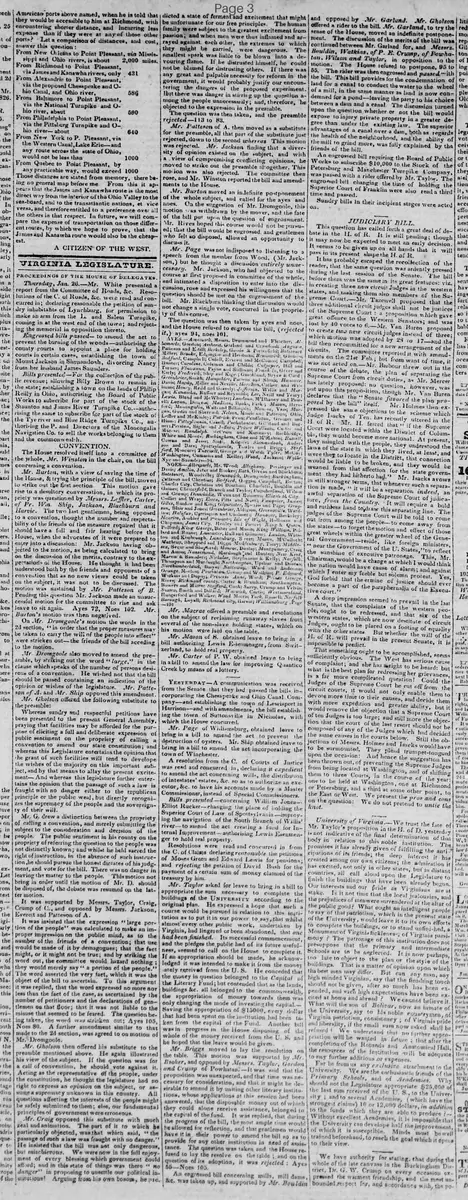
PROCEEDINGS OF THE HOUSE OF DELEGATES
Thursday, Jan. 26.--Mr. White presented a report from the Committee of Roads, &c. Resolutions of the C. of Roads, &c. were read and concurred in; declaring reasonable the petition of sundry inhabitants of Lynchburg, for permission to make an arm from the L. and Salem Turnpike, coming in at the west end of the town; and rejecting the memorial in opposition thereto.
Engrossed bills passed-- to amend the act to prevent the burning of the woods--authorising the county courts to appoint a place for holding courts in certain cases, establishing the town of Mount Jackson in Shenandoah, divorcing Nancy from her husband James Saynders.
Bills presented--For the collection of the public revenue; allowing Billy Brown to remain in the state; establishing a town on the lands of Philip Reilly in Ohio, authorising the Board of Public Works to subscribe for part of the stock of the Staunton and James River Turnpike Co.--authorising the same to subscribe for part of the stock of the Tye River and Blue Ridge Turnpike Co., authorising the P. and Directors of the Monongalia Navigation Co. to sell the works belonging to them and the commonwealth.
CONVENTION.
The House resolved itself into a committee of the whole. Mr. Winston in the chair, on the bill concerning a convention.
Mr. Burton, with a view of saving the time of the House, & trying the principle of the bill, moved to strike out the first section. This motion gave rise to a desultory conversation, in which its propriety was questioned by Messrs. Leffler, Carter, of Pr. Wm. Shin, Jackson, Blackburn and Harvie. The two last gentlemen, being opposed to a convention, thought the number and respectability of the friends of the measure required that it should have a full and fair hearing before the House, when the advocates of it were prepared to enter into a discussion: Mr. Jackson having objected to the motion, as being calculated to bring on the discussion of the merits, contrary to the expectations of the House. He thought it had been understood both by the friends and opponents of a convention that as no new views could be taken on the subject, it was not to be discussed. The motion was sustained by Mr. Patteson of B.
Pending this question Mr. Jackson made an unsuccessful motion for the committee to rise and ask leave to sit again. Ayes 72, Noes 102. Mr. Burton's motion was then negatived.
On Mr. Dromgoole's motion the words in the 2d section, "in order that the proper measures may be taken to carry the will of the people into effect" were stricken out--the friends of the bill acceding to the motion.
Mr. Dromgoole also moved to amend the preamble, by striking out the word "large," in the clause which speaks of the number of persons desirous of a convention. He wished not that the bill should be passed containing an indication of the opinion or wishes of the legislature. Mr. Patteson of A. and Mr. Ship opposed this amendment.
Mr. Gholson offered the following substitute to the preamble:
Whereas sundry and respectful petitions have been presented to the present General Assembly, praying that facilities may be afforded for the purpose of eliciting a full and deliberate expression of public sentiment on the propriety of calling a convention to amend our state constitution; and whereas this Legislature entertains the opinion that the grant of such facilities will tend to develope the wishes of the majority on this important subject, and by that means to allay the present excitement--And whereas this legislature further entertains the opinion that the passage of such a law is fraught with no danger either to the republican principle or the public weal, but directly recognizes the supremacy of the people and the sovereignty of their will.
Mr. G. drew a distinction between the propriety of calling a convention, and merely submitting the subject to the consideration and decision of the people. The public sentiment in his county on the propriety of referring the question to the people was not distinctly known; and while he held sacred the right of instruction, in the absence of such instruction, he should pursue the honest dictates of his judgment, and vote for the bill. There was no danger in leaving the matter to the people. This motion not being in order until the motion of Mr. D. should be disposed of, the debate was resumed on the latter motion.
It was supported by Messrs. Taylor, Craig, Crump of G., and opposed by Messrs. Jackson, Everett and Patteson of A.
It was insisted that the expression "large portion of the people" was calculated to make an improper impression on the public mind, as to the number of the friends of a convention; that use would be made of it by demagogues; that the fact might, or it might not be true; and by striking the word out, the committee would hazard nothing; they would merely say "a portion of the people." The word asserted the very fact, which it was the object of the bill to ascertain. To this argument it was replied, that the word expressed no more nor less than the fact of the case, as ascertained by the number of petitioners and the declarations of gentlemen on that floor; that it was not liable to the misuse that seemed to be feared. The question being taken, the word was stricken out; Ayes 105. Noes 80. A further amendment similar to that made to the 2d section, was agreed to on motion of Mr. Dromgoole.
Mr. Gholson then offered his substitute to the preamble mentioned above. He again illustrated his view of the subject. If the question was for a call of convention, he should vote against it. Acting as the representative of the people, under the constitution, he thought the legislature had no right to express an opinion on the subject, or assume a supremacy unknown in this country. All questions affecting the interests of the people might be safely submitted to them; else, our fundamental principles of government were erroneous.
Mr. Craig opposed this substitute with much zeal and animation. The part of it to which he particularly objected, was that which said, "the passage of such a law was fraught with no danger." He insisted that the bill was not only dangerous, but mischievous. We were now in the full enjoyment of every blessing which government could afford; and in this state of things was there "no danger" in proposing to unsettle our political institutions! Arguing from his own bosom, he predicted a state of ferment and excitement that might be unfortunate for our free principles. The human family were subject to the greatest excitement from passion; and when men were thus inflamed and arrayed against each other, the extremes to which they might be carried, were dangerous. The smallest spark was liable to be blown into a devouring flame. If he distrusted himself, he could not be blamed for distrusting others. If there was any great and palpable necessity for reform in the government, it would probably justify our encountering the dangers of the proposed experiment. But there was danger in stirring up the question among the people unnecessarily; and, therefore, he objected to the expression in the preamble.
The question was then taken, and the preamble rejected--113 to 83.
Mr. Patteson of A. then moved as a substitute for the preamble, all that part of the substitute just rejected, down to the second whereas This motion was rejected. Mr. Jackson finding that a diversity of opinion existed on the subject, and with a view of compromising conflicting opinions, he moved to strike out the preamble altogether, This motion was also rejected. The committee then rose, and Mr. Winston reported the bill and amendments to the House.
Mr. Burton moved an indefinite postponement of the whole subject, and called for the ayes and noes. On the suggestion of Mr. Dromgoole, this motion was withdrawn by the mover, and the fate of the bill put upon the question of engrossment.
Mr. Rives hoped this course would not be pursued; that the bill would be engrossed, and gentlemen who felt so disposed, allowed an opportunity to discuss it.
Mr. Page was not indisposed to listening to a speech from the member from Wood, (Mr. Jackson,) but he thought a discussion entirely unnecessary. Mr. Jackson, who had objected to the course at first proposed in committee of the whole, and intimated a disposition to enter into the discussion, rose and expressed his willingness that the question should be met on the engrossment of the bill. Mr. Blackburn thinking that discussion would not change a single vote, concurred in the propriety of this course.
The question was then taken by ayes and noes, and the House refused to engross the bill, (rejected it,) ayes 94, noes 101.
AYES.--Accomac, Messrs. Drummond and Fletcher. Albemarle, Gordon; Amherst. Garland and Crawford; Augusta Patteson and Estill; Berkeley, Goode & Porter Giles; Botetourt Miller; Brooke, Edgington and Herdman, Brunswick, Gholson; Bedford, Campbell; Cabell, Everett and McComas Campbell, Hunter; Caroline, Coleman and Childs; Culpeper, Hill and Garnet; Fluvanna, Payne and Swann; Franklin, Greer and Early; Frederick, Ship and Kiger ; Goochland, Bruce & Curd; Greenbrier, Smith; Hampshire, Parmer and Stoop; Hanover. Davis; Hardy, Miller and Neville, Harrison, Catber and Williams; Henry, Redd and Gravely; Jefferson, Willis and Morgan; Kanawha, Rutherford and Reynolds; Lee, Neill and Yeary; Lewis, Bland and McWhorter; Loudoun, M'Ildhaney and Powell: Logan, Duncomb; Madison, Banks, Fink; Mason, Hereford; Monongalia, Watts and Billingsly, Monroe, Vas; Morgan, Gustin and Sherrard; Nelson, Massie and Patteson; Ohio, Leffler and McKinley; Patrick. Penn; Pendleton, Greiner and Hiner; Pittsylvania, Cabell; Pocahontas. Gilliland and Burner; Preston, Sigler and Jeffers, Prince William, Carter and Mercer; Randolph. McCrum and Miaroney; Rockbridge, White and Moore, Rockingham, Kline and M'Mahon; Russell Cowan and Jesse; Scott, Kilgore; Shenandoah, Anderson and Bare; Spotsylvania, Towles and Briggs; Stafford, Moncure; Tazewell, George and Ward; Tyler, McCoy; Washington, Cummins and Keller; Wood, Jackson; Wythe, Nye and Saunders--94.
NOES--Albemarle, Mr. Wood: Alleghany. Persinger and Davis; Amelia, Jeter and Booker; Bath, Givens and Blackburn, Botetourt, Woodville; Brunswick, Dromgoole; Buckingham, Patteson and Christian; Bedford, Goggin; Campbell, Burton; Charles City, Christian and Douthatt; Charlotte, Bouldin and Gaines; Chesterfield, Branch and Taylor; Cumberland, Wilson and Crump; Dinwiddie, Wynn and Boisseau, Elizabeth City Collier and Wray; Essex, Pitts and Nivell; Fauquier, James; Giles, Smawley and King; Gloucester, Morris and Page; Grayson, Blair and Jones: Greenbrier, Alderson, Greensville, Wardlaw; Halifax, Carrington and Chalmers; Hanover, Berkeley; Henrico, Ambler and Pleasant; Isle of Wight, Hollaman and Chapman, James City. Henley and Pierce; King & Queen Pollard; King George, Barbee and Mason; King William, Pollard and Roane; Lancaster, Hall and Gilmore; Louisa, Winston and Kinbrough, Lunenburg, Street; Mason, M'Culloch; Mathews, Sheppard and Diggs, Mecklenburg, Tarry; Middlesex, Segar and Sheffield; Monroe, Dunlap; Montgomery, Craig and Amiss; Nansemond, Murdaugh and Hunter; New Kent, Macon & Saunders; Nicholas, Stephenson & Kelly; Norfolk, Thompson and Murdaugh; Northampton, Upshur and Dunton; Northumberland, Burwell; Nottoway, Ward and Anderson; Orange, Morton; Powhatan Crump and Watkins; P. Edward, Watkins and Dupuy; Princess Anne, Ward; Prince George, Rives; Richmond county, Carter & Bramham; Southampton, Bowers and Mason: Stafford, Cooke; Surry, Crump and Velvin; Sussex, Smith and Dillard; Warwick, Curtis; Westmoreland, Hungerford and Walker; Wood Morris; York, Russell, Norfolk Borough, Loyall; Richmond city, Harvie; Williamsburg , Page -101
Mr. Macrae offered a preamble and resolutions on the subject of reclaiming runaway slaves from several of the non-slave holding states, which on his motion were laid on the table.
Mr. Mason of S. obtained leave to bring in a bill authorizing Lewis Eisenmenger, from Switzerland, to hold real property.
Mr. Carter of P. W. obtained leave to bring in a bill to amend the law for improving Quantico Creek by means of a lottery.
YESTERDAY--A communication was received from the Senate that they had passed the bills incorporating the Chesapeake and Ohio Canal Company--and establishing the town of Lewisport in Harrison--and, with amendments, the bill establishing the town of Suttonsville in Nicholas, with which the House concurred.
Mr. Page of Williamsburg, obtained leave to bring in a bill to amend the act to prevent the destruction of oysters. Mr. Ship obtained leave to bring in a bill to amend the act incorporating the town of Winchester.
A resolution from the C. of Courts of Justice was read and concurred in, declaring it expedient to amend the act concerning wills, the distribution of intestates' estates, &c. so as to authorize an executor, &c. to have his accounts made by a Master Commissioner, instead of Special Commissioners.
Bills presented--concerning William Jones--. Elliot Rucker--changing the place of holding the Superior Court of Law of Spotsylvania--improving the navigation of the South Branch of Willis river--to amend the act creating a fund for Internal Improvement--authorising Lewis Eisenmenger to hold real property.
Resolutions were read and concurred in from the C. of Claims declaring reasonable the petitions of Moses Green and Edward Lewis for pensions; and rejecting the petition of David Bush for the payment of a certain sum of money claimed of the treasury by him.
Mr. Taylor asked for leave to bring in a bill to appropriate the sum necessary to complete the buildings of the University according to the original plan. He expressed a hope that such a course would be pursued in relation to this institution as to put it in our power to say, that whilst almost every other public work, undertaken by Virginia, had lingered or been abandoned, that one had been finished. Its successful commencement, and the pledges the public had of its future usefulness, seemed to call on the House to complete it. If an appropriation should be made, he acknowledged it was intended to make it from the money lately received from the U. S. He conceded that the money in question belonged to the Capital of the Literary Fund; but contended that as the lands, buildings &c. all belonged to the commonwealth, the appropriation of money towards them was only changing the mode of investing the capital.-- Saving the appropriation of $15,000, every dollar that had been spent on the institution had been taken from the capital of the Fund. Another bill was in progress in the House disposing of the whole of the money received from the U. S. and he hoped that the leave would be given.
Mr. Briggs moved to lay the resolution on the table. This motion was supported by Mr. Booker, and opposed by Messrs. Taylor, Gordon and Crump of Powhatan.--It was said that the proposition was unexpected, and that time was necessary for consideration, and that it might be desirable to amend it by uniting other literary institutions, whose applications at this session had been answered, that the disposable money out of which they could alone receive assistance, belonged to the capital of the fund. It was replied, that during the progress of the bill, the most ample time would be allowed for reflection, and that gentlemen would have it in their power to amend the bill so as to provide for any other institution in need of assistance. The question was taken and the House refused to lay the resolve on the table ; and on the question of its adoption, it was rejected : Ayes 55--Noes 105.
An engrossed bill concerning mills, mill dams, &c, was taken up, and supported by Mr. Bouldin and opposed by Mr. Garland. Mr. Gholson offered a rider to the bill. Mr. Garland, to try the sense of the House, moved an indefinite postponement. The discussion of the merits of the bill was continued between Mr. Garland for, and Messrs. Bouldin, Watkins, of P. E. Crump, of Powhatan, Wilson and Taylor, in opposition to the motion. The House refused to postpone, 95 to 55. The rider was then engrossed and passed with the bill. This bill provides for the condemnation of land for a canal to conduct the water to the wheel of a mill, in the same manner as land is now condemned for a pond--leaving the party to his choice between a dam and a canal. The discussion turned upon the question whether or not the bill would expose to injury private property in a greater degree than under the existing law. The superior advantages of a canal over a dam, both as regards the health of the neighborhood, and the ability of the mill to grind more, was fully explained by the friends of the bill.
An engrossed bill requiring the Board of Public Works to subscribe $10,000 to the Stock of the Petersburg and Manchester Turnpike Company, was passed with a rider offered by Mr. Taylor. The engrossed bill changing the time of holding the Superior Court of Franklin were also read a third time and passed.
Sundry bills in their incipient stages were acted on.
What sub-type of article is it?
What keywords are associated?
What entities or persons were involved?
Where did it happen?
Domestic News Details
Primary Location
Virginia
Event Date
Thursday, Jan. 26
Key Persons
Outcome
convention bill rejected 94-101; university funding bill rejected 55-105; mills bill passed 95-55; various other bills passed or presented; resolutions concurred in or rejected.
Event Details
The House of Delegates handled reports on roads, passed engrossed bills on woods burning prevention, court locations, town establishment, and divorce. Presented bills on revenue, state residency, town establishment, turnpike stocks, and navigation sales. Debated and rejected a bill on constitutional convention after amendments and votes. Handled resolutions on slaves, property holding, creek improvement, Senate bills, oysters, Winchester incorporation, wills, pensions, and claims. Rejected university completion funding. Passed bills on mills, dams, turnpikes, and court times.