Thank you for visiting SNEWPapers!
Sign up free
The Central Presbyterian
Richmond, Virginia
What is this article about?
Hon. Wm. C. P. Breckinridge's 1888 speech at the Presbyterian Centennial in Philadelphia links Calvinism's doctrines of divine sovereignty and predestination to the promotion of religious liberty, human equality, and historical progress from the Reformation onward.
Merged-components note: Merge continuation of the 'Calvinism and Religious Liberty' speech across pages 2 and 3 based on sequential reading order and clear textual continuation; relabel to 'story' as it is a delivered address rather than an unsigned editorial.
Clippings
1 of 2
OCR Quality
Full Text
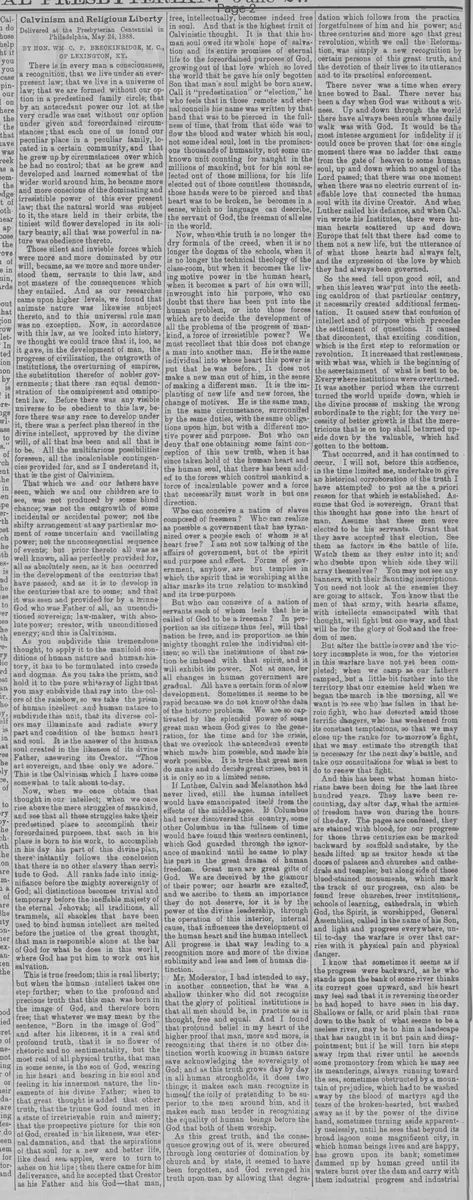
Delivered at the Presbyterian Centennial in Philadelphia, May 24, 1888.
By Hon. Wm. C. P. Breckinridge, M. C., of Lexington, Ky.
There is in every man a consciousness, a recognition, that we live under an ever-present law; that we live in a universe of law; that we are formed without our option in a predestined family circle; that by an antecedent power our lot at the very cradle was cast without our option under given and foreordained circumstances; that each one of us found our peculiar place in a peculiar family, located in a certain community, and that he grew up by circumstances over which he had no control; that as he grew and developed and learned somewhat of the wider world around him, he became more and more conscious of the dominating and irresistible power of this ever present law; that the natural world was subject to it, the stars held in their orbits, the tiniest wild flower developed in its solitary beauty, all that was powerful in nature was obedience thereto.
Those silent and invisible forces which were more and more dominated by our will, became, as we more and more understood them, servants to this law, and not masters of the consequences which they entailed. And as our researches came upon higher levels, we found that animate nature was likewise subject thereto, and to this universal rule man was no exception. Now, in accordance with this law, as we looked into history, we thought we could trace that it, too, as it gave, in the development of man, the progress of civilization, the outgrowth of institutions, the overturning of empires, the substitution therefor of nobler governments: that there ran equal demonstration of the omnipresent and omnipotent law. Before there was any visible universe to be obedient to this law, before there was any race to develop under it, there was a perfect plan thereof in the divine intellect, approved by the divine will, of all that has been and all that is to be. All the multifarious possibilities foreseen, all the incalculable contingencies provided for, and as I understand it, that is the gist of Calvinism.
That which we and our fathers have seen, which we and our children are to see, was not produced by some blind chance; was not the outgrowth of some incidental or accidental power: not the shifty arrangement at any particular moment of some uncertain and vacillating power; not the unconsequential sequence of events: but prior thereto all was as well known, all as perfectly provided for, all as absolutely seen, as it has occurred in the development of the centuries that have passed, and as it is to develop in the centuries that are to come; and that it was seen and provided for by a triune God who was Father of all, an unconditioned sovereign; law-maker, with absolute power; creator, with unconditioned energy; and this is Calvinism.
As you subdivide this tremendous thought, to apply it to the manifold conditions of human nature and human history, it has to be formulated into creeds and dogmas. As you take the prism, and hold it to the pure white ray of light that you may subdivide that ray into the colors of the rainbow, so we take the prism of human intellect and human nature to subdivide this unit, that its diverse colors may illuminate and radiate every part and condition of the human heart and soul. It is the answer of the human soul created in the likeness of its divine Father, answering its Creator. "Thou art sovereign, and thee only we adore."
This is the Calvinism which I have come somewhat to talk about to-day.
Now, when we once obtain that thought in our intellect; when we once rise above the mere struggles of mankind, and see that all these struggles take their predestined place to accomplish their foreordained purposes, that each in his place is born to his work, to accomplish in his day his part of this divine plan, there instantly follows the conclusion that there is no other slavery than servitude to God. All ranks fade into insignificance before the mighty sovereignty of God; all distinctions become trivial and temporary before the ineffable majesty of the eternal Jehovah; all traditions, all trammels, all shackles that have been used to bind human intellect are melted before the justice of the great thought, that man is responsible alone at the bar of God for what he does in this world, where God has put him to work out his salvation.
This is true freedom; this is real liberty; but when the human intellect takes one step further; when to the profound and precious truth that this man was born in the image of God, and therefore born free; that whatever we may mean by the sentence, "Born in the image of God" and after his likeness, it is a real and profound truth, that it is no flower of rhetoric and no sentimentality, but the most real of all physical truths, that man in some sense, is the son of God, wearing in his heart and bearing in his soul and feeling in his innermost nature, the lineaments of his divine Father; when to that great thought is added that other truth, that the triune God found men in a state of irretrievable ruin and misery; that the prospective picture for this son of God, created in his likeness, was eternal damnation, and that the aspirations of that soul for a new and better life, like dead sea apples, were to turn to ashes on his lips; then there came for him deliverance, and he accepted that Creator as his Father and his God—that man, free, intellectually, becomes indeed free in soul. And that is the highest fruit of Calvinistic thought. It is that this human soul owed its whole hope of salvation and its entire promises of eternal life to the foreordained purposes of God, growing out of that love which so loved the world that he gave his only begotten Son that man's soul might be born anew.
Call it "predestination" or "election," he who feels that in those remote and eternal councils his name was written by that hand that was to be pierced in the fullness of time, that from that side was to flow the blood and water which his soul—not some ideal soul, lost in the promiscuous thousands of humanity, not some unknown unit counting for naught in the millions of mankind, but for his soul selected out of those millions, for his life elected out of those countless thousands, those hands were to be pierced and that heart was to be broken—he becomes in a sense, which no language can describe, the servant of God, the freeman of all else in the world.
Now, when this truth is no longer the dry formula of the creed, when it is no longer the dogma of the schools, when it is no longer the technical theology of the class-room, but when it becomes the living motive power in the human heart, when it becomes a part of his own will, inwrought into his purpose, who can doubt that there has been put into the human problem, or into those forces which are to decide the development of all the problems of the progress of mankind, a force of irresistible power? We must recollect that this does not change a man into another man. He is the same individual into whose heart this power is put that he was before. It does not make a new man out of him, in the sense of making a different man. It is the implanting of new life and new forces, the change of motives. He is the same man, in the same circumstance, surrounded by the same duties, with the same obligations upon him, but with a different motive power and purpose. But who can deny that one obtaining some faint conception of this new truth, when it has since taken hold of the human heart and the human soul, that there has been added to the forces which control mankind a force of incalculable power and a force that necessarily must work in but one direction.
Who can conceive a nation of slaves composed of freemen? Who can realize as possible a government that has tyrannized over a people each of whom is at heart free? I am not now talking of the affairs of government, but of the spirit and purpose and effect. Forms of government, anyhow, are but temples in which the spirit that is worshiping at the altar marks its true relation to mankind and its true purpose: But who can conceive of a nation of servants each of whom feels that he is called of God to be a freeman? In proportion as its citizens thus feel, will that nation be free; and in proportion as this mighty thought rules the individual citizen; so will the institutions of that nation be imbued with that spirit, and it will exhibit its power. Not at once, for all changes in human government are gradual. All have a certain form of slow development. Sometimes it seems to be rapid because we do not know of the data of the historic problem. We are so captivated by the splendid power of some great man whom God gives to the generation, for the time and for the crisis, that we overlook the antecedent events which made him possible, and made his work possible. It is true that great men do make and do decide great crises, but it is only so in a limited sense.
If Luther, Calvin and Melancthon had never lived, still the human intellect would have emancipated itself from the effects of the middle-ages. If Columbus had never discovered this country, some other Columbus in the fullness of time would have found this western continent, which God guarded through the ignorance of mankind until he came to play his part in the great drama of human freedom. Great men are great gifts of God. We are deceived by the glamour of their power: our hearts are exalted, and we ascribe to them an importance they do not deserve, for it is by the power of the divine leadership, through the operation of this interior, internal cause, that influences the development of the human heart and the human intellect. All progress is that way leading to a recognition more and more of the divine sublimity and less and less of human distinction.
Mr. Moderator, I had intended to say, in another connection, that he was a shallow thinker who did not recognize that the glory of political institutions is that all men should be, in practice as in thought, free and equal. And I found that profound belief in my heart of the higher proof that man, more and more, is recognizing that there is no other distinction worth knowing in human nature save acknowledging the sovereignty of God; and as this truth grows day by day in all human strongholds, it does two things; it makes each man recognize in himself the folly of pretending to be superior to the men around him, and it makes each man tender in recognizing the equality of human beings before the God that both of them worship.
As this great truth, and the consequence growing out of it, were obscured through long centuries of domination by church and by state, it seemed to have been forgotten, and God revenged his truth upon man by allowing that degradation which follows from the practical forgetfulness of him and his power; and three centuries and more ago that great revolution, which we call the Reformation, was simply a new recognition by certain persons of this great truth, and the devotion of their lives to its utterance and to its practical enforcement.
There never was a time when every knee bowed to Baal. There never has been a day when God was without a witness. Up and down through the world there have always been souls whose daily walk was with God. It would be the most intense argument for infidelity if it could once be proven that for one single moment there was no ladder that came from the gate of heaven to some human soul, up and down which no angel of the Lord passed; that there was one moment when there was no electric current of ineffable love that connected the human soul with its divine Creator. And when Luther nailed his defiance, and when Calvin wrote his Institutes, there were human hearts scattered up and down Europe that felt that there had come to them not a new life, but the utterance of what those hearts had always felt, and the expression of the love by which they had always been governed.
So the seed fell upon good soil, and when this leaven was put into the seething cauldron of that particular century, it necessarily created additional fermentation. It caused anew that confusion of intellect and of purpose which precedes the settlement of questions. It caused that discontent, that exciting condition, which is the first step to reformation or revolution. It increased that restlessness with what was, which is the beginning of the ascertainment of what is best to be. Everywhere institutions were overturned. It was another period where the current turned the world upside down, which is the divine process of making the wrong subordinate to the right; for the very necessity of better growth is that the meretricious that is on top shall be turned upside down by the valuable, which had gotten to the bottom.
That occurred, and it has continued to occur. I will not, before this audience, in the time limited me, undertake to give an historical corroboration of the truth I have attempted to put as the a priori reason for that which is established. Assume that God is sovereign. Grant that this thought has gone into the heart of man. Assume that these men were elected to be his servants. Grant that they have accepted that election. See them as factors in the battle of life. Watch them as they enter into it: and who doubts upon which side they will array themselves? You may not see any banners, with their flaunting inscriptions. You need not look at the enemies they are going to attack. You know that the men of that army, with hearts aflame, with intellects emancipated with that thought, will fight but one way, and that will be for the glory of God and the freedom of men.
But after the battle is over and the victory incomplete is won, for the victories in this warfare have not yet been completed: when we camp as our fathers camped, but a little bit further into the territory that our enemies held when we began the march in the morning, all we want is to see who has fallen in that heroic fight, who has deserted amid those terrific dangers, who has weakened from its constant temptations, so that we may close up the ranks for to-morrow's fight, that we may estimate the strength that is necessary for the next day's battle, and take our consultations for what is best to do to renew that fight.
And this has been what human historians have been doing for the last three hundred years. They have been re-counting, day after day, what the armies of freedom have won during the hours of the day. The pages are confused, they are stained with blood, for our progress for those three centuries can be marked backward by scaffold and stake, by the heads lifted up as traitor heads at the doors of palaces and churches and cathedrals and temples: but along side of those blood-stained monuments, which mark the track of our progress, can also be found freer churches, freer institutions, schools of learning, cathedrals, in which God, the Spirit, is worshipped, General Assemblies, called in the name of his Son, and light and progress everywhere, until to-day the warfare is over that carries with it physical pain and physical danger.
I know that sometimes it seems as if the progress were backward, as he who stands upon the bank of some river thinks its current goes upward, and his heart may feel sad that it is reversing the order he had hoped to have seen in his day. Shallows or falls, or arid plain that runs down to the bank of what seems to be a useless river, may be to him a landscape that has naught in it but pain and disappointment; but if he will turn his steps away from that river until he ascends some promontory from which he may see its meanderings, always running toward the sea, sometimes obstructed by a mountain of prejudice, which had to be washed away by the blood of martyrs and the tears of the broken-hearted, but washed away as if by the power of the divine hand, sometimes turning aside apparently uselessly, until he sees that beyond its broad lagoon some magnificent city, in which human beings live and are happy, has grown upon its bank; sometimes dammed up by human greed until its waters burst over the dam and carry with them industrial progress and industrial
hope, that had been against God, but now is instinct with the spirit of the divine Master, and made to make melodious music in his praise as it becomes the steward of his charities and his missions, but always going to the sea. And so the river of human history has had the same great direction. It has always been toward human freedom—human freedom of the soul, human freedom of the will, human freedom of the intellect, until today we stand in an attitude utterly unlike that in which Calvin stood when he wrote his "Institutes" and when he paid homage to the church at Geneva. I hear it said that Calvinism is dying out. "We do not hold," it is said, "to the harsh and rugged old Calvinism of those hard days. Our preachers do not preach as Calvin preached. They do not talk as Luther talked." They are bringing down, I hear it constantly said, this doctrine of ours, this hard doctrine of ours, this cruel doctrine of ours, to a more enlightened day, to a softer civilization, and to a less prejudiced Calvinism than our fathers preached. I apprehend it is utterly untrue, and that he looks at but the surface who says so. We do not arm ourselves cap-a-pie, as our fathers did. We do not go, as John Knox did, before the queen to defend Scottish liberty. We do not have to die in the ranks of a physical army to preserve the germs of liberty. We are not called to the stake, and therefore the blare of the trumpet and the sound of the drum and the armor of the soldier we have laid aside. Other enemies meet our leaders. Other weapons are to be used for our defense. God's sovereignty was the stone out of the mountain that had to be used to destroy the class distinction which had grown up in the centuries that were then behind them. The individuality of every man, as the direct son of God, elect in the councils of eternity, and therefore not to be touched by mere man power, without law, had to be good in those olden days. Scottish, Genevan and Hollandish liberty had to be won by heroic endeavor and ceaseless courage. The life to be laid down was the physical life. The hollows across which human progress had to go were hollows that were to be filled with blood: and Calvinists were soldiers of the cross with a new destiny, and had to wage a new physical war. Commissioned by the Captain of salvation, they carried into the contest of that day the spirit of a certain physical warfare. To-day the sovereignty of our God is called in question in other ways. Science denies that this universe of his, that stretches out before our eyes, our intelligences and imaginations, does conform to the teachings of his book. In the halls of learning, in the school-house, in the college, the enemies of our God no longer deny the equality of men, but they give a certain apotheosis to human nature, and thereby bring man above his divine Master. No longer do we war with the implements of physical warfare, but we are to meet the world, the flesh and the devil in fight with these intellectual implements that are to win the fight for us. And in every Presbyterian seminary, thanks be to God, and in every Presbyterian pulpit, blessed be his divine name, the weapon with which we fight the warfare of to-day, is that God is the sovereign Creator of the universe around us, the Revealer of the Bible we believe, and the Father of the Savior who died to save mankind. It is the same old Calvinism of the past. It is that same heaven that Stephen saw when he was the first martyr; Paul, who stood consenting to his murder, saw in his long warfare to make the Gentile world Christian, and that our fathers in all ages have seen. It is the same blessed truth that lies at the foundation of this precious centennial today. Lines of geography may divide us; the traditions of the Bible dividing duty and allegiance, may put their veils temporarily between us; questions of diverse races, complex conditions and our delicate problems may make us hesitate about the form of organic union: but under all of these there is the same love, in substance, of the same sovereign God who in the eternity of the past gave his Son, who died for the elect of the world. This is the Calvinism of the present. It will be modified, as we go into the future, in the mere form of utterance or formulation of its creed: but in its essential substance it will never more be modified, until that Jerusalem coming down out of the skies shall come and dwell among men: when all who have gone before, when John Calvin will shake hands with the Moderator of your Assembly: when Melancthon will lie upon the breast of some one of these venerable fathers around me, and when the crowns that are put upon the heads of the elect will be thrown at the feet of the Lamb of God, recognizing that he only is worthy of worship and adoration.
KEEP CLOSE TO GOD. Here is the great, last certainty. Be sure of God. With simple, loving worship, by continual obedience, by purifying yourself even as he is pure, creep close to him, keep close to him. Be sure of God and nothing can overthrow or drown you. It is the great duty of Christians to take care that they offend not with their lips; and that they improve discourse and converse as much as may be, for the good of others.
What sub-type of article is it?
What themes does it cover?
What keywords are associated?
What entities or persons were involved?
Where did it happen?
Story Details
Key Persons
Location
Philadelphia
Event Date
May 24, 1888
Story Details
Speech arguing that Calvinism, emphasizing God's sovereignty and predestination, leads to true human freedom and religious liberty, influencing the Reformation and ongoing progress toward equality and emancipation from tyranny.