Thank you for visiting SNEWPapers!
Sign up free
Editorial
November 6, 1891
The Great West
Saint Paul, Ramsey County, Minnesota
What is this article about?
This editorial advocates for a graduated-cumulative tax system as a solution to economic abuses by wealthy classes, arguing it will destroy trusts and monopolies, equalize profits and opportunities, and regulate industries beneficially. It critiques current taxation favoring the rich and provides historical examples of taxation's regulatory power.
Merged-components note: Table is a copied excerpt integral to the article on the tax solution.
Clipping
OCR Quality
75%
Good
Full Text
The Tax "Solution,"
The Graduated-Cumulative Tax Will Destroy Trusts and Monopolies and Equalize Profits and Opportunities.
The tax solution undoubtedly takes the precedence of all others for the settlement of some of the enormous abuses against which the common people are organizing themselves throughout the length and breadth of the land. This is proven by the readiness with which it has won the indorsements of those, including some of the best intellects of the country, who have taken the time to give the method a careful study.
Inasmuch, however, as this (termed variously as the cumulative, graduated and progressive taxing method) is a comparatively recent development of the search for economic corrections, it has a considerable share of its educational crusade yet to perform ere it shall have won its way through the voices and pens of its disciples into the minds and convictions of the masses in toto. Possessed in my own mind of the utmost confidence in the superiority of this measure for the prevention of certain economic ills, I desire to add a few more ideas to the recent literature upon the subject in the hope of still further expediting the progress with which it is at present finding favor.
To begin with, I call attention to some features of taxation considered apart from its use as a solution or correction in the field of industrial affairs. Long as people shall have need for the authorities and duties of government, so long will they be under the necessity to raise revenue for the payment of the expenses attendant upon the same. We cannot have public or common preservation of the records, public order, public highways or public business without paying for them, and we cannot pay for them as public or common affairs without doing so from a public or private or common fund.
As there is no likelihood of there being found any measure so superior to that of taxation as to cause it to be entirely or even largely substituted for taxation, it is not probable that governments will be maintained independent of taxation. But the payment of a tax is not, in its real and proper sense, essentially a burden. It is no more so than the payment of a sum for a day's labor, the plowing of a field, the mining of a ton of coal or the making of a suit of clothes. There are some services which can be performed far more economically and satisfactorily as public affairs than they can be as private affairs; consequently it is a great advantage to have them performed in a public manner and the expense provided for from a public fund. Looked at in this, its proper, light, taxation must be admitted to be a benefit instead of a burden.
But to justify taxation upon the ground of its being a superior mode of providing for a superior mode of service is not to conclude that taxes may be levied without any particular regard to method, for that would be to commit a grave error. Why is this? Because taxation always exercises an influence in regulating the development or course of industries, and regulates them rightly or wrongly according as it is rightly or wrongly applied. Levied in one fashion it produces a healthy and safe development of industries; levied in another fashion it produces an abnormal and dangerous development of industries. This being so, two questions instead of one always properly come up for consideration when we set about devising a system of taxation to be levied for the public expense:
1. How much revenue do we need?
2. What effect will this tax have upon the industries of the people?
The first question is a mathematical one to be settled by reference to estimates based upon the annual expenditures; the second is an economic question to be settled by reference to needs demanded in our industrial system.
It is with the consideration of matters involved in the second question that I wish briefly to deal in the articles to follow, including an attempt to explain wherein the tax solution would fill some most important wants.
The claim made that taxation regulates the course of relative progress of industries, is borne out both by the reason of the thing and by practical experience. The reason for it we find to be as follows: Industries prosper or decline in proportion to the profitableness or want of it in them, and the cost of taxation is like that of the cost for labor, insurance, supplies, shelter or anything else of similar character: it goes into the items of expense and becomes a factor in determining what shall or shall not be left for profits. Coming out of the profits, as it does, then, or out of the principal, in lieu of there being no profits, it is bound to exercise a powerful influence in determining the manner of their development as to each other.
What do we find for this claim in the line of practical experience? I cite a couple of instances first to show not only that taxation is supposed to be a regulator of industries, but that it has been employed as such and found to work admirably. The tariff tax is one case in point. In the early existence of our government, when we were without manufactories of any consequence and foreign capitalists were determined to do all possible to have us remain without them, a tariff tax was laid by our congress upon foreign goods in order to encourage the building of manufactories within our domain. The tax served to restrain the foreigners to a sufficient degree to enable American manufacturers to get a foothold, and demonstrates very forcibly that taxation is not only a regulator of the course and progress of industries, but a most potent one.
Another case in point is that of the provision in the national banking act for a ten per cent. tax upon state bank issues. The object of the provision, which was to drive state bank issues out of circulation, was effectually accomplished and furnishes another instance of the most practical sort in substantiation of the theory that taxation regulates.
I refer next to a couple of instances of regulation now in force, and of such a character as to be most disastrous to the interests of the people, to show that taxation in any form does regulate.
The first is that class method of doing which consists in exacting high rates of interest for money; in fixing monopoly charges for rent; in compelling you to pay combination prices for what you buy and to take such prices as the speculators choose to allow you for what you sell; in forcing you to accept lock-out rates of wages--in short, which consists of the extortions practiced by the classes upon the masses. This is a system of regulation, the whole tendency of which is unduly to depress the common interests and elevate the class interests, and which will regulate the entire possessions of the masses into the hands of the classes unless something is soon done to prevent it. It is taxation, for though imposed by the classes instead of by law and slightly varying from the legal method, it directly affects expenses and profits, and is, therefore, a conspicuous illustration that taxation, no difference how laid, does regulate.
The next instance is the present common or state method of taxing the people. What is it? It is the method of taxing the middle class at a much higher rate per cent. than the rich, through allowing the rich to be exempted from or to dodge a large part of their share. As it must be admitted without argument that this practice serves to unnaturally depress the industries belonging to the common people and to unnaturally accelerate those belonging to the classes, and to intensify the tendency of the class method above described, it is another most positive example of the theory that taxation does regulate.
As this article is already becoming too long, I will cut it short by stating a few facts which will, in view of what has been said in the foregoing, undoubtedly be immediately understood:
1. Taxation does act as a regulator of the course and relative progress of industries.
2. The classes are rapidly transferring the business and wealth of the nation into the possession of themselves by a system of taxation peculiarly their own.
3. The present state method of taxation serves only to add to the advantage of the classes.
The conclusions to be derived from the statements in the foregoing may be summed up as follows:
1. Public or state taxation is unavoidable.
2. Such taxation does regulate, irrespective of whether it is designed to or not.
3. Class methods of taxation exist, the tendencies of which are to regulate or convert the industries of the people from those of competitive and medium-sized establishments controlled by the many to those of consolidated and enormous-sized establishments controlled by the few.
4. The public method regulates in the interest of the class methods.
From these conclusions we derive another set, which are as follows:
1. The class methods should be abolished.
2. The public method should be reformed.
This brings us to the immediate consideration of the subject which forms the caption of this article. What is the tax solution? It is such a modification of the present public taxing method as will cause it, without being affected in other respects except for the better, to be not only a non-facilitator of any of the class methods, but a positive preventive of a large portion of such class methods.
Before offering this system let me state specifically what these class methods are, then I can better point out what we do and what we do not expect to remedy by the system. They are as follows:
1. The contraction of the currency and the exaction of exorbitant rates of interest.
2. The monopolization of the land and the charging of exorbitant rates of rent.
3. The consolidation of business and manufacturing enterprises and the fixing of prices in their, the classes', interests.
4. The public tax favoritism of themselves through getting legal exemptions and practicing assessment undervaluations.
Here are four class methods, three of which we expect to remedy by the proposed reform in our system of taxation. Those which we expect to remedy are the last three, the first being remedied only by taking the power to issue the circulation away from the banks and resting it singly and purely in the government. We will remedy the fourth abuse by adopting the proposed public system in lieu of the present public system and properly enforcing it, while we will make use of it as a regulator to remedy the second and third abuses.
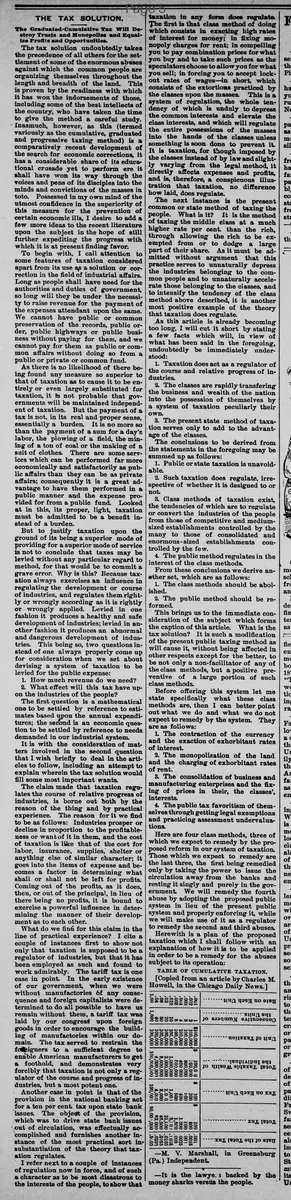
Herewith is a plan of the proposed taxation which I shall follow with an explanation of how it is to be applied in order to be a remedy for the abuses subject to its operation:
TABLE OF CUMULATIVE TAXATION
—It is the lawyers backed by the money sharks versus the people.
The Graduated-Cumulative Tax Will Destroy Trusts and Monopolies and Equalize Profits and Opportunities.
The tax solution undoubtedly takes the precedence of all others for the settlement of some of the enormous abuses against which the common people are organizing themselves throughout the length and breadth of the land. This is proven by the readiness with which it has won the indorsements of those, including some of the best intellects of the country, who have taken the time to give the method a careful study.
Inasmuch, however, as this (termed variously as the cumulative, graduated and progressive taxing method) is a comparatively recent development of the search for economic corrections, it has a considerable share of its educational crusade yet to perform ere it shall have won its way through the voices and pens of its disciples into the minds and convictions of the masses in toto. Possessed in my own mind of the utmost confidence in the superiority of this measure for the prevention of certain economic ills, I desire to add a few more ideas to the recent literature upon the subject in the hope of still further expediting the progress with which it is at present finding favor.
To begin with, I call attention to some features of taxation considered apart from its use as a solution or correction in the field of industrial affairs. Long as people shall have need for the authorities and duties of government, so long will they be under the necessity to raise revenue for the payment of the expenses attendant upon the same. We cannot have public or common preservation of the records, public order, public highways or public business without paying for them, and we cannot pay for them as public or common affairs without doing so from a public or private or common fund.
As there is no likelihood of there being found any measure so superior to that of taxation as to cause it to be entirely or even largely substituted for taxation, it is not probable that governments will be maintained independent of taxation. But the payment of a tax is not, in its real and proper sense, essentially a burden. It is no more so than the payment of a sum for a day's labor, the plowing of a field, the mining of a ton of coal or the making of a suit of clothes. There are some services which can be performed far more economically and satisfactorily as public affairs than they can be as private affairs; consequently it is a great advantage to have them performed in a public manner and the expense provided for from a public fund. Looked at in this, its proper, light, taxation must be admitted to be a benefit instead of a burden.
But to justify taxation upon the ground of its being a superior mode of providing for a superior mode of service is not to conclude that taxes may be levied without any particular regard to method, for that would be to commit a grave error. Why is this? Because taxation always exercises an influence in regulating the development or course of industries, and regulates them rightly or wrongly according as it is rightly or wrongly applied. Levied in one fashion it produces a healthy and safe development of industries; levied in another fashion it produces an abnormal and dangerous development of industries. This being so, two questions instead of one always properly come up for consideration when we set about devising a system of taxation to be levied for the public expense:
1. How much revenue do we need?
2. What effect will this tax have upon the industries of the people?
The first question is a mathematical one to be settled by reference to estimates based upon the annual expenditures; the second is an economic question to be settled by reference to needs demanded in our industrial system.
It is with the consideration of matters involved in the second question that I wish briefly to deal in the articles to follow, including an attempt to explain wherein the tax solution would fill some most important wants.
The claim made that taxation regulates the course of relative progress of industries, is borne out both by the reason of the thing and by practical experience. The reason for it we find to be as follows: Industries prosper or decline in proportion to the profitableness or want of it in them, and the cost of taxation is like that of the cost for labor, insurance, supplies, shelter or anything else of similar character: it goes into the items of expense and becomes a factor in determining what shall or shall not be left for profits. Coming out of the profits, as it does, then, or out of the principal, in lieu of there being no profits, it is bound to exercise a powerful influence in determining the manner of their development as to each other.
What do we find for this claim in the line of practical experience? I cite a couple of instances first to show not only that taxation is supposed to be a regulator of industries, but that it has been employed as such and found to work admirably. The tariff tax is one case in point. In the early existence of our government, when we were without manufactories of any consequence and foreign capitalists were determined to do all possible to have us remain without them, a tariff tax was laid by our congress upon foreign goods in order to encourage the building of manufactories within our domain. The tax served to restrain the foreigners to a sufficient degree to enable American manufacturers to get a foothold, and demonstrates very forcibly that taxation is not only a regulator of the course and progress of industries, but a most potent one.
Another case in point is that of the provision in the national banking act for a ten per cent. tax upon state bank issues. The object of the provision, which was to drive state bank issues out of circulation, was effectually accomplished and furnishes another instance of the most practical sort in substantiation of the theory that taxation regulates.
I refer next to a couple of instances of regulation now in force, and of such a character as to be most disastrous to the interests of the people, to show that taxation in any form does regulate.
The first is that class method of doing which consists in exacting high rates of interest for money; in fixing monopoly charges for rent; in compelling you to pay combination prices for what you buy and to take such prices as the speculators choose to allow you for what you sell; in forcing you to accept lock-out rates of wages--in short, which consists of the extortions practiced by the classes upon the masses. This is a system of regulation, the whole tendency of which is unduly to depress the common interests and elevate the class interests, and which will regulate the entire possessions of the masses into the hands of the classes unless something is soon done to prevent it. It is taxation, for though imposed by the classes instead of by law and slightly varying from the legal method, it directly affects expenses and profits, and is, therefore, a conspicuous illustration that taxation, no difference how laid, does regulate.
The next instance is the present common or state method of taxing the people. What is it? It is the method of taxing the middle class at a much higher rate per cent. than the rich, through allowing the rich to be exempted from or to dodge a large part of their share. As it must be admitted without argument that this practice serves to unnaturally depress the industries belonging to the common people and to unnaturally accelerate those belonging to the classes, and to intensify the tendency of the class method above described, it is another most positive example of the theory that taxation does regulate.
As this article is already becoming too long, I will cut it short by stating a few facts which will, in view of what has been said in the foregoing, undoubtedly be immediately understood:
1. Taxation does act as a regulator of the course and relative progress of industries.
2. The classes are rapidly transferring the business and wealth of the nation into the possession of themselves by a system of taxation peculiarly their own.
3. The present state method of taxation serves only to add to the advantage of the classes.
The conclusions to be derived from the statements in the foregoing may be summed up as follows:
1. Public or state taxation is unavoidable.
2. Such taxation does regulate, irrespective of whether it is designed to or not.
3. Class methods of taxation exist, the tendencies of which are to regulate or convert the industries of the people from those of competitive and medium-sized establishments controlled by the many to those of consolidated and enormous-sized establishments controlled by the few.
4. The public method regulates in the interest of the class methods.
From these conclusions we derive another set, which are as follows:
1. The class methods should be abolished.
2. The public method should be reformed.
This brings us to the immediate consideration of the subject which forms the caption of this article. What is the tax solution? It is such a modification of the present public taxing method as will cause it, without being affected in other respects except for the better, to be not only a non-facilitator of any of the class methods, but a positive preventive of a large portion of such class methods.
Before offering this system let me state specifically what these class methods are, then I can better point out what we do and what we do not expect to remedy by the system. They are as follows:
1. The contraction of the currency and the exaction of exorbitant rates of interest.
2. The monopolization of the land and the charging of exorbitant rates of rent.
3. The consolidation of business and manufacturing enterprises and the fixing of prices in their, the classes', interests.
4. The public tax favoritism of themselves through getting legal exemptions and practicing assessment undervaluations.
Here are four class methods, three of which we expect to remedy by the proposed reform in our system of taxation. Those which we expect to remedy are the last three, the first being remedied only by taking the power to issue the circulation away from the banks and resting it singly and purely in the government. We will remedy the fourth abuse by adopting the proposed public system in lieu of the present public system and properly enforcing it, while we will make use of it as a regulator to remedy the second and third abuses.
Herewith is a plan of the proposed taxation which I shall follow with an explanation of how it is to be applied in order to be a remedy for the abuses subject to its operation:
TABLE OF CUMULATIVE TAXATION
—It is the lawyers backed by the money sharks versus the people.
| [Copied from an article by Charles M. Howell, in the Chicago Daily News.] |
What sub-type of article is it?
Economic Policy
Taxation
Social Reform
What keywords are associated?
Graduated Tax
Cumulative Taxation
Trusts Destruction
Monopolies
Economic Regulation
Class Abuses
Tax Reform
What entities or persons were involved?
Classes
Masses
Trusts
Monopolies
Congress
National Banking Act
Editorial Details
Primary Topic
Graduated Cumulative Tax To Destroy Trusts And Monopolies
Stance / Tone
Strongly Supportive Of Tax Reform Against Class Abuses
Key Figures
Classes
Masses
Trusts
Monopolies
Congress
National Banking Act
Key Arguments
Taxation Regulates Industrial Development And Profits.
Current Taxation Favors The Rich And Enables Class Extortions.
Graduated Cumulative Tax Will Prevent Monopolies, Equalize Opportunities, And Remedy Economic Abuses.
Historical Examples Like Tariffs And Bank Taxes Show Taxation's Regulatory Power.
Public Taxation Is Unavoidable But Must Be Reformed To Counter Class Methods.