Thank you for visiting SNEWPapers!
Sign up free
Story
June 8, 1899
The Frontier
O'neill, O'neill City, Holt County, Nebraska
What is this article about?
Article details evolution of Nebraska's irrigation laws from pre-1889 unregulated use to 1895 system prioritizing first beneficial use, adjudication of 995 old claims and 486 new applications by 1898, water measurement, and benefits of irrigation in increasing crop yields by 30-50%.
Clipping
OCR Quality
95%
Excellent
Full Text
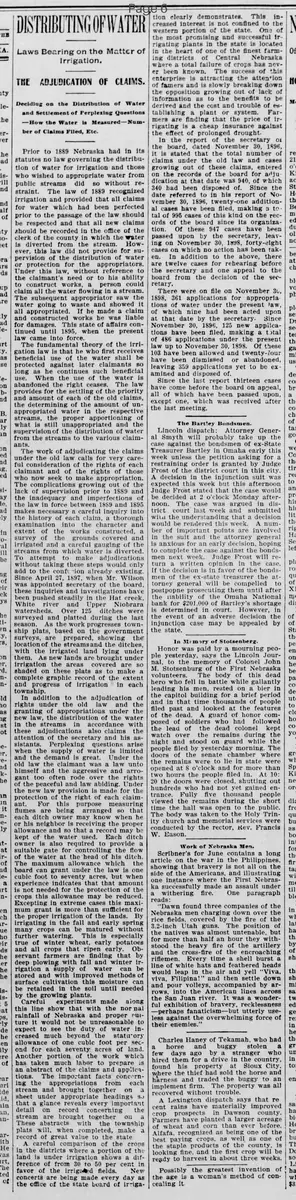
DISTRIBUTING OF WATER
Laws Bearing on the Matter of Irrigation.
THE ADJUDICATION OF CLAIMS.
Deciding on the Distribution of Water and Settlement of Perplexing Questions -How the Water is Measured-Number of Claims Filed. Etc.
Prior to 1889 Nebraska had in its statutes no law governing the distribution of water for irrigation and those who wished to appropriate water from public streams did so without restraint. The law of 1889 recognized irrigation and provided that all claims for water which had been perfected prior to the passage of the law should be respected and that all new claims should be recorded in the office of the clerk of the county in which the water is diverted from the stream. However, this law did not provide for supervision of the distribution of water or protection for the appropriators. Under this law, without reference to the claimant's need or to his ability to construct works, a person could claim all the water flowing in a stream. The subsequent appropriator saw the water going to waste and showed it all appropriated. If he made a claim and constructed works he was liable for damages. This state of affairs continued until 1895, when the present law came into force.
The fundamental theory of the irrigation law is that he who first receives beneficial use of the water shall be protected against later claimants so long as he continues such beneficial use. When the use of the water is abandoned the right ceases. The law provides for the settling of the priority and amount of each of the old claims, the determining of the amount of unappropriated water in the respective streams, the proper apportioning of what is still unappropriated and the supervision of the distribution of water from the streams to the various claimants.
The work of adjudicating the claims under the old law calls for very careful consideration of the rights of each claimant and of the rights of those who now seek to make appropriation. The complications growing out of the lack of supervision prior to 1889 and the inadequacy and imperfections of the law in force between 1889 and 1895 makes necessary a careful inquiry into the history of each claim, a thorough examination into the character and extent of the works constructed, a survey of the grounds covered and irrigated and a careful gauging of the streams from which water is diverted. To attempt to make adjudications without taking these steps would only add to the confusion already existing.
Since April 27, 1897, when Mr. Wilson was appointed secretary of the board, these inquiries and investigations have been pushed steadily in the Hat creek, White river and Upper Niobrara watersheds. Over 125 ditches were surveyed and platted during the last season. As the work progresses township plats, based on the government surveys, are prepared, showing the location of the streams and the ditches, with the irrigated land lying under them. As new lands are brought under irrigation the areas covered are so shaded on these plats as to make a complete graphic record of the extent and progress of irrigation in each township.
In addition to the adjudication of rights under the old law and the granting of appropriations under the new law, the distribution of the water in the streams in accordance with these adjudications also claims the attention of the secretary and his assistants. Perplexing questions arise when the supply of water is limited and the demand is great. Under the old law the claimant was a law unto himself and the aggressive and arrogant too often rode over the rights of the peaceful and law abiding. Under the new law provision is made for the protection of the right of each claimant. For this purpose measuring flumes are being arranged so that each ditch owner may know when he or his neighbor is receiving the proper allowance and so that a record may be kept of the water used. Each ditch owner is also required to provide a suitable gate for controlling the flow of the water at the head of his ditch.
The maximum allowance which the board can grant under the law is one cubic foot to seventy acres, but when experience indicates that that amount is not needed for the protection of the crops this allowance may be reduced. Excepting in extreme cases this maximum grant is more than sufficient for the proper irrigation of the lands. By irrigating in the fall and early spring many crops can be matured without further watering. This is especially true of winter wheat, early potatoes and all crops that ripen early. Observant farmers are finding that by deep plowing with fall and winter irrigation a supply of water can be stored and with improved methods of surface cultivation this moisture can be retained in the soil until needed by the growing plants.
Careful experiments made along this line show that with the normal rainfall of Nebraska and proper culture it would not be unreasonable to expect to see the duty of water increased much beyond the statutory allowance of one cubic foot per second for each seventy acres of land.
Another portion of the work which has taken much labor to prepare is an abstract of the claims and applications. The important facts concerning the appropriations from each stream are brought together on a sheet under appropriate headings so that a glance reveals every important detail on record concerning the stream. These abstracts with the township plats will, when completed, make a record of great value to the state.
A careful comparison of the crops in the districts where a portion of the land is under irrigation shows a difference of from 30 to 50 per cent in favor of the irrigated fields.
New concerts are being made every day as the office of the state board of irrigation clearly demonstrates. This increased interest is not confined to the western portion of the state. One of the most promising and successful irrigating plants in the state is located in the heart of one of the finest farming districts of Central Nebraska where a total failure of crops has never been known. The success of his enterprise is attracting the attention of farmers and is slowly breaking down the opposition growing out of lack of information as to the benefits to be derived and the cost and trouble of establishing a plant or system. Farmers are finding that the price of irrigating is a cheap insurance against the effect of prolonged drought.
In the report of the secretary of the board, dated November 30, 1896, it is stated that the total number of claims under the old law and cases growing out of these claims, entered on the records of the board for adjudication at that date was 940, of which 340 had been disposed of. Since the date referred to in his report of November 30, 1896, twenty-one additional cases have been filed, making a total of 995 cases of this kind on the records of the board since its organization. Of these 947 cases have been passed upon by the secretary, leaving on November 30, 1898, forty-eight cases on which no action has been taken. In addition to the above, there are twelve cases for rehearing before the secretary and one appeal to the board from the decision of the secretary.
There were on file on November 30, 1898, 361 applications for appropriations of water under the present law, of which nine had been acted upon at that date by the secretary. Since November 30, 1896, 125 new applications have been filed, making a total of 486 applications under the present law up to November 30, 1898. Of these 103 have been allowed and twenty-four have been dismissed or abandoned, leaving 359 applications yet to be examined and disposed of.
Since the last report thirteen cases have come before the board on appeal, all of which have been passed upon, except one, which was received after the last meeting.
Laws Bearing on the Matter of Irrigation.
THE ADJUDICATION OF CLAIMS.
Deciding on the Distribution of Water and Settlement of Perplexing Questions -How the Water is Measured-Number of Claims Filed. Etc.
Prior to 1889 Nebraska had in its statutes no law governing the distribution of water for irrigation and those who wished to appropriate water from public streams did so without restraint. The law of 1889 recognized irrigation and provided that all claims for water which had been perfected prior to the passage of the law should be respected and that all new claims should be recorded in the office of the clerk of the county in which the water is diverted from the stream. However, this law did not provide for supervision of the distribution of water or protection for the appropriators. Under this law, without reference to the claimant's need or to his ability to construct works, a person could claim all the water flowing in a stream. The subsequent appropriator saw the water going to waste and showed it all appropriated. If he made a claim and constructed works he was liable for damages. This state of affairs continued until 1895, when the present law came into force.
The fundamental theory of the irrigation law is that he who first receives beneficial use of the water shall be protected against later claimants so long as he continues such beneficial use. When the use of the water is abandoned the right ceases. The law provides for the settling of the priority and amount of each of the old claims, the determining of the amount of unappropriated water in the respective streams, the proper apportioning of what is still unappropriated and the supervision of the distribution of water from the streams to the various claimants.
The work of adjudicating the claims under the old law calls for very careful consideration of the rights of each claimant and of the rights of those who now seek to make appropriation. The complications growing out of the lack of supervision prior to 1889 and the inadequacy and imperfections of the law in force between 1889 and 1895 makes necessary a careful inquiry into the history of each claim, a thorough examination into the character and extent of the works constructed, a survey of the grounds covered and irrigated and a careful gauging of the streams from which water is diverted. To attempt to make adjudications without taking these steps would only add to the confusion already existing.
Since April 27, 1897, when Mr. Wilson was appointed secretary of the board, these inquiries and investigations have been pushed steadily in the Hat creek, White river and Upper Niobrara watersheds. Over 125 ditches were surveyed and platted during the last season. As the work progresses township plats, based on the government surveys, are prepared, showing the location of the streams and the ditches, with the irrigated land lying under them. As new lands are brought under irrigation the areas covered are so shaded on these plats as to make a complete graphic record of the extent and progress of irrigation in each township.
In addition to the adjudication of rights under the old law and the granting of appropriations under the new law, the distribution of the water in the streams in accordance with these adjudications also claims the attention of the secretary and his assistants. Perplexing questions arise when the supply of water is limited and the demand is great. Under the old law the claimant was a law unto himself and the aggressive and arrogant too often rode over the rights of the peaceful and law abiding. Under the new law provision is made for the protection of the right of each claimant. For this purpose measuring flumes are being arranged so that each ditch owner may know when he or his neighbor is receiving the proper allowance and so that a record may be kept of the water used. Each ditch owner is also required to provide a suitable gate for controlling the flow of the water at the head of his ditch.
The maximum allowance which the board can grant under the law is one cubic foot to seventy acres, but when experience indicates that that amount is not needed for the protection of the crops this allowance may be reduced. Excepting in extreme cases this maximum grant is more than sufficient for the proper irrigation of the lands. By irrigating in the fall and early spring many crops can be matured without further watering. This is especially true of winter wheat, early potatoes and all crops that ripen early. Observant farmers are finding that by deep plowing with fall and winter irrigation a supply of water can be stored and with improved methods of surface cultivation this moisture can be retained in the soil until needed by the growing plants.
Careful experiments made along this line show that with the normal rainfall of Nebraska and proper culture it would not be unreasonable to expect to see the duty of water increased much beyond the statutory allowance of one cubic foot per second for each seventy acres of land.
Another portion of the work which has taken much labor to prepare is an abstract of the claims and applications. The important facts concerning the appropriations from each stream are brought together on a sheet under appropriate headings so that a glance reveals every important detail on record concerning the stream. These abstracts with the township plats will, when completed, make a record of great value to the state.
A careful comparison of the crops in the districts where a portion of the land is under irrigation shows a difference of from 30 to 50 per cent in favor of the irrigated fields.
New concerts are being made every day as the office of the state board of irrigation clearly demonstrates. This increased interest is not confined to the western portion of the state. One of the most promising and successful irrigating plants in the state is located in the heart of one of the finest farming districts of Central Nebraska where a total failure of crops has never been known. The success of his enterprise is attracting the attention of farmers and is slowly breaking down the opposition growing out of lack of information as to the benefits to be derived and the cost and trouble of establishing a plant or system. Farmers are finding that the price of irrigating is a cheap insurance against the effect of prolonged drought.
In the report of the secretary of the board, dated November 30, 1896, it is stated that the total number of claims under the old law and cases growing out of these claims, entered on the records of the board for adjudication at that date was 940, of which 340 had been disposed of. Since the date referred to in his report of November 30, 1896, twenty-one additional cases have been filed, making a total of 995 cases of this kind on the records of the board since its organization. Of these 947 cases have been passed upon by the secretary, leaving on November 30, 1898, forty-eight cases on which no action has been taken. In addition to the above, there are twelve cases for rehearing before the secretary and one appeal to the board from the decision of the secretary.
There were on file on November 30, 1898, 361 applications for appropriations of water under the present law, of which nine had been acted upon at that date by the secretary. Since November 30, 1896, 125 new applications have been filed, making a total of 486 applications under the present law up to November 30, 1898. Of these 103 have been allowed and twenty-four have been dismissed or abandoned, leaving 359 applications yet to be examined and disposed of.
Since the last report thirteen cases have come before the board on appeal, all of which have been passed upon, except one, which was received after the last meeting.
What sub-type of article is it?
Historical Event
What themes does it cover?
Justice
What keywords are associated?
Irrigation Law
Water Adjudication
Nebraska Irrigation
Water Claims
Stream Diversion
What entities or persons were involved?
Mr. Wilson
Where did it happen?
Nebraska
Story Details
Key Persons
Mr. Wilson
Location
Nebraska
Event Date
1889 1898
Story Details
History and implementation of Nebraska's irrigation laws from 1889 to 1895, focusing on adjudication of old claims, new appropriations, water distribution supervision, and progress in watersheds like Hat Creek, White River, and Upper Niobrara.