Thank you for visiting SNEWPapers!
Sign up free
Alexandria Advertiser And Commercial Intelligencer
Alexandria, Virginia
What is this article about?
In the House of Commons on June 10, debate on the Irish Martial Law Bill renewal. Irish MPs urge postponement due to low attendance, but Mr. Abbott pushes forward, proposing extension during the war and one month after peace. Mr. George Ponsonby strongly opposes the indefinite extension, citing it as unprecedented and contrary to union hopes. Mr. Addington suggests annual review instead. Debate continues without resolution.
Merged-components note: Continuation of the article on the Imperial Parliament's debate regarding the Irish Martial Law Bill, spanning across pages with sequential reading order.
Clippings
1 of 2
OCR Quality
Full Text
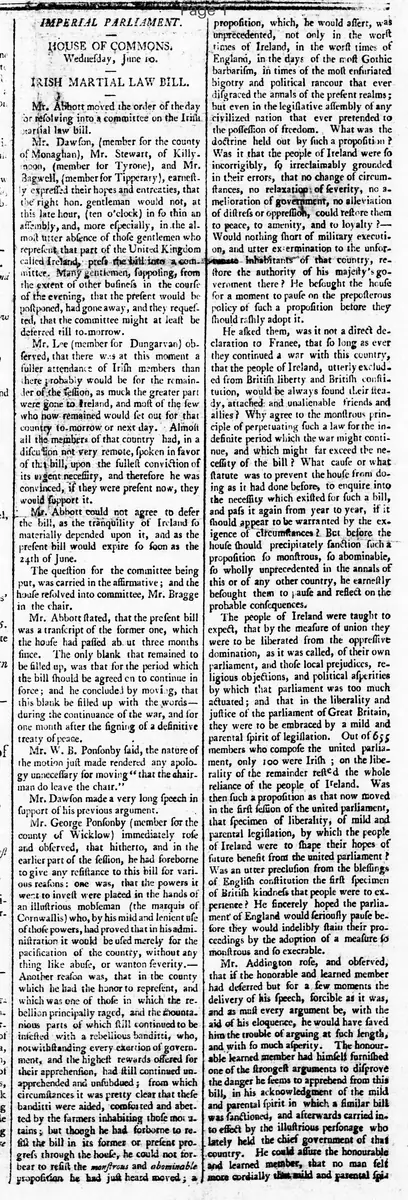
HOUSE OF COMMONS
Wednesday, June 10.
IRISH MARTIAL LAW BILL.
Mr. Abbott moved the order of the day for resolving into a committee on the Irish martial law bill.
Mr. Dawson, (member of the county of Monaghan), Mr. Stewart, of Kildare, Mr. Moon, (member for Tyrone), and Mr. Bagwell, (member for Tipperary), earnestly expressed their hopes and entreaties, that the right hon. gentleman would not, at this late hour, (ten o'clock) in so thin an assembly, and, more especially, in the almost utter absence of those gentlemen who represent that part of the United Kingdom called Ireland:— press the bill into a committee. Many gentlemen, supposing, from the extent of other business in the course of the evening, that the present would be postponed, had gone away, and they requested, that the committee might at least be deferred till to-morrow.
Mr. Lee (member for Dungarvan) observed, that there was at this moment a fuller attendance of Irish members than there probably would be for the remainder of the session, as much the greater part were gone to Ireland, and most of the few who now remained would set out for that country to-morrow or next day. Almost all the members of that country had, in a discussion not very remote, spoken in favor of this bill, upon the fullest conviction of its urgent necessity, and therefore he was convinced, if they were present now, they would support it.
Mr. Abbott could not agree to defer the bill, as the tranquility of Ireland so materially depended upon it, and as the present bill would expire so soon as the 24th of June.
The question for the committee being put, was carried in the affirmative; and the house resolved into committee, Mr. Bragge in the chair.
Mr. Abbott stated, that the present bill was a transcript of the former one, which the house had passed about three months since. The only blank that remained to be filled up, was that for the period which the bill should be agreed to continue in force: and he concluded by moving, that this blank be filled up with the words— during the continuance of the war, and for one month after the signing of a definitive treaty of peace.
Mr. W. B. Ponsonby said, the nature of the motion just made rendered any apology unnecessary for moving ' that the chairman do leave the chair.'
Mr. Dawson made a very long speech in support of his previous argument.
Mr. George Ponsonby (member of the county of Wicklow) immediately rose and observed, that hitherto, and in the earlier part of the session, he had forborne to give any resistance to this bill for various reasons: one was, that the powers it went to invest were placed in the hands of an illustrious nobleman (the marquis of Cornwallis) who, by his mild and lenient use of those powers, had proved that in his administration it would be used merely for the pacification of the country, without anything like abuse, or wanton severity.— Another reason was, that in the county which he had the honor to represent, and which was one of those in which the rebellion principally raged, and the mountainous parts of which still continued to be infested with a rebellious banditti, who, notwithstanding every exertion of government, and the highest rewards offered for their apprehension, had still continued unapprehended and unsubdued : from which circumstances it was pretty clear that these banditti were aided, comforted and abetted by the farmers inhabiting those most mountainous ; but though he had forborne to resist the bill in its former or present progress through the house, he could not forbear to resist the monstrous and abominable proposition he had just heard moved; a proposition, which, he would assert, was unprecedented, not only in the worst times of Ireland. in the worst times of England, in the days of the most Gothic barbarism, in times of the most infuriated bigotry and political rancour that ever disgraced the annals of the present realms; but even in the legislative assembly of any civilized nation that ever pretended to the possession of freedom. What was the doctrine held out by such a proposition ? Was it that the people of Ireland were so incorrigibly, so irreclaimably grounded in their errors, that no change of circumstances, no relaxation of severity, no amelioration of government, no alleviation of distress or oppression, could restore them to peace, to amenity, and to loyalty ?— Would nothing short of military execution, and utter extermination to the unfortunate inhabitants of that country, restore the authority of his majesty's government there? He besought the house for a moment to pause on the preposterous policy of such a proposition before they should rashly adopt it.
He asked them, was it not a direct declaration to France, that so long as ever they continued a war with this country, that the people of Ireland, utterly excluded from British liberty and British constitution, would be always found their ready, attached and unalienable friends and allies? Why agree to the monstrous principle of perpetuating such a law for the indefinite period which the war might continue, and which might far exceed the necessity of the bill ? What cause or what statute was to prevent the house from doing as it had done before, to enquire into the necessity which existed for such a bill, and pass it again from year to year, if it should appear to be warranted by the exigence of circumstances ? But before the house should precipitately sanction such a proposition: so monstrous, so abominable, so wholly unprecedented in the annals of this or of any other country, he earnestly besought them to pause and reflect on the probable consequences.
The people of Ireland were taught to expect, that by the measure of union they were to be liberated from the oppressive domination, as it was called, of their own parliament, and those local prejudices, religious objections, and political asperities by which that parliament was too much actuated; and that in the liberality and justice of the parliament of Great Britain, they were to be embraced by a mild and parental spirit of legislation. Out of 655 members who compose the united parliament, only 100 were Irish ; on the liberality of the remainder rested the whole reliance of the people of Ireland. Was then such a proposition as that now moved in the first session of the united parliament. that specimen of liberality, of mild and parental legislation, by which the people of Ireland were to shape their hopes of future benefit from the united parliament ? Was an utter preclusion from the blessings of English constitution the first specimen of British kindness that people were to experience? He sincerely hoped the parliament of England would seriously pause before they would indelibly stain their proceedings by the adoption of a measure so monstrous and so execrable.
Mr. Addington rose, and observed. that if the honorable and learned member had deferred but for a few moments the delivery of his speech, forcible as it was, and as must every argument be, with the aid of his eloquence, he would have saved him the trouble of arguing at such length, and with so much asperity. The honorable learned member had himself furnished one of the strongest arguments to disprove the danger he seems to apprehend from this bill, in his acknowledgment of the mild and parental spirit in which a similar bill was sanctioned, and afterwards carried into effect by the illustrious personage who lately held the chief government of that country. He could assure the honorable and learned member, that no man felt more cordially this mild and parental spirit Spirit of legislation, or its pivot towards the government, and the real happiness and prosperity of Ireland, than his right honorable friend who made the motion objected to: and he hoped the honorable and learned member had witnessed no proceeding in that house in the smallest degree derogatory to the hopes he professed for the people of Ireland, and its lenient and parental attention. He was free, however, to own, that his personal opinion was perfectly concurrent to the argument of the honorable and learned member, and that he was for giving the house an opportunity of considering the measure as to its necessity from year to year, and re-enacting it, if in its wisdom it should seem necessary, rather than pass it to the extent proposed by his right honorable friend, of whose intention to move its continuance in the way it stood by the present motion, he was not aware.
If his right honorable friend was disposed to take his advice, and withdraw his motion, the amendment he should have the honor to move would be to insert the 25th of March next: but even if the motion should continue worded in its present form, he had every reasonable hope, (he did not wish to excite sanguine and premature expectations,) that the period of continuance proposed by the motion would by no means extend to the period his amendment would go to. The honorable and learned gentleman had given another strong argument in favor of the bill, for he had acknowledged the country to be infested with a rebel banditti, who were cherished by the people, and unsubdued by all the efforts of the government. He noticed the disposition of some honorable gentlemen to excite alarms in the public mind, upon the uncertainty of peace. He knew the motives that actuated such arguments; but though he by no means wished to raise eager and perhaps unwarranted expectations of such an event, it was, in his own expectation, by no means too improbable as to warrant anything like despair.
Mr. Ponsonby explained by saying the right honorable member's accuracy forsook him, when he stated him (Mr. Ponsonby) to have represented all Ireland in a state which he had only ascribed to that of a single county. He was extremely consoled by the expectations of peace expressed by the right honorable gentleman; but as he spoke with hope only, and not with confidence, he was sorry the country could not look to his declaration with all the confidence that could be wished. With respect to the hon. gentleman who made the motion, he could not mean anything personally applied, as he really did not know who he was till informed by the right hon. gentleman.
Mr. Grey rose, and in answer to what he conceived some allusions personally to him from the right hon. gentleman, charging him with a wish to destroy in the public mind the hopes of peace, assured the house that in any argument or motion he had brought forward on that subject, he had no other view than a wish to bring fairly before parliament, previously to its prorogation, the real state of things, and the ground on which the country stood as to the hopes of peace. However, for anything the hon. member had alluded in personal asperity to himself, he was highly consoled in the declaration of the honorable gentleman, as to the prospects of peace; and still more so by his having disclaimed all privity to the present motion previously to its being moved by the right hon. secretary for Ireland. Against the principle of this motion he inveighed in the strongest terms of reprobation, as unprecedented, and unparalleled in the annals of legislation in the worst of times, and the most despotic countries; and if anything could increase his astonishment at such a motion coming from such a man as the right honorable gentleman who introduced it, it was hardihood of his venturing to come forward to that house with such a proposition, without any previous communication whatever with that minister who appointed him to his situation, and who was responsible for every measure of his administration. But when he recollected that right honorable gentleman before he was in power, to be the ready advocate of all their coercive measures: prompt on all occasions to anticipate ministers in their thirst of inordinate power; to be the strenuous supporter of harsh laws; to be the author of a bill for the severe measure of reviving forfeitures in cases of treason: and this before he had any personal interest in the government of the country—he was little surprised that this first public act of his government towards Ireland—should be one which assured so inauspiciously to the people of that country; but he sincerely hoped his government would ere long be changed, as, from principles such as those he manifested, no tranquility was to be expected in any country committed to his direction.
The Chancellor of the Exchequer.— Upon the hon. gentleman's speech, and the temper of his speech, I shall make no comment. I am sure they must have produced their due effect. I am sure the house must have heard with astonishment the part directed against my honorable friend (hear! hear!) I am sorry that I feel in it a degree of political enmity that I had no right to expect. I am stated as saying that I did not hear of this proposition—I certainly was not aware of it at the moment, but I did hear yesterday of such a proposition, and in justice to my hon. friend, I must admit, he did ask me whether my opinion was the same as then? The proposition was certainly made to me yesterday, but it was not explicitly expressed, and I did not think it would be made, though certainly I had a right to expect it. With respect to the insinuation of insincerity, if the honorable gentleman can state any incongruity between my words and my conduct—if he can show any one instance of the kind, in the whole course of my public or my private life—then I admit he has a right to suspect my sincerity in negotiation. This insinuation I must say in defence of my private character, which I do and shall protect: but I have a further motive in the public good, which must be injured by such suspicions, if suffered to go abroad. This is not the first time I have heard insinuations of the kind thrown out; and I am sorry I have so long passed them over in silence —they are the more painful to me, as coming from the honorable gentleman, particularly for causes long antecedent to my present situation; and if he thinks them well founded, it is impossible he could have the good opinion of me, which I thought he had a right to expect. How shall we suppose the enemy will treat with a government which they believe to be insincere in its professions? I shall not, however, pursue the subject any further—I only meant in rising to do justice to my honorable friend, whom I considered as having been very unjustly treated.
(To be continued.)
What sub-type of article is it?
What keywords are associated?
What entities or persons were involved?
Where did it happen?
Foreign News Details
Primary Location
Ireland
Event Date
Wednesday, June 10
Key Persons
Event Details
Debate in the House of Commons on renewing the Irish Martial Law Bill, which expires June 24. Mr. Abbott proposes extending it during the war and one month after peace. Irish members request postponement due to low attendance. Mr. George Ponsonby opposes the extension as unprecedented and harmful to Irish hopes under the union, praising Marquis of Cornwallis's mild administration but decrying perpetual martial law. Mr. Addington suggests annual renewal to March 25 next and expresses hope for peace. Mr. Grey criticizes the motion's principle and Mr. Abbott's background. Chancellor defends sincerity and clarifies prior knowledge of the proposal. Debate ongoing.