Thank you for visiting SNEWPapers!
Sign up free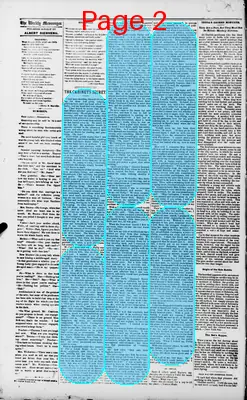
Literary
March 21, 1891
The Weekly Messenger
Saint Martinville, Breaux Bridge, Parks, Saint Martin County, Louisiana
What is this article about?
Ruth Sidney, a young woman caring for her deceased sister Bessie's four children, navigates family duties and heartbreak after losing her childhood love, Philip Carrington, to a deceptive separation orchestrated by his aunt Esther. Years later, during tableaux at the Carrington home, Ruth discovers a hidden letter and flowers in a secret cabinet, revealing Philip's enduring love and Esther's meddling. She confronts Esther, sends a confession letter to Philip abroad, and reunites with him upon his return.
Clipping
OCR Quality
98%
Excellent
Full Text
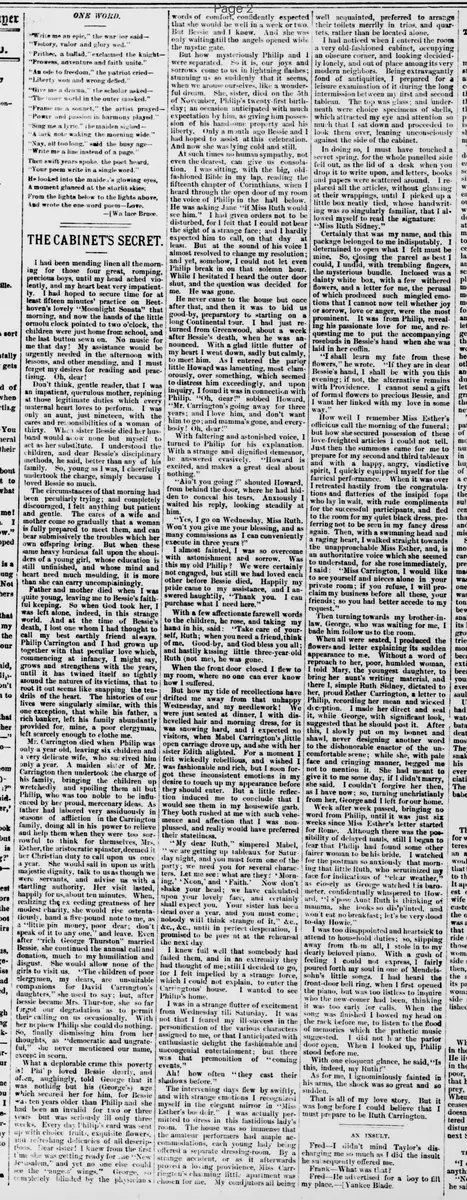
THE CABINET'S SECRET.
I had been mending linen all the morning for those four great, romping, precious boys, until my head ached violently, and my heart beat very impatiently. I had hoped to secure time for at least fifteen minutes' practice on Beethoven's lovely "Moonlight Sonata" that morning, and now the hands of the little ormolu clock pointed to two o'clock, the children were just home from school, and the last button sewn on. No music for me that day! My assistance would be urgently needed in the afternoon with lessons, and other mending, and I must forget my desires for reading and practising. Oh, dear!
Don't think, gentle reader, that I was an impatient, querulous mother, repining at those legitimate duties which every maternal heart loves to perform. I was only an aunt, just nineteen, with the cares and responsibilities of a woman of thirty. When sister Bessie died her husband would allow none but myself to act as her substitute. I understood the children, and dear Bessie's disciplinary methods, he said, better than any of his family. So, young as I was, I cheerfully undertook the charge, simply because I loved Bessie so much.
The circumstances of that morning had been peculiarly trying; and completely discouraged, I felt anything but patient and gentle. The cares of a wife and mother come so gradually that a woman is fully prepared to meet them, and can bear submissively the troubles which her own offspring bring. But when these same heavy burdens fall upon the shoulders of a young girl, whose education is still unfinished, and whose mind and heart need much moulding, it is more than she can carry uncomplainingly.
Father and mother died when I was quite young, leaving me to Bessie's faithful keeping. So when God took her, I was left alone, indeed, in this strange world. And at the time of Bessie's death, I lost one whom I had thought to call my best earthly friend always.
Philip Carrington and I had grown up together with that peculiar love which, commencing at infancy, I might say, grows and strengthens with the years, until it has twined itself so tightly around the natures of its victims, that to root it out seems like snapping the tendrils of the heart. The histories of our lives were singularly similar, with this one exception, that while his father, a rich banker, left his family abundantly provided for, mine, a poor clergyman, left scarcely enough to clothe me.
Mr. Carrington died when Philip was only a year old, leaving six children and a very delicate wife, who survived him only a year. A maiden sister of Mr. Carrington then undertook the charge of his family, bringing the children up wretchedly and spoiling them all but Philip, who was too noble to be influenced by her proud, mercenary ideas. As father had labored very assiduously in seasons of affliction in the Carrington family, doing all in his power to relieve and help them when they were too sorrowful to think for themselves, Mrs. Esther, the aristocratic spinster, deemed it her Christian duty to call upon us once a year.
She would sail in upon us with majestic dignity, talk to us as though we were servants, and advise us with a startling authority. Her visit lasted, happily for us, about ten minutes. When, realizing the exceeding greatness of her modest charity, she would rise ostentatiously, hand a five-pound note to me, as a "little pin money, poor dear; don't speak of it to any one," and leave. Even after "rich George Thurston" married Bessie, she continued the annual call and donation, much to my humiliation and disgust.
She would allow none of the girls to visit us. "The children of poor clergymen, my dears, are unsuitable companions for David Carrington's daughters," she used to say: but, after Bessie became Mrs. Thurston, she so far forgot our degradation as to permit their calling on us occasionally. With her nephew Philip she could do nothing. So, finally dismissing him from her thoughts, as "democratic and ungrateful," she never mentioned our name, except in scorn.
What a deplorable crime this poverty is! Philip loved Bessie dearly, and often, laughingly, told George that it was nothing but his (George's) age which secured her for him, for Bessie was ten years older than Philip and she had been an invalid for two or three years but was seriously ill only three weeks. Every day Philip's card was sent up with choice fruit, exquisite flowers, and refreshing delicacies of all descriptions. Dear sister! I knew from the first time she was getting ready for the "New Jerusalem," and yet no one else could see the "angels' wings."
George, so completely blinded by the physician's words of comfort, confidently expected that she would be well in a week or two. But Bessie and I knew. And she was only waiting till the angels opened wide the mystic gate.
But how mysteriously Philip and I were separated. So it is, our joys and sorrows come to us in lightning flashes: stunning us so suddenly that it seems, when we arouse ourselves, like a wonderful dream. She, sister, died on the 5th of November, Philip's twenty-first birthday; an occasion anticipated with much expectation by him, as giving him possession of his handsome property and his liberty. Only a month ago Bessie and I had hoped to assist at this celebration. And now she was lying cold and still.
At such times no human sympathy, not even the dearest, can give us consolation. I was sitting, with the big, old-fashioned Bible in my lap, reading the fifteenth chapter of Corinthians, when I heard through the open door of my room the voice of Philip in the hall below. He was asking Jane "if Miss Ruth would see him." I had given orders not to be disturbed, for I felt that I could not bear the sight of a strange face; and I hardly expected him to call, on that day at least. But at the sound of his voice I almost resolved to change my resolution; and yet, somehow, I could not let even Philip break in on that solemn hour. While I hesitated I heard the outer door shut, and the question was decided for me.
He was gone. He never came to the house but once after that, and then it was to bid us good-by, preparatory to starting on a long Continental tour. I had just returned from Greenwood, about a week after Bessie's death, when he was announced. With a glad little flutter of my heart I went down, sadly but calmly, to meet him. As I entered the parlor little Howard was lamenting, most clamorously, over something, which seemed to distress him exceedingly, and upon inquiry, I found it was in connection with Philip. "Oh, dear!" sobbed Howard, "Mr. Carrington's going away for three years: and I love him, and don't want him to go; and mamma's gone, and everybody! Oh, dear!"
With faltering and astonished voice, I turned to Philip for his explanation. With a strange and dignified demeanor, he answered evasively. "Howard is excited, and makes a great deal about nothing."
"Ain't you going?" shouted Howard from behind the door, where he had hidden to conceal his tears. Anxiously I waited his reply, looking steadily at him.
"Yes, I go on Wednesday, Miss Ruth. Won't you give me your blessing, and as many commissions as I can conveniently execute in three years?"
I almost fainted, I was so overcome with astonishment and sorrow. Was this my old Philip? We were certainly not engaged, but still we had loved each other before Bessie died. Happily my pride came to my assistance, and I answered haughtily, "Thank you. I can purchase what I need here."
With a few affectionate farewell words to the children, he rose, and taking my hand in his, said: "Take care of yourself, Ruth; when you need a friend, think of me. Good-by, and God bless you all:" and hastily kissing little three-year-old Ruth (not me), he was gone.
When the front door closed I flew to my room, where no one can ever know how I suffered. But how my tide of recollections have drifted me away from that unhappy Wednesday, and my needlework! We were just seated at dinner, I with dishevelled hair and morning dress, for it was snowing hard, and I expected no visitors, when Mabel Carrington's little open carriage drove up, and she with her sister Edith alighted. For a moment I felt wickedly rebellious, and wished I was fashionable and rich, but I soon forgot these inconsistent emotions in my desire to touch up my appearance before they should enter.
But a little reflection induced me to conclude that I would see them in my housewife garb. They both rushed at me with such vehemence and affection that I was nonplussed, and really would have preferred their stateliness.
"My dear Ruth," simpered Mabel, "we are getting up tableaux for Saturday night, and you must form one of the party; we need you for several characters. Let me see: what are they? 'Morning,' 'Noon,' and 'Faith.' Now don't shake your head; we have calculated upon your lovely face, and certainly shall expect you. Your sister has been dead over a year, and you must come; nobody will think strange of it," &c., &c., &c., until in perfect desperation, I promised to be present at the rehearsal the next day.
I knew full well that somebody had failed them, and in an extremity they had thought of me; still I decided to go, for I felt impelled by a strange force, which I could not explain, to enter the Carringtons' house. I wanted to see Philip's home.
I was in a strange flutter of excitement from Wednesday till Saturday. It was not that I feared my ill-success in the personification of the various characters assigned to me, or that I anticipated with enthusiastic delight the fashionable and uncongenial entertainment: but there was that premonition of coming events.
Ah! how often "they cast their shadows before."
The intervening days flew by swiftly, and with strange emotions I recognized myself in the elegant mirror in "Miss Esther's boudoir." I was actually permitted to dress in this fastidious lady's room. The house was so immense that the amateur performers had ample accommodations, each young lady being offered a separate dressing-room.
By a strange accident, or as it afterwards proved a loving providence, Miss Carrington's charming little apartment was chosen for me. My coadjutors all being well acquainted, preferred to arrange their toilets merrily in trios, and quartets, rather than be located alone.
I had noticed when I entered the room a very old-fashioned cabinet, occupying an obscure corner, and looking decidedly lonely, and out of place among its very modern neighbors. Being extravagantly fond of antiquities, I prepared for a leisure examination of it during the long intermission between my first and second tableau. The top was glass; and underneath were choice specimens of shells, which attracted my eye and attention so much that I sat down and proceeded to look them over, leaning unconsciously against the side of the cabinet.
In doing so, I must have touched a secret spring, for the whole panelled side fell out, as the lid of a desk when you drop it to write upon, and letters, books and papers were scattered around. I replaced all the articles, without glancing at their wrappings, until I picked up a little box neatly tied, whose handwriting was so singularly familiar, that I allowed myself to read the signature: "Miss Ruth Sidney."
Certainly that was my name, and this package belonged to me indisputably. I determined to open what I felt must be mine. So, closing the parcel as best I could, I undid, with trembling fingers, the mysterious bundle. Inclosed was a dainty white box, with a few withered flowers, and a letter for me, the perusal of which produced such mingled emotions that I cannot now tell whether joy or sorrow, love or anger, were the most prominent. It was from Philip, revealing his passionate love for me, and requesting me to put the accompanying rosebuds in Bessie's hand when she was laid in her coffin.
"I shall learn my fate from these flowers," he wrote. "If they are in dear Bessie's hand, I shall be with you this evening; if not, the alternative remains with Providence. I cannot send a gift of formal flowers to precious Bessie, and I want her linked with my love in some way."
How well I remember Miss Esther's officious call the morning of the funeral; but how she secured possession of these love-freighted articles I could not tell. Just then the summons came for me to prepare for my second and third tableaux and with a happy, angry, vindictive spirit, I quickly equipped myself for the farcical performance. "When it was over I retreated hastily from the congratulations and flatteries of the insipid fops who lay in wait, with rude compliments for the successful participants, and fled to the room for my quiet black dress, preferring not to be seen in my fancy dress again. Then, with a swimming head and a raging heart, I walked straight towards the unapproachable Miss Esther, and, in an authoritative voice which she seemed to understand, for she rose immediately, I said: "Miss Carrington, I would like to see yourself and nieces alone in your private room; if you refuse, I will proclaim my business before all these, your friends; so you had better accede to my request."
Then turning towards my brother-in-law, George, who was waiting for me, I bade him follow us to the room. When all were seated, I produced the flowers and letter explaining its sudden appearance to me. Without a word of reproach to her, poor, humbled woman, I told Mary, the youngest daughter, to bring her aunt's writing material, and there I, simple Ruth Sidney, dictated to her, proud Esther Carrington, a letter to Philip, recording her mean and wicked deception. I made her direct and seal it, while George, with significant look, suggested that he should post it. After this, I slowly put on my bonnet and shawl, never designing another word to the dishonorable enactor of the uncomfortable scene; while she, with pale face and cringing manner, begged me not to mention it. She had meant to give it to me some day, if I didn't marry, she said. I couldn't forgive her then, as I have now; so, turning unchristianly from her, George and I left for our home.
Week after week passed, bringing no word from Philip, until it was just six weeks since Miss Esther's letter started for Rome. Although there was the possibility of delayed mails, still I began to fear that Philip had found some other fairer woman to be his bride. I watched for the postman so anxiously that morning that little Ruth, who scrutinized my face for indications of "clear weather," as closely as George watched his barometer, confidentially whispered to Howard, "I s'pose Aunt Ruth is thinking o' mamma, she looks so dis'p'inted, and won't eat no breakfast; let's be very good to-day Howie."
I was too disappointed and heartsick to attend to household duties: so, slipping away from them all, I stole in to my dearly beloved piano. With a gush of feeling I could not express, I fairly poured forth my soul in one of Mendelssohn's little songs. I had heard the front-door bell ring, when I first opened the piano, but was too listless to inquire who the new-comer had been, thinking it was too early for calls. When the song was finished I bowed my head on the rack before me, to listen to the flood of memories which the pathetic music suggested. I did not hear the parlor door open.
When I looked up, Philip stood before me. With one eloquent glance, he said, "Is this, indeed, my Ruth?" As for me, I ignominiously fainted in his arms, the shock was so great and so sudden.
That is all of my love story. But it was long before I could believe that I must prepare to be Ruth Carrington.
I had been mending linen all the morning for those four great, romping, precious boys, until my head ached violently, and my heart beat very impatiently. I had hoped to secure time for at least fifteen minutes' practice on Beethoven's lovely "Moonlight Sonata" that morning, and now the hands of the little ormolu clock pointed to two o'clock, the children were just home from school, and the last button sewn on. No music for me that day! My assistance would be urgently needed in the afternoon with lessons, and other mending, and I must forget my desires for reading and practising. Oh, dear!
Don't think, gentle reader, that I was an impatient, querulous mother, repining at those legitimate duties which every maternal heart loves to perform. I was only an aunt, just nineteen, with the cares and responsibilities of a woman of thirty. When sister Bessie died her husband would allow none but myself to act as her substitute. I understood the children, and dear Bessie's disciplinary methods, he said, better than any of his family. So, young as I was, I cheerfully undertook the charge, simply because I loved Bessie so much.
The circumstances of that morning had been peculiarly trying; and completely discouraged, I felt anything but patient and gentle. The cares of a wife and mother come so gradually that a woman is fully prepared to meet them, and can bear submissively the troubles which her own offspring bring. But when these same heavy burdens fall upon the shoulders of a young girl, whose education is still unfinished, and whose mind and heart need much moulding, it is more than she can carry uncomplainingly.
Father and mother died when I was quite young, leaving me to Bessie's faithful keeping. So when God took her, I was left alone, indeed, in this strange world. And at the time of Bessie's death, I lost one whom I had thought to call my best earthly friend always.
Philip Carrington and I had grown up together with that peculiar love which, commencing at infancy, I might say, grows and strengthens with the years, until it has twined itself so tightly around the natures of its victims, that to root it out seems like snapping the tendrils of the heart. The histories of our lives were singularly similar, with this one exception, that while his father, a rich banker, left his family abundantly provided for, mine, a poor clergyman, left scarcely enough to clothe me.
Mr. Carrington died when Philip was only a year old, leaving six children and a very delicate wife, who survived him only a year. A maiden sister of Mr. Carrington then undertook the charge of his family, bringing the children up wretchedly and spoiling them all but Philip, who was too noble to be influenced by her proud, mercenary ideas. As father had labored very assiduously in seasons of affliction in the Carrington family, doing all in his power to relieve and help them when they were too sorrowful to think for themselves, Mrs. Esther, the aristocratic spinster, deemed it her Christian duty to call upon us once a year.
She would sail in upon us with majestic dignity, talk to us as though we were servants, and advise us with a startling authority. Her visit lasted, happily for us, about ten minutes. When, realizing the exceeding greatness of her modest charity, she would rise ostentatiously, hand a five-pound note to me, as a "little pin money, poor dear; don't speak of it to any one," and leave. Even after "rich George Thurston" married Bessie, she continued the annual call and donation, much to my humiliation and disgust.
She would allow none of the girls to visit us. "The children of poor clergymen, my dears, are unsuitable companions for David Carrington's daughters," she used to say: but, after Bessie became Mrs. Thurston, she so far forgot our degradation as to permit their calling on us occasionally. With her nephew Philip she could do nothing. So, finally dismissing him from her thoughts, as "democratic and ungrateful," she never mentioned our name, except in scorn.
What a deplorable crime this poverty is! Philip loved Bessie dearly, and often, laughingly, told George that it was nothing but his (George's) age which secured her for him, for Bessie was ten years older than Philip and she had been an invalid for two or three years but was seriously ill only three weeks. Every day Philip's card was sent up with choice fruit, exquisite flowers, and refreshing delicacies of all descriptions. Dear sister! I knew from the first time she was getting ready for the "New Jerusalem," and yet no one else could see the "angels' wings."
George, so completely blinded by the physician's words of comfort, confidently expected that she would be well in a week or two. But Bessie and I knew. And she was only waiting till the angels opened wide the mystic gate.
But how mysteriously Philip and I were separated. So it is, our joys and sorrows come to us in lightning flashes: stunning us so suddenly that it seems, when we arouse ourselves, like a wonderful dream. She, sister, died on the 5th of November, Philip's twenty-first birthday; an occasion anticipated with much expectation by him, as giving him possession of his handsome property and his liberty. Only a month ago Bessie and I had hoped to assist at this celebration. And now she was lying cold and still.
At such times no human sympathy, not even the dearest, can give us consolation. I was sitting, with the big, old-fashioned Bible in my lap, reading the fifteenth chapter of Corinthians, when I heard through the open door of my room the voice of Philip in the hall below. He was asking Jane "if Miss Ruth would see him." I had given orders not to be disturbed, for I felt that I could not bear the sight of a strange face; and I hardly expected him to call, on that day at least. But at the sound of his voice I almost resolved to change my resolution; and yet, somehow, I could not let even Philip break in on that solemn hour. While I hesitated I heard the outer door shut, and the question was decided for me.
He was gone. He never came to the house but once after that, and then it was to bid us good-by, preparatory to starting on a long Continental tour. I had just returned from Greenwood, about a week after Bessie's death, when he was announced. With a glad little flutter of my heart I went down, sadly but calmly, to meet him. As I entered the parlor little Howard was lamenting, most clamorously, over something, which seemed to distress him exceedingly, and upon inquiry, I found it was in connection with Philip. "Oh, dear!" sobbed Howard, "Mr. Carrington's going away for three years: and I love him, and don't want him to go; and mamma's gone, and everybody! Oh, dear!"
With faltering and astonished voice, I turned to Philip for his explanation. With a strange and dignified demeanor, he answered evasively. "Howard is excited, and makes a great deal about nothing."
"Ain't you going?" shouted Howard from behind the door, where he had hidden to conceal his tears. Anxiously I waited his reply, looking steadily at him.
"Yes, I go on Wednesday, Miss Ruth. Won't you give me your blessing, and as many commissions as I can conveniently execute in three years?"
I almost fainted, I was so overcome with astonishment and sorrow. Was this my old Philip? We were certainly not engaged, but still we had loved each other before Bessie died. Happily my pride came to my assistance, and I answered haughtily, "Thank you. I can purchase what I need here."
With a few affectionate farewell words to the children, he rose, and taking my hand in his, said: "Take care of yourself, Ruth; when you need a friend, think of me. Good-by, and God bless you all:" and hastily kissing little three-year-old Ruth (not me), he was gone.
When the front door closed I flew to my room, where no one can ever know how I suffered. But how my tide of recollections have drifted me away from that unhappy Wednesday, and my needlework! We were just seated at dinner, I with dishevelled hair and morning dress, for it was snowing hard, and I expected no visitors, when Mabel Carrington's little open carriage drove up, and she with her sister Edith alighted. For a moment I felt wickedly rebellious, and wished I was fashionable and rich, but I soon forgot these inconsistent emotions in my desire to touch up my appearance before they should enter.
But a little reflection induced me to conclude that I would see them in my housewife garb. They both rushed at me with such vehemence and affection that I was nonplussed, and really would have preferred their stateliness.
"My dear Ruth," simpered Mabel, "we are getting up tableaux for Saturday night, and you must form one of the party; we need you for several characters. Let me see: what are they? 'Morning,' 'Noon,' and 'Faith.' Now don't shake your head; we have calculated upon your lovely face, and certainly shall expect you. Your sister has been dead over a year, and you must come; nobody will think strange of it," &c., &c., &c., until in perfect desperation, I promised to be present at the rehearsal the next day.
I knew full well that somebody had failed them, and in an extremity they had thought of me; still I decided to go, for I felt impelled by a strange force, which I could not explain, to enter the Carringtons' house. I wanted to see Philip's home.
I was in a strange flutter of excitement from Wednesday till Saturday. It was not that I feared my ill-success in the personification of the various characters assigned to me, or that I anticipated with enthusiastic delight the fashionable and uncongenial entertainment: but there was that premonition of coming events.
Ah! how often "they cast their shadows before."
The intervening days flew by swiftly, and with strange emotions I recognized myself in the elegant mirror in "Miss Esther's boudoir." I was actually permitted to dress in this fastidious lady's room. The house was so immense that the amateur performers had ample accommodations, each young lady being offered a separate dressing-room.
By a strange accident, or as it afterwards proved a loving providence, Miss Carrington's charming little apartment was chosen for me. My coadjutors all being well acquainted, preferred to arrange their toilets merrily in trios, and quartets, rather than be located alone.
I had noticed when I entered the room a very old-fashioned cabinet, occupying an obscure corner, and looking decidedly lonely, and out of place among its very modern neighbors. Being extravagantly fond of antiquities, I prepared for a leisure examination of it during the long intermission between my first and second tableau. The top was glass; and underneath were choice specimens of shells, which attracted my eye and attention so much that I sat down and proceeded to look them over, leaning unconsciously against the side of the cabinet.
In doing so, I must have touched a secret spring, for the whole panelled side fell out, as the lid of a desk when you drop it to write upon, and letters, books and papers were scattered around. I replaced all the articles, without glancing at their wrappings, until I picked up a little box neatly tied, whose handwriting was so singularly familiar, that I allowed myself to read the signature: "Miss Ruth Sidney."
Certainly that was my name, and this package belonged to me indisputably. I determined to open what I felt must be mine. So, closing the parcel as best I could, I undid, with trembling fingers, the mysterious bundle. Inclosed was a dainty white box, with a few withered flowers, and a letter for me, the perusal of which produced such mingled emotions that I cannot now tell whether joy or sorrow, love or anger, were the most prominent. It was from Philip, revealing his passionate love for me, and requesting me to put the accompanying rosebuds in Bessie's hand when she was laid in her coffin.
"I shall learn my fate from these flowers," he wrote. "If they are in dear Bessie's hand, I shall be with you this evening; if not, the alternative remains with Providence. I cannot send a gift of formal flowers to precious Bessie, and I want her linked with my love in some way."
How well I remember Miss Esther's officious call the morning of the funeral; but how she secured possession of these love-freighted articles I could not tell. Just then the summons came for me to prepare for my second and third tableaux and with a happy, angry, vindictive spirit, I quickly equipped myself for the farcical performance. "When it was over I retreated hastily from the congratulations and flatteries of the insipid fops who lay in wait, with rude compliments for the successful participants, and fled to the room for my quiet black dress, preferring not to be seen in my fancy dress again. Then, with a swimming head and a raging heart, I walked straight towards the unapproachable Miss Esther, and, in an authoritative voice which she seemed to understand, for she rose immediately, I said: "Miss Carrington, I would like to see yourself and nieces alone in your private room; if you refuse, I will proclaim my business before all these, your friends; so you had better accede to my request."
Then turning towards my brother-in-law, George, who was waiting for me, I bade him follow us to the room. When all were seated, I produced the flowers and letter explaining its sudden appearance to me. Without a word of reproach to her, poor, humbled woman, I told Mary, the youngest daughter, to bring her aunt's writing material, and there I, simple Ruth Sidney, dictated to her, proud Esther Carrington, a letter to Philip, recording her mean and wicked deception. I made her direct and seal it, while George, with significant look, suggested that he should post it. After this, I slowly put on my bonnet and shawl, never designing another word to the dishonorable enactor of the uncomfortable scene; while she, with pale face and cringing manner, begged me not to mention it. She had meant to give it to me some day, if I didn't marry, she said. I couldn't forgive her then, as I have now; so, turning unchristianly from her, George and I left for our home.
Week after week passed, bringing no word from Philip, until it was just six weeks since Miss Esther's letter started for Rome. Although there was the possibility of delayed mails, still I began to fear that Philip had found some other fairer woman to be his bride. I watched for the postman so anxiously that morning that little Ruth, who scrutinized my face for indications of "clear weather," as closely as George watched his barometer, confidentially whispered to Howard, "I s'pose Aunt Ruth is thinking o' mamma, she looks so dis'p'inted, and won't eat no breakfast; let's be very good to-day Howie."
I was too disappointed and heartsick to attend to household duties: so, slipping away from them all, I stole in to my dearly beloved piano. With a gush of feeling I could not express, I fairly poured forth my soul in one of Mendelssohn's little songs. I had heard the front-door bell ring, when I first opened the piano, but was too listless to inquire who the new-comer had been, thinking it was too early for calls. When the song was finished I bowed my head on the rack before me, to listen to the flood of memories which the pathetic music suggested. I did not hear the parlor door open.
When I looked up, Philip stood before me. With one eloquent glance, he said, "Is this, indeed, my Ruth?" As for me, I ignominiously fainted in his arms, the shock was so great and so sudden.
That is all of my love story. But it was long before I could believe that I must prepare to be Ruth Carrington.
What sub-type of article is it?
Prose Fiction
What themes does it cover?
Love Romance
Social Manners
Moral Virtue
What keywords are associated?
Romance
Family Secret
Aunt Deception
Poverty Class
Inheritance
Reunion
Sentimental Story
Literary Details
Title
The Cabinet's Secret.
Key Lines
"I Shall Learn My Fate From These Flowers," He Wrote. "If They Are In Dear Bessie's Hand, I Shall Be With You This Evening; If Not, The Alternative Remains With Providence. I Cannot Send A Gift Of Formal Flowers To Precious Bessie, And I Want Her Linked With My Love In Some Way."
When I Looked Up, Philip Stood Before Me. With One Eloquent Glance, He Said, "Is This, Indeed, My Ruth?" As For Me, I Ignominiously Fainted In His Arms, The Shock Was So Great And So Sudden.
What A Deplorable Crime This Poverty Is!