Thank you for visiting SNEWPapers!
Sign up free
Editorial
April 19, 1924
Iron County News
Hurley, Iron County, Wisconsin
What is this article about?
S. W. Straus, president of the American Society for Thrift, uses examples of scientific harnessing of wasted natural forces—like volcanic steam in Italy and Bolivia, tides in the Bay of Fundy, and hydro-electric power—to illustrate how thrift and efficiency propel human progress.
Clipping
OCR Quality
98%
Excellent
Full Text
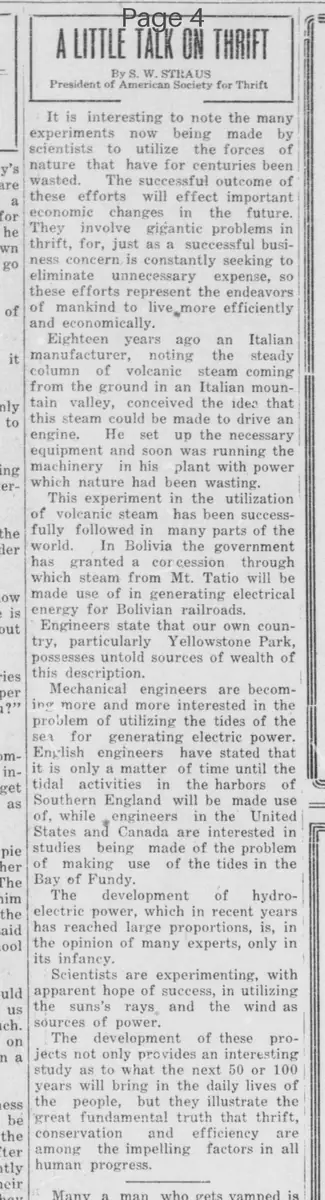
A LITTLE TALK ON THRIFT
By S. W. STRAUS
President of American Society for Thrift
It is interesting to note the many experiments now being made by scientists to utilize the forces of nature that have for centuries been wasted. The successful outcome of these efforts will effect important economic changes in the future. They involve gigantic problems in thrift, for, just as a successful business concern is constantly seeking to eliminate unnecessary expense, so these efforts represent the endeavors of mankind to live more efficiently and economically.
Eighteen years ago an Italian manufacturer, noting the steady column of volcanic steam coming from the ground in an Italian mountain valley, conceived the idea that this steam could be made to drive an engine. He set up the necessary equipment and soon was running the machinery in his plant with power which nature had been wasting.
This experiment in the utilization of volcanic steam has been successfully followed in many parts of the world. In Bolivia the government has granted a concession through which steam from Mt. Tatio will be made use of in generating electrical energy for Bolivian railroads.
Engineers state that our own country, particularly Yellowstone Park, possesses untold sources of wealth of this description.
Mechanical engineers are becoming more and more interested in the problem of utilizing the tides of the sea for generating electric power. English engineers have stated that it is only a matter of time until the tidal activities in the harbors of Southern England will be made use of, while engineers in the United States and Canada are interested in studies being made of the problem of making use of the tides in the Bay of Fundy.
The development of hydro-electric power, which in recent years has reached large proportions, is, in the opinion of many experts, only in its infancy.
Scientists are experimenting, with apparent hope of success, in utilizing the sun's rays and the wind as sources of power.
The development of these projects not only provides an interesting study as to what the next 50 or 100 years will bring in the daily lives of the people, but they illustrate the great fundamental truth that thrift, conservation and efficiency are among the impelling factors in all human progress.
By S. W. STRAUS
President of American Society for Thrift
It is interesting to note the many experiments now being made by scientists to utilize the forces of nature that have for centuries been wasted. The successful outcome of these efforts will effect important economic changes in the future. They involve gigantic problems in thrift, for, just as a successful business concern is constantly seeking to eliminate unnecessary expense, so these efforts represent the endeavors of mankind to live more efficiently and economically.
Eighteen years ago an Italian manufacturer, noting the steady column of volcanic steam coming from the ground in an Italian mountain valley, conceived the idea that this steam could be made to drive an engine. He set up the necessary equipment and soon was running the machinery in his plant with power which nature had been wasting.
This experiment in the utilization of volcanic steam has been successfully followed in many parts of the world. In Bolivia the government has granted a concession through which steam from Mt. Tatio will be made use of in generating electrical energy for Bolivian railroads.
Engineers state that our own country, particularly Yellowstone Park, possesses untold sources of wealth of this description.
Mechanical engineers are becoming more and more interested in the problem of utilizing the tides of the sea for generating electric power. English engineers have stated that it is only a matter of time until the tidal activities in the harbors of Southern England will be made use of, while engineers in the United States and Canada are interested in studies being made of the problem of making use of the tides in the Bay of Fundy.
The development of hydro-electric power, which in recent years has reached large proportions, is, in the opinion of many experts, only in its infancy.
Scientists are experimenting, with apparent hope of success, in utilizing the sun's rays and the wind as sources of power.
The development of these projects not only provides an interesting study as to what the next 50 or 100 years will bring in the daily lives of the people, but they illustrate the great fundamental truth that thrift, conservation and efficiency are among the impelling factors in all human progress.
What sub-type of article is it?
Science Or Medicine
Economic Policy
Social Reform
What keywords are associated?
Thrift
Conservation
Efficiency
Scientific Progress
Natural Forces
Volcanic Steam
Tidal Power
What entities or persons were involved?
S. W. Straus
American Society For Thrift
Italian Manufacturer
Mt. Tatio
Yellowstone Park
Bay Of Fundy
Editorial Details
Primary Topic
Promotion Of Thrift Through Utilization Of Natural Forces
Stance / Tone
Advocatory Of Thrift And Efficiency
Key Figures
S. W. Straus
American Society For Thrift
Italian Manufacturer
Mt. Tatio
Yellowstone Park
Bay Of Fundy
Key Arguments
Scientists Are Utilizing Wasted Natural Forces Like Volcanic Steam For Power
Examples Include Italian Factory, Bolivian Railroads, And Potential In Yellowstone
Tidal Power Studies In England, Us, And Canada
Hydro Electric Power Is In Its Infancy
Experiments With Sun's Rays And Wind As Power Sources
Thrift, Conservation, And Efficiency Drive Human Progress