Thank you for visiting SNEWPapers!
Sign up free
Gazette Of The United States, & Philadelphia Daily Advertiser
Philadelphia, Philadelphia County, Pennsylvania
What is this article about?
Survivors from the Liverpool slave ship Thomas arrived in Nassau in late November 1797, reporting a slave revolt off Africa in early September that murdered most of the crew. Escapers seized an abandoned brig and reached Long Island and Watling's Island in the Bahamas.
Clipping
OCR Quality
Full Text
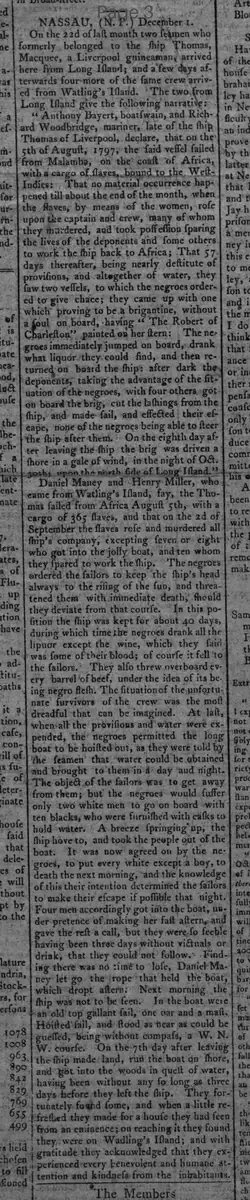
On the 22d of last month two seamen who formerly belonged to the ship Thomas, Macquee, a Liverpool guineaman, arrived here from Long Island; and a few days afterwards four more of the same crew arrived from Watling's Island. The two from Long Island give the following narrative:
"Anthony Bayert, boatswain, and Richard Woodbridge, mariner, late of the ship Thomas of Liverpool, declare, that on the 5th of August, 1797, the said vessel sailed from Malamba, on the coast of Africa, with a cargo of slaves, bound to the West Indies: That no material occurrence happened till about the end of the month, when the slaves, by means of the women, rose upon the captain and crew, many of whom they murdered, and took possession sparing the lives of the deponents and some others to work the ship back to Africa; That 57 days thereafter, being nearly destitute of provisions, and altogether of water, they saw two vessels, to which the negroes ordered to give chase; they came up with one which proving to be a brigantine, without a soul on board, having 'The Robert of Charleston' painted on her stern: The negroes immediately jumped on board, drank what liquor they could find, and then returned on board the ship: after dark the deponents, taking the advantage of the situation of the negroes, with four others, got on board the brig, cut the lashings from the ship, and made sail, and effected their escape, none of the negroes being able to steer the ship after them. On the eighth day after leaving the ship the brig was driven ashore in a gale of wind, in the night of Oct. 6th upon the north side of Long Island.'"
Daniel Maney and Henry Miller, who came from Watling's Island, say, the Thomas sailed from Africa August 5th, with a cargo of 365 slaves, and that on the 2d of September the slaves rose and murdered all ship's company, excepting seven or eight who got into the jolly boat, and ten whom they spared to work the ship. The negroes ordered the sailors to keep the ship's head always to the rising of the sun, and threatened them with immediate death, should they deviate from that course. In this position the ship was kept for about 40 days, during which time the negroes drank all the liquor except the wine, which they said was some of their blood; of course it fell to the sailors.' They also threw overboard every barrel of beef, under the idea of its being negro flesh. The situation of the unfortunate survivors of the crew was the most dreadful that can be imagined. At last, when all the provisions and water were expended, the negroes permitted the long boat to be hoisted out, as they were told by the seamen' that water could be obtained and brought to them in a day and night. The object of the sailors was to get away from them; but the negroes would suffer only two white men to go on board with ten blacks, who were furnished with casks to hold water. A breeze springing up, the ship hove to, and took the people out of the boat. It was now agreed on by the negroes, to put every white except a boy, to death the next morning, and the knowledge of this their intention determined the sailors to make their escape if possible that night. Four men accordingly got into the boat, under pretence of making her fast astern, and gave the rest a call, but they were so feeble having been three days without victuals or drink, that they could not follow. Finding there was no time to lose, Daniel Maney let go the rope that held the boat, which dropt astern. Next morning the ship was not to be seen. In the boat were an old top gallant sail, one oar and a mat. Hoisted sail, and stood as near as could be guessed, being without compass, on a W. N. W. course. On the 7th day after leaving the ship made land, run the boat on shore, and got into the woods in quest of water, having been without any so long as three days before they left the ship. They fortunately found some, and when a little refreshed they made for a house they had seen from an eminence; on reaching it they found they were on Watling's Island; and with gratitude they acknowledged that they experienced every benevolent and humane attention and kindness from the inhabitants.
What sub-type of article is it?
What keywords are associated?
What entities or persons were involved?
Where did it happen?
Foreign News Details
Primary Location
Long Island And Watling's Island, Bahamas
Event Date
August To October 1797
Key Persons
Outcome
most of the crew murdered by slaves; 365 slaves aboard; survivors escaped to bahamian islands; slaves retained control of the ship, fate unknown.
Event Details
The Liverpool slave ship Thomas, under Captain Macquee, sailed from Malamba, Africa, on August 5, 1797, with 365 slaves bound for the West Indies. Around September 2, the slaves revolted, killing most of the crew and sparing a few to navigate back to Africa. After 40-57 days of hardship, including exhaustion of provisions, some crew escaped by seizing an abandoned brigantine (The Robert of Charleston) or a longboat, landing on Long Island (October 6) and Watling's Island.