Thank you for visiting SNEWPapers!
Sign up free
Daily National Intelligencer
Washington, District Of Columbia
What is this article about?
Faculty, trustees, and a former professor at South Carolina College praise James Ogilvie's innovative oratorical lectures delivered from March to June 1815, noting rapid student improvements in elocution, composition, and enthusiasm for literature, dated July 3-7, 1815, in Columbia, SC.
Merged-components note: Continuation of the same article on the progress of eloquence across adjacent columns in reading order.
Clipping
OCR Quality
Full Text
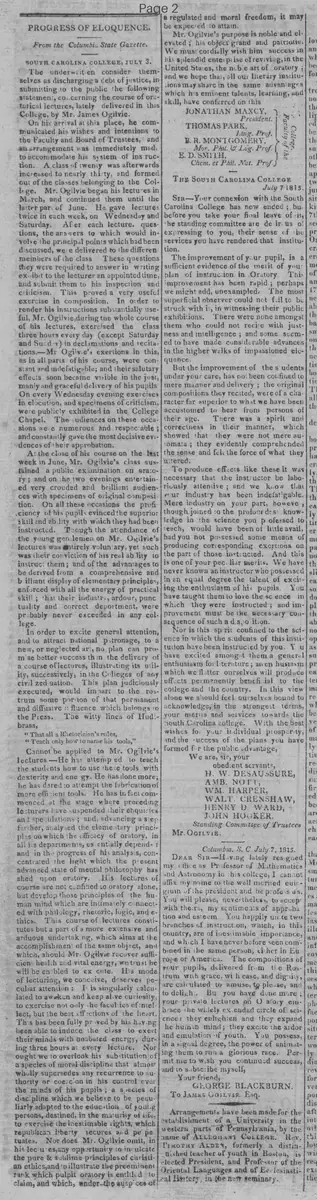
From the Columbia State Gazette
SOUTH CAROLINA COLLEGE, JULY 3.
The undersigned consider themselves as discharging a debt of justice, in submitting to the public the following statement, concerning the course of oratorical lectures, lately delivered in this College, by Mr. James Ogilvie.
On his arrival at this place, he communicated his wishes and intentions to the Faculty and Board of Trustees, and an arrangement was immediately made to accommodate his system of instruction. A class of twenty was afterwards increased to nearly thirty, and formed out of the classes belonging to the College. Mr. Ogilvie began his lectures in March, and continued them until the latter part of June. He gave lectures twice in each week, on Wednesday and Saturday. After each lecture, questions, the answers to which would involve the principal points which had been discussed, were delivered to the different members of the class. These questions they were required to answer in writing, exhibit to the lecturer at an appointed time, and submit them to his inspection and criticism. This proved a very useful exercise in composition. In order to render his instructions substantially useful, Mr. Ogilvie, during the whole course of his lectures, exercised the class three hours every day (except Saturday and Sunday) in declamations and recitations. Mr. Ogilvie's exertions in this, as in all parts of his course, were constant and indefatigable; and their salutary effects soon became visible in the just, manly and graceful delivery of his pupils. On every Wednesday evening exercises in elocution, and specimens of criticism, were publicly exhibited in the College Chapel. The audiences on these occasions were numerous and respectable; and constantly gave the most decisive evidences of their approbation.
At the close of his course on the last week in June, Mr. Ogilvie's class sustained a public examination on oratory; and on the two evenings entertained very crowded and brilliant audiences with specimens of original composition. On all these occasions the proficiency of his pupils evinced the superior skill and ability with which they had been instructed. Though the attendance of the young gentlemen on Mr. Ogilvie's lectures was entirely voluntary, yet such was their conviction of his real ability to instruct them; and of the advantages to be derived from a comprehensive and brilliant display of elementary principles, enforced with all the energy of practical skill; that their industry, ardour, punctuality and correct deportment, were probably never exceeded in any college.
In order to excite general attention, and to attract national patronage, to a new, or neglected art, no plan can promise better success than the delivery of a course of lectures, illustrating its utility, successively, in the Colleges of any civilized nation. This plan judiciously executed, would impart to the rostrum some portion of that permanent and diffusive influence which belongs to the Press. The witty lines of Hudibrass,
"That all a Rhetorician's rules
Teach only how to name his tools,"
Cannot be applied to Mr. Ogilvie's lectures. He has attempted to teach the students how to use these tools with dexterity and energy. He has done more; he has dared to attempt the fabrication of more efficient tools. He has in fact commenced at the stage where preceding lecturers have suspended their enquiries and speculations; and, advancing a step further, analyzed the elementary principles on which the efficacy of oratory, in all its departments, essentially depends; and in the progress of his analysis, concentrated the light which the present advanced state of mental philosophy has shed upon oratory. His lectures of course are not confined to oratory alone, but develop those principles of the human mind which are intimately connected with philology, rhetoric, logic, and ethics. This course of lectures constitutes but a part of a more extensive and arduous undertaking, which aims at the accomplishment of the same object, and which, should Mr. Ogilvie recover sufficient health and vital energy, we trust he will be enabled to execute. His mode of lecturing, we conceive, deserves peculiar attention: It is singularly calculated to awaken and keep alive curiosity, to exercise not only the faculties of intellect, but the best affections of the heart. This has been fully proved by his having been able to induce the class to exert their minds with unabated energy, during three hours at every lecture. Nor ought we to overlook his substitution of a species of moral discipline that almost wholly supersedes any recurrence to authority or coercion in his control over the minds of his pupils; a species of discipline which we believe to be peculiarly adapted to the education of young persons, destined, in the maturity of life, to exercise the inestimable rights, which republican liberty secures and perpetuates. Nor does Mr. Ogilvie omit, in his lectures, any opportunity to inculcate the pure & sublime principles of christian ethics, and to illustrate the preeminent rank which pulpit oratory is entitled to claim, and which, under the auspices of
a regulated and moral freedom, it may be expected to attain.
Mr. Ogilvie's purpose is noble and elevated; his object grand and patriotic. We must cordially wish him success in his splendid enterprise of reviving, in the United States, the noble art of oratory; and we hope that all our literary institutions may share in the same advantages which his eminent talents, learning, and skill, have conferred on this
JONATHAN MAXCY,
President.
THOMAS PARK,
E. D. SMITH.
B. R. MONTGOMERY,
Mor. Phil. Log. Prof.
Ling. Prof.
Faculty of the
College
Chem. et Phil. Nat. Prof
THE SOUTH CAROLINA COLLEGE
July 7 1815.
SIR—Your connexion with the South Carolina College has now ended; but before you take your final leave of it, the standing committee are desirous of expressing to you, their sense of the services you have rendered that institution.
The improvement of your pupils, is a sufficient evidence of the merit of your plan of instruction in Oratory. This improvement has been rapid; perhaps we might add, unexampled. The most superficial observer could not fail to be struck with it, in witnessing their public exhibitions. There were none amongst them who could not recite with justice and intelligence; and some seemed to have made considerable advances in the higher walks of impassioned eloquence.
But the improvement of the students under your care, has not been confined to mere manner and delivery: the original compositions they recited, were of a character far superior to what we have been accustomed to hear from persons of their age. There was a spirit and correctness in their manner, which showed that they were not mere automata: they evidently comprehended the sense and felt the force of what they uttered.
To produce effects like these it was necessary that the instructor be laboriously attentive; and we know that your industry has been indefatigable. Mere industry on your part, however, though joined to the profoundest knowledge in the science you professed to teach, would have been of little avail, had you not possessed some means of producing corresponding exertions on the part of those instructed. And this is one of your peculiar merits. We have never known an instructor who possessed in an equal degree the talent of exciting the enthusiasm of his pupils. You have taught them to love the science in which they were instructed; and improvement must be the necessary consequence of such a disposition.
Nor is this spirit confined to the science in which the students of this institution have been instructed by you. You have excited among them a general enthusiasm for literature; an enthusiasm which we flatter ourselves will produce effects permanently beneficial to the college and the country. In this view alone we should feel ourselves bound to acknowledge, in the strongest terms, your merits and services towards the South Carolina college. With the best wishes for your individual prosperity, and the success of the plans you have formed for the public advantage,
We are, sir, your
obedient servants,
H. W. DESAUSSURE,
AMB. NOIT,
WM. HARPER,
WALT. CRENSHAW,
HENRY D. WARD,
JOHN HOOKER,
Standing Committee of Trustees
Mr. OGILVIE.
Columbia, S. C. July 7, 1815.
Dear SIR—Having lately resigned my office as Professor of Mathematics and Astronomy in this college, I cannot affix my name to the well merited eulogium of the president and the professors. You will please, nevertheless, to accept with theirs, my sentiments of approbation and esteem. You happily unite two branches of instruction, which, in this country, are of inestimable importance, and which I have never before seen combined in the same person, either in Europe or America. The compositions of your pupils, delivered from the Rostrum with grace, with ease, and dignity, are calculated to amuse, to please, and to delight. But you have done more; your private lectures on Oratory embrace the widely extended circle of science: they enlighten and they expand the human mind; they excite the ardor and emulation of youth. You possess, in a signal degree, the power of animating them to run a glorious race. Permit me to wish you continued success, and to subscribe myself,
Your friend,
GEORGE BLACKBURN.
TO JAMES OGILVIE, Esq.
What sub-type of article is it?
What themes does it cover?
What keywords are associated?
What entities or persons were involved?
Where did it happen?
Story Details
Key Persons
Location
South Carolina College, Columbia, S. C.
Event Date
1815
Story Details
Faculty and trustees issue statements praising James Ogilvie's voluntary oratorical lectures from March to June 1815, which improved students' elocution, composition, and enthusiasm for literature through daily exercises, public exhibitions, and innovative methods integrating mental philosophy, ethics, and republican values.