Thank you for visiting SNEWPapers!
Sign up free
Yorkville Enquirer
York, York County, South Carolina
What is this article about?
South Carolina House introduces general sales tax bill to replace property levy, sparking merchant opposition. Senate to review appropriations and revenue measures like soft drinks and tobacco taxes to cover gasoline tax deficit. Other bills include yacht exemptions, Sunday observance, and concerns over school attendance waste.
Clipping
OCR Quality
Full Text
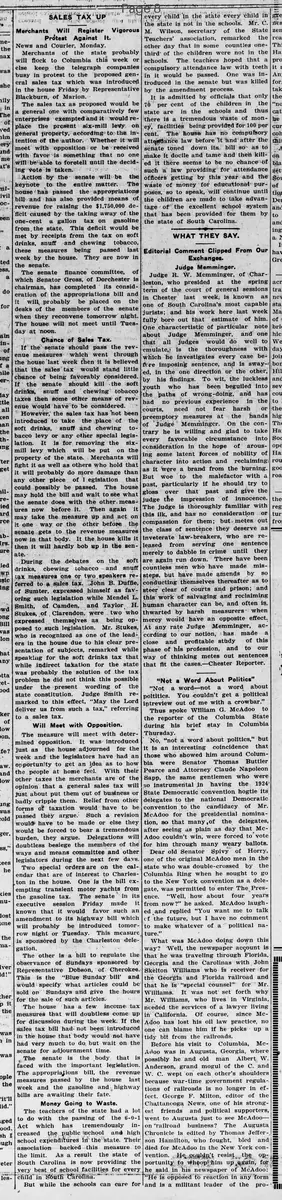
The sales tax as proposed would be a general one with comparatively few enterprises exempted and it would replace the present six-mill levy on general property according to the intention of the author. Whether it will meet with opposition or be received with favor is something that no one will be able to foretell until the deciding vote is taken.
Action by the senate will be the keynote to the entire matter. The house has passed the appropriations bill and has also provided means of revenue for raising the $1,750,000 deficit caused by the taking away of the one-cent a gallon tax on gasoline from the state. This deficit would be met by receipts from the tax on soft drinks, snuff and chewing tobacco, these measures being passed last week by the house. They are now in the senate.
The senate finance committee, of which Senator Gross, of Dorchester is chairman, has completed its consideration of the appropriations bill and it will probably be placed on the desks of the members of the senate when they reconvene tomorrow night. The house will not meet until Tuesday at noon.
Chance of Sales Tax.
If the senate should pass the revenue measures which went through the house last week then it is believed that the sales tax would stand little chance of being favorably considered. If the senate should kill the soft drinks, snuff and chewing tobacco taxes then some other means of revenue would have to be considered.
However, the sales tax has not been introduced to take the place of the soft drinks, snuff and chewing tobacco levy or any other special legislation. It is for removing the six-mill levy which will be put on the property of the state. Merchants will fight it as well as others who hold that it will probably do more damage than any other piece of legislation that could possibly be passed. The house may hold the bill and wait to see what the senate does with the other measures now before it. Then again it may take the measure up and act on it one way or the other before the senate gets to the revenue measures now in that body. If the house kills it then it will hardly bob up in the senate.
During the debates on the soft drinks, chewing tobacco and snuff tax measures one or two speakers referred to a sales tax. John B. Duffie, of Sumter, expressed himself as favoring such legislation while Mendel L. Smith, of Camden, and Taylor H. Stukes, of Clarendon, were two who expressed themselves as being opposed to such legislation. Mr. Stukes, who is recognized as one of the leaders in the house due to his clear presentation of subjects, remarked while speaking for the soft drinks tax that while indirect taxation for the state was probably the solution of the tax problem he did not think this possible under the present wording of the state constitution. Judge Smith remarked to this effect, "May the Lord deliver us from such a tax," referring to a sales tax.
Will Meet with Opposition.
The measure will meet with determined opposition. It was introduced just as the house adjourned for the week and the legislators have had an opportunity to get an idea as to how the people at home feel. With their other taxes the merchants are of the opinion that a general sales tax will just about put them out of business or badly cripple them. Relief from other forms of taxation would have to be passed they argue. Such a revision would have to be made or else they would be forced to bear a tremendous burden, they argue. Delegations will doubtless besiege the members of the ways and means committee and other legislators during the next few days.
Two special orders are on the calendar that are of interest to Charleston in the house. One is the bill exempting transient motor yachts from the gasoline tax. The senate in its executive session Friday made it known that it would favor such an amendment to its highway bill which will probably be introduced tomorrow night or Tuesday. This measure is sponsored by the Charleston delegation.
The other is a bill to regulate the observance of Sundays sponsored by Representative Dobson, of Cherokee. This is the "Blue Sunday bill" and would specify what articles could be sold on Sundays and give the hours for the sale of such articles.
The house has a few income tax measures that will doubtless come up for discussion during the week. If the sales tax bill had not been introduced in the house that body would not have had very much to do but wait on the senate for adjournment time.
The senate is the body that is faced with the important legislation. The appropriations bill, the revenue measures passed by the house last week and the gasoline and highway bills are awaiting their fate.
Money Going to Waste.
The teachers of the state had a lot to do with the passing of the 6-0-1 Act which has tremendously increased the public school and high school expenditures in the state. Their association backed this measure to the limit. As a result the state of South Carolina is now providing the very best of school facilities for every child in South Carolina.
But while the schools can care for every child in the state every child in the state is not in the schools. Mr. C. M. Wilson, secretary of the State Teachers' association, remarked the other day that in some counties one-third of the children were not in the schools. The teachers hoped that a compulsory attendance law with teeth in it would be passed. One was introduced in the senate but was killed by the amendment process.
It is admitted by officials that only 70 per cent of the children in the state are in the schools and thus there is a tremendous waste of money, facilities being provided for 100 per cent. The house has no compulsory attendance law before it and after the senate toned down its bill so as to make it docile and tame and then killed it there seems to be no chance of such a law providing for attendance officers getting by this year and the waste of money for educational purposes, so to speak, will continue until the children are made to take advantage of the excellent school system that has been provided for them by the state of South Carolina.
What sub-type of article is it?
What keywords are associated?
What entities or persons were involved?
Where did it happen?
Domestic News Details
Primary Location
Columbia
Event Date
This Week
Key Persons
Outcome
proposed sales tax faces opposition from merchants; senate to decide on revenue measures including soft drinks, snuff, and tobacco taxes to cover $1,750,000 deficit; compulsory school attendance bill killed; ongoing waste in education funding due to low attendance.
Event Details
South Carolina House introduced general sales tax bill Friday to replace six-mill property levy, prompting merchant protests. Debates on alternative revenue sources like taxes on soft drinks, snuff, and chewing tobacco to address gasoline tax removal deficit. Senate finance committee finished appropriations bill. Other bills include yacht gasoline tax exemption, Sunday observance regulations, and income tax measures. Education section highlights waste from 30% non-attendance despite expanded facilities under 6-0-1 Act; compulsory attendance bill failed.