Thank you for visiting SNEWPapers!
Sign up free
New Hampshire Statesman
Concord, Merrimack County, New Hampshire
What is this article about?
Biographical tale of John Taylor, a brilliant but tragic lawyer who, in 1840 Clarksville, Texas, volunteers to defend Mary Elliston in a slander suit against wealthy planter George Hopkins, delivering a masterful oration that secures a $50,000 verdict, leading to Hopkins' lynching.
Clipping
OCR Quality
Full Text
A Tale of John Taylor,
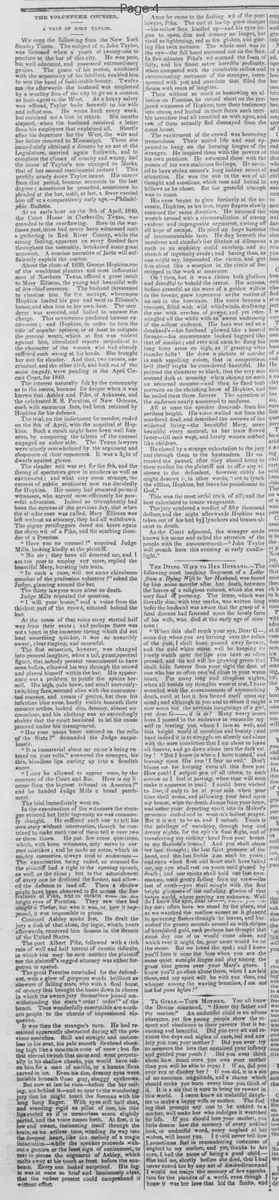
We copy the following from the New York Sunday Times. The subject of it, John Taylor, was licensed when a youth of twenty-one to practice at the bar of this city. He was poor, but well educated, and possessed extraordinary genius. The grace of his person, combined with the superiority of his intellect, enabled him to win the hand of fashionable beauty. Twelve months afterwards the husband was employed by a wealthy firm of the city to go on a mission as land-agent to the West. As a heavy salary was offered, Taylor bade farewell to his wife and infant son. He wrote back every week, but received not a line in return. Six months elapsed, when the husband received a letter from his employers that explained all. Shortly after his departure for the West, the wife and her father removed to Mississippi. There she immediately obtained a divorce by an act of the Legislature, married again forthwith, and to complete the climax of cruelty and wrong, had the name of Taylor's son changed to Marks, that of her second matrimonial partner! This perfidy nearly drove Taylor insane. His career from that period, became eccentric in the last degree; sometimes he preached, sometimes he pleaded at the bar, until, at last, a fever carried him off at a comparatively early age.—Philadelphia Bulletin.
At an early hour on the 9th of April, 1840 the Court House in Clarksville, Texas, was crowded to the overflowing. Save in the war-times past, there had never been witnessed such a gathering in Red River County, while the strong feeling, apparent on every flushed face throughout the assembly, betokened some great occasion. A concise narrative of facts will sufficiently explain the matter.
About the close of 1839, George Hopkins, one of the wealthiest planters and most influential men of Northern Texas, offered a great insult to Mary Elliston, the young and beautiful wife of his chief-overseer. The husband threatened to chastise him for the outrage, whereupon Hopkins loaded his gun and went to Elliston's house, and shot him in his own door. The murderer was arrested, and bailed to answer the charge. This occurrence produced intense excitement; and Hopkins, in order to turn the tide of popular opinion, or at least to mitigate the general wrath, which at first was violent against him, circulated reports prejudicial to the character of the woman who had already suffered such wrong at his hands. She brought her suit for slander. And thus, two causes, one criminal, and the other civil, and both out of the same tragedy, were pending in the April Circuit Court, for 1840.
The interest naturally felt by the community as to the issues, became far deeper when it was known that Ashley and Pike, of Arkansas, and the celebrated S. S. Prentiss, of New Orleans, each with enormous fees, had been retained by Hopkins for his defence.
The trial, on the indictment for murder, ended on the 8th of April, with the acquittal of Hopkins. Such a result might have been well foreseen, by comparing the talents of the counsel engaged on either side. The Texan lawyers were utterly overwhelmed by the argument and eloquence of their opponents. It was a fight of dwarfs against giants.
The slander suit was set for the 9th, and the throng of spectators grew in numbers as well as excitement; and what may seem strange, the current of public sentiment now ran decidedly for Hopkins. His money had procured pointed witnesses, who served most efficiently his powerful advocates. Indeed so triumphantly had been the success of the previous day, that when the slander case was called, Mary Elliston was left without an attorney, they had all withdrawn. The pigmy pettifoggers dared not brave again the sharp wit of a Pike, and the scathing thunder of a Prentiss.
"Have you no counsel?" enquired Judge Mills, looking kindly at the plaintiff.
"No sir; they have all deserted me, and I am too poor to employ any more, replied the beautiful Mary, bursting into tears.
"In such a case, will not some chivalrous member of the profession volunteer?" asked the Judge, glancing around the bar.
The thirty lawyers were silent as death. Judge Mills repeated the question.
"I will, your honor," said a voice from the thickest part of the crowd, situated behind the bar.
At the tones of that voice many started half way from their seats; and perhaps there was not a heart in the immense throng which did not beat something quicker, it was so unearthly sweet, clear ringing, and mournful.
The first sensation, however, was changed into general laughter, when a tall, gaunt, spectral figure, that nobody present remembered to have seen before, elbowed his way through the crowd and placed himself within the bar. His appearance was a problem to puzzle the sphinx herself. His high, pale brow, and small nervously-twitching face, seemed alive with the concentrated essence, and cream of genius, but then his infantine blue eyes, hardly visible beneath their massive arches, looked dim, dreamy, almost unconscious, and his clothing was so exceedingly shabby that the court hesitated to let the cause proceed under his management.
"Has your name been entered on the rolls of the State?" demanded the Judge suspiciously.
"It is immaterial about my name's being entered on your rolls," answered the stranger, his thin, bloodless lips curling up into a fiendish sneer.
"I may be allowed to appear once, by the courtesy of the Court and Bar. Here is my license from the highest tribunal in America?" and he handed Judge Mills a broad parchment.
The trial immediately went on.
In the examination of the witnesses the stranger evinced but little ingenuity as was common. He suffered each one to tell his own story without interruption, though he contrived to make each one of them tell it over two or three times. He put few cross-questions, which, with keen witnesses, only serve to correct mistakes; and he made no notes, which in mighty memories, always tend to embarrass.—The examination being ended, as counsel for the plaintiff had a right to the opening speech, as well as the close; but to the astonishment of every one he declined the former, and allowed the defence to lead off. Then a shadow might have been observed to flit across the fine features of Pike, and to darken even in the bright eyes of Prentiss. They saw they had caught a Tartar, but who it was, or how it happened, it was impossible to guess.
Colonel Ashley spoke first. He dealt the jury a dish of that close, dry logic, which, years afterwards, rendered him famous in the Senate of the United States.
The poet Albert Pike, followed with a rich rain of wit and half torrent of caustic ridicule, in which you may be sure neither the plaintiff nor the plaintiff's ragged attorney was either forgotten or spared.
The great Prentiss concluded for the defendant, with a glow of gorgeous words brilliant as showers of falling stars, who with a final burst of oratory that brought the house down in cheers in which the sworn jury themselves joined notwithstanding the stern "order! order!" of the bench. Thus wonderfully susceptible are southern people to the charms of impassioned eloquence.
It was then the stranger's turn. He had remained apparently abstracted during all the previous speeches. Still and straight and motionless in his seat, his pale smooth forehead shooting high like a mountain cone of snow; but for that eternal twitch that came and went perpetually in his shallow cheeks, you would have taken him for a man of marble, or a human form carved in ice. Even his dim, dreamy eyes were invisible beneath those gray, shaggy eyebrows.
But now at last he rises—before the bar railing, not behind it—and so near to the wondering jury that he might touch the foreman with his long bony finger. With eyes still half shut, and standing rigid as pillar of iron, his thin lips curled as if in measureless scorn slightly parted, and the voice comes forth. At first, it is low and sweet, insinuating itself through the brain, as an artless tune, winding its way into the deepest heart, like the melody of a magic incantation—while the speaker proceeds without a gesture or the least sign of excitement, to tear in pieces the argument of Ashley, which melts away at his touch as frost before the sun beam. Every one looked surprised. His logic was at once so brief and luminously clear, that the rudest peasant could comprehend it without effort.
Anon he came to the dazzling wit of the poet lawyer, Pike. The curl of his lip grew sharper—his sallow face kindled up—and his eyes began to open, dim and dreamy no longer, but vivid as lightning, red as fire globes, and glaring like twin meteors. The whole soul was in the eye—the full heart streamed out on the face. In five minutes Pike's wit seemed the foam of folly, and his finest satire horrible profanity, when compared with the inimitable sallies and exterminating sarcasms of the stranger, interspersed with jest and anecdote that filled the forum with roars of laughter.
Then without so much as bestowing an allusion on Prentiss, he turned short on the perjured witnesses of Hopkins, tore their testimony into atoms, and hurled in their faces such terrible invective that all trembled as with ague, and two of them actually fled dismayed from the court house.
The excitement of the crowd was becoming tremendous. Their united life and soul appeared to hang on the burning tongue of the stranger. He inspired them with the powers of his own passions. He saturated them with the poison of his own malicious feelings. He seemed to have stolen nature's long hidden secret of attraction. He was the sun to the sea of all thought and emotions, which rose and boiled in billows as he chose. But his grateful triumph was to come.
His eyes began to glare furtively at the assassin, Hopkins, as his lean, taper fingers slowly assumed the same direction. He hemmed the wretch around with a circumvallation of strong evidence and impregnable argument, cutting off all hope of escape. He piled up huge bastions of insurmountable facts. He dug beneath the murderer and slander's feet ditches of dilemmas such as no sophistry could overleap, and no stretch of ingenuity evade; and having thus, as one might say, impounded the victim, and girt him about like a scorpion in the circle of fire stripped to the work of massacre.
Oh! then, but it was a vision both glorious and dreadful to behold the orator. His actions, before graceful as the wave of a golden willow in the breeze, grew impetuous as the motion of an oak in the hurricane. His voice became a trumpet, filled with wild whirlwinds, deafening the ear with crashes of power, and yet intermingled all the while with as sweet undersong of the softest cadence. His face was red as a drunkard's—his forehead glowed like a heated furnace—his countenance looked haggard like that of maniac; and ever and anon he flung his long bony arms on high, as if grasping after thunder bolts! He drew a picture of murder in such appalling colors, that in comparison hell itself might be considered beautiful. He painted the slanderer so black, that the very sun seemed dark at noonday when shining on such an accursed monster—and then he fixed both portraits on the shrinking brow of Hopkins, and he nailed them there forever The agitation of the audience nearly amounted to madness.
All at once the speaker descend from his perilous height. His voice wailed out from the murdered dead, and described the sorrows of the widowed living—the beautiful Mary, more beautiful every moment, as her tears flowed faster—till men wept, and lovely women sobbed like children.
He closed by a strange exhortation to the jury and through them to the bystanders. He entreated the panel, after they should bring in their verdict for the plaintiff not to offer any violence to the defendant, however richly he might deserve it, in other words, "not to lynch the villain, Hopkins, but leave his punishment to God."
This was the most artful trick of all; and the best calculated to insure vengeance.
The jury rendered a verdict of fifty thousand dollars, and the night afterwards Hopkins was taken out of his bed by lynchers and beaten almost to death.
As the Court adjourned. the stranger made known his name and called the attention of the people with the announcement—“John Taylor will preach here this evening at early candle-light.”
What sub-type of article is it?
What themes does it cover?
What keywords are associated?
What entities or persons were involved?
Where did it happen?
Story Details
Key Persons
Location
Clarksville, Texas; Red River County
Event Date
9th Of April, 1840; Close Of 1839
Story Details
John Taylor, a brilliant but eccentric lawyer betrayed by his wife, volunteers to defend Mary Elliston in a slander suit against George Hopkins, who murdered her husband and slandered her. Despite facing top lawyers, Taylor's masterful speech dismantles the defense, secures a $50,000 verdict, and incites a lynching of Hopkins.