Thank you for visiting SNEWPapers!
Sign up free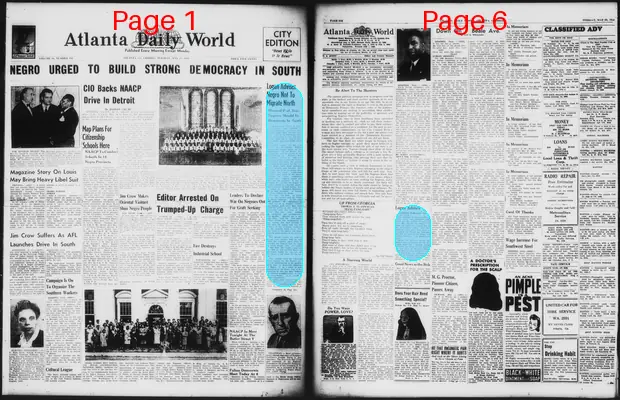
Atlanta Daily World
Atlanta, Fulton County, Georgia
What is this article about?
Dr. Rayford W. Logan, speaking in Atlanta in 1946, predicts Negro success in Southern voting rights, reviews historical failures post-Civil War and around 1900, cites reasons for current progress, advises against northern migration, and urges Democrats affiliation to liberalize the party.
Merged-components note: Continuation of the story 'Logan Advises Negro Not To Migrate North' from page 1 to page 6.
Clippings
1 of 2
OCR Quality
Full Text
Negro Not To
Migrate North
Howard Prof. Says
Negroes Should Be
Democrats In South
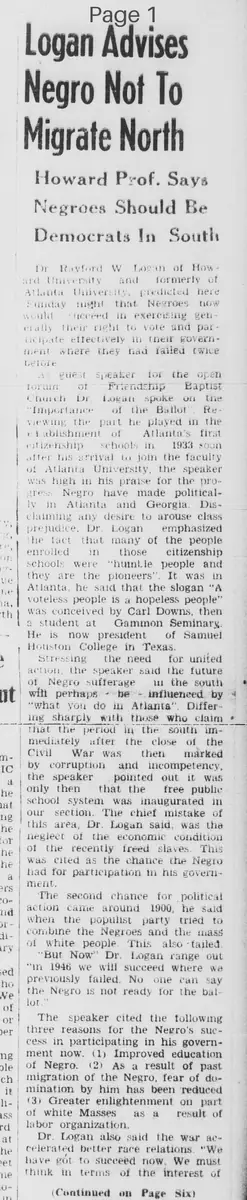
Dr Rayford W Logan of Howard University and formerly of Atlanta University predicted here Tuesday night that Negroes now will succeed in exercising generally their right to vote and participate effectively in their government where they had failed twice before.
As guest speaker for the open forum of Friendship Baptist Church Dr Logan spoke on the Importance of the Ballot Reviewing the part he played in the establishment of Atlanta's first citizenship schools in 1933 soon after his arrival to join the faculty of Atlanta University. the speaker was high in his praise for the progress Negroes have made politically in Atlanta and Georgia Disclaiming any desire to arouse class prejudice. Dr Logan emphasized the fact that many of the people enrolled in those citizenship school were "humble people and they are the pioneers". It was in Atlanta. he said that the slogan "A voteless people is a hopeless people" was conceived by Carl Downs, then a student at Gammon Seminary. He is now president of Samuel Houston College in Texas.
Stressing the need for united action the speaker said the future of Negro suffrage in the south will perhaps be influenced by "what you do in Atlanta" Differing sharply with those who claim that the period in the south immediately after the close of the Civil War was then marked by corruption and incompetency, the speaker pointed out it was only then that the free public school system was inaugurated in our section. The chief mistake of this area, Dr. Logan said, was the neglect of the economic condition of the recently freed slaves This was cited as the chance the Negro had for participation in his government.
The second chance for political action came around 1900, he said when the populist party tried to combine the Negroes and the mass of white people This also failed "But Now" Dr. Logan rang out "in 1946 we will succeed where we previously failed. No one can say the Negro is not ready for the ballot"
The speaker cited the following three reasons for the Negro's success in participating in his government now. (1) Improved education of Negro. (2) As a result of past migration of the Negro. fear of domination by him has been reduced (3) Greater enlightenment on part of white Masses as a result of labor organization.
Dr. Logan also said the war accelerated better race relations "We have got to succeed now. We must think in terms of the interest of
(Continued on Page Six)
Logan Advises
(Continued From Page One)
all the people"
The speaker charged the Republican party "has supported legislation for the welfare of the people." He advised the Negro "to make his political power felt in the Democratic party." The Republican party has "long since abandoned the Negro" he said adding that he believed the Negro will further liberalize the Democratic party.
During the question period, Dr. Logan spoke out against urging further mass migration of the Negro from the south. It was pointed out that some of the worst Negro slums were in large northern cities.
Dr. Logan has an unusual background of training and experience and is one of the nation's most prominent lecturers, and writers.
What sub-type of article is it?
What themes does it cover?
What keywords are associated?
What entities or persons were involved?
Where did it happen?
Story Details
Key Persons
Location
Atlanta, Georgia
Event Date
Tuesday Night In 1946
Story Details
Dr. Rayford W. Logan speaks on the importance of the ballot, reviews Negro political history in the South, predicts success in voting rights in 1946 due to improved education, reduced fears from migration, and white enlightenment; advises against further migration north and urges Negroes to influence the Democratic Party.