Thank you for visiting SNEWPapers!
Sign up free
Story
September 22, 1829
Constitutional Whig
Richmond, Virginia
What is this article about?
1829 newspaper reports on controversy accusing Postmaster General William T. Barry of selling Lexington, KY post office to Joseph Ficklin for $4000 to settle John Fowler's $10,000 defalcation; Ficklin denies payment; involves Henry Clay, lost bonds, and partisan defenses.
Clipping
OCR Quality
95%
Excellent
Full Text
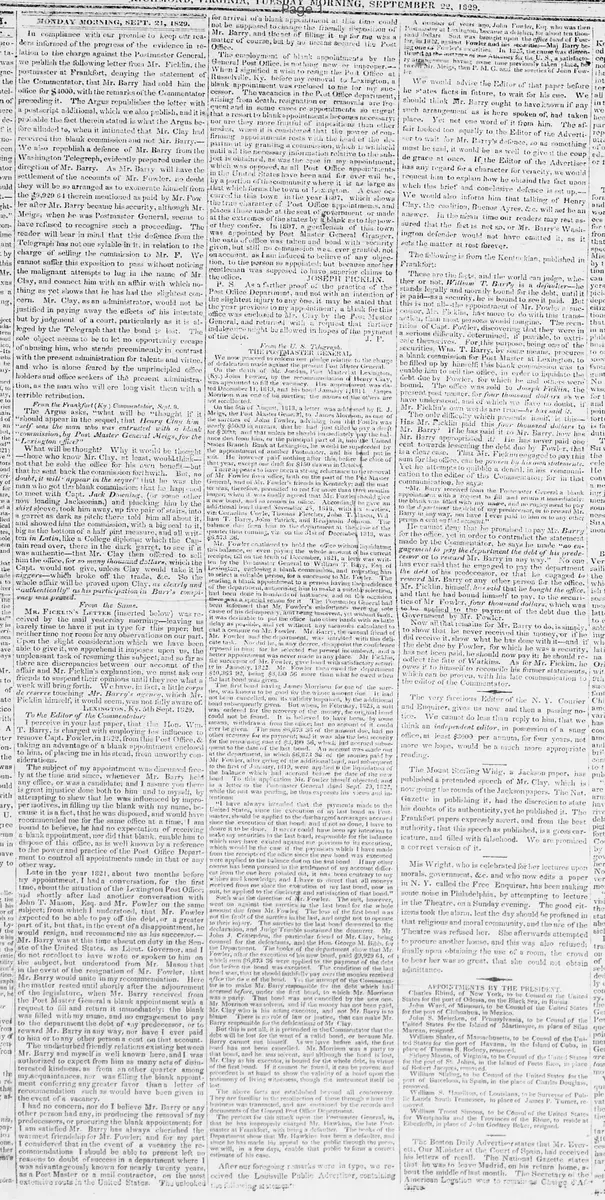
MONDAY MORNING, SEPT. 21, 1829.
In compliance with our promise to keep our readers informed of the progress of the evidence in relation to the charge against the Postmaster General, we publish the following letter from Mr. Ficklin, the postmaster at Frankfort, denying the statement of the Commentator, that Mr. Barry had sold him the office for $4000, with the remarks of the Commentator preceding it. The Argus republishes the letter with a postscript additional, which we also publish, and it is probable the fact therein stated is what the Argus before alluded to, when it intimated that Mr. Clay had received the blank commission and not Mr. Barry.
We also republish a defence of Mr. Barry from the Washington Telegraph, evidently prepared under the direction of Mr. Barry. As Mr. Barry will have the settlement of the accounts of Mr. Fowler, no doubt they will be so arranged as to exonerate himself from the $9,929 64 therein mentioned as paid by Mr. Fowler after Mr. Barry became his security, although Mr. Meigs, when he was Postmaster General, seems to have refused to recognize such a proceeding. The reader will bear in mind that this defence from the Telegraph has not one syllable in it, in relation to the charge of selling the commission to Mr. F. We cannot suffer this exposition to pass without noticing the malignant attempts to lug in the name of Mr. Clay, and connect him with an affair with which nothing as yet shows that he has had the slightest concern. Mr. Clay, as an administrator, would not be justified in paying away the effects of his intestate but by judgment of a court, particularly as it is alleged by the Telegraph that the bond is lost. The sole object seems to be to let no opportunity escape of abusing him, who stands preeminently in contrast with the present administration for talents and virtue, and who is alone feared by the unprincipled office holders and office seekers of the present administration, as the man who will ere long visit them with a terrible retribution.
From the Frankfort (Ky) Commentator, Sept. 8.
The Argus asks, "what will be thought if it should appear in the sequel, that Henry Clay himself was the man who was entrusted with a blank commission, by Post Master General Meigs, for the Lexington office?"
What will be thought? Why it would be thought—those who know Mr. Clay, at least, would think—not that he sold the office for his own benefit—but that he sent back the commission forthwith. But, no doubt, it will appear in the sequel" that he was the man who got the blank commission; that he happened to meet with Capt. Jack Downing, (or some other now leading Jacksonian,) and plucking him by the shirt sleeve, took him away, up five pair of stairs, into a garret as dark as pitch; there told him all about it, and showed him the commission, with a big seal to it, big as the bottom of a half pint measure, and all written in Latin, like a College diploma; which the Captain read over, there in the dark garret, to see if it was authentic—that Mr. Clay then offered to sell him the office, for so many thousand dollars, which the Capt. would not give, unless Clay would take it in niggers—which broke off the trade, &c. So the whole affair will be proved upon Clay, as clearly and "authentically" as his participation in Burr's conspiracy was proved.
From the Same.
MR. FICKLIN'S LETTER (inserted below) was received by the mail yesterday morning—leaving us barely time to have it put in type for this paper; but neither time nor room for any observations on our part. Upon the slight consideration which we have been able to give it, we apprehend it imposes upon us, the unpleasant task of resuming this subject; and so far as there are discrepancies between our account of the affair and Mr. Ficklin's explanation, we must ask our friends to suspend their opinions until they see what a week will bring forth." We have, in fact, a little corps de reserve touching Mr. Barry's agency, which Mr. Ficklin himself, it would seem, was not fully aware of.
Lexington, Ky. 5th Sept. 1829.
To the Editor of the Commentator:
I perceive in your last paper, that the Hon. Wm. T. Barry, is charged with employing his influence to remove Capt. Fowler, in 1821, from this Post Office, & taking an advantage of a blank appointment enclosed to him, of placing me in his stead, from unworthy considerations.
The subject of my appointment was discussed freely at the time and since, whenever Mr. Barry held any office, or was a candidate; and I assure you there is great injustice done both to him and to myself, by attempting to show that he was influenced by improper motives, in filling up the blank with my name, because it is a fact, that he was disposed, and would have recommended me for the same office at a time, I am bound to believe, he had no expectation of receiving a blank appointment, nor did that blank, enable him to dispose of this office, as is well known by a reference to the power and practice of the Post Office Department to control all appointments made in that or any other way.
Late in the year 1821, about two months before my appointment, I had a conversation, for the first time, about the situation of the Lexington Post Office; and shortly after had another conversation with John T. Mason, Esq. and Mr. Fowler on the same subject; from which I understood, that Mr. Fowler expected to be able to pay off the debt, or a greater part of it, but that, in the event of a disappointment, he would resign, and recommend me as his successor.
Mr. Barry was at this time absent on duty in the Senate of the United States, as Lieut. Governor, and I do not recollect to have wrote or spoken to him on the subject, but understood from Mr. Mason that in the event of the resignation of Mr. Fowler, that Mr. Barry would unite in my recommendation. Here the matter rested until shortly after the adjournment of the legislature, when Mr. Barry received from the Post Master General a blank appointment with a request to fill and return it immediately: the blank was filled with my name, and no engagement to pay to the department the debt of my predecessor, or to reward Mr. Barry in any way, nor have I ever paid to him or to any other person a cent on that account.
The undisturbed friendly relations existing between Mr. Barry and myself is well known here, and I was authorized to expect from him as many acts of disinterested kindness, as from any other quarter among my acquaintances, nor was filling the blank appointment conferring any greater favor than a letter of recommendation such as would have been given in the event of a vacancy.
I had no concern, nor do I believe Mr. Barry or any other person had any, in producing the removal of my predecessors, or procuring the blank appointment; for I am satisfied Mr. Barry has always cherished the warmest friendship for Mr. Fowler; and for my part I considered that in the event of a vacancy the recommendations I should be able to present left no reasons to doubt of success in a department where I was advantageously known for nearly twenty years, as a Post Master or a mail contractor, on the most extensive routes in the United States. The looked for arrival of a blank appointment at this time could not be supposed to change the friendly disposition of Mr. Barry. and the act of filling it up for me was a matter of course, but by no means secured the Post Office.
The employment of blank appointments by the General Post Office, is nothing new or improper.
When I signified a wish to resign the Post Office at Russelville, Ky. before my removal to Lexington, a blank appointment was enclosed to me for my successor.
The vacancies in the Post Office department, arising from death, resignation or removals are frequent and in some cases re-appointments so urgent that a resort to blank appointments becomes necessary: nor are they more fruitful of impositions than other modes, when it is considered that the power of confirming appointments rests with the head of the department by granting a commission, which is withheld until all the necessary information relative to the subject is obtained, as was the case in my appointment, which was opposed, as all Post Office appointments in the United States have been and for ever will be, by a portion of the community where it is as large as that which forms the town of Lexington. A case occurring in this town in the year 1817, which shows the true character of Post Office appointments, and places those made at the seat of government or made at the extremes of the states by a blank as to the power they confer. In 1817, a gentleman of this town was appointed by Post Master General Granger, the oath of office was taken and bond with security given, but still no commission was ever granted. not on account, as I am induced to believe of any objection, to the person so appointed; but because another gentleman was supposed to have superior claims to the office.
JOSEPH FICKLIN.
P. S. As a further proof of the practice of the Post Office Department, and not with an intention of the slightest injury to anyone, it may be stated that the year previous to my appointment, a blank for this office was enclosed to Mr. Clay by the Post Master General, and returned with a request that further indulgence might be allowed in hopes of the payment of the debt.
J. F.
From the U. S. Telegraph.
THE POSTMASTER GENERAL.
We now proceed to redeem our pledge relative to the charge of defalcation made against the present Post Master General.
On the death of Mr. Jordan, Post Master at Lexington, (Ky.) John Fowler, by the recommendation of Henry Clay, was appointed to fill the vacancy. His appointment was dated December 11, 1813, and his bond January 1, 1814. James Morrison was one of his sureties; the names of the others are not recollected.
On the 5th of August, 1818, a letter was addressed by R. J. Meigs, the Post Master General, to James Morrison, as one of the sureties of John Fowler, advising him that Fowler was nearly $5000 in arrears; that he had just failed to pay a draft for $4000; and that unless he should immediately pay the balance due from him, or the principal part of it, into the United States Branch Bank at Lexington, he would be superseded by the appointment of another Postmaster, and his bond put in suit. He however paid nothing after this, before the close of that year, except one draft for $150 drawn in October.
There appears to have been a strong reluctance to the removal of Mr. Fowler from office, both on the part of the Post Master General, and of Mr. Fowler's friends in Kentucky; and the matter was, therefore, permitted to rest for more than three months longer; when it was finally agreed that Mr. Fowler should give a new bond, and so remain in office. Accordingly he gave an additional bond dated November 25, 1818, with six sureties, viz: Cornelius Coyle, Thomas Fletcher, John T. Mason, William T. Barry, John Patrick, and Benjamin Johnson. The balance due from him to the department at the close of the quarter then running, viz on the 31st of December 1818, was $6,873 36.
Mr. Fowler continued to hold the office without liquidating this balance, or even paying the whole amount of his current receipts; till on the tenth of December, 1821, a letter was written by the Postmaster General to William T. Barry, Esq. of Lexington, enclosing a blank commission, and requesting him to select a suitable person, for a successor to Mr. Fowler. "The sending a blank appointment to a person having the confidence of the department, authorizing him to make a suitable selection, had been done in hundreds of instances, and on this occasion there was a special reason for it. The Postmaster General had been informed that Mr. Fowler's misfortunes were the sole cause of his delinquency, and being insolvent, yet without fault, it was desirable to put the office into other hands with as little delay as possible, and yet without any measures calculated to cast a censure on Mr. Fowler. Mr. Barry, the mutual friend of Mr. Fowler and the department, was intrusted with this delicate task. Nor did he, in any degree, disappoint the confidence reposed in him: for he selected the present incumbent, and a better appointment was never made in any place. Mr. Ficklin, the successor of Mr. Fowler, gave bond with satisfactory security in January, 1822. Mr. Fowler then owed the department $10,363 92, being $3,490 56 more than what he owed when the last bond was given.
The first bond having James Morrison for one of the sureties, was known to be good for the whole amount due. It had not been cancelled, nor its validity impaired, by the additional bond subsequently given. But when, in February, 1823, a suit was ordered for the recovery of the money, the original bond could not be found. It is believed to have been, by some means, withdrawn from the office; but no account of it could ever be given. The sum $6,873 36 of the amount due, had no other security for its payment; and it was also the best security for the remaining sum of $3,490 56, which had accrued subsequent to the date of the last bond. An account was made out at the department, in which $6,873 36 of the monies paid by Mr. Fowler, after giving of the additional bond, and subsequent to the first of January, 1819, were applied to the liquidation of the balance which had accrued before the date of the new bond. To this application Mr. Fowler himself objected: and in a letter to the Postmaster General dated Sept. 29, 1822, while the suit was pending, he thus expresses his views and intentions:
"I have always intended that the payments made to the United States, since the execution of my last bond as Postmaster, should be applied to the discharge of arrearages accrued since the execution of that bond: and if not so done, I have to desire it to be done. It never could have been my intention to make my securities in the last bond, responsible for the balance which may have existed against me previous to its execution, which would be the case if the payments which I have made from the receipts of the office since the new bond was executed were applied to the balance due on the first bond. If any other course has been pursued in the settlement of my account different from the one here pointed out, it has been contrary to my wishes and knowledge, and I have to direct that all moneys received from me since the execution of my last bond, now in suit, be applied to the discharge and satisfaction of that bond."
Such was the direction of Mr. Fowler. The suit, however, went on against the sureties in the last bond for the whole amount due from Mr. Fowler. The loss of the first bond was not the fault of the sureties in the last, and ought not to operate to their injury. The sureties to the last bond demurred to the declaration, and Judge Trumble sustained the demurrer. Mr. John J. Crittenden, the particular friend of Mr. Clay, being counsel for the defendants, and the Hon. George M. Bibb, for the Department. The books of the department show that Mr. Fowler, after the execution of his new bond, paid $9,929 64, of which sum $6,873 36 were applied to the payment of the debt due before the bond was executed. The condition of the last bond was, that he should faithfully pay over the monies received after the date of the bond. Yet the attempt of the Commentator is to make Mr. Barry responsible for the debt which had accrued before, under the first bond, to which Mr. Morrison was a party. That bond was not cancelled by the new one. Mr. Morrison was solvent, and if the money has not been paid, Mr. Clay who is his acting executor, and not Mr. Barry is to blame. There is no rule of law or justice, that can make Mr. Barry responsible for the defalcations of Mr. Clay.
But this is not all. it is pretended in the Commentator that the debt will be lost for the want of a valid bond, or because Mr. Barry cannot sue himself. As we have before said, the first bond has not been cancelled. Mr. Morrison was a party to that bond, and he was so solvent, and although the bond is lost, Mr. Clay as his executor, is bound for the whole debt, in virtue of the first bond. If it cannot be found, it can be proven: and precedent is at hand to show the validity of a bond upon the testimony of living witnesses, though the instrument itself be lost.
The above facts are established beyond all controversy. They are familiar in the recollection of those through whom the business was transacted, and are sustained by the records and documents of the General Post Office Department.
The pretext for this attack upon the Postmaster General, is, that he has improperly charged Mr. Hawkins, the late Postmaster at Frankfort, with being a defaulter. The books of the Department show that Mr. Hawkins has been a defaulter, and since he has made his appeal to the public through the press, we will, in a few days, enable that public to form a correct estimate of his case.
After our foregoing remarks were in type, we received the Louisville Public Advertiser, containing the following statement:
A number of years ago, John Fowler, Esq. who was then Postmaster at Lexington, became a defaulter, for about ten thousand dollars. Suit was brought upon the office bond of Fowler, in 1822, against Fowler and his securities—Maj. Barry being one of Fowler's securities. In 1825, the cause was discontinued at the instance of the attorney for the U. S., a satisfactory arrangement having some time previously taken place, between Mr. Meigs, then P. M. G. and the sureties of John Fowler.
We would advise the Editor of that paper before he states facts in future, to wait for his cue. We should think Mr. Barry ought to have known if any such arrangement as is here spoken of, had taken place. Yet not one word of it from him. The affair looked too squally to the Editor of the Advertiser to wait for Mr. Barry's defence, so as something must be said, it would be as well to give it the coup de grace at once. If the Editor of the Advertiser has any regard for a character for veracity, we would request him to explain how he obtained the fact upon which this brief and conclusive defence is set up.
We would also inform him that talking of Henry Clay, the coalition, Buenos Ayres, &c. will not be an answer. In the mean time our readers may rest assured that the act is not so, or Mr. Barry's Washington defender would not have omitted it, as it sets the matter at rest forever.
The following is from the Kentuckian, published in Frankfort:
These are the facts, and the world can judge, whether or not. William T. Barry is a defaulter—he stands legally and morally bound for the debt, until it is paid—as a security, he is bound to see it paid. But this is not all—the appointment of Mr. Fowler's successor, Mr. Ficklin, has more to do with this transaction, than most persons would imagine. The securities of Capt. Fowler, discovering that they were in a serious difficulty, determined, if possible, to extricate themselves. For this purpose, being one of the securities, Wm. T. Barry, by some means, procures a blank commission for Post Master at Lexington, to be filled up by himself; this blank commission was to enable him to sell the office, in order to liquidate the debt due by Fowler, for which he and others were bound. The office was sold to Joseph Ficklin, the present post master, for four thousand dollars as we have understood, and of which we have no doubt, if Mr. Ficklin's own words are true—he has said it.
The only difficulty which presents itself, is this—Has Mr. Ficklin paid this four thousand dollars to Mr. Barry? If he has paid it to Mr. Barry, how has Mr. Barry appropriated it? He has never paid one cent towards lessening the debt due by Fowler, that is a clear case. That Mr. Ficklin engaged to pay this sum for the office, can be proven by his own statements. Yet he attempts to quibble a denial, in his communication to the editor of the Commentator; for in that communication, he says:
"Mr. Barry received from the Postmaster General a blank appointment with a request to fill and return it immediately: the blank was filled with my name, and no engagement to pay to the department the debt of my predecessor, or to reward Mr. Barry in any way, nor have I ever paid to him or to any other person a cent on that account."
He cannot deny that he promised to pay Mr. Barry for the office, yet in order to contradict the statement made by the Commentator, he says he made "no engagement to pay the department the debt of his predecessor or to reward Mr. Barry in any way." No one has ever said that he engaged to pay the department the debt of his predecessor, or that he engaged to reward Mr. Barry or any other person for the office.
Mr. Ficklin, himself, has said that he bought the office, and that he had bound himself to pay, to the securities of Mr. Fowler, four thousand dollars, which was to be applied to the payment of the debt due the Government by Mr. Fowler.
Now all that remains for Mr. Barry to do, is simply, to show that he never received this money, or if he did receive it, show what he has done with it—and if the debt due by Fowler, for which he was a security, has not been paid, he should now pay it; he should recollect the fate of Watkins. As for Mr. Ficklin, he owes it to himself to reconcile his former statements, which can be proven, with his late communication to the editor of the Commentator.
In compliance with our promise to keep our readers informed of the progress of the evidence in relation to the charge against the Postmaster General, we publish the following letter from Mr. Ficklin, the postmaster at Frankfort, denying the statement of the Commentator, that Mr. Barry had sold him the office for $4000, with the remarks of the Commentator preceding it. The Argus republishes the letter with a postscript additional, which we also publish, and it is probable the fact therein stated is what the Argus before alluded to, when it intimated that Mr. Clay had received the blank commission and not Mr. Barry.
We also republish a defence of Mr. Barry from the Washington Telegraph, evidently prepared under the direction of Mr. Barry. As Mr. Barry will have the settlement of the accounts of Mr. Fowler, no doubt they will be so arranged as to exonerate himself from the $9,929 64 therein mentioned as paid by Mr. Fowler after Mr. Barry became his security, although Mr. Meigs, when he was Postmaster General, seems to have refused to recognize such a proceeding. The reader will bear in mind that this defence from the Telegraph has not one syllable in it, in relation to the charge of selling the commission to Mr. F. We cannot suffer this exposition to pass without noticing the malignant attempts to lug in the name of Mr. Clay, and connect him with an affair with which nothing as yet shows that he has had the slightest concern. Mr. Clay, as an administrator, would not be justified in paying away the effects of his intestate but by judgment of a court, particularly as it is alleged by the Telegraph that the bond is lost. The sole object seems to be to let no opportunity escape of abusing him, who stands preeminently in contrast with the present administration for talents and virtue, and who is alone feared by the unprincipled office holders and office seekers of the present administration, as the man who will ere long visit them with a terrible retribution.
From the Frankfort (Ky) Commentator, Sept. 8.
The Argus asks, "what will be thought if it should appear in the sequel, that Henry Clay himself was the man who was entrusted with a blank commission, by Post Master General Meigs, for the Lexington office?"
What will be thought? Why it would be thought—those who know Mr. Clay, at least, would think—not that he sold the office for his own benefit—but that he sent back the commission forthwith. But, no doubt, it will appear in the sequel" that he was the man who got the blank commission; that he happened to meet with Capt. Jack Downing, (or some other now leading Jacksonian,) and plucking him by the shirt sleeve, took him away, up five pair of stairs, into a garret as dark as pitch; there told him all about it, and showed him the commission, with a big seal to it, big as the bottom of a half pint measure, and all written in Latin, like a College diploma; which the Captain read over, there in the dark garret, to see if it was authentic—that Mr. Clay then offered to sell him the office, for so many thousand dollars, which the Capt. would not give, unless Clay would take it in niggers—which broke off the trade, &c. So the whole affair will be proved upon Clay, as clearly and "authentically" as his participation in Burr's conspiracy was proved.
From the Same.
MR. FICKLIN'S LETTER (inserted below) was received by the mail yesterday morning—leaving us barely time to have it put in type for this paper; but neither time nor room for any observations on our part. Upon the slight consideration which we have been able to give it, we apprehend it imposes upon us, the unpleasant task of resuming this subject; and so far as there are discrepancies between our account of the affair and Mr. Ficklin's explanation, we must ask our friends to suspend their opinions until they see what a week will bring forth." We have, in fact, a little corps de reserve touching Mr. Barry's agency, which Mr. Ficklin himself, it would seem, was not fully aware of.
Lexington, Ky. 5th Sept. 1829.
To the Editor of the Commentator:
I perceive in your last paper, that the Hon. Wm. T. Barry, is charged with employing his influence to remove Capt. Fowler, in 1821, from this Post Office, & taking an advantage of a blank appointment enclosed to him, of placing me in his stead, from unworthy considerations.
The subject of my appointment was discussed freely at the time and since, whenever Mr. Barry held any office, or was a candidate; and I assure you there is great injustice done both to him and to myself, by attempting to show that he was influenced by improper motives, in filling up the blank with my name, because it is a fact, that he was disposed, and would have recommended me for the same office at a time, I am bound to believe, he had no expectation of receiving a blank appointment, nor did that blank, enable him to dispose of this office, as is well known by a reference to the power and practice of the Post Office Department to control all appointments made in that or any other way.
Late in the year 1821, about two months before my appointment, I had a conversation, for the first time, about the situation of the Lexington Post Office; and shortly after had another conversation with John T. Mason, Esq. and Mr. Fowler on the same subject; from which I understood, that Mr. Fowler expected to be able to pay off the debt, or a greater part of it, but that, in the event of a disappointment, he would resign, and recommend me as his successor.
Mr. Barry was at this time absent on duty in the Senate of the United States, as Lieut. Governor, and I do not recollect to have wrote or spoken to him on the subject, but understood from Mr. Mason that in the event of the resignation of Mr. Fowler, that Mr. Barry would unite in my recommendation. Here the matter rested until shortly after the adjournment of the legislature, when Mr. Barry received from the Post Master General a blank appointment with a request to fill and return it immediately: the blank was filled with my name, and no engagement to pay to the department the debt of my predecessor, or to reward Mr. Barry in any way, nor have I ever paid to him or to any other person a cent on that account.
The undisturbed friendly relations existing between Mr. Barry and myself is well known here, and I was authorized to expect from him as many acts of disinterested kindness, as from any other quarter among my acquaintances, nor was filling the blank appointment conferring any greater favor than a letter of recommendation such as would have been given in the event of a vacancy.
I had no concern, nor do I believe Mr. Barry or any other person had any, in producing the removal of my predecessors, or procuring the blank appointment; for I am satisfied Mr. Barry has always cherished the warmest friendship for Mr. Fowler; and for my part I considered that in the event of a vacancy the recommendations I should be able to present left no reasons to doubt of success in a department where I was advantageously known for nearly twenty years, as a Post Master or a mail contractor, on the most extensive routes in the United States. The looked for arrival of a blank appointment at this time could not be supposed to change the friendly disposition of Mr. Barry. and the act of filling it up for me was a matter of course, but by no means secured the Post Office.
The employment of blank appointments by the General Post Office, is nothing new or improper.
When I signified a wish to resign the Post Office at Russelville, Ky. before my removal to Lexington, a blank appointment was enclosed to me for my successor.
The vacancies in the Post Office department, arising from death, resignation or removals are frequent and in some cases re-appointments so urgent that a resort to blank appointments becomes necessary: nor are they more fruitful of impositions than other modes, when it is considered that the power of confirming appointments rests with the head of the department by granting a commission, which is withheld until all the necessary information relative to the subject is obtained, as was the case in my appointment, which was opposed, as all Post Office appointments in the United States have been and for ever will be, by a portion of the community where it is as large as that which forms the town of Lexington. A case occurring in this town in the year 1817, which shows the true character of Post Office appointments, and places those made at the seat of government or made at the extremes of the states by a blank as to the power they confer. In 1817, a gentleman of this town was appointed by Post Master General Granger, the oath of office was taken and bond with security given, but still no commission was ever granted. not on account, as I am induced to believe of any objection, to the person so appointed; but because another gentleman was supposed to have superior claims to the office.
JOSEPH FICKLIN.
P. S. As a further proof of the practice of the Post Office Department, and not with an intention of the slightest injury to anyone, it may be stated that the year previous to my appointment, a blank for this office was enclosed to Mr. Clay by the Post Master General, and returned with a request that further indulgence might be allowed in hopes of the payment of the debt.
J. F.
From the U. S. Telegraph.
THE POSTMASTER GENERAL.
We now proceed to redeem our pledge relative to the charge of defalcation made against the present Post Master General.
On the death of Mr. Jordan, Post Master at Lexington, (Ky.) John Fowler, by the recommendation of Henry Clay, was appointed to fill the vacancy. His appointment was dated December 11, 1813, and his bond January 1, 1814. James Morrison was one of his sureties; the names of the others are not recollected.
On the 5th of August, 1818, a letter was addressed by R. J. Meigs, the Post Master General, to James Morrison, as one of the sureties of John Fowler, advising him that Fowler was nearly $5000 in arrears; that he had just failed to pay a draft for $4000; and that unless he should immediately pay the balance due from him, or the principal part of it, into the United States Branch Bank at Lexington, he would be superseded by the appointment of another Postmaster, and his bond put in suit. He however paid nothing after this, before the close of that year, except one draft for $150 drawn in October.
There appears to have been a strong reluctance to the removal of Mr. Fowler from office, both on the part of the Post Master General, and of Mr. Fowler's friends in Kentucky; and the matter was, therefore, permitted to rest for more than three months longer; when it was finally agreed that Mr. Fowler should give a new bond, and so remain in office. Accordingly he gave an additional bond dated November 25, 1818, with six sureties, viz: Cornelius Coyle, Thomas Fletcher, John T. Mason, William T. Barry, John Patrick, and Benjamin Johnson. The balance due from him to the department at the close of the quarter then running, viz on the 31st of December 1818, was $6,873 36.
Mr. Fowler continued to hold the office without liquidating this balance, or even paying the whole amount of his current receipts; till on the tenth of December, 1821, a letter was written by the Postmaster General to William T. Barry, Esq. of Lexington, enclosing a blank commission, and requesting him to select a suitable person, for a successor to Mr. Fowler. "The sending a blank appointment to a person having the confidence of the department, authorizing him to make a suitable selection, had been done in hundreds of instances, and on this occasion there was a special reason for it. The Postmaster General had been informed that Mr. Fowler's misfortunes were the sole cause of his delinquency, and being insolvent, yet without fault, it was desirable to put the office into other hands with as little delay as possible, and yet without any measures calculated to cast a censure on Mr. Fowler. Mr. Barry, the mutual friend of Mr. Fowler and the department, was intrusted with this delicate task. Nor did he, in any degree, disappoint the confidence reposed in him: for he selected the present incumbent, and a better appointment was never made in any place. Mr. Ficklin, the successor of Mr. Fowler, gave bond with satisfactory security in January, 1822. Mr. Fowler then owed the department $10,363 92, being $3,490 56 more than what he owed when the last bond was given.
The first bond having James Morrison for one of the sureties, was known to be good for the whole amount due. It had not been cancelled, nor its validity impaired, by the additional bond subsequently given. But when, in February, 1823, a suit was ordered for the recovery of the money, the original bond could not be found. It is believed to have been, by some means, withdrawn from the office; but no account of it could ever be given. The sum $6,873 36 of the amount due, had no other security for its payment; and it was also the best security for the remaining sum of $3,490 56, which had accrued subsequent to the date of the last bond. An account was made out at the department, in which $6,873 36 of the monies paid by Mr. Fowler, after giving of the additional bond, and subsequent to the first of January, 1819, were applied to the liquidation of the balance which had accrued before the date of the new bond. To this application Mr. Fowler himself objected: and in a letter to the Postmaster General dated Sept. 29, 1822, while the suit was pending, he thus expresses his views and intentions:
"I have always intended that the payments made to the United States, since the execution of my last bond as Postmaster, should be applied to the discharge of arrearages accrued since the execution of that bond: and if not so done, I have to desire it to be done. It never could have been my intention to make my securities in the last bond, responsible for the balance which may have existed against me previous to its execution, which would be the case if the payments which I have made from the receipts of the office since the new bond was executed were applied to the balance due on the first bond. If any other course has been pursued in the settlement of my account different from the one here pointed out, it has been contrary to my wishes and knowledge, and I have to direct that all moneys received from me since the execution of my last bond, now in suit, be applied to the discharge and satisfaction of that bond."
Such was the direction of Mr. Fowler. The suit, however, went on against the sureties in the last bond for the whole amount due from Mr. Fowler. The loss of the first bond was not the fault of the sureties in the last, and ought not to operate to their injury. The sureties to the last bond demurred to the declaration, and Judge Trumble sustained the demurrer. Mr. John J. Crittenden, the particular friend of Mr. Clay, being counsel for the defendants, and the Hon. George M. Bibb, for the Department. The books of the department show that Mr. Fowler, after the execution of his new bond, paid $9,929 64, of which sum $6,873 36 were applied to the payment of the debt due before the bond was executed. The condition of the last bond was, that he should faithfully pay over the monies received after the date of the bond. Yet the attempt of the Commentator is to make Mr. Barry responsible for the debt which had accrued before, under the first bond, to which Mr. Morrison was a party. That bond was not cancelled by the new one. Mr. Morrison was solvent, and if the money has not been paid, Mr. Clay who is his acting executor, and not Mr. Barry is to blame. There is no rule of law or justice, that can make Mr. Barry responsible for the defalcations of Mr. Clay.
But this is not all. it is pretended in the Commentator that the debt will be lost for the want of a valid bond, or because Mr. Barry cannot sue himself. As we have before said, the first bond has not been cancelled. Mr. Morrison was a party to that bond, and he was so solvent, and although the bond is lost, Mr. Clay as his executor, is bound for the whole debt, in virtue of the first bond. If it cannot be found, it can be proven: and precedent is at hand to show the validity of a bond upon the testimony of living witnesses, though the instrument itself be lost.
The above facts are established beyond all controversy. They are familiar in the recollection of those through whom the business was transacted, and are sustained by the records and documents of the General Post Office Department.
The pretext for this attack upon the Postmaster General, is, that he has improperly charged Mr. Hawkins, the late Postmaster at Frankfort, with being a defaulter. The books of the Department show that Mr. Hawkins has been a defaulter, and since he has made his appeal to the public through the press, we will, in a few days, enable that public to form a correct estimate of his case.
After our foregoing remarks were in type, we received the Louisville Public Advertiser, containing the following statement:
A number of years ago, John Fowler, Esq. who was then Postmaster at Lexington, became a defaulter, for about ten thousand dollars. Suit was brought upon the office bond of Fowler, in 1822, against Fowler and his securities—Maj. Barry being one of Fowler's securities. In 1825, the cause was discontinued at the instance of the attorney for the U. S., a satisfactory arrangement having some time previously taken place, between Mr. Meigs, then P. M. G. and the sureties of John Fowler.
We would advise the Editor of that paper before he states facts in future, to wait for his cue. We should think Mr. Barry ought to have known if any such arrangement as is here spoken of, had taken place. Yet not one word of it from him. The affair looked too squally to the Editor of the Advertiser to wait for Mr. Barry's defence, so as something must be said, it would be as well to give it the coup de grace at once. If the Editor of the Advertiser has any regard for a character for veracity, we would request him to explain how he obtained the fact upon which this brief and conclusive defence is set up.
We would also inform him that talking of Henry Clay, the coalition, Buenos Ayres, &c. will not be an answer. In the mean time our readers may rest assured that the act is not so, or Mr. Barry's Washington defender would not have omitted it, as it sets the matter at rest forever.
The following is from the Kentuckian, published in Frankfort:
These are the facts, and the world can judge, whether or not. William T. Barry is a defaulter—he stands legally and morally bound for the debt, until it is paid—as a security, he is bound to see it paid. But this is not all—the appointment of Mr. Fowler's successor, Mr. Ficklin, has more to do with this transaction, than most persons would imagine. The securities of Capt. Fowler, discovering that they were in a serious difficulty, determined, if possible, to extricate themselves. For this purpose, being one of the securities, Wm. T. Barry, by some means, procures a blank commission for Post Master at Lexington, to be filled up by himself; this blank commission was to enable him to sell the office, in order to liquidate the debt due by Fowler, for which he and others were bound. The office was sold to Joseph Ficklin, the present post master, for four thousand dollars as we have understood, and of which we have no doubt, if Mr. Ficklin's own words are true—he has said it.
The only difficulty which presents itself, is this—Has Mr. Ficklin paid this four thousand dollars to Mr. Barry? If he has paid it to Mr. Barry, how has Mr. Barry appropriated it? He has never paid one cent towards lessening the debt due by Fowler, that is a clear case. That Mr. Ficklin engaged to pay this sum for the office, can be proven by his own statements. Yet he attempts to quibble a denial, in his communication to the editor of the Commentator; for in that communication, he says:
"Mr. Barry received from the Postmaster General a blank appointment with a request to fill and return it immediately: the blank was filled with my name, and no engagement to pay to the department the debt of my predecessor, or to reward Mr. Barry in any way, nor have I ever paid to him or to any other person a cent on that account."
He cannot deny that he promised to pay Mr. Barry for the office, yet in order to contradict the statement made by the Commentator, he says he made "no engagement to pay the department the debt of his predecessor or to reward Mr. Barry in any way." No one has ever said that he engaged to pay the department the debt of his predecessor, or that he engaged to reward Mr. Barry or any other person for the office.
Mr. Ficklin, himself, has said that he bought the office, and that he had bound himself to pay, to the securities of Mr. Fowler, four thousand dollars, which was to be applied to the payment of the debt due the Government by Mr. Fowler.
Now all that remains for Mr. Barry to do, is simply, to show that he never received this money, or if he did receive it, show what he has done with it—and if the debt due by Fowler, for which he was a security, has not been paid, he should now pay it; he should recollect the fate of Watkins. As for Mr. Ficklin, he owes it to himself to reconcile his former statements, which can be proven, with his late communication to the editor of the Commentator.
What sub-type of article is it?
Deception Fraud
Crime Story
Historical Event
What themes does it cover?
Deception
Crime Punishment
Justice
What keywords are associated?
Postmaster Scandal
Office Selling
Defalcation
Blank Commission
Political Controversy
What entities or persons were involved?
William T. Barry
Joseph Ficklin
John Fowler
Henry Clay
R. J. Meigs
James Morrison
Where did it happen?
Lexington, Ky.
Story Details
Key Persons
William T. Barry
Joseph Ficklin
John Fowler
Henry Clay
R. J. Meigs
James Morrison
Location
Lexington, Ky.
Event Date
1821
Story Details
Accusations that William T. Barry sold the Lexington postmaster position to Joseph Ficklin for $4000 to cover John Fowler's defalcation of nearly $10,000; Ficklin denies paying Barry; defenses and counterarguments involve lost bonds, sureties, and political attacks on Barry and Clay.