Thank you for visiting SNEWPapers!
Sign up free
Virginia Argus
Richmond, Virginia
What is this article about?
This letter to the Virginia Argus corrects a false report claiming 11 of 13 recent Chancellor decrees from Richmond were reversed by the Court of Appeals. It clarifies that most reversals (17 of 24) were from former Chancellor Wythe's cases (pre-1806), while current Chancellor Taylor's 17 cases had only 5 reversals, mostly partial. The author defends Taylor's judicial accuracy and efficiency, citing case statistics and precedents from Hening & Munford reports.
Clipping
OCR Quality
Full Text
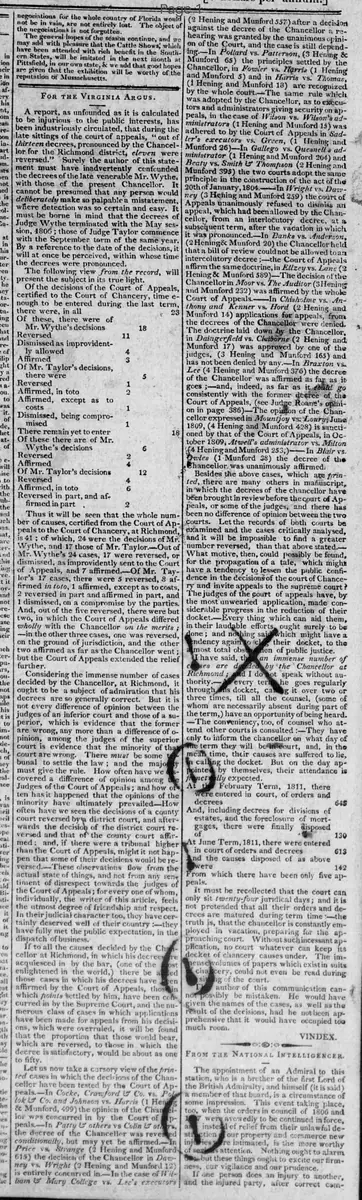
A report, as unfounded as it is calculated to be injurious to the public interests, has been industriously circulated, that during the late sittings of the court of appeals, "out of thirteen decrees, pronounced by the Chancellor for the Richmond district, eleven were reversed." Surely the author of this statement must have inadvertently confounded the decrees of the late venerable Mr. Wythe, with those of the present Chancellor. It cannot be presumed that any person would deliberately make so palpable a misstatement, where detection was so certain and easy. It must be borne in mind that the decrees of Judge Wythe terminated with the May session, 1806; those of Judge Taylor commence with the September term of the same year. By a reference to the date of the decisions, it will at once be perceived, within whose time the decrees were pronounced.
The following view from the record, will present the subject in its true light.
Of the decisions of the Court of Appeals, certified to the Court of Chancery, time enough to be entered during the last term, there were, in all 23
Of these, there were of Mr. Wythe's decisions.
Reversed
Dismissed as improvidently allowed
Affirmed
Of Mr. Taylor's decisions, there were
Reversed
Affirmed in toto
Affirmed, except as to costs
Dismissed, being compromised
There remain yet to enter
Of these there are of Mr. Wythe's decisions
Reversed
Affirmed
Of Mr. Taylor's decisions
Reversed
Affirmed in toto
Reversed in part, and affirmed in part
Thus it will be seen that the whole number of causes, certified from the Court of Appeals to the Court of Chancery, at Richmond, is 41; of which, 24 were the decisions of Mr. Wythe, and 17 those of Mr. Taylor.—Out of Mr. Wythe's 24 cases, 17 were reversed, or dismissed, as improvidently sent to the Court of Appeals, and 7 affirmed.—Of Mr. Taylor's 17 cases, there were 5 reversed, 8 affirmed in toto, 1 affirmed, except as to costs, 2 reversed in part and affirmed in part, and 1 dismissed, on a compromise by the parties. And, out of the five reversed, there were but two, in which the Court of Appeals differed wholly with the Chancellor on the merits; —in the other three cases, one was reversed, on the ground of jurisdiction, and the other two affirmed as far as the Chancellor went; but the Court of Appeals extended the relief further.
Considering the immense number of cases decided by the Chancellor, at Richmond, it ought to be a subject of admiration that his decrees are so generally correct. But it is not every difference of opinion between the judges of an inferior court and those of a superior, which is evidence that the former are wrong, any more than a difference of opinion, among the judges of the superior court is evidence that the minority of that court are wrong. There must be some tribunal to settle the law; and the majority must give the rule. How often have we covered a difference of opinion among Judges of the Court of Appeals: and how often has it happened that the opinions of the minority have ultimately prevailed—How often have we seen the decisions of a county court reversed by a district court, and afterwards the decision of the district court reversed and that of the county court affirmed: and, if there were a tribunal higher than the Court of Appeals, might it not happen that some of their decisions would be reversed.—These observations flow from the actual state of things, and not from any sentiment of disrespect towards the judges of the Court of Appeals; for every one of whom, individually, the writer of this article, feels the utmost degree of friendship and respect. In their judicial character too, they have certainly deserved well of their country: they have fully met the public expectation, in the dispatch of business.
If to all the causes decided by the Chancellor at Richmond, in which his decrees are acquiesced in by the bar, (one of the most enlightened in the world,) there be added those cases in which his decrees have been affirmed by the Court of Appeals, those in which points settled by him, have been concurred in by the Supreme Court, and the numerous class of cases in which applications have been made for appeals from his decisions, which were overruled, it will be found that the proportion that those would bear, which are reversed, to those in which the decree is satisfactory, would be about as one to fifty.
Let us now take a cursory view of the printed cases in which the decisions of the Chancellor have been tested by the Court of Appeals.—In Cocke, Crawford & Co. vs. Pollock & Co. and Johnson vs. Harris (1 Hening & Munford, 499) the opinion of the Chancellor was concurred in by the Court of Appeals.—In Patty & others vs. Colin & others, the decree of the Chancellor was reversed conditionally, but may yet be affirmed.—In Price vs. Strange (2 Hening and Munford 615) the decision of the Chancellor in Darney vs. Wright (2 Hening and Munford 12) is entirely concurred in.—In the case of William & Mary College vs. Lee's executors (2 Hening and Munford 557) after a decision against the decree of the Chancellor a re-hearing was granted by the unanimous opinion of the Court, and the case is still depending.—In Pollard vs. Patterson, (3 Hening & Munford 65) the principles settled by the Chancellor, in Forler vs. Harris (1 Hening and Munford 5) and in Harris vs. Thomas, (1 Hening and Munford 18) are recognized by the whole court.—The same rule which was adopted by the Chancellor, as to executors and administrators giving security on appeals, in the case of Wilson vs. Wilson's administrators (1 Hening and Munford 15) was adhered to by the Court of Appeals in Sadler's executors vs. Green, (1 Hening and Munford 26)—In Gallego vs. Quesnell's administrator (1 Hening and Munford 204) and Beaty vs. Smith & Thompson (2 Hening and Munford 395) the two courts adopt the same principle in the construction of the act of the 20th of January, 1804.—In Wright vs. Dasney (3 Hening and Munford 259) the court of Appeals unanimously refused to dismiss an appeal, which had been allowed by the Chancellor, from an interlocutory decree, at a subsequent term, after the vacation in which it was pronounced.—In Banks vs. Anderson, (2 Hening & Munford 20) the Chancellor held that a bill of review could not be allowed to an interlocutory decree; the Court of Appeals affirm the same doctrine, in Ellzey vs. Lane (2 Hening & Munford 589)— The decision of the Chancellor in Moor vs. The Auditor (3 Hening and Munford 232) was affirmed by the whole Court of Appeals.—In Chisholme vs. Anthony and Kenner vs. Hord (2 Hening and Munford 14) applications for appeals, from the decrees of the Chancellor were denied. The doctrine laid down by the Chancellor, in Daingerfield vs. Claiborne (2 Hening and Munford 17) was approved by one of the judges, (3 Hening and Munford 165) and has not been denied by any.—In Braxton vs. Lee (4 Hening and Munford 376) the decree of the Chancellor was affirmed as far as it goes;—and, indeed, as far as it could go consistently with the former decree of the Court of Appeals, (see Judge Roane's opinion in page 386)—The opinion of the Chancellor expressed in Mountjoy vs. Loury, June 1809, (4 Hening and Munford 428) is sanctioned by that of the Court of Appeals, in October 1809, Atwell's administrator vs. Milton (4 Hening and Munford 253,)— In Blair vs. Owings (1 Munford 38) the decree of the Chancellor. was unanimously affirmed.
Besides the above cases, which are printed, there are many others in manuscript, in which the decrees of the chancellor have been brought in review before the court of Appeals, or some of the judges, and there has been no difference of opinion between the two Courts. Let the records of both courts be examined and the cases critically analysed, and it will be impossible to find a greater number reversed, than that above stated.— What motive, then, could possibly be found, for the propagation of a tale, which might have a tendency to lessen the public confidence in the decisions of the court of Chancery and invite appeals to the supreme court? The judges of the court of appeals have, by the most unwearied application, made considerable progress in the reduction of their docket.—Every thing which can aid them, in their laudable efforts, ought surely to be done; and nothing said which might have a tendency again to clog their docket, to the almost total obstruction of public justice.
I have said, that an immense number of causes are decided by the Chancellor at Richmond; and I do not speak without authority.—every term he goes regularly through his docket, calling it over two or three times, till all the counsel, (some of whom are necessarily absent during part of the term,) have an opportunity of being heard. —The conveniency, too, of counsel who attend other courts is consulted :—They have only to inform the chancellor on what day of the term they will be in court, and, in the mean time, their causes are suffered to lie, in calling the docket. But on the day appointed by themselves, their attendance is generally expected.
At the February Term, 1811, there were entered in court, of orders and decrees 645
And, including decrees for divisions of estates, and the foreclosure of mortgages, there were finally disposed of 130
At June Term, 1811, there were entered in court of orders and decrees 613
And the causes disposed of as above were 142
From which there have been only five appeals.
It must be recollected that the court can only sit twenty-four judicial days; and it is not pretended that all their orders and decrees are matured during term time :-the truth is, that the chancellor is constantly employed in vacation, preparing for the approaching court. Without such incessant application, no court whatever can keep its docket of chancery causes under. The immense volumes of papers which exist in suits chancery, could not even be read during sitting of the court.
The author of this communication cannot possibly be mistaken. He would have given the names of the cases, as well as the result of the decisions, had he not been apprehensive that it would have occupied too much room.
VINDEX.
What sub-type of article is it?
What themes does it cover?
What keywords are associated?
What entities or persons were involved?
Letter to Editor Details
Author
Vindex
Recipient
The Virginia Argus
Main Argument
the rumor that 11 of 13 recent chancellor decrees were reversed is false; most reversals were from former chancellor wythe's cases, not current chancellor taylor's, whose decisions are largely affirmed and demonstrate high accuracy given the volume of cases handled.
Notable Details