Thank you for visiting SNEWPapers!
Sign up free
Story
September 11, 1841
The North Carolinian
Fayetteville, Cumberland County, North Carolina
What is this article about?
1840 political commentary refuting Whig claims that the U.S. Bank was the decisive election issue, quoting Thomas Ewing's letter denying it and emphasizing executive power concerns, plus Daniel Webster's views on a potential national bank.
Clipping
OCR Quality
95%
Excellent
Full Text
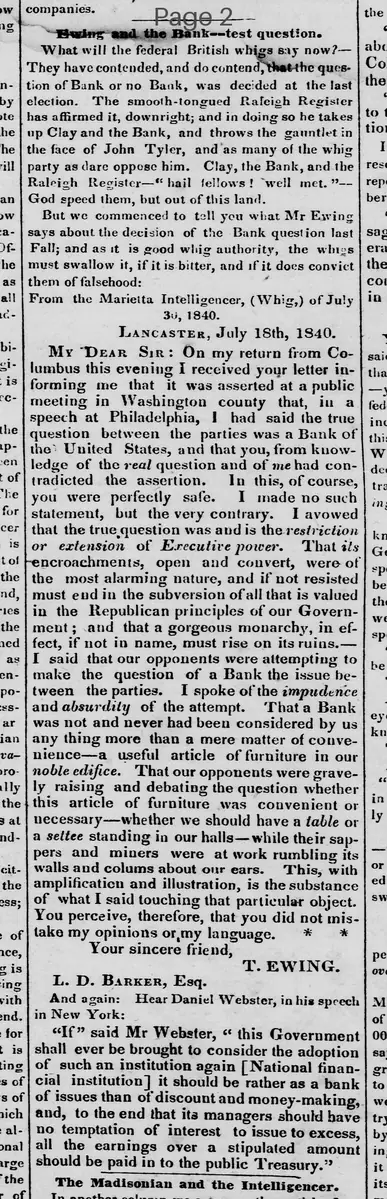
Ewing and the Bank—test question.
What will the federal British whigs say now?— They have contended, and do contend, that the question of Bank or no Bank, was decided at the last election. The smooth-tongued Raleigh Register has affirmed it, downright; and in doing so he takes up Clay and the Bank, and throws the gauntlet in the face of John Tyler, and as many of the whig party as dare oppose him. Clay, the Bank, and the Raleigh Register—"hail fellows! well met."— God speed them. but out of this land.
But we commenced to tell you what Mr Ewing says about the decision of the Bank question last Fall; and as it is good whig authority, the whigs must swallow it, if it is bitter, and if it does convict them of falsehood:
From the Marietta Intelligencer, (Whig,) of July 30, 1840.
My Dear Sir: On my return from Columbus this evening I received your letter informing me that it was asserted at a public meeting in Washington county that, in a speech at Philadelphia, I had said the true question between the parties was a Bank of the United States, and that you, from knowledge of the real question and of me had contradicted the assertion. In this, of course, you were perfectly safe. I made no such statement, but the very contrary. I avowed that the true question was and is the restriction or extension of Executive power. That its encroachments, open and covert, were of the most alarming nature, and if not resisted must end in the subversion of all that is valued in the Republican principles of our Government; and that a gorgeous monarchy, in effect, if not in name, must rise on its ruins.— I said that our opponents were attempting to make the question of a Bank the issue between the parties. I spoke of the impudence and absurdity of the attempt. That a Bank was not and never had been considered by us any thing more than a mere matter of convenience—a useful article of furniture in our noble edifice. That our opponents were gravely raising and debating the question whether this article of furniture was convenient or necessary—whether we should have a table or a settee standing in our halls—while their sappers and miners were at work rumbling its walls and columns about our ears.
This, with amplification and illustration, is the substance of what I said touching that particular object.
You perceive, therefore, that you did not mistake my opinions or my language.
Your sincere friend,
T. EWING.
L. D. Barker, Esq.
And again: Hear Daniel Webster, in his speech in New York:
"If" said Mr Webster, "this Government shall ever be brought to consider the adoption of such an institution again [National financial institution] it should be rather as a bank of issues than of discount and money-making, and, to the end that its managers should have no temptation of interest to issue to excess, all the earnings over a stipulated amount should be paid in to the public Treasury."
What will the federal British whigs say now?— They have contended, and do contend, that the question of Bank or no Bank, was decided at the last election. The smooth-tongued Raleigh Register has affirmed it, downright; and in doing so he takes up Clay and the Bank, and throws the gauntlet in the face of John Tyler, and as many of the whig party as dare oppose him. Clay, the Bank, and the Raleigh Register—"hail fellows! well met."— God speed them. but out of this land.
But we commenced to tell you what Mr Ewing says about the decision of the Bank question last Fall; and as it is good whig authority, the whigs must swallow it, if it is bitter, and if it does convict them of falsehood:
From the Marietta Intelligencer, (Whig,) of July 30, 1840.
My Dear Sir: On my return from Columbus this evening I received your letter informing me that it was asserted at a public meeting in Washington county that, in a speech at Philadelphia, I had said the true question between the parties was a Bank of the United States, and that you, from knowledge of the real question and of me had contradicted the assertion. In this, of course, you were perfectly safe. I made no such statement, but the very contrary. I avowed that the true question was and is the restriction or extension of Executive power. That its encroachments, open and covert, were of the most alarming nature, and if not resisted must end in the subversion of all that is valued in the Republican principles of our Government; and that a gorgeous monarchy, in effect, if not in name, must rise on its ruins.— I said that our opponents were attempting to make the question of a Bank the issue between the parties. I spoke of the impudence and absurdity of the attempt. That a Bank was not and never had been considered by us any thing more than a mere matter of convenience—a useful article of furniture in our noble edifice. That our opponents were gravely raising and debating the question whether this article of furniture was convenient or necessary—whether we should have a table or a settee standing in our halls—while their sappers and miners were at work rumbling its walls and columns about our ears.
This, with amplification and illustration, is the substance of what I said touching that particular object.
You perceive, therefore, that you did not mistake my opinions or my language.
Your sincere friend,
T. EWING.
L. D. Barker, Esq.
And again: Hear Daniel Webster, in his speech in New York:
"If" said Mr Webster, "this Government shall ever be brought to consider the adoption of such an institution again [National financial institution] it should be rather as a bank of issues than of discount and money-making, and, to the end that its managers should have no temptation of interest to issue to excess, all the earnings over a stipulated amount should be paid in to the public Treasury."
What sub-type of article is it?
Historical Event
What themes does it cover?
Deception
What keywords are associated?
Bank Question
Whig Party
1840 Election
Executive Power
Thomas Ewing
Daniel Webster
What entities or persons were involved?
T. Ewing
Henry Clay
John Tyler
Daniel Webster
L. D. Barker
Where did it happen?
United States
Story Details
Key Persons
T. Ewing
Henry Clay
John Tyler
Daniel Webster
L. D. Barker
Location
United States
Event Date
July 30, 1840
Story Details
Political critique arguing the 1840 election's true issue was executive power, not the Bank of the United States, quoting Ewing's letter clarifying his Philadelphia speech and Webster's New York remarks on bank structure.