Thank you for visiting SNEWPapers!
Sign up free
The Enquirer
Richmond, Henrico County, Virginia
What is this article about?
President James Madison transmits to Congress copies of diplomatic correspondence between U.S. Secretary of State James Monroe and British Envoy Augustus J. Foster, dated June 10-14, 1812, concerning the conditions for repealing British Orders in Council in response to French decrees.
Clipping
OCR Quality
Full Text
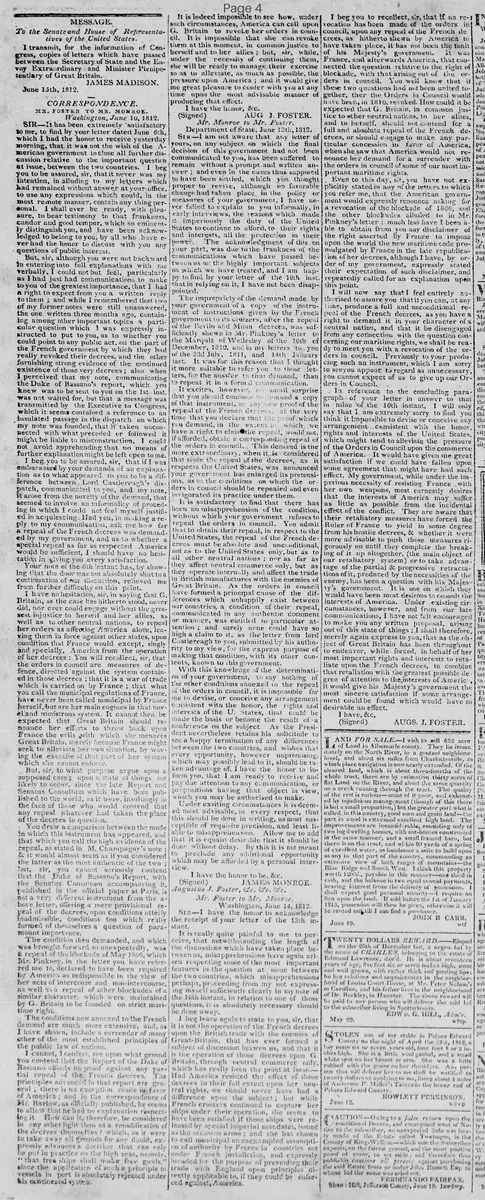
To the Senate and House of Representatives of the United States:
I transmit, for the information of Congress, copies of letters which have passed between the Secretary of State and the Envoy Extraordinary and Minister Plenipotentiary of Great Britain.
JAMES MADISON.
June 15th, 1812.
CORRESPONDENCE.
MR. FOSTER TO MR. MONROE.
Washington, June 10, 1812.
SIR--It has been extremely satisfactory to me, to find by your letter dated June 6th, which I had the honor to receive yesterday morning, that it was not the wish of the American government to close all further discussion relative to the important question at issue, between the two countries. I beg you to be assured, sir, that it never was my intention, in alluding to my letters which had remained without answer at your office, to use any expressions which could, in the most remote manner, contain any thing personal. I shall ever be ready, with pleasure, to bear testimony to that frankness, candor and good temper, which so eminently distinguish you, and have been acknowledged to belong to you, by all who have ever had the honor to discuss with you any questions of public interest.
But, sir, although you were not backward in entering into full explanations with me verbally, I could not but feel, particularly as I had just had communications to make to you of the greatest importance, that I had a right to expect from you a written reply to them; and while I remembered that two of my former notes were still unanswered, the one written three months ago, containing among other important topics a particular question which I was expressly instructed to put to you, as to whether you could point to any public act, on the part of the French government by which they had really revoked their decrees, and the other furnishing strong evidence of the continued existence of those very decrees; also when I perceived that my note, communicating the Duke of Bassano's report, which you knew was to be sent to you on the 1st inst. was not waited for, but that a message was transmitted by the Executive to Congress, which it seems contained a reference to an insulated passage in the dispatch on which my note was founded, that if taken unconnected with what preceded or followed it might be liable to misconstruction, I could not avoid apprehending that no means of further explanation might be left open to me.
I beg you to be assured, sir, that if I was embarrassed by your demands of an explanation as to what appeared to you to be a difference between Lord Castlereagh's dispatch, communicated to you, and my note, it arose from the novelty of the demand, that seemed to involve an informality of proceeding in which I could not feel myself justified in acquiescing. Had you, in making a reply to my communication, ask me how far a repeal of the French decrees was demanded by my government, and as to whether a special repeal as far as respected America would be sufficient, I should have no hesitation in giving you every satisfaction.
Your note of the 6th instant has, by showing that the door was not absolutely shut to a continuation of our discussion, relieved me from further difficulty on this point.
I have no hesitation, sir, in saying that G. Britain, as the case has hitherto stood, never did, nor ever could engage without the grossest injustice to herself and her allies, as well as to other neutral nations, to repeal her orders as affecting America alone, leaving them in force against other states, upon condition that France would except, singly and specially, America from the operation of her decrees: You will recollect, sir, that the orders in council are measures of defence, directed against the system contained in those decrees; that it is a war of trade which is carried on by France; that what you call the municipal regulations of France, have never been called municipal by France herself, but are her main engines in that novel and monstrous system. It cannot then be expected that Great Britain should renounce her efforts to throw back upon France the evils with which she menaces Great Britain, merely because France might seek to alleviate her own situation, by waving the exercise of that part of her system which she cannot enforce.
But, sir, to what purpose argue upon a supposed case; upon a state of things not likely to occur, since the late Report and Senatus Consultum which have been published to the world, as it were, insultingly in the face of those who would contend that any repeal whatever had taken the place of the decrees in question.
You draw a comparison between the mode in which this instrument has appeared, and that which you call the high evidence of the repeal, as stated in M. Champagny's note; & it would almost seem as if you considered the latter as the most authentic of the two; but, sir, you cannot seriously contend that the Duke of Bassano's Report, with the Senatus Consultum accompanying it, published in the official paper at Paris, is not a very different instrument from the above letter, offering a mere provisional repeal of the decrees, upon conditions utterly inadmissible, conditions too which really formed of themselves a question of paramount importance.
The condition then demanded, and which was brought forward so unexpectedly, was a repeal of the blockade of May 1806, which Mr. Pinkney, in the letter you have referred me to, declared to have been required by America as indispensable in the view of her acts of intercourse and non-intercourse, as well as a repeal of other blockades of a similar character, which were maintained by G. Britain to be founded on strict maritime right.
The conditions now annexed to the French demand are much more extensive, and, as I have shown, include a surrender of many other of the most established principles of the public law of nations.
I cannot, I confess, see upon what ground you contend that the Report of the Duke of Bassano affords no proof against any partial repeal of the French decrees. The principles advanced in that report are general; there is no exception made in favor of America: and in the correspondence of Mr. Barlow, as officially published, he seems to allow that he had no explanation respecting it. How can it, therefore, be considered in any other light than as a republication of the decrees themselves? which, as it were to take away all grounds for any doubt, expressly advances a doctrine that can only be put in practice on the high seas, namely, "that free ships shall make free goods," since the application of such a principle to vessels in port is absolutely rejected under his continental system.
It is indeed impossible to see how, under such circumstances, America can call upon G. Britain to revoke her orders in council. It is impossible that she can revoke them at this moment, in common justice to herself and to her allies; but, sir, while, under the necessity of continuing them, she will be ready to manage their exercise so as to alleviate, as much as possible, the pressure upon America; and it would give me great pleasure to confer with you at any time upon the most advisable manner of producing that effect.
I have the honor, &c.
(Signed) AUG J. FOSTER.
Mr. Monroe to Mr. Foster.
Department of State. June 13th, 1812.
SIR--I am not aware that any letter of yours, on any subject, on which the final decision of this government had not been communicated to you, has been suffered to remain without a prompt and written answer; and even in the cases thus supposed to have been settled, which you thought proper to revive, although no favorable change had taken place in the policy or measures of your government, I have never failed to explain to you informally, in early interviews, the reasons which made it imperiously the duty of the United States to continue to afford, to their rights and interests, all the protection in their power. The acknowledgment of this on your part, was due to the frankness of the communications which have passed between us on the highly important subjects on which we have treated, and I am happy to find by your letter of the 10th inst. that in relying on it, I have not been disappointed.
The impropriety of the demand made by your government of a copy of the instrument of instructions given by the French government to its cruizers, after the repeal of the Berlin and Milan decrees, was sufficiently shewn in Mr. Pinkney's letter to the Marquis of Wellesley of the 10th of December, 1810, and in my letters to you of the 23d July, 1811, and 14th January last. It was for this reason that I thought it more suitable to refer you to those letters, for the answer to that demand, than to repeat it in a formal communication.
It excites, however, no small surprise that you should continue to demand a copy of that instrument, or any new proof of the repeal of the French decrees, at the very time that you declare that the proof which you demand, in the extent to which we have a right to claim the repeal, would not, if afforded, obtain a corresponding repeal of the orders in council. This demand is the more extraordinary, when it is considered that since the repeal of the decrees, as it respects the United States, was announced your government has enlarged its pretensions, as to the conditions on which the orders in council should be repealed and even invigorated its practice under them.
It is satisfactory to find that there has been no misapprehension of the condition, without which your government refuses to repeal the orders in council. You admit that to obtain their repeal, in respect to the United States, the repeal of the French decrees must be absolute and unconditional, not as to the United States only, but as to all other neutral nations; nor as far as they affect neutral commerce only, but as they operate internally and affect the trade in British manufactures with the enemies of Great Britain. As the orders in council have formed a principal cause of the differences which unhappily exist between our countries, a condition of their repeal, communicated in any authentic document or manner, was entitled to particular attention; and surely none could have so high a claim to it, as the letter from Lord Castlereagh to you, submitted by his authority to my view, for the express purpose of making that condition, with its other contents, known to this government.
With this knowledge of the determination of your government, to say nothing of the other conditions annexed to the repeal of the orders in council, it is impossible for me to devise, or conceive any arrangement consistent with the honor, the rights and interests of the United States, that could be made the basis or become the result of a conference on the subject. As the President nevertheless retains his solicitude to see a happy termination of any differences between the two countries, and wishes that every opportunity, however unpromising, which may possibly lead to it, should be taken advantage of, I have the honor to inform you, that I am ready to receive and pay due attention to any communication, or propositions having that object in view, which you may be authorised to make.
Under existing circumstances it is deemed most advisable, in every respect, that this should be done in writing, as most susceptible of requisite precision, and least liable to misapprehension. Allow me to add that it is equally desirable that it should be done without delay. By this it is not meant to preclude any additional opportunity which may be afforded by a personal interview.
I have the honor to be, &c.
(Signed) JAMES MONROE.
Augustus J. Foster, Esq. &c. &c.
Mr. Foster to Mr. Monroe.
Washington, June 14, 1812.
SIR--I have the honor to acknowledge the receipt of your letter of the 13th instant.
It is really quite painful to me to perceive, that notwithstanding the length of the discussions which have taken place between us, misapprehensions have again arisen respecting some of the most important features in the question at issue between the two countries, which misapprehensions perhaps, proceeding from my not expressing myself sufficiently clearly in my note of the 10th instant, in relation to one of those questions, it is absolutely necessary should be done away.
I beg leave again to state to you, sir, that it is not the operation of the French decrees upon the British trade with the enemies of Great Britain, that has ever formed a subject of discussion between us, and that it is the operation of those decrees upon G. Britain, through neutral commerce only, which has really been the point at issue. Had America resisted the effect of those decrees in their full extent upon her neutral rights, we should never have had a difference upon the subject: but while French cruizers continued to capture her ships under their operation, she seems to have been satisfied if those ships were released by special imperial mandates, issued as the occasion arose: and she has chosen to call municipal an unexampled assumption of authority by France in countries not under French jurisdiction, and expressly invaded for the purpose of preventing their trade with England upon principles directly applicable to, if they could be enforced against, America.
I beg you to recollect, sir, that if no revocation has been made of the orders in council, upon any repeal of the French decrees, as hitherto shewn by America to have taken place, it has not been the fault of his Majesty's government. It was France, and afterwards America, that connected the question relative to the right of blockade, with that arising out of the orders in council. You well know that if these two questions had not been united together, then the Orders in Council would have been, in 1810, revoked. How could it be expected that G. Britain, in common justice to other neutral nations, to her allies, and to herself, should not contend for a full and absolute repeal of the French decrees, or should engage to make any particular concession in favor of America, when she saw that America would not renounce her demand for a surrender with the orders in council of some of our most important maritime rights.
Even to this day, sir, you have not explicitly stated in any of the letters to which you refer me, that the American government would expressly renounce asking for a revocation of the blockade of 1806, and the other blockades alluded to in Mr. Pinkney's letter: much less have I been able to obtain from you any disclaimer of the right asserted by France to impose upon the world the new maritime code promulgated by France in the late republication of her decrees, although I have, by order of my government, expressly stated their expectation of such disclaimer, and repeatedly called for an explanation upon this point.
I will now say that I feel entirely authorised to assure you that if you can, at any time, produce a full and unconditional repeal of the French decrees, as you have a right to demand it in your character of a neutral nation, and that it be disengaged from any connection with the question concerning our maritime rights, we shall be ready to meet you with a revocation of the orders in council. Previously to your producing such an instrument, which I am sorry to see you appear to regard as unnecessary, you cannot expect of us to give up our Orders in Council.
In reference to the concluding paragraph of your letter in answer to that in mine of the 10th instant, I will only say that I am extremely sorry to find you think it impossible to devise or conceive any arrangement, consistent with the honor, rights and interests of the United States, which might tend to alleviate the pressure of the Orders in Council upon the commerce of America. It would have given me great satisfaction if we could have fallen upon some agreement that might have had such effect. My government, while under the imperious necessity of resisting France with her own weapons, most earnestly desires that the interests of America may suffer as little as possible from the incidental effect of the conflict. They are aware that their retaliatory measures have forced the Ruler of France to yield in some degree from his hostile decrees, & whether it were more advisable to push those measures rigorously on until they complete the breaking of it up altogether, (the main object of our retaliatory system) or to take advantage of the partial & progressive retractions of it, produced by the necessities of the enemy, has been a question with his Majesty's government. It is one on which they would have been most desirous to consult the interests of America. Under existing circumstances, however, and from our late communications, I have not felt encouraged to make you any written proposal, arising out of this state of things; I shall therefore, merely again express to you, that as the object of Great Britain has been throughout to endeavor, while forced, in behalf of her most important rights and interests to retaliate upon the French decrees, to combine that retaliation with the greatest possible degree of attention to the interests of America, it would give his Majesty's government the most sincere satisfaction if some arrangement could be found which would have so desirable an effect.
I have, &c.
(Signed) AUGS. J. FOSTER.
What sub-type of article is it?
What keywords are associated?
What entities or persons were involved?
Where did it happen?
Domestic News Details
Primary Location
Washington
Event Date
June 15th, 1812
Key Persons
Outcome
no resolution reached; continued diplomatic discussions on conditions for repealing british orders in council contingent on full repeal of french decrees; offers to alleviate pressure on american commerce.
Event Details
President Madison transmits to Congress correspondence between Monroe and Foster debating the repeal of French decrees and British Orders in Council, including demands for proof of repeal, conditions involving blockades and maritime rights, and proposals for arrangements to reduce impact on U.S. interests.