Thank you for visiting SNEWPapers!
Sign up free
Story
January 4, 1922
The Laramie Republican
Laramie, Albany County, Wyoming
What is this article about?
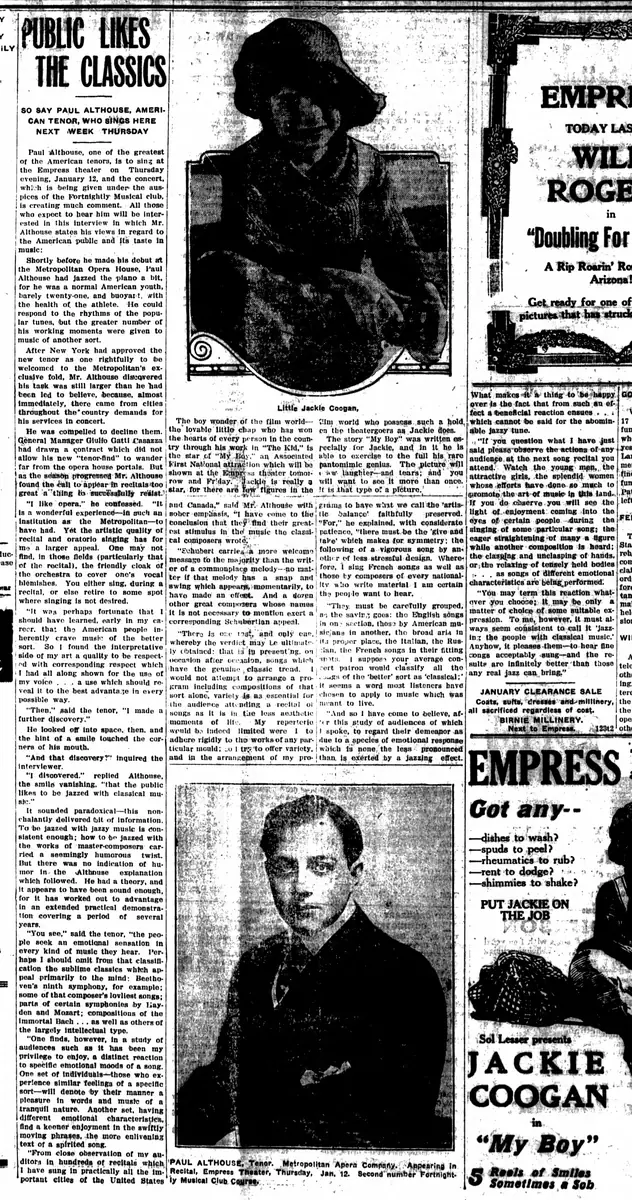
Paul Althouse, acclaimed American tenor, shares in an interview his views on the public's preference for classical music with emotional 'jazz-like' appeal, ahead of his concert at Empress theater on January 12.
Clipping
OCR Quality
85%
Good
Full Text
PUBLIC LIKES
THE CLASSICS
SO Says PAUL Althouse, Ameri-
CAN TENOR, WHO SINGS HERE
NEXT WEEK THURSDAY
Paul Althouse, one of the greatest
of the American tenors, is to sing at
the Empress theater on Thursday
evening, January 12, and the concert,
which is being given under the aus-
pices of the Fortnightly Musical club,
is creating much comment. All those
who expect to hear him will be inter-
esting in this interview in which Mr.
Althouse states his views in regard to
the American public and its taste in
music:
Shortly before he made his debut at
the Metropolitan Opera House, Paul
Althouse had jazzed the piano a bit,
for he was a normal American youth,
barely twenty-one, and buoyant with
the health of the athlete. He could
respond to the rhythms of the popu-
lar tunes, but the greater number of
his working moments were given to
music of another sort.
After New York had approved the
new tenor as one rightfully to be
welcomed to the Metropolitan's ex-
clusive fold, Mr. Althouse discovered
his task was still larger than he had
been led to believe, because, almost
immediately, there came from cities
throughout the country demands for
his services in concert.
He was compelled to decline them.
had drawn a contract which did not
allow his new "tenor-find" to wander
far from the opera house portals. But
General Manager Giulio Gatti Casazza
as the season progressed—Mr. Althouse
is a wonderful experienced—in such a
great institution as the Metropolitan—to
have had. Yet the artistic quality of
recital and oratorio singing has for
me a larger appeal. One may not
find, in those fields (particularly that
of the recital), the friendly cloak of
the orchestra to cover one's vocal
blemishes. You either sing, during a
recital, or else retire to some spot
where singing is not desired.
"It was perhaps fortunate that I
should have learned, early in my ca-
reer, that the American people in-
herently crave music of the better
sort. So I found the interpretative
side of my art a quality to be respect-
ed with corresponding respect which
I had all along shown for the use of
my voice . . . a use which should re-
veal it to the best advantage in every
possible way.
"Then," said the tenor, "I made a
further discovery."
He looked off into space, then, and
the hint of a smile touched the cor-
ners of his mouth.
"And that discovery?" inquired the
interviewer.
"I discovered,"
replied Althouse,
the smile vanishing, "that the public
likes to be jazzed with classical mu-
sic."
It sounded paradoxical—this non-
chalantly delivered bit of information.
consistent enough: how to be jazzed with
the works of master-composers' car-
ried a seemingly humorous
twist.
But there was no indication of hu-
mor in the
Althouse
explanation
which followed. He had a theory, and
it appears to have been sound enough,
for it has worked out to advantage
in an extended practical demonstra-
tion covering a period of several
years.
"You see," said the tenor, "the peo-
ple seek an emotional sensation in
overy kind of music they hear. Per-
haps I should omit from that classifl-
cation the sublime classics which ap-
peal primarily to the mind: Beetho-
ven's ninth symphony, for example;
some of that composer's loveliest songs;
parts of certain symphonies by Hay-
den and Mozart; compositions of the
immortal Bach . . . as well as others of
the largely intellectual type.
"One finds, however, in a study of
audience such as it has been my
privilege to enjoy, a distinct reaction
to specific emotional moods of a song.
One set of individuals—those who ex-
perience similar feelings of a specific
sort—will denote by their manner a
pleasure in words and music of a
tranquil nature. Another set, having
different emotional characteristics.
find a keener enjoyment in the swiftly
moving phrases, the more enlivening
text of a spirited song.
"From close observation of my au-
ditors in hundreds of recitals which
I have sung in practically all the im-
portant cities of the United States
and Canada," said Mr. Althouse with
sober emphasis, "I have come to this
conclusion that they find their great-
est stimulus in the music the clas-
sical composers wrote."
"Schubert carries a more welcomg
message to the majority than the writ-
er of a commonplace melody—no mat-
ter if that melody has a snap and
swing which appears, momentarily, to
have made an effect. And a dozen
other great composers whose names
it is not necessary to mention exert a
corresponding Schubertian appeal.
"There is one test, and only one,
whereby the verdict may be ultimate-
ly obtained: that is in presenting, on
occasion after occasion, songs which
have the genuine, classic trend. I
would not attempt to arrange a pro-
gram including compositions of that
sort alone, variety is, as essential for
the audience attending a recital of
songs as it is in the less aesthetic
moments of life. My repertorio
would be indeed limited were I to
adhere rigidly to the works of any par-
ticular mould; so I try to offer variety,
and in the arrangement of my pro-
grains to have what we call the 'artis-
tic balance' faithfully preserved.
"For," he explained, with considerate
patience, "there must be the 'give and
take' which makes for symmetry: the
following of a vigorous song by an
other of less stressful design. Where-
fore, I sing French songs as well as
those by composers of every national-
ity who write material I am certain
the people want to hear.
"They must be carefully grouped,
as the saying goes: the English songs
in one section, those by American mu-
sicians in another, the broad aria in
its proper place, the Italian, the Rus-
sian, the French songs in their fitting
spots. I suppose your average con-
cert patron would classify all the
songs of the 'better' sort as 'classical;'
it seems a word most listeners have
chosen to apply to music which was
meant to live.
"And so I have come to believe, af-
ter this study of audiences of which
I spoke, to regard their demeanor as
due to a species of emotional response
which is none the less pronounced
than is exerted by a jazzing effect.
What makes it a thing to be happy
over is the fact that from such an ef-
fect a beneficial reaction ensues . . . :
which cannot be said for the abomin-
able jazzy tune.
", "If you question what I have just
said please observe the actions of any
audience, at the next song recital you
attend. Watch the young men, the
attractive girls, the splendid women
whose efforts have done so much to
promote the art of music in this land.
If you do observe, you will see the
light of enjoyment coming into the
eyes of certain people during the
singing of some particular song; the
eager straightening of many a figure
while another composition is heard;
the clasping and unclasping of hands,
or the relaxing of tensely held bodies
. . . as songs of different emotional
characteristics are being performed.
"You may term this reaction what-
ever you choose; it may be only a
matter of choice of some suitable ex-
pression. To me, however, it must al-
ways seem consistent to call it 'jazz-
ing the people with classical music.'
Anyhow, it pleases them—to hear fine
songs acceptably sung—and the re-
sults are infinitely better than those
any real jazz can bring."
THE CLASSICS
SO Says PAUL Althouse, Ameri-
CAN TENOR, WHO SINGS HERE
NEXT WEEK THURSDAY
Paul Althouse, one of the greatest
of the American tenors, is to sing at
the Empress theater on Thursday
evening, January 12, and the concert,
which is being given under the aus-
pices of the Fortnightly Musical club,
is creating much comment. All those
who expect to hear him will be inter-
esting in this interview in which Mr.
Althouse states his views in regard to
the American public and its taste in
music:
Shortly before he made his debut at
the Metropolitan Opera House, Paul
Althouse had jazzed the piano a bit,
for he was a normal American youth,
barely twenty-one, and buoyant with
the health of the athlete. He could
respond to the rhythms of the popu-
lar tunes, but the greater number of
his working moments were given to
music of another sort.
After New York had approved the
new tenor as one rightfully to be
welcomed to the Metropolitan's ex-
clusive fold, Mr. Althouse discovered
his task was still larger than he had
been led to believe, because, almost
immediately, there came from cities
throughout the country demands for
his services in concert.
He was compelled to decline them.
had drawn a contract which did not
allow his new "tenor-find" to wander
far from the opera house portals. But
General Manager Giulio Gatti Casazza
as the season progressed—Mr. Althouse
is a wonderful experienced—in such a
great institution as the Metropolitan—to
have had. Yet the artistic quality of
recital and oratorio singing has for
me a larger appeal. One may not
find, in those fields (particularly that
of the recital), the friendly cloak of
the orchestra to cover one's vocal
blemishes. You either sing, during a
recital, or else retire to some spot
where singing is not desired.
"It was perhaps fortunate that I
should have learned, early in my ca-
reer, that the American people in-
herently crave music of the better
sort. So I found the interpretative
side of my art a quality to be respect-
ed with corresponding respect which
I had all along shown for the use of
my voice . . . a use which should re-
veal it to the best advantage in every
possible way.
"Then," said the tenor, "I made a
further discovery."
He looked off into space, then, and
the hint of a smile touched the cor-
ners of his mouth.
"And that discovery?" inquired the
interviewer.
"I discovered,"
replied Althouse,
the smile vanishing, "that the public
likes to be jazzed with classical mu-
sic."
It sounded paradoxical—this non-
chalantly delivered bit of information.
consistent enough: how to be jazzed with
the works of master-composers' car-
ried a seemingly humorous
twist.
But there was no indication of hu-
mor in the
Althouse
explanation
which followed. He had a theory, and
it appears to have been sound enough,
for it has worked out to advantage
in an extended practical demonstra-
tion covering a period of several
years.
"You see," said the tenor, "the peo-
ple seek an emotional sensation in
overy kind of music they hear. Per-
haps I should omit from that classifl-
cation the sublime classics which ap-
peal primarily to the mind: Beetho-
ven's ninth symphony, for example;
some of that composer's loveliest songs;
parts of certain symphonies by Hay-
den and Mozart; compositions of the
immortal Bach . . . as well as others of
the largely intellectual type.
"One finds, however, in a study of
audience such as it has been my
privilege to enjoy, a distinct reaction
to specific emotional moods of a song.
One set of individuals—those who ex-
perience similar feelings of a specific
sort—will denote by their manner a
pleasure in words and music of a
tranquil nature. Another set, having
different emotional characteristics.
find a keener enjoyment in the swiftly
moving phrases, the more enlivening
text of a spirited song.
"From close observation of my au-
ditors in hundreds of recitals which
I have sung in practically all the im-
portant cities of the United States
and Canada," said Mr. Althouse with
sober emphasis, "I have come to this
conclusion that they find their great-
est stimulus in the music the clas-
sical composers wrote."
"Schubert carries a more welcomg
message to the majority than the writ-
er of a commonplace melody—no mat-
ter if that melody has a snap and
swing which appears, momentarily, to
have made an effect. And a dozen
other great composers whose names
it is not necessary to mention exert a
corresponding Schubertian appeal.
"There is one test, and only one,
whereby the verdict may be ultimate-
ly obtained: that is in presenting, on
occasion after occasion, songs which
have the genuine, classic trend. I
would not attempt to arrange a pro-
gram including compositions of that
sort alone, variety is, as essential for
the audience attending a recital of
songs as it is in the less aesthetic
moments of life. My repertorio
would be indeed limited were I to
adhere rigidly to the works of any par-
ticular mould; so I try to offer variety,
and in the arrangement of my pro-
grains to have what we call the 'artis-
tic balance' faithfully preserved.
"For," he explained, with considerate
patience, "there must be the 'give and
take' which makes for symmetry: the
following of a vigorous song by an
other of less stressful design. Where-
fore, I sing French songs as well as
those by composers of every national-
ity who write material I am certain
the people want to hear.
"They must be carefully grouped,
as the saying goes: the English songs
in one section, those by American mu-
sicians in another, the broad aria in
its proper place, the Italian, the Rus-
sian, the French songs in their fitting
spots. I suppose your average con-
cert patron would classify all the
songs of the 'better' sort as 'classical;'
it seems a word most listeners have
chosen to apply to music which was
meant to live.
"And so I have come to believe, af-
ter this study of audiences of which
I spoke, to regard their demeanor as
due to a species of emotional response
which is none the less pronounced
than is exerted by a jazzing effect.
What makes it a thing to be happy
over is the fact that from such an ef-
fect a beneficial reaction ensues . . . :
which cannot be said for the abomin-
able jazzy tune.
", "If you question what I have just
said please observe the actions of any
audience, at the next song recital you
attend. Watch the young men, the
attractive girls, the splendid women
whose efforts have done so much to
promote the art of music in this land.
If you do observe, you will see the
light of enjoyment coming into the
eyes of certain people during the
singing of some particular song; the
eager straightening of many a figure
while another composition is heard;
the clasping and unclasping of hands,
or the relaxing of tensely held bodies
. . . as songs of different emotional
characteristics are being performed.
"You may term this reaction what-
ever you choose; it may be only a
matter of choice of some suitable ex-
pression. To me, however, it must al-
ways seem consistent to call it 'jazz-
ing the people with classical music.'
Anyhow, it pleases them—to hear fine
songs acceptably sung—and the re-
sults are infinitely better than those
any real jazz can bring."
What sub-type of article is it?
Biography
What themes does it cover?
Moral Virtue
Triumph
What keywords are associated?
Paul Althouse
American Tenor
Classical Music
Public Taste
Recital Singing
What entities or persons were involved?
Paul Althouse
Giulio Gatti Casazza
Where did it happen?
Empress Theater
Story Details
Key Persons
Paul Althouse
Giulio Gatti Casazza
Location
Empress Theater
Event Date
January 12
Story Details
Paul Althouse, American tenor, discusses in an interview his career from debut at Metropolitan Opera, initial contract limitations, and discovery that American audiences prefer classical music presented with emotional appeal akin to jazz, emphasizing variety in recitals.