Thank you for visiting SNEWPapers!
Sign up free
The Bottineau Courant
Bottineau, Bottineau County, North Dakota
What is this article about?
Reports from October 19 detail Paris peace commission talks where Spain resists US stance on Cuban debt, proposing Philippines surrender instead; US refuses debt assumption and demands full Philippines control. Washington sees it as ploy for European sympathy; Madrid faces military backlash.
Merged-components note: These two components are continuations of the same article on the Spanish-American peace negotiations and Philippine sovereignty, based on sequential reading order and thematic continuity.
Clipping
OCR Quality
Full Text
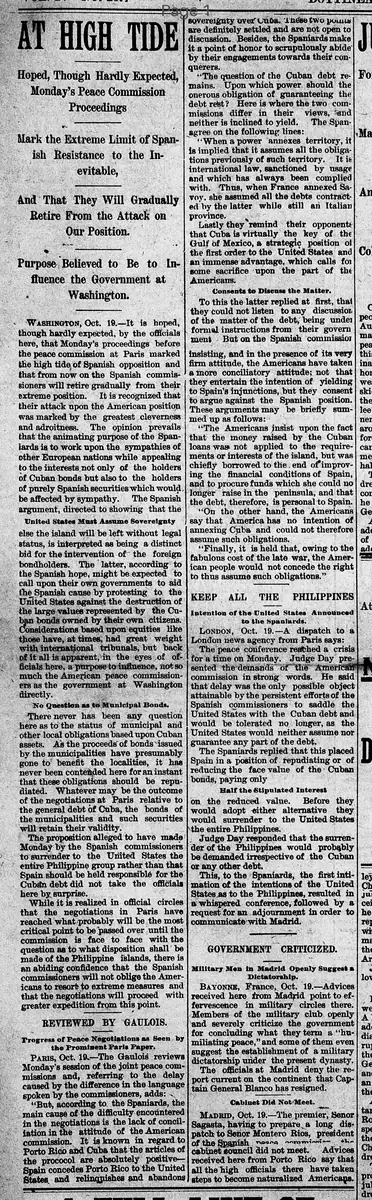
Hoped, Though Hardly Expected, Monday's Peace Commission Proceedings Mark the Extreme Limit of Spanish Resistance to the Inevitable, And That They Will Gradually Retire From the Attack on Our Position.
Purpose Believed to Be to Influence the Government at Washington.
WASHINGTON, Oct. 19.—It is hoped, though hardly expected, by the officials here, that Monday's proceedings before the peace commission at Paris marked the high tide of Spanish opposition and that from now on the Spanish commissioners will retire gradually from their extreme position. It is recognized that their attack upon the American position was marked by the greatest cleverness and adroitness. The opinion prevails that the animating purpose of the Spaniards is to work upon the sympathies of other European nations while appealing to the interests not only of the holders of Cuban bonds but also to the holders of purely Spanish securities which would be affected by sympathy. The Spanish argument, directed to showing that the United States Must Assume Sovereignty else the island will be left without legal status, is interpreted as being a distinct bid for the intervention of the foreign bondholders. The latter, according to the Spanish hope, might be expected to call upon their own governments to aid the Spanish cause by protesting to the United States against the destruction of the large values represented by the Cuban bonds owned by their own citizens. Considerations based upon equities like those have, at times had great weight with international tribunals, but back of it all is apparent, in the eyes of officials here, a purpose to influence, not so much the American peace commissioners as the government at Washington directly.
No Question as to Municipal Bonds.
There never has been any question here as to the status of municipal and other local obligations based upon Cuban assets. As the proceeds of bonds issued by the municipalities have presumably gone to benefit the localities, it has never been contended here for an instant that these obligations should be repudiated. Whatever may be the outcome of the negotiations at Paris relative to the general debt of Cuba, the bonds of the municipalities and such securities will retain their validity.
The proposition alleged to have made Monday by the Spanish commissioners to surrender to the United States the entire Philippine group rather than that Spain should be held responsible for the Cuban debt did not take the officials here by surprise. While it is realized in official circles that the negotiations in Paris have reached what probably will be the most critical point to be passed over until the commission is face to face with the question as to what disposition shall be made of the Philippine islands, there is an abiding confidence that the Spanish commissioners will not oblige the Americans to resort to extreme measures and that the negotiations will proceed with greater expedition from this point.
REVIEWED BY GAULOIS.
Progress of Peace Negotiations as Seen by the Prominent Paris Paper.
Paris, Oct. 19.—The Gaulois reviews Monday's session of the joint peace commissions and, referring to the delay caused by the difference in the language spoken by the commissioners, adds:
"But, according to the Spaniards, the main cause of the difficulty encountered in the negotiations is the lack of conciliation in the attitude of the American commission. It is known in regard to Porto Rico and Cuba that the articles of the protocol are absolutely positive Spain concedes Porto Rico to the United States and relinquishes and abandons sovereignty over Cuba. These two points are definitely settled and are not open to discussion. Besides, the Spaniards make it a point of honor to scrupulously abide by their engagements towards their conquerors.
"The question of the Cuban debt remains. Upon which power should the onerous obligation of guaranteeing the debt rest? Here is where the two commissions differ in their views, and neither is inclined to yield. The Spaniards agree on the following lines:
"When a power annexes territory, it is implied that it assumes all the obligations previously of such territory. It is international law, sanctioned by usage and which has always been complied with. Thus, when France annexed Savoy, she assumed all the debts contracted by the latter while still an Italian province.
Lastly they remind their opponents that Cuba is virtually the key of the Gulf of Mexico, a strategic position of the first order to the United States and an immense advantage, which calls for some sacrifice upon the part of the Americans.
Consents to Discuss the Matter.
To this the latter replied at first, that they could not listen to any discussion of the matter of the debt, being under formal instructions from their government. But on the Spanish commissioners insisting, and in the presence of its very firm attitude, the Americans have taken a more conciliatory attitude; not that they entertain the intention of yielding to Spain's injunctions, but they consent to argue against the Spanish position. These arguments may be briefly summed up as follows:
"The Americans insist upon the fact that the money raised by the Cuban loans was not applied to the requirements or interests of the island, but was chiefly borrowed to the end of improving the financial conditions of Spain, and to procure funds which she could no longer raise in the peninsula, and that the debt, therefore, is personal to Spain.
"On the other hand, the Americans say that America has no intention of annexing Cuba and could not therefore assume such obligations.
"Finally, it is held that, owing to the fabulous cost of the late war, the American people would not concede the right to thus assume such obligations."
KEEP ALL THE PHILIPPINES
Intention of the United States Announced to the Spaniards.
London, Oct. 19.—A dispatch to a London news agency from Paris says:
The peace conference reached a crisis for a time on Monday. Judge Day presented the demands of the American commission in strong words. He said that delay was the only possible object attainable by the persistent efforts of the Spanish commissioners to saddle the United States with the Cuban debt and would be tolerated no longer, as the United States would neither assume nor guarantee any part of the debt.
The Spaniards replied that this placed Spain in a position of repudiating or of reducing the face value of the Cuban bonds, paying only Half the Stipulated Interest on the reduced value. Before they would adopt either alternative they would surrender to the United States the entire Philippines.
Judge Day responded that the surrender of the Philippines would probably be demanded irrespective of the Cuban or any other debt.
This, to the Spaniards, the first intimation of the intentions of the United States as to the Philippines, resulted in a whispered conference, followed by a request for an adjournment in order to communicate with Madrid
GOVERNMENT CRITICIZED.
Military Men in Madrid Openly Suggest a Dictatorship.
Bayonne, France, Oct. 19.—Advices received here from Madrid point to effervescence in military circles there. Members of the military club openly and severely criticize the government for concluding what they term a "humiliating peace," and some of them even suggest the establishment of a military dictatorship under the present dynasty.
The officials at Madrid deny the report current on the continent that Captain General Blanco has resigned.
Cabinet Did Not Meet.
MADRID, Oct. 19.—The premier, Senor Sagasta, having to prepare a long dispatch to Senor Montero Rios, president of the Spanish peace commission, cabinet council did not meet. Advices received here from Porto Rico say that all the high officials there have taken steps to become naturalized Americans.
What sub-type of article is it?
What keywords are associated?
What entities or persons were involved?
Where did it happen?
Foreign News Details
Primary Location
Paris
Event Date
Monday's Proceedings, Reported October 19
Key Persons
Outcome
spanish commissioners propose surrendering entire philippines rather than assuming cuban debt; americans refuse to assume or guarantee debt; negotiations continue with confidence in resolution; municipal cuban bonds retain validity; criticism in madrid military circles
Event Details
Officials in Washington hope Spanish resistance in Paris peace commission peaks, interpreting Spanish arguments on Cuban debt as bid for European intervention. Spaniards argue US must assume debt per international law; Americans counter debt benefits Spain, not Cuba, and no annexation intended. US demands full Philippines regardless of debt. Madrid military criticizes government; cabinet prepares dispatch; Porto Rico officials seek US naturalization.