Thank you for visiting SNEWPapers!
Sign up free
Domestic News
December 14, 1826
Martinsburg Gazette And Public Advertiser
Martinsburg, Berkeley County, West Virginia
What is this article about?
Agricola in the New-England Farmer stresses the importance of cattle color for quality farming, noting that prosperous New England farms, like those in Worcester county, favor red, brown, or brindle oxen and cows for their value and hardiness.
Clipping
OCR Quality
98%
Excellent
Full Text
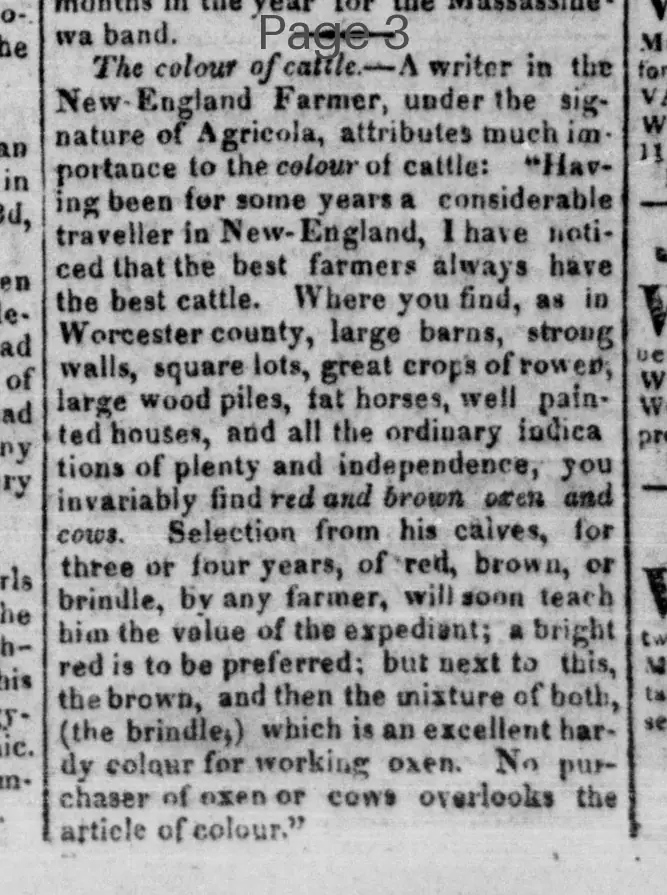
The colour of cattle.—A writer in the New-England Farmer, under the signature of Agricola, attributes such importance to the colour of cattle: "Having been for some years a considerable traveller in New-England, I have noticed that the best farmers always have the best cattle. Where you find, as in Worcester county, large barns, strong walls, square lots, great crops of rowen; large wood piles, fat horses, well painted houses, and all the ordinary indications of plenty and independence, you invariably find red and brown oxen and cows. Selection from his calves, or three or four years, of red, brown, or brindle, by any farmer, will soon teach him the value of the expedient; a bright red is to be preferred; but next to this, the brown, and then the mixture of both, (the brindle,) which is an excellent hardy colour for working oxen. No purchaser of oxen or cows overlooks the article of colour."
What sub-type of article is it?
Agriculture
What keywords are associated?
Cattle Color
Red Oxen
Brown Cows
Brindle Cattle
New England Farming
What entities or persons were involved?
Agricola
Where did it happen?
New England
Domestic News Details
Primary Location
New England
Key Persons
Agricola
Event Details
A writer named Agricola attributes importance to the color of cattle, observing that the best farmers in New-England, particularly in Worcester county, have red and brown oxen and cows. He recommends selecting red, brown, or brindle calves over three or four years, preferring bright red, then brown, then brindle for working oxen.