Thank you for visiting SNEWPapers!
Sign up free
The National Intelligencer And Washington Advertiser
Washington, District Of Columbia
What is this article about?
Transcript of U.S. House of Representatives evening session on March 3, debating a bill to prohibit Navy Secretary from trading; amendment to include other secretaries fails, bill rejected. Resolution thanks outgoing Speaker Theodore Sedgwick, who delivers farewell address; house adjourns sine die.
Merged-components note: This is a continuation of the detailed narrative report on congressional proceedings from page 1 (House debate) to page 2 (speaker's address and adjournment), forming a single logical story unit. Label adjusted to 'story' as it is a full narrative article on national events.
Clippings
1 of 2
OCR Quality
Full Text
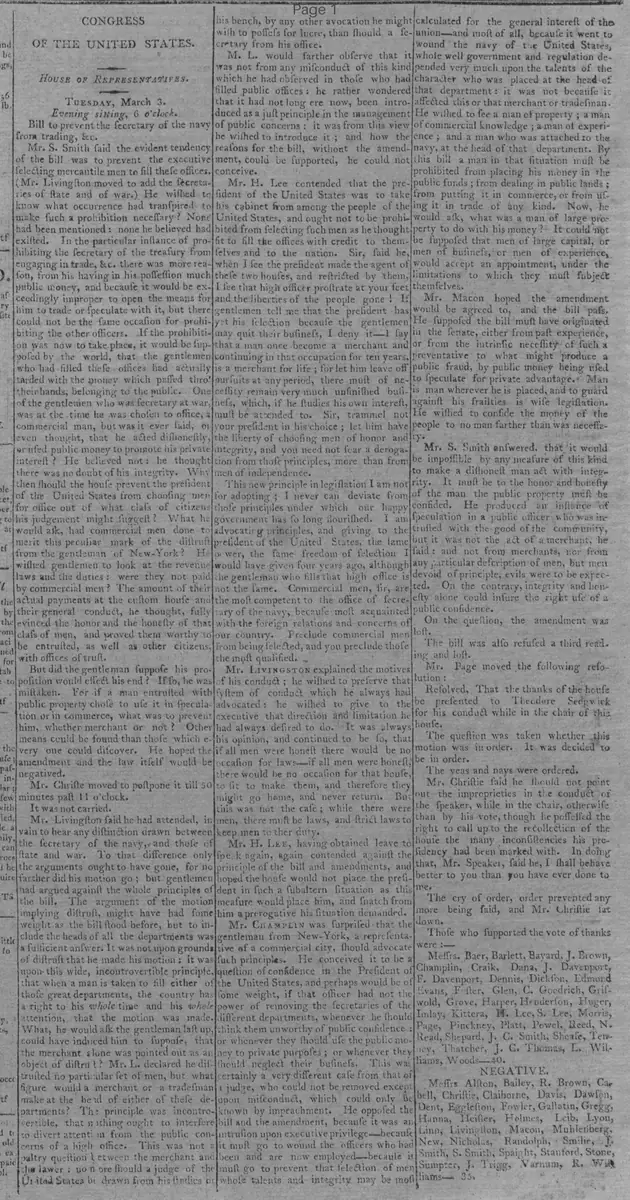
OF THE UNITED STATES.
HOUSE OF REPRESENTATIVES.
Tuesday, March 3.
Evening sitting, 6 o'clock.
Bill to prevent the Secretary of the navy from trading, &c.
Mr. S. Smith said the evident tendency of the bill was to prevent the executive selecting mercantile men to fill these offices. (Mr. Livingston moved to add the Secretaries of state and of war.) He wished to know what occurrence had transpired to make such a prohibition necessary? None had been mentioned : none he believed had existed. In the particular instance of prohibiting the Secretary of the treasury from engaging in trade, &c. there was more reason, from his having in his possession much public money, and because it would be exceedingly improper to open the means for him to trade or peculate with it, but there could not be the same occasion for prohibiting the other officers. If the prohibition was now to take place, it would be supposed by the world, that the gentlemen who had filled these offices had actually traded with the money which passed through their hands, belonging to the public. One of the gentlemen who was secretary at war, was at the time he was chosen to office, a commercial man, but was it ever said, or even thought, that he acted dishonestly, or used public money to promote his private interest ? He believed not: he thought there was no doubt of his integrity. Why then should the house prevent the president of the United States from choosing men for office out of what class of citizens his judgment might suggest? What he would ask, had commercial men done to merit this peculiar mark of the distrust from the gentleman of New-York? He wished gentlemen to look at the revenue laws and the duties : were they not paid by commercial men ? The amount of their actual payments at the custom house and their general conduct, he thought, fully evinced the honor and the honesty of that class of men, and proved them worthy to be entrusted, as well as other citizens, with offices of trust. But did the gentleman suppose his proposition would effect his end ? If so, he was mistaken. For if a man entrusted with public property chose to use it in peculation or in commerce, what was to prevent him, whether merchant or not ? Other means could be found than those which every one could discover. He hoped the amendment and the law itself would be negatived.
Mr. Christie moved to postpone it till 50 minutes past 11 o'clock.
It was not carried.
Mr. Livingston said he had attended, in vain to hear any distinction drawn between the secretary of the navy, and those of state and war. To that difference only the arguments ought to have gone, for no farther did his motion go ; but gentlemen had argued against the whole principles of the bill. The argument of the motion implying distrust, might have had some weight as the bill stood before, but to include the heads of all the departments was a sufficient answer. It was not upon grounds of distrust that he made his motion : it was upon this wide, incontrovertible principle, that when a man is taken to fill either of those great departments, the country has a right to his whole time and his whole attention, that the motion was made. What, he would ask the gentleman last up, could have induced him to suppose, that the merchant alone was pointed out as an object of distrust? Mr. L. declared he distrusted no particular set of men, but what figure would a merchant or a tradesman make at the head of either of these departments? The principle was incontrovertible, that nothing ought to interfere to divert attention from the public concerns of a high office. This was not a paltry question between the merchant and the lawyer : no more should a judge of the United States be drawn from his studies or his bench, by any other avocation he might wish to pursue for lucre, than should a secretary from his office.
Mr. L. would farther observe that it was not from any misconduct of this kind which he had observed in those who had filled public offices: he rather wondered that it had not long ere now, been introduced as a just principle in the management of public concerns : it was from this view he wished to introduce it : and how the reasons for the bill, without the amendment, could be supported, he could not conceive.
Mr. H. Lee contended that the president of the United States was to take his cabinet from among the people of the United States, and ought not to be prohibited from electing such men as he thought fit to fill the offices with credit to themselves and to the nation. Sir, said he, when I see the president made the agent of these two houses, and restricted by them, I see that high officer prostrate at your feet and the liberties of the people gone ! If gentlemen tell me that the president has yet his election because the gentlemen may quit their business, I deny it—I say that a man once become a merchant and continuing in that occupation for ten years, is a merchant for life : for let him leave off pursuits at any period, there must of necessity remain very much unfinished business, which, if he studies his own interest, must be attended to. Sir, trammel not your president in his choice ; let him have the liberty of choosing men of honor and integrity, and you need not fear a derogation from those principles, more than from men of independence.
This new principle in legislation I am not for adopting ; I never can deviate from those principles under which our happy government has so long flourished. I am advocating principles, and giving to the president of the United States, the same power, the same freedom of selection I would have given four years ago, although the gentleman who fills that high office is not the same. Commercial men, sir, are the most competent to the office of secretary of the navy, because most acquainted with the foreign relations and concerns of our country. Preclude commercial men from being selected, and you preclude those the most qualified.
Mr. Livingston explained the motives of his conduct; he wished to preserve that system of conduct which he always had advocated: he wished to give to the executive that direction and limitation he had always desired to do. It was always his opinion, and continued to be so, that if all men were honest there would be no occasion for laws—if all men were honest, there would be no occasion for that house. to it to make them, and therefore they might go home, and never return. But this was not the case; while there were men, there must be laws, and strict laws to keep men to their duty.
Mr. H. Lee, having obtained leave to speak again, again contended against the principle of the bill and amendments, and hoped the house would not place the president in such a subaltern situation as this measure would place him, and snatch from him a prerogative his situation demanded.
Mr. Champlin was surprised that the gentleman from New-York, a representative of a commercial city, should advocate such principles. He conceived it to be a question of confidence in the President of the United States, and perhaps would be of some weight, if that officer had not the power of removing the secretaries of the different departments, whenever he should think them unworthy of public confidence : or whenever they should use the public money to private purposes; or whenever they should neglect their business. This was certainly a very different case from that of a judge, who could not be removed except upon misconduct, which could only be known by impeachment. He opposed the bill and the amendment, because it was an intrusion upon executive privilege—because it must go to wound the officers who had been and are now employed—because it must go to prevent that election of men whose talents and integrity may be most calculated for the general interest of the union—and most of all, because it went to wound the navy of the United States, whose well government and regulation depended very much upon the talents of the character who was placed at the head of that department: it was not because it affected this or that merchant or tradesman. He wished to see a man of property ; a man of commercial knowledge ; a man of experience ; and a man who was attached to the navy, at the head of that department. By this bill a man in that situation must be prohibited from placing his money in the public funds ; from dealing in public lands : from putting it in commerce, or from using it in trade of any kind. Now, he would ask, what was a man of large property to do with his money? It could not be supposed that men of large capital, or men of business, or men of experience would accept an appointment, under the limitations to which they must subject themselves.
Mr. Macon hoped the amendment would be agreed to, and the bill pass. He supposed the bill must have originated in the senate, either from past experience, or from the intrinsic necessity of such a preventative to what might produce a public fraud, by public money being used to peculate for private advantage. Man is man wherever he is placed, and to guard against his frailties is wise legislation. He wished to confide the money of the people to no man farther than was necessary.
Mr. S. Smith answered. that it would be impossible by any measure of this kind to make a dishonest man act with integrity. It must be to the honor and honesty of the man the public property must be confided. He produced an instance of peculation in a public officer who was intrusted with the good of the community, but it was not the act of a merchant, he said: and not from merchants, nor from any particular description of men, but men devoid of principle, evils were to be expected. On the contrary, integrity and honesty alone could insure the right use of a public confidence.
On the question, the amendment was lost.
The bill was also refused a third reading and lost.
Mr. Page moved the following resolution :
Resolved, That the thanks of the house be presented to Theodore Sedgwick for his conduct while in the chair of this house.
The question was taken whether this motion was in order. It was decided to be in order.
The yeas and nays were ordered.
Mr. Christie said he should vote against it, without pointing out the improprieties in the conduct of the speaker, while in the chair, otherwise than by his vote, though he possessed the right to call up to the recollection of the house the many inconsistencies his presidency had been marked with. In doing that, Mr. Speaker, said he, I shall behave better to you than you have ever done to me.
The cry of order, order prevented any more being said, and Mr. Christie sat down.
Those who supported the vote of thanks were :
Messrs. Baer, Bartlett, Bayard. J. Brown, Champlin, Craik, Dana, J. Davenport, F. Davenport, Dennis, Dickson, Edmond Evans, Foster, Glen, C. Goodrich, Griswold, Grove, Harper, Henderson, Huger, Imlay, Kittera, H. Lee, S. Lee, Morris, Page, Pinckney, Platt, Powell, Reed, N. Read, Shepard, J. C. Smith, Schuyler, Tenney, Thatcher, J. C. Thomas, L. Williams, Woods—40.
NEGATIVE.
Messrs. Alston, Bailey, R. Brown, Campbell, Christie, Claiborne, Davis, Dawson, Dent, Eggleston, Fowler, Gallatin, Gregg, Hanna, Heister, Holmes, Leib, Lyon, Linn, Livingston, Macon, Muhlenberg, New, Nicholas, Randolph, Smilie, F. Smith, S. Smith, Sprigg, Stanton, Stone, Sumter, J. Trigg, Varnum, R. Williams— 35.
The speaker then rose and addressed the house as follows:
"Accept, gentlemen, my thanks, for the respectful terms in which you have been pleased to express the opinion you entertain of the manner in which I have discharged the arduous duties of the station to which I was raised by your kind regard.
Although I am conscious of having incessantly endeavored faithfully to execute the trust confided to this chair; yet I am sensible, that whatever success may have attended my endeavors, is justly attributable to the candid, and honorable, and firm support which you have constantly afforded: I cannot lay the least claim to merit for any thing that I have done, because the generous confidence which you had reposed in me, demanded, that I should devote all my feeble talents to your service.
Being now about to retire from this house, and I hope, from the public councils forever, permit me, gentlemen, to bid you, collectively and individually, an affectionate farewell. It is true that I have long wished to indulge repose in the shade of private life—but the moment of separation inflicts an anguish not to be expressed by language—It is a separation from men of dignity of character, of honorable sentiment, and of disinterested patriotism, an association with whom has been my pride and solace amidst all the fatigue and vexation of public life.
Of the friendship (long, uninterrupted and cordial as it has been) of such men, I shall always cherish a grateful remembrance. May you receive the reward most grateful to generous spirits—the reward of witnessing as the effects of your talents, the increasing prosperity, and happiness, and glory of your country.
As the last words which I shall utter, as a public man, allow me to declare, that those with whom I have had the honor, here, to act and think: whose confidence I have enjoyed; whose bosoms have been opened to my inspection; deserve all the esteem, affection and gratitude, which their countrymen can bestow. On this occasion I deem myself authorized, from the present circumstances, to make this declaration—and I do it in the most solemn manner in the presence of the assembled representatives of America and not only so, but in the awful presence of that heart-searching Being to whom I feel myself responsible for all my conduct. May the Almighty keep you in his holy protection—Farewell."
The house afterwards sat about 3 hours, during which time several messages were received, but it was with very much difficulty the speaker could keep a quorum together to receive them.
Just at 12 o'clock, Messrs. Pinckney and Grove returned from the President of the United States, whither they had been dispatched by the order of the house, to know if he had farther communication to make to them. The President wished them a safe journey to their respective homes.
Mr. Shaw then reported several bills as signed by the president, and then the speaker adjourned the house sine die.
What sub-type of article is it?
What themes does it cover?
What keywords are associated?
What entities or persons were involved?
Where did it happen?
Story Details
Key Persons
Location
United States House Of Representatives
Event Date
Tuesday, March 3
Story Details
Debate on bill prohibiting Secretary of the Navy from trading; amendment to include Secretaries of State and War rejected 35-40; bill fails third reading. Resolution thanks Speaker Sedgwick passes 40-35; he delivers emotional farewell speech. House adjourns sine die after receiving presidential messages.