Thank you for visiting SNEWPapers!
Sign up free
Story
November 5, 1938
The Gazette
Cleveland, Cuyahoga County, Ohio
What is this article about?
Historical overview of Aztec society in pre-Columbian Mexico, covering warrior armor, daily life, education, government structure, slavery, and crime and punishment systems in Tenochtitlan.
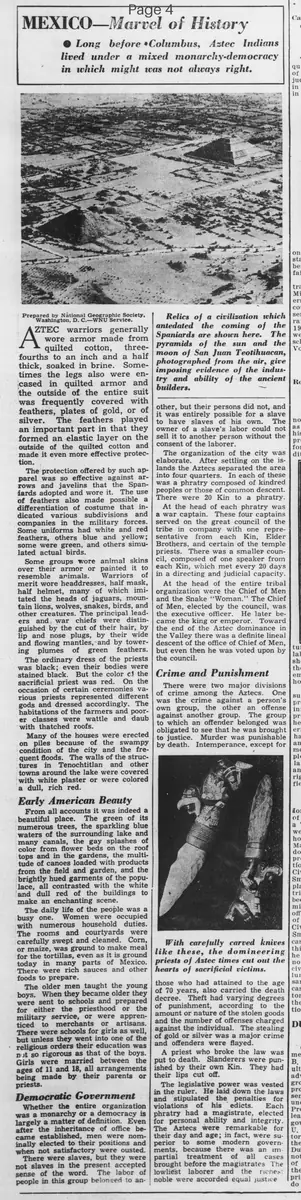
Merged-components note: Image is an illustration within the 'Mexico Marvel of History' story, spatial overlap.
Clipping
OCR Quality
88%
Good
Full Text
MEXICO Marvel of History
Long before Columbus, Aztec Indians lived under a mixed monarchy-democracy in which might was not always right.
Prepared by National Geographic Society, Washington, D.C.-WNU Service.
Aztec warriors generally wore armor made from a quilted cotton, three-fourths to an inch and a half thick, soaked in brine. Sometimes the legs also were encased in quilted armor and the outside of the entire suit was frequently covered with feathers, plates of gold, or of silver. The feathers played an important part in that they formed an elastic layer on the outside of the quilted cotton and made it even more effective protection.
The protection offered by such apparel was so effective against arrows and javelins that the Spaniards adopted and wore it. The use of feathers also made possible a differentiation of costume that indicated various subdivisions and companies in the military forces. Some uniforms had white and red feathers, others blue and yellow; some were green, and others simulated actual birds.
Some groups wore animal skins over their armor or painted it to resemble animals.
Warriors of merit wore headdresses, half mask, half helmet, many of which imitated the heads of jaguars, mountain lions, wolves, snakes, birds, and other creatures. The principal leaders and war chiefs were distinguished by the cut of their hair, by lip and nose plugs, by their wide and flowing mantles, and by towering plumes of green feathers.
The ordinary dress of the priests was black; even their bodies were stained black. But the color of the sacrificial priest was red. On the occasion of certain ceremonies various priests represented different gods and dressed accordingly.
The habitations of the farmers and poorer classes were wattle and daub with thatched roofs. Many of the houses were erected on piles because of the swampy condition of the city and the frequent floods. The walls of the structures in Tenochtitlan and other towns around the lake were covered with white plaster or were colored a dull, rich red.
Early American Beauty
From all accounts it was indeed a beautiful place. The green of its numerous trees, the sparkling blue waters of the surrounding lake and many canals, the gay splashes of color from flower beds on the roof tops and in the gardens, the multitude of canoes loaded with products from the field and garden, and the brightly hued garments of the populace, all contrasted with the white and dull red of the buildings to make an enchanting scene.
The daily life of the people was a busy one. Women were occupied with numerous household duties. The rooms and courtyards were carefully swept and cleaned. Corn, or maize, was ground to make meal for the tortillas, even as it is ground today in many parts of Mexico. There were rich sauces and other foods to prepare.
The older men taught the young boys. When they became older they were sent to schools and prepared for either the priesthood or the military service, or were apprenticed to merchants or artisans.
There were schools for girls as well, but unless they went into one of the religious orders their education was not so rigorous as that of the boys. Girls were married between the ages of 11 and 18, all arrangements being made by their parents or priests.
Democratic Government
Whether the entire organization was a monarchy or a democracy is largely a matter of definition. Even after the inheritance of office became established, men were nominally elected to their positions and when not satisfactory were ousted.
There were slaves, but they were not slaves in the present accepted sense of the word. The labor of people in this group belonged to another, but their persons did not, and it was entirely possible for a slave to have slaves of his own. The owner of a slave's labor could not sell it to another person without the consent of the laborer.
The organization of the city was elaborate. After settling on the islands the Aztecs separated the area into four quarters. In each of these was a phratry composed of kindred peoples or those of common descent. There were 20 KINS to a phratry. At the head of each phratry was a war captain. These four captains served on the great council of the tribe in company with one representative from each KIN, Elder Brothers, and certain of the temple priests. There was a smaller council, composed of one speaker from each KIN, which met every 20 days in a directing and judicial capacity.
At the head of the entire tribal organization were the Chief of Men and the Snake Woman. The Chief of Men, elected by the council, was the executive officer. He later became the king or emperor. Toward the end of the Aztec dominance in the Valley there was a definite lineal descent of the office of Chief of Men, but even then he was voted upon by the council.
Crime and Punishment
There were two major divisions of crime among the Aztecs. One was the crime against a person's own group, the other an offense against another group. The group to which an offender belonged was obligated to see that he was brought to justice. Murder was punishable by death. Intemperance, except for those who had attained to the age of 70 years, also carried the death decree. Theft had varying degrees of punishment, according to the amount or nature of the stolen goods and the number of offenses charged against the individual. The stealing of gold or silver was a major crime and offenders were flayed.
A priest who broke the law was put to death. Slanderers were punished by their own KIN. They had their lips cut off.
The legislative power was vested in the ruler. He laid down the laws and stipulated the penalties for violations of his edicts.
Each phratry had a magistrate, elected for personal ability and integrity. The Aztecs were remarkable for their day and age; in fact, were superior to some modern governments, because there was an impartial treatment of all cases brought before the magistrates. The lowliest laborer and the richest noble were accorded equal justice.
Long before Columbus, Aztec Indians lived under a mixed monarchy-democracy in which might was not always right.
Prepared by National Geographic Society, Washington, D.C.-WNU Service.
Aztec warriors generally wore armor made from a quilted cotton, three-fourths to an inch and a half thick, soaked in brine. Sometimes the legs also were encased in quilted armor and the outside of the entire suit was frequently covered with feathers, plates of gold, or of silver. The feathers played an important part in that they formed an elastic layer on the outside of the quilted cotton and made it even more effective protection.
The protection offered by such apparel was so effective against arrows and javelins that the Spaniards adopted and wore it. The use of feathers also made possible a differentiation of costume that indicated various subdivisions and companies in the military forces. Some uniforms had white and red feathers, others blue and yellow; some were green, and others simulated actual birds.
Some groups wore animal skins over their armor or painted it to resemble animals.
Warriors of merit wore headdresses, half mask, half helmet, many of which imitated the heads of jaguars, mountain lions, wolves, snakes, birds, and other creatures. The principal leaders and war chiefs were distinguished by the cut of their hair, by lip and nose plugs, by their wide and flowing mantles, and by towering plumes of green feathers.
The ordinary dress of the priests was black; even their bodies were stained black. But the color of the sacrificial priest was red. On the occasion of certain ceremonies various priests represented different gods and dressed accordingly.
The habitations of the farmers and poorer classes were wattle and daub with thatched roofs. Many of the houses were erected on piles because of the swampy condition of the city and the frequent floods. The walls of the structures in Tenochtitlan and other towns around the lake were covered with white plaster or were colored a dull, rich red.
Early American Beauty
From all accounts it was indeed a beautiful place. The green of its numerous trees, the sparkling blue waters of the surrounding lake and many canals, the gay splashes of color from flower beds on the roof tops and in the gardens, the multitude of canoes loaded with products from the field and garden, and the brightly hued garments of the populace, all contrasted with the white and dull red of the buildings to make an enchanting scene.
The daily life of the people was a busy one. Women were occupied with numerous household duties. The rooms and courtyards were carefully swept and cleaned. Corn, or maize, was ground to make meal for the tortillas, even as it is ground today in many parts of Mexico. There were rich sauces and other foods to prepare.
The older men taught the young boys. When they became older they were sent to schools and prepared for either the priesthood or the military service, or were apprenticed to merchants or artisans.
There were schools for girls as well, but unless they went into one of the religious orders their education was not so rigorous as that of the boys. Girls were married between the ages of 11 and 18, all arrangements being made by their parents or priests.
Democratic Government
Whether the entire organization was a monarchy or a democracy is largely a matter of definition. Even after the inheritance of office became established, men were nominally elected to their positions and when not satisfactory were ousted.
There were slaves, but they were not slaves in the present accepted sense of the word. The labor of people in this group belonged to another, but their persons did not, and it was entirely possible for a slave to have slaves of his own. The owner of a slave's labor could not sell it to another person without the consent of the laborer.
The organization of the city was elaborate. After settling on the islands the Aztecs separated the area into four quarters. In each of these was a phratry composed of kindred peoples or those of common descent. There were 20 KINS to a phratry. At the head of each phratry was a war captain. These four captains served on the great council of the tribe in company with one representative from each KIN, Elder Brothers, and certain of the temple priests. There was a smaller council, composed of one speaker from each KIN, which met every 20 days in a directing and judicial capacity.
At the head of the entire tribal organization were the Chief of Men and the Snake Woman. The Chief of Men, elected by the council, was the executive officer. He later became the king or emperor. Toward the end of the Aztec dominance in the Valley there was a definite lineal descent of the office of Chief of Men, but even then he was voted upon by the council.
Crime and Punishment
There were two major divisions of crime among the Aztecs. One was the crime against a person's own group, the other an offense against another group. The group to which an offender belonged was obligated to see that he was brought to justice. Murder was punishable by death. Intemperance, except for those who had attained to the age of 70 years, also carried the death decree. Theft had varying degrees of punishment, according to the amount or nature of the stolen goods and the number of offenses charged against the individual. The stealing of gold or silver was a major crime and offenders were flayed.
A priest who broke the law was put to death. Slanderers were punished by their own KIN. They had their lips cut off.
The legislative power was vested in the ruler. He laid down the laws and stipulated the penalties for violations of his edicts.
Each phratry had a magistrate, elected for personal ability and integrity. The Aztecs were remarkable for their day and age; in fact, were superior to some modern governments, because there was an impartial treatment of all cases brought before the magistrates. The lowliest laborer and the richest noble were accorded equal justice.
What sub-type of article is it?
Historical Event
Curiosity
What themes does it cover?
Social Manners
Justice
What keywords are associated?
Aztec Warriors
Armor Feathers
Daily Life
Government Structure
Crime Punishment
Tenochtitlan Society
Where did it happen?
Tenochtitlan And Other Towns Around The Lake
Story Details
Location
Tenochtitlan And Other Towns Around The Lake
Event Date
Long Before Columbus
Story Details
Description of Aztec warrior armor, priestly dress, housing, daily life, education, mixed monarchy-democracy government with councils and elected officials, unique slavery system, and impartial crime and punishment practices.