Thank you for visiting SNEWPapers!
Sign up free
Letter to Editor
January 13, 1764
The New Hampshire Gazette And Historical Chronicle
Portsmouth, Greenland, Rockingham County, New Hampshire
What is this article about?
A Boston correspondent criticizes the new, complex psalmody performed by gallery singers in churches, arguing it excludes the congregation and turns worship into amusement. Advocates for simple tunes like the Old Hundredth to enable unified praise.
Clipping
OCR Quality
98%
Excellent
Full Text
BOSTON, January 9.
To the PRINTERS.
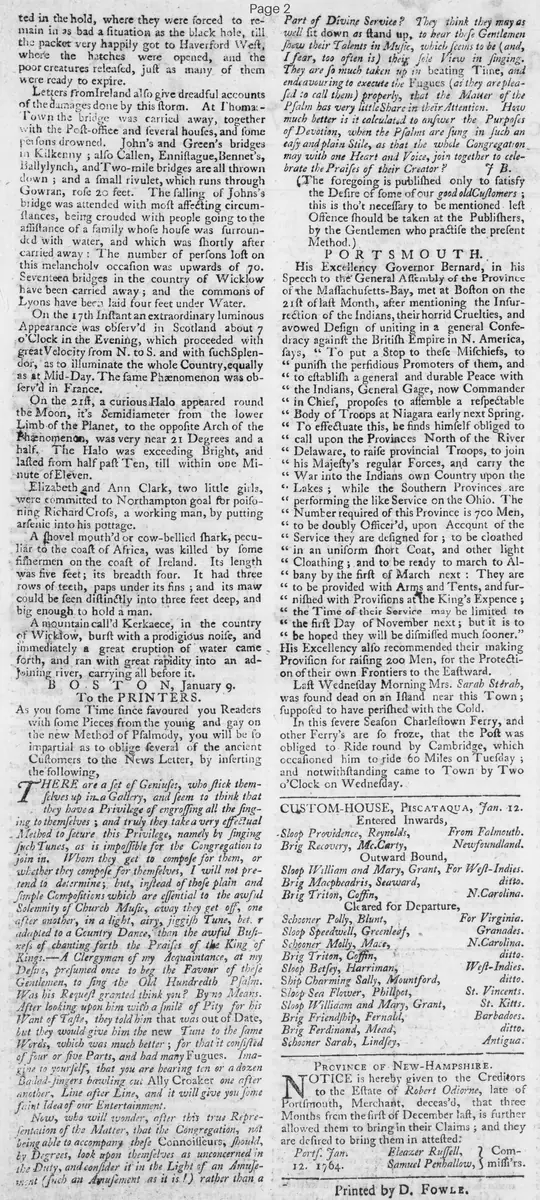
As you some time since favoured your readers with some pieces from the young and gay on the new method of psalmody, you will be so impartial as to oblige several of the ancient customers to the News Letter, by inserting the following.
There are a set of geniuses, who stick themselves up in a gallery, and seem to think that they have a privilege of engrossing all the singing to themselves; and truly they take a very effectual method to secure this privilege, namely by singing such tunes, as is impossible for the congregation to join in. Whom they get to compose for them, or whether they compose for themselves, I will not pretend to determine; but, instead of those plain and simple compositions which are essential to the awful solemnity of church music, away they get off, one after another, in a light, airy, jiggish tune, better adapted to a country dance, than the awful business of chanting forth the praises of the King of Kings. A clergyman of my acquaintance, at my desire, presumed once to beg the favour of these gentlemen, to sing the Old Hundredth Psalm. Was his request granted think you? By no means. After looking upon him with a smile of pity for his want of taste, they told him that was out of date, but they would give him the new tune to the same words, which was much better; for that it consisted of four or five parts, and had many fugues. Imagine to yourself, that you are hearing ten or a dozen ballad-singers bawling out Ally Croaker one after another, line after line, and it will give you some faint idea of our entertainment.
Now, who will wonder, after this true representation of the matter, that the congregation, not being able to accompany these connoisseurs, should, by degrees, look upon themselves as unconcerned in the duty, and consider it in the light of an amusement (such an amusement as it is!) rather than a part of divine service? They think they may as well sit down as stand up, to hear these gentlemen show their talents in music, which seems to be (and, I fear, too often is) their sole view in singing. They are so much taken up in beating time, and endeavouring to execute the fugues (as they are pleased to call them) properly, that the matter of the psalm has very little share in their attention. How much better is it calculated to answer the purposes of devotion, when the psalms are sung in such an easy and plain style, as that the whole congregation may with one heart and voice, join together to celebrate the praises of their Creator?
F. B.
(The foregoing is published only to satisfy the desire of some of our good old customers; this is thought necessary to be mentioned, lest offence should be taken at the publishers, by the gentlemen who practice the present method.)
To the PRINTERS.
As you some time since favoured your readers with some pieces from the young and gay on the new method of psalmody, you will be so impartial as to oblige several of the ancient customers to the News Letter, by inserting the following.
There are a set of geniuses, who stick themselves up in a gallery, and seem to think that they have a privilege of engrossing all the singing to themselves; and truly they take a very effectual method to secure this privilege, namely by singing such tunes, as is impossible for the congregation to join in. Whom they get to compose for them, or whether they compose for themselves, I will not pretend to determine; but, instead of those plain and simple compositions which are essential to the awful solemnity of church music, away they get off, one after another, in a light, airy, jiggish tune, better adapted to a country dance, than the awful business of chanting forth the praises of the King of Kings. A clergyman of my acquaintance, at my desire, presumed once to beg the favour of these gentlemen, to sing the Old Hundredth Psalm. Was his request granted think you? By no means. After looking upon him with a smile of pity for his want of taste, they told him that was out of date, but they would give him the new tune to the same words, which was much better; for that it consisted of four or five parts, and had many fugues. Imagine to yourself, that you are hearing ten or a dozen ballad-singers bawling out Ally Croaker one after another, line after line, and it will give you some faint idea of our entertainment.
Now, who will wonder, after this true representation of the matter, that the congregation, not being able to accompany these connoisseurs, should, by degrees, look upon themselves as unconcerned in the duty, and consider it in the light of an amusement (such an amusement as it is!) rather than a part of divine service? They think they may as well sit down as stand up, to hear these gentlemen show their talents in music, which seems to be (and, I fear, too often is) their sole view in singing. They are so much taken up in beating time, and endeavouring to execute the fugues (as they are pleased to call them) properly, that the matter of the psalm has very little share in their attention. How much better is it calculated to answer the purposes of devotion, when the psalms are sung in such an easy and plain style, as that the whole congregation may with one heart and voice, join together to celebrate the praises of their Creator?
F. B.
(The foregoing is published only to satisfy the desire of some of our good old customers; this is thought necessary to be mentioned, lest offence should be taken at the publishers, by the gentlemen who practice the present method.)
What sub-type of article is it?
Persuasive
Social Critique
Religious
What themes does it cover?
Religion
Social Issues
What keywords are associated?
Psalmody
Church Music
Congregation Singing
Old Hundredth
Fugues
Divine Service
What entities or persons were involved?
F. B.
To The Printers.
Letter to Editor Details
Author
F. B.
Recipient
To The Printers.
Main Argument
the new method of psalmody, with complex tunes and fugues, prevents the congregation from participating in worship and turns it into mere entertainment; simple, plain compositions are essential for unified devotion.
Notable Details
References Old Hundredth Psalm
Compares New Tunes To Country Dances And Ballad Singers Bawling 'Ally Croaker'
Publisher's Note To Avoid Offense