Thank you for visiting SNEWPapers!
Sign up free
Editorial
October 6, 1859
White Cloud Kansas Chief
White Cloud, Doniphan County, Kansas
What is this article about?
This editorial reprints and supports Schuyler Colfax's argument that Republicans must unite with anti-slavery opposition forces to ensure victory in the 1860 presidential election, prioritizing success as a duty without compromising core principles against slavery extension.
Clipping
OCR Quality
88%
Good
Full Text
Is Success a Duty
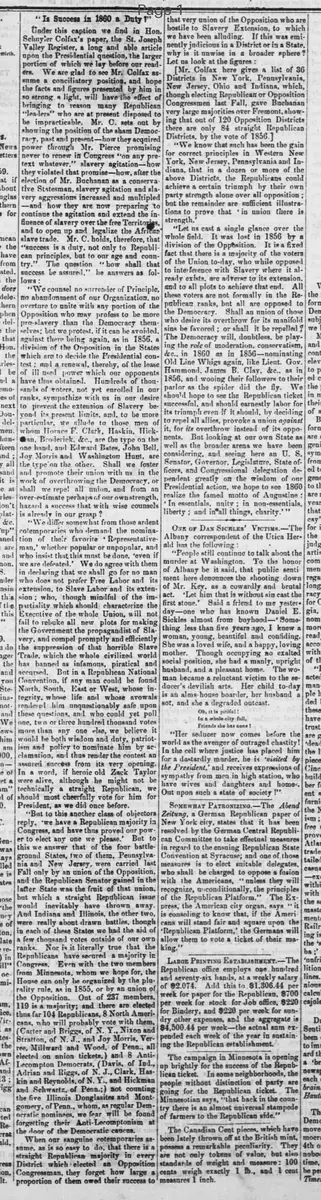
Under this caption we find in Hon. Schuyler Colfax's paper, the St. Joseph Valley Register, a long and able article upon the Presidential question, the larger portion of which we lay before our readers. We are glad to see Mr. Colfax assume a conciliatory position, and hope the acts and figures presented by him in so strong a light, will have the effect of bringing to reason many Republican "leaders" who are at present disposed to be impracticable. Mr. C. sets out by showing the position of the sham Democracy, past and present—how they acquired power through Mr. Pierce promising never to renew in Congress "on any pretext whatever." slavery agitation—how they violated that promise—how, after the election of Mr. Buchanan as a conservative Statesman, slavery agitation and slavery aggressions increased and multiplied—and how they are now preparing to continue the agitation and extend the influence of slavery over the free Territories, and to open up and legalize the African slave trade. Mr. C. holds, therefore, that "success is a duty, not only to Republican principles, but to our age and country."
The question "how shall that success be assured." he answers as follows:
"We counsel no surrender of Principle, no abandonment of our Organization, no overture to unite with any portion of the Opposition who may profess to be more pro-slavery than the Democracy themselves; but we protest, if it can be avoided, against there being again, as in 1856, a division of the Opposition in the States which are to decide the Presidential contest: and a renewal, thereby, of the lease of ill used power which our opponents have thus obtained. Hundreds of thousands of voters, not yet enrolled in our ranks, sympathize with us in our desire to prevent the extension of Slavery beyond its present limits. and, to be more particular, we allude to those men of whom Horace . Clark. Haskin. Hickman. Broderick. &c., are the type on the one hand. and Edward Bates. John Bell. Gov Morris and Washington Hunt, are the type on the other. Shall we foster and promote their union with us in the work of overthrowing the Democracy, or shall we repel all union. and from an over-estimate perhaps of our own strength hazard a success that with wise counsels is already in our grasp?
"We differ somewhat from those ardent contemporaries who demand the nomination of their favorite Representative-man.' whether popular or unpopular, and who insist that this must be done. 'even if we are defeated.' We do agree with them in declaring that we shall go for no man who does not prefer Free Labor and its extension. to Slave Labor and its extension; who, though mindful of the impartiality which should characterize the Executive of the whole Union. will not fail to rebuke all new plots for making the Government the propagandist of Slavery, and compel promptly and efficiently the suppression of that horrible Slave Trade, which the whole civilized world has. banned as infamous. piratical and accursed. But in a Republican National Convention. if any man could be found North, South, East or West. whose integrity. whose life and whose avowals rendered: him unquestionably safe upon these questions, and who could yet poll one, two or three hundred thousand votes more than any one else, we believe it would be both wisdom and duty. patriotism and policy to nominate him by acclamation, and thus render the contest an assured success from its very opening.
In a word, if heroic old Zack Taylor were alive, although he might not be technically a straight Republican, we should most cheerfully vote for him for President, as we did once before.
"But to this another class of objectors reply.' we have a Republican majority in Congress, and have thus proved our power to elect any one we please.' But to this we answer that of the four battle-ground States, two of them, Pennsylvania and New Jersey, were carried last Fall only by an union of the Opposition, and the Republican Senator gained in the latter State was the fruit of that union, but which a straight Republican issue would inevitably have thrown away. And Indiana and Illinois, the other two, were really about drawn battles, though in each of these States we had the aid of a few thousand votes outside of our own ranks. Nor is it literally true that the Republicans have secured a majority in Congress. Even with the two members from Minnesota, whom we hope for, the House can only be organized by the plurality rule, as in 1855. or by an union of the Opposition. Out of 237 members. 119 is a majority; and there are elected thus far 104 Republicans, 8 North Americans, who will probably vote with them, (Carter and Briggs. of N. Y.. Nixon and Stratton. of N. J.. and Joy Morris, Verree, Millward and Wood, of Penn., all elected on union tickets. and 8 Anti-Lecompton Democrats. (Davis, of Ind., Adrian and Riggs, of N. J., Clark, Haskin and Reynolds, of N. Y., and Hickman and Schwartz, of Penn.;) not counting the five Illinois Douglasites and Montgomery, of Penn., whom, as regular Democratic nominees, we fear will be found forgetting their Anti-Lecomptonism at the door of the Democratic caucus.
When our sanguine contemporaries assume, as is so easy to do, that there is a straight Republican majority in every District which elected an Opposition Congressman, they forget how large a proportion of them owed their success to that very union of the Opposition who are hostile to Slavery Extension, to which we have been alluding. If this was eminently judicious in a District or in a State. why is it unwise in a broader sphere? Let us look at the figures:
[Mr. Colfax here gives a list of 36 Districts in New York, Pennsylvania, New Jersey. Ohio and Indiana, which, though electing Republican or Opposition Congressmen last Fall, gave Buchanan very large majorities over Fremont, showing that out of 120 Opposition Districts there are only 84 straight Republican Districts, by the vote of 1856.]
"We know that such has been the gain for correct principles in Western New York, New Jersey, Pennsylvania and Indiana, that in a dozen or more of the above Districts, the Republicans could achieve a certain triumph by their own party strength alone over all opposition; but the remainder are sufficient illustrations to prove that 'in union there is strength.'
"Let us cast a single glance over the whole field. It was lost in 1856 by a division of the Opposition. It is a fixed fact that there is a majority of the voters of the Union to-day. who while opposed to interference with Slavery where it already exists, are adverse to its extension. bad to all plots to achieve that end. All these voters are not formally in the Republican ranks, but all are opposed to the Democracy. Shall an union of those who desire its overthrow for its manifold sins be favored; or shall it be repelled? The Democracy will, doubtless, be playing the role of moderation. conservatism, &c., in 1860 as in 1856—nominating Old Line Whigs again. like Lieut. Gov. Hammond, James B. Clay. &c.. as in 1856, and wooing their followers to their parlor as the spider did the fly. We should hope to see the Republican ticket successful, and should earnestly labor for its triumph even if it should, by deciding to repel all allies, provoke a union against it, for its overthrow instead of its opponents. But looking at our own State as well as the broader arena we have been considering. and seeing here an U. S. Senator, Governor, Legislature, State officers, and Congressional delegation dependent greatly on the wisdom of our Presidential action, we hope to see 1860 realize the famed motto of Augustine: 'In essentials, unity; in non-essentials, liberty; and in all things, charity.'
Under this caption we find in Hon. Schuyler Colfax's paper, the St. Joseph Valley Register, a long and able article upon the Presidential question, the larger portion of which we lay before our readers. We are glad to see Mr. Colfax assume a conciliatory position, and hope the acts and figures presented by him in so strong a light, will have the effect of bringing to reason many Republican "leaders" who are at present disposed to be impracticable. Mr. C. sets out by showing the position of the sham Democracy, past and present—how they acquired power through Mr. Pierce promising never to renew in Congress "on any pretext whatever." slavery agitation—how they violated that promise—how, after the election of Mr. Buchanan as a conservative Statesman, slavery agitation and slavery aggressions increased and multiplied—and how they are now preparing to continue the agitation and extend the influence of slavery over the free Territories, and to open up and legalize the African slave trade. Mr. C. holds, therefore, that "success is a duty, not only to Republican principles, but to our age and country."
The question "how shall that success be assured." he answers as follows:
"We counsel no surrender of Principle, no abandonment of our Organization, no overture to unite with any portion of the Opposition who may profess to be more pro-slavery than the Democracy themselves; but we protest, if it can be avoided, against there being again, as in 1856, a division of the Opposition in the States which are to decide the Presidential contest: and a renewal, thereby, of the lease of ill used power which our opponents have thus obtained. Hundreds of thousands of voters, not yet enrolled in our ranks, sympathize with us in our desire to prevent the extension of Slavery beyond its present limits. and, to be more particular, we allude to those men of whom Horace . Clark. Haskin. Hickman. Broderick. &c., are the type on the one hand. and Edward Bates. John Bell. Gov Morris and Washington Hunt, are the type on the other. Shall we foster and promote their union with us in the work of overthrowing the Democracy, or shall we repel all union. and from an over-estimate perhaps of our own strength hazard a success that with wise counsels is already in our grasp?
"We differ somewhat from those ardent contemporaries who demand the nomination of their favorite Representative-man.' whether popular or unpopular, and who insist that this must be done. 'even if we are defeated.' We do agree with them in declaring that we shall go for no man who does not prefer Free Labor and its extension. to Slave Labor and its extension; who, though mindful of the impartiality which should characterize the Executive of the whole Union. will not fail to rebuke all new plots for making the Government the propagandist of Slavery, and compel promptly and efficiently the suppression of that horrible Slave Trade, which the whole civilized world has. banned as infamous. piratical and accursed. But in a Republican National Convention. if any man could be found North, South, East or West. whose integrity. whose life and whose avowals rendered: him unquestionably safe upon these questions, and who could yet poll one, two or three hundred thousand votes more than any one else, we believe it would be both wisdom and duty. patriotism and policy to nominate him by acclamation, and thus render the contest an assured success from its very opening.
In a word, if heroic old Zack Taylor were alive, although he might not be technically a straight Republican, we should most cheerfully vote for him for President, as we did once before.
"But to this another class of objectors reply.' we have a Republican majority in Congress, and have thus proved our power to elect any one we please.' But to this we answer that of the four battle-ground States, two of them, Pennsylvania and New Jersey, were carried last Fall only by an union of the Opposition, and the Republican Senator gained in the latter State was the fruit of that union, but which a straight Republican issue would inevitably have thrown away. And Indiana and Illinois, the other two, were really about drawn battles, though in each of these States we had the aid of a few thousand votes outside of our own ranks. Nor is it literally true that the Republicans have secured a majority in Congress. Even with the two members from Minnesota, whom we hope for, the House can only be organized by the plurality rule, as in 1855. or by an union of the Opposition. Out of 237 members. 119 is a majority; and there are elected thus far 104 Republicans, 8 North Americans, who will probably vote with them, (Carter and Briggs. of N. Y.. Nixon and Stratton. of N. J.. and Joy Morris, Verree, Millward and Wood, of Penn., all elected on union tickets. and 8 Anti-Lecompton Democrats. (Davis, of Ind., Adrian and Riggs, of N. J., Clark, Haskin and Reynolds, of N. Y., and Hickman and Schwartz, of Penn.;) not counting the five Illinois Douglasites and Montgomery, of Penn., whom, as regular Democratic nominees, we fear will be found forgetting their Anti-Lecomptonism at the door of the Democratic caucus.
When our sanguine contemporaries assume, as is so easy to do, that there is a straight Republican majority in every District which elected an Opposition Congressman, they forget how large a proportion of them owed their success to that very union of the Opposition who are hostile to Slavery Extension, to which we have been alluding. If this was eminently judicious in a District or in a State. why is it unwise in a broader sphere? Let us look at the figures:
[Mr. Colfax here gives a list of 36 Districts in New York, Pennsylvania, New Jersey. Ohio and Indiana, which, though electing Republican or Opposition Congressmen last Fall, gave Buchanan very large majorities over Fremont, showing that out of 120 Opposition Districts there are only 84 straight Republican Districts, by the vote of 1856.]
"We know that such has been the gain for correct principles in Western New York, New Jersey, Pennsylvania and Indiana, that in a dozen or more of the above Districts, the Republicans could achieve a certain triumph by their own party strength alone over all opposition; but the remainder are sufficient illustrations to prove that 'in union there is strength.'
"Let us cast a single glance over the whole field. It was lost in 1856 by a division of the Opposition. It is a fixed fact that there is a majority of the voters of the Union to-day. who while opposed to interference with Slavery where it already exists, are adverse to its extension. bad to all plots to achieve that end. All these voters are not formally in the Republican ranks, but all are opposed to the Democracy. Shall an union of those who desire its overthrow for its manifold sins be favored; or shall it be repelled? The Democracy will, doubtless, be playing the role of moderation. conservatism, &c., in 1860 as in 1856—nominating Old Line Whigs again. like Lieut. Gov. Hammond, James B. Clay. &c.. as in 1856, and wooing their followers to their parlor as the spider did the fly. We should hope to see the Republican ticket successful, and should earnestly labor for its triumph even if it should, by deciding to repel all allies, provoke a union against it, for its overthrow instead of its opponents. But looking at our own State as well as the broader arena we have been considering. and seeing here an U. S. Senator, Governor, Legislature, State officers, and Congressional delegation dependent greatly on the wisdom of our Presidential action, we hope to see 1860 realize the famed motto of Augustine: 'In essentials, unity; in non-essentials, liberty; and in all things, charity.'
What sub-type of article is it?
Partisan Politics
Slavery Abolition
What keywords are associated?
Republican Unity
Presidential Election 1860
Slavery Extension Opposition
Schuyler Colfax
Free Labor
Slave Trade Suppression
Opposition Alliance
Democratic Power Overthrow
What entities or persons were involved?
Schuyler Colfax
Franklin Pierce
James Buchanan
Horace Clark
Haskin
Hickman
Broderick
Edward Bates
John Bell
Gov Morris
Washington Hunt
Zack Taylor
Buchanan Democracy
Editorial Details
Primary Topic
Republican Strategy For Ensuring Success In The 1860 Presidential Election Through Unity Against Slavery Extension
Stance / Tone
Conciliatory Urging Of Principled Unity For Electoral Success
Key Figures
Schuyler Colfax
Franklin Pierce
James Buchanan
Horace Clark
Haskin
Hickman
Broderick
Edward Bates
John Bell
Gov Morris
Washington Hunt
Zack Taylor
Buchanan Democracy
Key Arguments
Success Is A Duty To Republican Principles And The Country
Avoid Division Of Opposition As In 1856 To Prevent Renewing Democratic Power
Unite With Anti Slavery Sympathizers Not Yet In Republican Ranks
Nominate A Candidate Safe On Slavery Issues Who Can Maximize Votes
Congressional Majority Relies On Opposition Unions, Not Straight Republican Strength Alone
Figures From Key Districts Show Need For Union To Overcome Buchanan Majorities
Majority Of Voters Oppose Slavery Extension; Unite To Overthrow Democracy
Even Nominate Non Technical Republican Like Zack Taylor If He Ensures Victory
Democratic Moderation In 1860 Will Woo Opponents; Republicans Must Not Repel Allies