Thank you for visiting SNEWPapers!
Sign up free
Literary
November 11, 1881
The State Rights Democrat
Albany, Linn County, Oregon
What is this article about?
In 1488, during a rebellion against King James III of Scotland, miller Gawain Beaton and his wife Mysie shelter a wounded knight at their mill on the Bannock River, unaware he is the king. Rebels arrive disguised as aid and assassinate him, hiding the body.
Clipping
OCR Quality
98%
Excellent
Full Text
Selected Story:
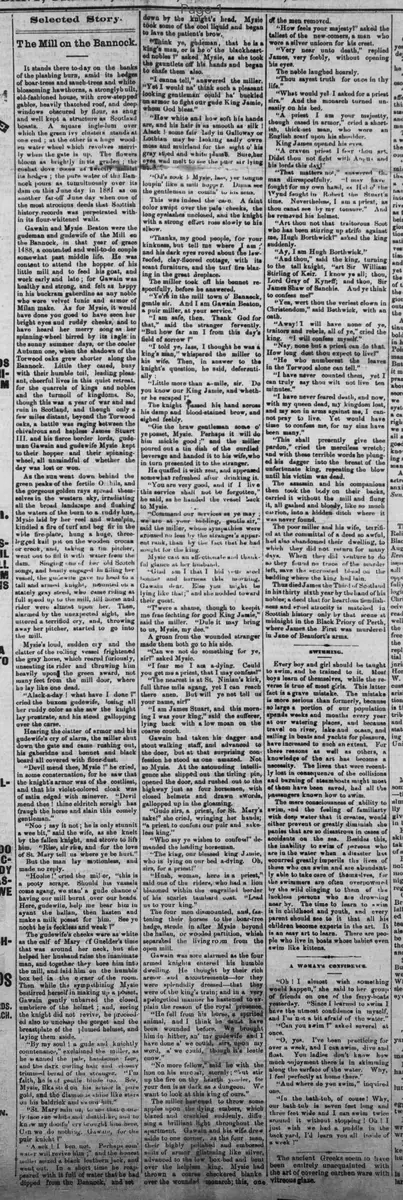
The Mill on the Bannock
It stands there to-day on the banks
of the plashing burn, amid its hedges
of bower-trees and sauch-trees and white
blossoming hawthorns, a strongly built,
old-fashioned house, with crow-stepped
gables, heavily thatched roof, and deep
windows obscured by flour, as snug
and well kept a structure as Scotland
boasts. A square ingle-lum over
which the green ivy clusters stands at
one end; at the other is a huge wooden
water wheel which revolves merri-
ly when the gate is up. The flowers
bloom as brightly in its garden; the
cushat dove coos as sweetly amidst
its hedges; the pure water of the Ban-
nock pours as tumultuously over its
dam on this June day in 1881 as on
another far-off June day when one of
the most atrocious deeds that Scottish
history records was perpetrated with-
in its flour-whitened walls.
Gawain and Mysie Beaton were the
gudeman and gudewife of the Mill on
the Bannock, in that year of grace
1488, a contented and well-to-do couple
somewhat past middle life. He was
content to attend the hopper of his
little mill and to feed his goats, and
work early and late; for Gawain was
healthy and strong, and felt as happy
in his buckram gaberdine as any noble
who wore velvet tunic and armor of
Milan make. As for Mysie, it would
have done you good to have seen her
bright eyes and ruddy cheeks, and to
have heard her merry song as her
spinning-wheel whirred by its ingle in
the sunny summer days, or the cooler
Autumn ones, when the shadows of the
Torwood oaks grew shorter along the
Bannock. Little they cared, busy
with their humble toil, leading pleas-
ant, cheerful lives in this quiet retreat.
for the quarrels of kings and nobles
and the turmoil of kingdoms. So,
though this was a year of war and sad
ruin in Scotland, and though only a
few miles distant, beyond the Torwood
oaks, a battle was raging between the
chivalrous and hapless James Stuart
III. and his fierce border lords, gude-
man Gawain and gudewife Mysie kept
to their hopper and their spinning
wheel, all unmindful of whether the
day was lost or won.
As the sun went down behind the
green peaks of the fertile Ochils, and
the gorgeous golden rays spread them-
themselves in the western sky, irradiating
all the broad landscape and flushing
the waters of the burn to a ruddy hue,
Mysie laid by her reel and wheel, kin-
dled a fire of turf and bog fir in the
wide fire-place, hung a huge, three-
legged kail pot on the wooden crook
or crook, and, taking a tin pitcher,
went out to fill it with water from the
dam. Singing one of her old Scotch
songs, and busily engaged in filling her
vessel, the gudewife gave no heed to a
tall and armed knight, mounted on a
stately gray steed, who came riding at
full speed up to the mill, till horse and
rider were almost upon her. Then,
alarmed by the unexpected sight, she
uttered a terrified cry, and, throwing
away her pitcher, started to go into
the mill.
Mysie's loud, sudden cry and the
clatter of the rolling vessel frightened
the gray horse, which reared furiously,
unseating its rider and throwing him
heavily upon the green sward, not
many feet from the mill door, where
he lay like one dead.
"Alack-a-day! what have I done?"
cried the buxom gudewife, losing all
her ruddy color as she saw the knight
lie prostrate, and his steed galloping
over the carse.
Hearing the clatter of armor and his
gudewife's cry of alarm, the miller shut
down the gate and came rushing out,
his gaberdine and bonnet and black
beard all covered with flour-dust.
"Devil mend thee, Mysie!" he cried,
in some consternation, for he saw that
the knight's armor was of the costliest,
and that his violet-colored cloak was
of satin edged with miniver. "Devil
mend thee! thine eldritch scraigh has
fraught the horse and slain this comely
gentleman."
"Noo; say it not; he is only stunned
a wee bit," said the wife, as she knelt
by the fallen knight, and strove to lift
him. "Rise, sir knight, and for the love
of St. Mary tell us where ye be hurt."
But the man lay motionless, and
made no reply.
"Hoolie!" cried the miller, "this is
a pretty scrape. Should his vassals
come again, we stand a good chance
of having our mill burnt over our heads.
Here, gudewife, help me bear him in
beyond the hallan, then hasten and
make a milk posset for him. See ye
nocht he is feckless and weak!"
The gudewife's cheeks were as white
as the calf of Mary of Gueldres' time
that was around her neck, but she
helped her husband raise the inanimate
man, and together they bore him into
the mill, and laid him on the humble
box bed in the corner of the room.
Then while the sympathizing Mysie
bestirred herself in making up a posset,
Gawain gently unbarred the closed
umbriere of the helmet; and, seeing
the knight did not revive, he proceed-
ed also to un clasp the gorget and the
breastplate of the plumed helmet, and
laying them aside.
"By my soul! gude and knightly
countenance," exclaimed the miller, as
he scanned the pale, handsome face,
and the dark curling hair and closely
trimmed beard of the stranger. "I'm
in faith, he is of gentle blood too. See,
Mysie, ilka stud on his armor is pure
gold, and the diamond shines like stars
on his baldrick and sword hilt."
"St. Mary sain us, my se he is sae white and deathlike, and to
know my doeful cry brought him here.
Can we do nothing, Gawain, for the
puir knight?"
"Alack! I ken not. Perhaps some
water will revive him;" and the honest
miller seized a black leathern jack, and
went out. In a short time he reappeared with it full of water that he had
dipped from the Bannock, and set
down by the knight's head. Mysie
took some of the cool liquid and began
to lave the patient's brow.
"Think ye, gudeman, that he is a
king's man, or is he o' the blackheart-
ed nobles?" asked Mysie, as she took
the gauntlets off his hands and began
to chafe them also.
"I canna tell." answered the miller.
"Yet I would na' think such a pleasant
looking gentleman could ha' buckled
on armor to fight our gude King Jamie,
whom God bless."
"How white and how soft his hands
are, and his hair is as smooth as silk!
Alack! some fair lady in Galloway or
Lothian may be looking sadly owre
moss and muirland for the sight o' his
gray steed and white plume. Sure, her
eyes wad melt to see the puir sir lying
hard."
"Od's zooks, Mysie, lass, your tongue
loupin' like a mill hopper. Dima fash
the gentleman is comin' to his senses."
This was indeed the case. A faint
color swept over the pale cheeks, the
long eyelashes unclosed, and the knight
with a strong effort rose slowly to his
elbow.
"Thanks, my good people, for your
kindness, but tell me where I am;
and his dark eyes roved about the low.
roofed, clay-floored cottage, with its
scant furniture, and the turf fire blazing in the great fireplace.
The miller took off his bonnet re-
spectfully, before he answered.
"Ye're in the mill town o' Bannock,
gentle sir. And I am Gawain Beaton,
a puir miller, at your service."
"I am safe, then. Thank God for
that," said the stranger fervently.
"But how far am I from this day's
field of sorrow?"
"I told ye, lass, I thought he was a
king's man." whispered the miller to
his wife. Then, in answer to the
knight's question, he said, deferentially:
"Little more than a mile, sir. Do
you know our King Jamie, and whether he escaped?"
The knight passed his hand across
his damp and blood-stained brow, and
sighed feebly.
"Gie the braw gentleman some o'
ye posset, Mysie. Perhaps it will do
him mickle good;" and the miller
poured out a tin dish of the curdled
beverage and handed it to his wife, who
in turn presented it to the stranger.
He quaffed it with zest, and appeared
somewhat refreshed after drinking it.
"You are very good, and if I live
this service shall not be forgotten,"
he said, as he handed the vessel back
to Mysie.
"Command our services as ye may;
we are at your bidding, gentle sir,"
said the miller, whose sympathies were
aroused no less by the stranger's apparent rank, than by the fact that he had
sought for the king.
Mysie cast an affectionate and thankful glance at her husband.
"Glad am I that I hid ye put on steel
and harness this morning.
Gawain dear. Else you might be
lying like that;" and she nodded toward their guest.
"'T were a shame, though to keep it
me frae fechtin for good King Jamie,"
said the miller. "Dule it may bring
to us, Mysie, my dear."
A groan from the wounded stranger
made them both go to his side.
"Can we not do something for ye,
sir?" asked Mysie.
"I fear me I am a-dying. Could
you get me a priest, that I may confess?"
"The nearest is at St. Ninian's kirk,
full three mile awa, yet I can reach
there soon. But will ye not tell us
your name, sir?"
"I am James Stuart, and this morning I was your king," said the sufferer,
lying back with a low moan on the
coarse couch.
Gawain had taken his dagger and
stout walking staff, and advanced to
the door, but at that surprising con-
fession he stood as one awed. Not
so Mysie. At the astounding intelli-
gence she slipped out the tirling pin,
opened the door, and rushed out to the
highway just as four horsemen, with
closed helmets and drawn swords,
galloped up in the gloaming.
"Gude sirs, a priest, for St. Mary's
sake!" she cried, wringing her hands;
"a priest to confess our puir and sake-
less king.
"Who say ye wishes to confess?" de-
manded the leading horseman.
"The king, our blessed king Jamie
who is lying on our bed a-dying. Oh,
sirs, for a priest!"
"Hush, woman, here is a priest,"
said one of the riders, who had a lion
blazoned within the engrailed border
of his scarlet emblazoned coat. "Lead
us to your king."
The four men dismounted, and, fastening their horses to the bower-tree
hedge, strode in after Mysie beyond
the hallan, or wooden partition, which
separated the living room from the
open mill.
Gawain was sore alarmed as the four
armed knights entered his humble
dwelling. He thought by their rich
armor and accoutrements—for they
were splendidly dressed—that they
were of the king's train; and in a very
apologetical manner he hastened to ex-
plain the reason of the royal presence.
"He fell from his horse, a spirited
animal, and I think he must have
been wounded before. We brought
him in hither, an' my gudewife and I
have done a' we could, sirs, upon my
word, a' we could, though its leetle
enow."
"No more, fellow," said he with the
lion on his surcoat, sternly; "but stir
up the fire on thy hearth yonder, for
your den is as dark as a dungeon. We
want to look at this king of ours."
The miller hastened to throw some
apples upon the dying embers, which
blazed and crackled suddenly, diffusing a brilliant light throughout the
apartment. Gawain and his wife drew
aside to one corner, as the four men,
their highly polished and embossed
suits of armor glistening like silver,
advanced to the low box-bed and bent
over the helpless king. Mysie had
thrown a coarse checkered blanket
over the wounded monarch; this, one
Of the men removed.
"How feels your majesty?" asked the
tallest of the new-comers, a man who
wore a silver unicorn for his crest.
"Very near unto death," replied
James, very feebly, without opening
his eyes.
The noble laughed hoarsely.
"Thou sayest truth for once in thy
life."
"What would ye! I asked for a priest
sirs." And the monarch turned un-
easily on his bed.
"A priest I am your majesty,
though cased in armor," cried a short-
ish, thick-set man, who wore
an
English scarf upon his shoulder.
King James opened his eyes.
"A craven priest I fear thou art.
Didst thou not fight with Angus and
his lords this day?
"That matters not," answered the
man disrespectfully. "I may have
fought for my own hand, an' Hal o' the
Wynd fought in Robert the Stuart's
time. Nevertheless, I am a priest, as
thou canst see by my tonsure."
And
he removed his helmet.
"Art thou not that traitorous Scot
who has been stirring up strife against
me, Hugh Borthwick?" asked the king
suddenly.
"Ay, I am Hugh Borthwick."
"And thou," said the king, turning
to the tall knight, "art Sir William
Stirling of Keir. I know ye all; thou,
Lord Gray of Kyneff; and thou, Sir
James Shaw of Sauchie. And ye think
to confess me?"
"Yea, wert thou the veriest clown in
Christendom," said Borthwick, with an
oath.
"Away! I will have none of ye,
traitors and rebels, all of ye," cried the
king. "I will confess myself."
"Nay, none but a priest can do that.
How long dost thou expect to live?"
"He who numberest the leaves
in the Torwood alone can tell."
"I have never counted them, yet I
can truly say thou wilt not live ten
minutes."
"I have never feared death, and now,
with my queen dead, my kingdom lost,
and my son in arms against me, I can-
not pray to live. Yet would I have
time to confess me, for my sins have
been many."
"This shall presently give thee
pardon," cried the merciless wretch;
and with these terrible words he plunged his dagger into the breast of the
unfortunate king, repeating the blow
until his victim was dead.
The assassin and his companions
then took the body on their backs,
carried it without the mill and flung
it, all gashed and bloody, like so much
carrion, into a hidden ditch where it
was never found.
The poor miller and his wife, terrified at the committal of a deed so awful,
had also abandoned their dwelling, to
which they did not return for many
days. When they did venture to do
so they found no trace of the murder
left, save the encrusted blood on the
bedding where the king had lain.
Thus died James the Third of Scotland in his thirty-sixth year by the hand of his
nobles; a deed that for heartless fiendish-
ness and cruel atrocity is matched in
Scottish history only by that scene at
midnight in the Black Friary of Perth,
where James the First was murdered
in Jane of Beaufort's arms.
The Mill on the Bannock
It stands there to-day on the banks
of the plashing burn, amid its hedges
of bower-trees and sauch-trees and white
blossoming hawthorns, a strongly built,
old-fashioned house, with crow-stepped
gables, heavily thatched roof, and deep
windows obscured by flour, as snug
and well kept a structure as Scotland
boasts. A square ingle-lum over
which the green ivy clusters stands at
one end; at the other is a huge wooden
water wheel which revolves merri-
ly when the gate is up. The flowers
bloom as brightly in its garden; the
cushat dove coos as sweetly amidst
its hedges; the pure water of the Ban-
nock pours as tumultuously over its
dam on this June day in 1881 as on
another far-off June day when one of
the most atrocious deeds that Scottish
history records was perpetrated with-
in its flour-whitened walls.
Gawain and Mysie Beaton were the
gudeman and gudewife of the Mill on
the Bannock, in that year of grace
1488, a contented and well-to-do couple
somewhat past middle life. He was
content to attend the hopper of his
little mill and to feed his goats, and
work early and late; for Gawain was
healthy and strong, and felt as happy
in his buckram gaberdine as any noble
who wore velvet tunic and armor of
Milan make. As for Mysie, it would
have done you good to have seen her
bright eyes and ruddy cheeks, and to
have heard her merry song as her
spinning-wheel whirred by its ingle in
the sunny summer days, or the cooler
Autumn ones, when the shadows of the
Torwood oaks grew shorter along the
Bannock. Little they cared, busy
with their humble toil, leading pleas-
ant, cheerful lives in this quiet retreat.
for the quarrels of kings and nobles
and the turmoil of kingdoms. So,
though this was a year of war and sad
ruin in Scotland, and though only a
few miles distant, beyond the Torwood
oaks, a battle was raging between the
chivalrous and hapless James Stuart
III. and his fierce border lords, gude-
man Gawain and gudewife Mysie kept
to their hopper and their spinning
wheel, all unmindful of whether the
day was lost or won.
As the sun went down behind the
green peaks of the fertile Ochils, and
the gorgeous golden rays spread them-
themselves in the western sky, irradiating
all the broad landscape and flushing
the waters of the burn to a ruddy hue,
Mysie laid by her reel and wheel, kin-
dled a fire of turf and bog fir in the
wide fire-place, hung a huge, three-
legged kail pot on the wooden crook
or crook, and, taking a tin pitcher,
went out to fill it with water from the
dam. Singing one of her old Scotch
songs, and busily engaged in filling her
vessel, the gudewife gave no heed to a
tall and armed knight, mounted on a
stately gray steed, who came riding at
full speed up to the mill, till horse and
rider were almost upon her. Then,
alarmed by the unexpected sight, she
uttered a terrified cry, and, throwing
away her pitcher, started to go into
the mill.
Mysie's loud, sudden cry and the
clatter of the rolling vessel frightened
the gray horse, which reared furiously,
unseating its rider and throwing him
heavily upon the green sward, not
many feet from the mill door, where
he lay like one dead.
"Alack-a-day! what have I done?"
cried the buxom gudewife, losing all
her ruddy color as she saw the knight
lie prostrate, and his steed galloping
over the carse.
Hearing the clatter of armor and his
gudewife's cry of alarm, the miller shut
down the gate and came rushing out,
his gaberdine and bonnet and black
beard all covered with flour-dust.
"Devil mend thee, Mysie!" he cried,
in some consternation, for he saw that
the knight's armor was of the costliest,
and that his violet-colored cloak was
of satin edged with miniver. "Devil
mend thee! thine eldritch scraigh has
fraught the horse and slain this comely
gentleman."
"Noo; say it not; he is only stunned
a wee bit," said the wife, as she knelt
by the fallen knight, and strove to lift
him. "Rise, sir knight, and for the love
of St. Mary tell us where ye be hurt."
But the man lay motionless, and
made no reply.
"Hoolie!" cried the miller, "this is
a pretty scrape. Should his vassals
come again, we stand a good chance
of having our mill burnt over our heads.
Here, gudewife, help me bear him in
beyond the hallan, then hasten and
make a milk posset for him. See ye
nocht he is feckless and weak!"
The gudewife's cheeks were as white
as the calf of Mary of Gueldres' time
that was around her neck, but she
helped her husband raise the inanimate
man, and together they bore him into
the mill, and laid him on the humble
box bed in the corner of the room.
Then while the sympathizing Mysie
bestirred herself in making up a posset,
Gawain gently unbarred the closed
umbriere of the helmet; and, seeing
the knight did not revive, he proceed-
ed also to un clasp the gorget and the
breastplate of the plumed helmet, and
laying them aside.
"By my soul! gude and knightly
countenance," exclaimed the miller, as
he scanned the pale, handsome face,
and the dark curling hair and closely
trimmed beard of the stranger. "I'm
in faith, he is of gentle blood too. See,
Mysie, ilka stud on his armor is pure
gold, and the diamond shines like stars
on his baldrick and sword hilt."
"St. Mary sain us, my se he is sae white and deathlike, and to
know my doeful cry brought him here.
Can we do nothing, Gawain, for the
puir knight?"
"Alack! I ken not. Perhaps some
water will revive him;" and the honest
miller seized a black leathern jack, and
went out. In a short time he reappeared with it full of water that he had
dipped from the Bannock, and set
down by the knight's head. Mysie
took some of the cool liquid and began
to lave the patient's brow.
"Think ye, gudeman, that he is a
king's man, or is he o' the blackheart-
ed nobles?" asked Mysie, as she took
the gauntlets off his hands and began
to chafe them also.
"I canna tell." answered the miller.
"Yet I would na' think such a pleasant
looking gentleman could ha' buckled
on armor to fight our gude King Jamie,
whom God bless."
"How white and how soft his hands
are, and his hair is as smooth as silk!
Alack! some fair lady in Galloway or
Lothian may be looking sadly owre
moss and muirland for the sight o' his
gray steed and white plume. Sure, her
eyes wad melt to see the puir sir lying
hard."
"Od's zooks, Mysie, lass, your tongue
loupin' like a mill hopper. Dima fash
the gentleman is comin' to his senses."
This was indeed the case. A faint
color swept over the pale cheeks, the
long eyelashes unclosed, and the knight
with a strong effort rose slowly to his
elbow.
"Thanks, my good people, for your
kindness, but tell me where I am;
and his dark eyes roved about the low.
roofed, clay-floored cottage, with its
scant furniture, and the turf fire blazing in the great fireplace.
The miller took off his bonnet re-
spectfully, before he answered.
"Ye're in the mill town o' Bannock,
gentle sir. And I am Gawain Beaton,
a puir miller, at your service."
"I am safe, then. Thank God for
that," said the stranger fervently.
"But how far am I from this day's
field of sorrow?"
"I told ye, lass, I thought he was a
king's man." whispered the miller to
his wife. Then, in answer to the
knight's question, he said, deferentially:
"Little more than a mile, sir. Do
you know our King Jamie, and whether he escaped?"
The knight passed his hand across
his damp and blood-stained brow, and
sighed feebly.
"Gie the braw gentleman some o'
ye posset, Mysie. Perhaps it will do
him mickle good;" and the miller
poured out a tin dish of the curdled
beverage and handed it to his wife, who
in turn presented it to the stranger.
He quaffed it with zest, and appeared
somewhat refreshed after drinking it.
"You are very good, and if I live
this service shall not be forgotten,"
he said, as he handed the vessel back
to Mysie.
"Command our services as ye may;
we are at your bidding, gentle sir,"
said the miller, whose sympathies were
aroused no less by the stranger's apparent rank, than by the fact that he had
sought for the king.
Mysie cast an affectionate and thankful glance at her husband.
"Glad am I that I hid ye put on steel
and harness this morning.
Gawain dear. Else you might be
lying like that;" and she nodded toward their guest.
"'T were a shame, though to keep it
me frae fechtin for good King Jamie,"
said the miller. "Dule it may bring
to us, Mysie, my dear."
A groan from the wounded stranger
made them both go to his side.
"Can we not do something for ye,
sir?" asked Mysie.
"I fear me I am a-dying. Could
you get me a priest, that I may confess?"
"The nearest is at St. Ninian's kirk,
full three mile awa, yet I can reach
there soon. But will ye not tell us
your name, sir?"
"I am James Stuart, and this morning I was your king," said the sufferer,
lying back with a low moan on the
coarse couch.
Gawain had taken his dagger and
stout walking staff, and advanced to
the door, but at that surprising con-
fession he stood as one awed. Not
so Mysie. At the astounding intelli-
gence she slipped out the tirling pin,
opened the door, and rushed out to the
highway just as four horsemen, with
closed helmets and drawn swords,
galloped up in the gloaming.
"Gude sirs, a priest, for St. Mary's
sake!" she cried, wringing her hands;
"a priest to confess our puir and sake-
less king.
"Who say ye wishes to confess?" de-
manded the leading horseman.
"The king, our blessed king Jamie
who is lying on our bed a-dying. Oh,
sirs, for a priest!"
"Hush, woman, here is a priest,"
said one of the riders, who had a lion
blazoned within the engrailed border
of his scarlet emblazoned coat. "Lead
us to your king."
The four men dismounted, and, fastening their horses to the bower-tree
hedge, strode in after Mysie beyond
the hallan, or wooden partition, which
separated the living room from the
open mill.
Gawain was sore alarmed as the four
armed knights entered his humble
dwelling. He thought by their rich
armor and accoutrements—for they
were splendidly dressed—that they
were of the king's train; and in a very
apologetical manner he hastened to ex-
plain the reason of the royal presence.
"He fell from his horse, a spirited
animal, and I think he must have
been wounded before. We brought
him in hither, an' my gudewife and I
have done a' we could, sirs, upon my
word, a' we could, though its leetle
enow."
"No more, fellow," said he with the
lion on his surcoat, sternly; "but stir
up the fire on thy hearth yonder, for
your den is as dark as a dungeon. We
want to look at this king of ours."
The miller hastened to throw some
apples upon the dying embers, which
blazed and crackled suddenly, diffusing a brilliant light throughout the
apartment. Gawain and his wife drew
aside to one corner, as the four men,
their highly polished and embossed
suits of armor glistening like silver,
advanced to the low box-bed and bent
over the helpless king. Mysie had
thrown a coarse checkered blanket
over the wounded monarch; this, one
Of the men removed.
"How feels your majesty?" asked the
tallest of the new-comers, a man who
wore a silver unicorn for his crest.
"Very near unto death," replied
James, very feebly, without opening
his eyes.
The noble laughed hoarsely.
"Thou sayest truth for once in thy
life."
"What would ye! I asked for a priest
sirs." And the monarch turned un-
easily on his bed.
"A priest I am your majesty,
though cased in armor," cried a short-
ish, thick-set man, who wore
an
English scarf upon his shoulder.
King James opened his eyes.
"A craven priest I fear thou art.
Didst thou not fight with Angus and
his lords this day?
"That matters not," answered the
man disrespectfully. "I may have
fought for my own hand, an' Hal o' the
Wynd fought in Robert the Stuart's
time. Nevertheless, I am a priest, as
thou canst see by my tonsure."
And
he removed his helmet.
"Art thou not that traitorous Scot
who has been stirring up strife against
me, Hugh Borthwick?" asked the king
suddenly.
"Ay, I am Hugh Borthwick."
"And thou," said the king, turning
to the tall knight, "art Sir William
Stirling of Keir. I know ye all; thou,
Lord Gray of Kyneff; and thou, Sir
James Shaw of Sauchie. And ye think
to confess me?"
"Yea, wert thou the veriest clown in
Christendom," said Borthwick, with an
oath.
"Away! I will have none of ye,
traitors and rebels, all of ye," cried the
king. "I will confess myself."
"Nay, none but a priest can do that.
How long dost thou expect to live?"
"He who numberest the leaves
in the Torwood alone can tell."
"I have never counted them, yet I
can truly say thou wilt not live ten
minutes."
"I have never feared death, and now,
with my queen dead, my kingdom lost,
and my son in arms against me, I can-
not pray to live. Yet would I have
time to confess me, for my sins have
been many."
"This shall presently give thee
pardon," cried the merciless wretch;
and with these terrible words he plunged his dagger into the breast of the
unfortunate king, repeating the blow
until his victim was dead.
The assassin and his companions
then took the body on their backs,
carried it without the mill and flung
it, all gashed and bloody, like so much
carrion, into a hidden ditch where it
was never found.
The poor miller and his wife, terrified at the committal of a deed so awful,
had also abandoned their dwelling, to
which they did not return for many
days. When they did venture to do
so they found no trace of the murder
left, save the encrusted blood on the
bedding where the king had lain.
Thus died James the Third of Scotland in his thirty-sixth year by the hand of his
nobles; a deed that for heartless fiendish-
ness and cruel atrocity is matched in
Scottish history only by that scene at
midnight in the Black Friary of Perth,
where James the First was murdered
in Jane of Beaufort's arms.
What sub-type of article is it?
Prose Fiction
What themes does it cover?
Political
War Peace
What keywords are associated?
James Iii
Scottish History
Royal Murder
Mill On The Bannock
1488
Rebellion
King James Stuart
Literary Details
Title
The Mill On The Bannock
Subject
The Murder Of King James Iii In 1488
Key Lines
"I Am James Stuart, And This Morning I Was Your King," Said The Sufferer, Lying Back With A Low Moan On The Coarse Couch.
"This Shall Presently Give Thee Pardon," Cried The Merciless Wretch; And With These Terrible Words He Plunged His Dagger Into The Breast Of The Unfortunate King, Repeating The Blow Until His Victim Was Dead.
Thus Died James The Third Of Scotland In His Thirty Sixth Year By The Hand Of His Nobles; A Deed That For Heartless Fiendish Ness And Cruel Atrocity Is Matched In Scottish History Only By That Scene At Midnight In The Black Friary Of Perth, Where James The First Was Murdered In Jane Of Beaufort's Arms.