Thank you for visiting SNEWPapers!
Sign up free
Editorial
April 2, 1792
National Gazette
Philadelphia, Philadelphia County, Pennsylvania
What is this article about?
This editorial argues in favor of the House of Representatives' plan for apportioning seats based on each state's population, rooted in federal compact principles, against the Senate's aggregate population approach, which it deems unconstitutional and risky for state rights.
Clipping
OCR Quality
95%
Excellent
Full Text
For the NATIONAL GAZETTE.
On the REPRESENTATION BILL.
(Continued from No. 42.)
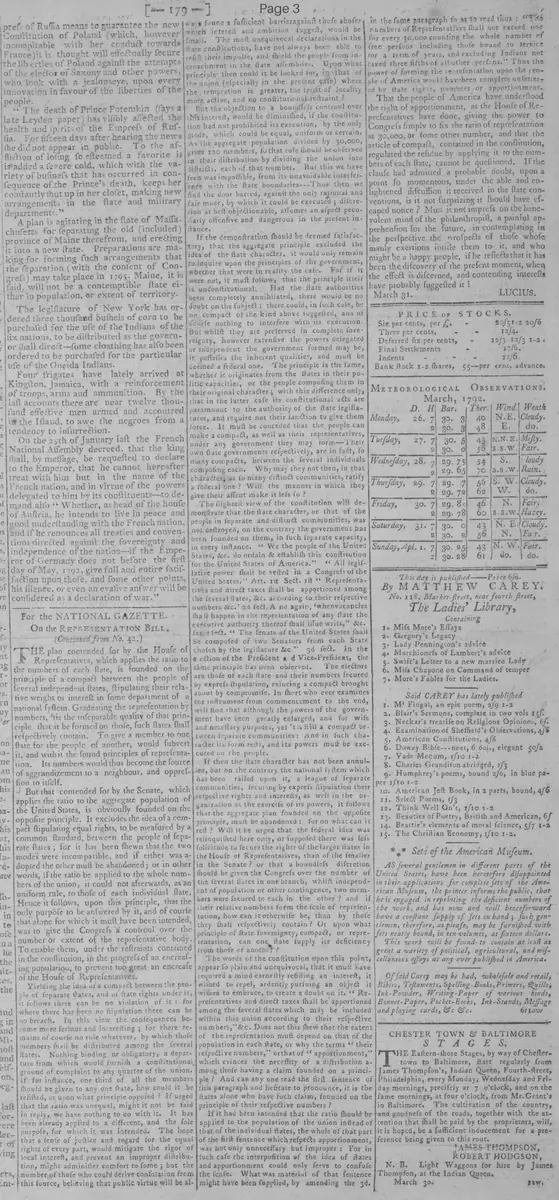
The plan contended for by the House of Representatives, which applies the ratio to the numbers of each state, is founded on the principle of a compact between the people of several independent states, stipulating their relative weight or interest in some department of a national system. Graduating the representation by numbers, 'tis the inseparable quality of that principle that it be formed on those, such states shall respectively contain. To give a member to one state for the people of another, would subvert it, and with it the sound principles of representation. Its numbers would thus become the source of aggrandizement to a neighbour, and oppression to itself.
But that contended for by the Senate, which applies the ratio to the aggregate population of the United States, is obviously founded on the opposite principle. It excludes the idea of a compact stipulating equal rights, to be measured by a common standard, between the people of separate states; for it has been shewn that the two modes were incompatible, and if either was adopted the other must be abandoned; or in other words, if the ratio be applied to the whole numbers of the union, it could not afterwards, as an uniform rule, to those of each individual state. Hence it follows, upon this principle, that the only purpose to be answered by it, and of course that alone for which it must have been intended, was to give the Congress a controul over the number or extent of the representative body. To enable them, under the restraints contained in the constitution, in the progress of an encreasing population, to prevent too great an encrease of the House of Representatives.
Yielding the idea of a compact between the people of separate states, and of state rights under it, it follows there can be no violation of it: for where there has been no stipulation there can be no breach. In this view the consequences become more serious and interesting; for there remains of course no rule whatever, by which those members shall be distributed among the several states. Nothing binding or obligatory, a departure from which would furnish a constitutional ground of complaint to any quarter of the union. If for instance, one third of all the members should be given to any one state, how could it be resisted, or upon what principle opposed? If urged that the ratio was unequal, might it not be said in reply, we have nothing to do with it. It has been already applied to a different, and the sole purpose, for which it was intended. The hope that a sense of justice and regard for the equal rights of every part, would mitigate the rigor of local interest, and prevent an improper distribution, might administer comfort to some; but the number of those who could derive consolation from this source, believing that public virtue will be always found a sufficient barrier against those abuses which interest and ambition suggest, would be small. The most unequivocal declarations in the state constitutions, have not always been able to resist their impulse, and shield the people from encroachment in the state assemblies. Upon what principle then could it be looked for, in that of the union (especially in the present case) where the temptation is greater, the spirit of locality more active, and no constitutional restraint?
But the objection to a boundless controul over his interest, would be diminished, if the constitution had not prohibited its execution, by the only mode, which could be equal, uniform or certain. As the aggregate population divided by 30,000, gives 120 members, so that rule should be observed in their distribution by dividing the union into districts, each of that number. But this we have seen was impossible, from its unavoidable interference with the state boundaries---Thus then we find the door barred, against the only rational and fair mode, by which it could be executed; discretion at best objectionable, assumes an aspect peculiarly offensive and dangerous in the present instance.
If the demonstration should be deemed satisfactory, that the aggregate principle excluded the idea of the state character, it would only remain to inquire upon the principles of the government, whether that were in reality the case. For if it were not, it must follow, that the principle itself is unconstitutional. Had the state authorities been completely annihilated, there would be no doubt on the subject: there could, in such case, be no compact of the kind above suggested, and of course nothing to interfere with its execution. But whilst they are preserved in complete sovereignty, however extensive the powers delegated or independent the government formed may be, it possesses the inherent qualities, and must be deemed a federal one. The principle is the same, whether it originates from the states in their politic capacities, or the people composing them in their original character; with this difference only, that in the latter case its constitutional acts are paramount to the authority of the state legislatures, and require not their sanction to give them force. It must be conceded that the people can make a compact, as well as their representatives, under any government they may form--Their own state governments respectively, are in fact, so many compacts, between the several individuals composing each. Why may they not then, in that character, as so many distinct communities, ratify a federal one? Will the manner in which they give their assent make it less so?
The slightest view of the constitution will demonstrate that the state character, or that of the people in separate and distinct communities, was not destroyed, on the contrary the government has been founded on them, in such separate capacity, in every instance. "We the people of the United States, &c. do ordain & establish this constitution for the United States of America." "All legislative power shall be vested in a Congress of the United States." Art. 1st Sect. 1st "Representatives and direct taxes shall be apportioned among the several states, &c. according to their respective numbers &c." 2d sect. And again, 'when vacancies shall happen in the representation of any state the executive authority thereof shall issue writs," &c. 4th sect. "The Senate of the United States shall be composed of two Senators from each State chosen by the legislature &c." 3d sect. In the election of the President & Vice-President, the same principle has been observed. The electors are those of each state and their numbers secured by express stipulation, evincing a compact brought about by compromise. In short who ever examines the instrument from commencement to the end, will find that although the powers of the government have been greatly enlarged, and for wise and necessary purposes, yet 'tis still a compact between separate communities: And in such character its form rests, and its powers must be executed on the people.
If then the state character has not been annulled, but on the contrary the national system which has been raised upon it, a league of separate communities, securing by express stipulation their respective rights and interests, as well in the organization as the exercise of its powers, it follows that the aggregate plan founded on the opposite principle, must be abandoned: for on what can it rest? Will it be urged that the federal idea was relinquished here only, or supposed there was less solicitude to secure the rights of the larger states in the House of Representatives, than of the smaller in the Senate? or that a boundless discretion should be given the Congress over the number of the several states in one branch, whilst independent of population or other contingency, two members were secured to each in the other? and if their relative numbers form the scale of representation, how can it otherwise be, than by those they shall respectively contain? Or upon what principle of state sovereignty, compact, or representation, can one state supply its deficiency from those of another?
The words of the constitution upon this point, appear so plain and unequivocal, that it must have required a mind earnestly resisting an interest, it wished to repel, ardently pursuing an object it wished to embrace, to create a doubt on it. "Representatives and direct taxes shall be apportioned among the several states which may be included within this union according to their respective numbers,"&c. Does not this shew that the extent of the representation must depend on that of the population in each state, or why the terms "their respective numbers," or that of "apportionment," which evinces the necessity of a distribution among those having a claim founded on a principle? And can any one read the first sentence of this paragraph and hesitate to pronounce, it is the states alone who have such claim, founded on the principle of their respective numbers?
If it had been intended that the ratio should be applied to the population of the union instead of that of the individual states, the whole of that part of the first sentence which respects apportionment, was not only unnecessary but improper: For in such case the interposition of the idea of states and apportionment could only serve to confuse the sense. What was material of that sentence might have been supplied, by amending the 3d. in the same paragraph so as to read thus: "The numbers of Representatives shall not exceed one for every 30,000 counting the whole number of free persons including those bound to service for a term of years, and excluding Indians not taxed three fifths of all other persons." Thus the power of forming the representation upon the people of America would have been complete unfettered by state rights, numbers or apportionment.
That the people of America have understood the right of apportionment, as the House of Representatives have done, giving the power to Congress simply to fix the ratio of representation at 30,000, or some other number, and that the article of compact, contained in the constitution, regulated the residue by applying it to the numbers of each state, cannot be questioned. If the clause had admitted a probable doubt, upon a point so momentous, under the able and enlightened discussion it received in the state conventions, is it not surprising it should have escaped notice? Must it not impress on the benevolent mind of the philanthropist, a painful apprehension for the future, in contemplating in the perspective the prospects of those whose manly exertions entitle them to it, and who might be a happy people, if he reflects that it has been the discovery of the present moment, when the effect is discerned, and contending interests have probably suggested it!
On the REPRESENTATION BILL.
(Continued from No. 42.)
The plan contended for by the House of Representatives, which applies the ratio to the numbers of each state, is founded on the principle of a compact between the people of several independent states, stipulating their relative weight or interest in some department of a national system. Graduating the representation by numbers, 'tis the inseparable quality of that principle that it be formed on those, such states shall respectively contain. To give a member to one state for the people of another, would subvert it, and with it the sound principles of representation. Its numbers would thus become the source of aggrandizement to a neighbour, and oppression to itself.
But that contended for by the Senate, which applies the ratio to the aggregate population of the United States, is obviously founded on the opposite principle. It excludes the idea of a compact stipulating equal rights, to be measured by a common standard, between the people of separate states; for it has been shewn that the two modes were incompatible, and if either was adopted the other must be abandoned; or in other words, if the ratio be applied to the whole numbers of the union, it could not afterwards, as an uniform rule, to those of each individual state. Hence it follows, upon this principle, that the only purpose to be answered by it, and of course that alone for which it must have been intended, was to give the Congress a controul over the number or extent of the representative body. To enable them, under the restraints contained in the constitution, in the progress of an encreasing population, to prevent too great an encrease of the House of Representatives.
Yielding the idea of a compact between the people of separate states, and of state rights under it, it follows there can be no violation of it: for where there has been no stipulation there can be no breach. In this view the consequences become more serious and interesting; for there remains of course no rule whatever, by which those members shall be distributed among the several states. Nothing binding or obligatory, a departure from which would furnish a constitutional ground of complaint to any quarter of the union. If for instance, one third of all the members should be given to any one state, how could it be resisted, or upon what principle opposed? If urged that the ratio was unequal, might it not be said in reply, we have nothing to do with it. It has been already applied to a different, and the sole purpose, for which it was intended. The hope that a sense of justice and regard for the equal rights of every part, would mitigate the rigor of local interest, and prevent an improper distribution, might administer comfort to some; but the number of those who could derive consolation from this source, believing that public virtue will be always found a sufficient barrier against those abuses which interest and ambition suggest, would be small. The most unequivocal declarations in the state constitutions, have not always been able to resist their impulse, and shield the people from encroachment in the state assemblies. Upon what principle then could it be looked for, in that of the union (especially in the present case) where the temptation is greater, the spirit of locality more active, and no constitutional restraint?
But the objection to a boundless controul over his interest, would be diminished, if the constitution had not prohibited its execution, by the only mode, which could be equal, uniform or certain. As the aggregate population divided by 30,000, gives 120 members, so that rule should be observed in their distribution by dividing the union into districts, each of that number. But this we have seen was impossible, from its unavoidable interference with the state boundaries---Thus then we find the door barred, against the only rational and fair mode, by which it could be executed; discretion at best objectionable, assumes an aspect peculiarly offensive and dangerous in the present instance.
If the demonstration should be deemed satisfactory, that the aggregate principle excluded the idea of the state character, it would only remain to inquire upon the principles of the government, whether that were in reality the case. For if it were not, it must follow, that the principle itself is unconstitutional. Had the state authorities been completely annihilated, there would be no doubt on the subject: there could, in such case, be no compact of the kind above suggested, and of course nothing to interfere with its execution. But whilst they are preserved in complete sovereignty, however extensive the powers delegated or independent the government formed may be, it possesses the inherent qualities, and must be deemed a federal one. The principle is the same, whether it originates from the states in their politic capacities, or the people composing them in their original character; with this difference only, that in the latter case its constitutional acts are paramount to the authority of the state legislatures, and require not their sanction to give them force. It must be conceded that the people can make a compact, as well as their representatives, under any government they may form--Their own state governments respectively, are in fact, so many compacts, between the several individuals composing each. Why may they not then, in that character, as so many distinct communities, ratify a federal one? Will the manner in which they give their assent make it less so?
The slightest view of the constitution will demonstrate that the state character, or that of the people in separate and distinct communities, was not destroyed, on the contrary the government has been founded on them, in such separate capacity, in every instance. "We the people of the United States, &c. do ordain & establish this constitution for the United States of America." "All legislative power shall be vested in a Congress of the United States." Art. 1st Sect. 1st "Representatives and direct taxes shall be apportioned among the several states, &c. according to their respective numbers &c." 2d sect. And again, 'when vacancies shall happen in the representation of any state the executive authority thereof shall issue writs," &c. 4th sect. "The Senate of the United States shall be composed of two Senators from each State chosen by the legislature &c." 3d sect. In the election of the President & Vice-President, the same principle has been observed. The electors are those of each state and their numbers secured by express stipulation, evincing a compact brought about by compromise. In short who ever examines the instrument from commencement to the end, will find that although the powers of the government have been greatly enlarged, and for wise and necessary purposes, yet 'tis still a compact between separate communities: And in such character its form rests, and its powers must be executed on the people.
If then the state character has not been annulled, but on the contrary the national system which has been raised upon it, a league of separate communities, securing by express stipulation their respective rights and interests, as well in the organization as the exercise of its powers, it follows that the aggregate plan founded on the opposite principle, must be abandoned: for on what can it rest? Will it be urged that the federal idea was relinquished here only, or supposed there was less solicitude to secure the rights of the larger states in the House of Representatives, than of the smaller in the Senate? or that a boundless discretion should be given the Congress over the number of the several states in one branch, whilst independent of population or other contingency, two members were secured to each in the other? and if their relative numbers form the scale of representation, how can it otherwise be, than by those they shall respectively contain? Or upon what principle of state sovereignty, compact, or representation, can one state supply its deficiency from those of another?
The words of the constitution upon this point, appear so plain and unequivocal, that it must have required a mind earnestly resisting an interest, it wished to repel, ardently pursuing an object it wished to embrace, to create a doubt on it. "Representatives and direct taxes shall be apportioned among the several states which may be included within this union according to their respective numbers,"&c. Does not this shew that the extent of the representation must depend on that of the population in each state, or why the terms "their respective numbers," or that of "apportionment," which evinces the necessity of a distribution among those having a claim founded on a principle? And can any one read the first sentence of this paragraph and hesitate to pronounce, it is the states alone who have such claim, founded on the principle of their respective numbers?
If it had been intended that the ratio should be applied to the population of the union instead of that of the individual states, the whole of that part of the first sentence which respects apportionment, was not only unnecessary but improper: For in such case the interposition of the idea of states and apportionment could only serve to confuse the sense. What was material of that sentence might have been supplied, by amending the 3d. in the same paragraph so as to read thus: "The numbers of Representatives shall not exceed one for every 30,000 counting the whole number of free persons including those bound to service for a term of years, and excluding Indians not taxed three fifths of all other persons." Thus the power of forming the representation upon the people of America would have been complete unfettered by state rights, numbers or apportionment.
That the people of America have understood the right of apportionment, as the House of Representatives have done, giving the power to Congress simply to fix the ratio of representation at 30,000, or some other number, and that the article of compact, contained in the constitution, regulated the residue by applying it to the numbers of each state, cannot be questioned. If the clause had admitted a probable doubt, upon a point so momentous, under the able and enlightened discussion it received in the state conventions, is it not surprising it should have escaped notice? Must it not impress on the benevolent mind of the philanthropist, a painful apprehension for the future, in contemplating in the perspective the prospects of those whose manly exertions entitle them to it, and who might be a happy people, if he reflects that it has been the discovery of the present moment, when the effect is discerned, and contending interests have probably suggested it!
What sub-type of article is it?
Constitutional
Partisan Politics
What keywords are associated?
Representation Bill
Apportionment
State Compact
Federal Principles
House Of Representatives
Senate Plan
Constitutional Interpretation
Population Ratio
What entities or persons were involved?
House Of Representatives
Senate
Congress
States
Constitution Of The United States
Editorial Details
Primary Topic
Apportionment Of Representatives By State Populations Versus Aggregate Union Population
Stance / Tone
Strongly Supportive Of House Plan And Critical Of Senate Plan As Unconstitutional
Key Figures
House Of Representatives
Senate
Congress
States
Constitution Of The United States
Key Arguments
House Plan Based On Compact Between States, Applying Ratio To Each State's Numbers
Senate Plan Applies Ratio To Aggregate Population, Excluding State Compact Idea
Aggregate Approach Gives Congress Uncontrolled Discretion Over Distribution, Risking Inequality
Constitution Preserves State Character And Federal Principles In Representation
Apportionment Must Be Among States According To Their Respective Numbers
Alternative Wording In Constitution Would Have Clarified Aggregate Intent If That Was Meant