Thank you for visiting SNEWPapers!
Sign up free
The New Hampshire Gazette
Portsmouth, Rockingham County, New Hampshire
What is this article about?
Opening session of the New Hampshire Legislature on November 17, 1824, in Concord. Governor David L. Morril's message addresses national prosperity, education, judiciary, and militia improvements. House and Senate handle petitions, resolutions, and unfinished business, including references to Lafayette's visit.
Clipping
OCR Quality
Full Text
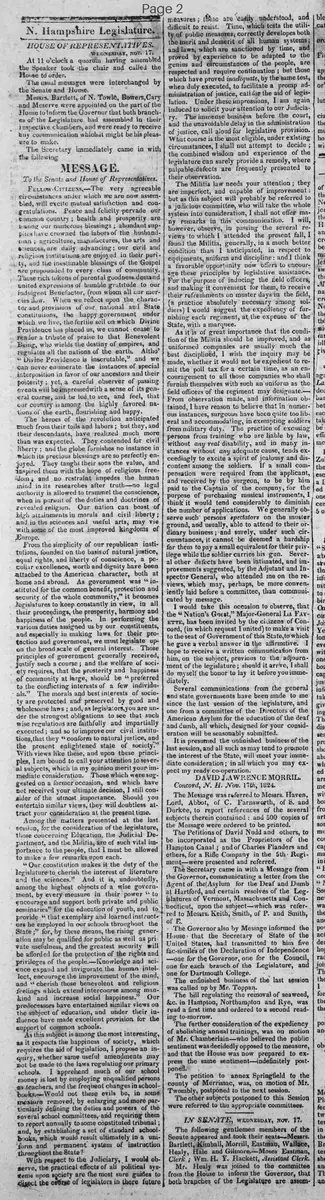
HOUSE OF REPRESENTATIVES.
WEDNESDAY, NOV. 17:
At 11 o'clock a quorum having assembled the Speaker took the chair and called the House to order.
The usual messages were interchanged by the Senate and House.
Messrs. Bartlett, of N. Towle, Bowers, Cary and Meserve were appointed on the part of the House to inform the Governor that both branches of the Legislature had assembled in their respective chambers, and were ready to receive any communication which it might be his pleasure to make.
The Secretary immediately came in with the following
MESSAGE.
To the Senate and House of Representatives.
Fellow-Citizens,—The very agreeable circumstances under which we are now assembled, will excite mutual satisfaction and congratulations. Peace and felicity pervade our common country; health and prosperity are among our numerous blessings; abundant supplies have crowned the labors of the husband-man; agriculture, manufactures, the arts and sciences, are daily advancing; our civil and religious institutions are enjoyed in their purity, and the inestimable blessings of the Gospel are propounded to every class of community.
These rich tokens of parental goodness demand united expressions of humble gratitude to our indulgent Benefactor, from whom all our mercies flow. When we reflect upon the character and provisions of our national and State constitutions, the happy government under which we live, the fertile soil on which Divine Providence has placed us, we cannot cease to render a tribute of praise to that Benevolent Being, who wields the destiny of empires, and regulates all the nations of the earth. Although Divine Providence is inscrutable, and we can never enumerate the instances of special interposition in favor of our ancestors and their posterity; yet, a careful observer of passing events will be impressed with a sense of its general course, and be led to see, and feel, that our country is among the highly favored nations of the earth, flourishing and happy.
The heroes of the revolution anticipated much from their toils and labors; but they, and their descendants, have realized much more than was expected. They contended for civil liberty; and the globe furnishes no instance in which its precious blessings are so perfectly enjoyed. They taught their sons the value, and inspired them with the hope of religious freedom; and no restraint impedes the human mind in its researches after truth—no legal authority is allowed to trammel the conscience, when in pursuit of the duties and doctrines of revealed religion. Our nation can boast of high attainments in morals and civil liberty; and in the sciences and useful arts, may vie with some of the most improved kingdoms of Europe.
From the simplicity of our republican institutions, founded on the basis of natural justice, equal rights, and liberty of conscience, a peculiar excellence, worth and dignity have been attached to the American character, both at home and abroad. As government was instituted for the common benefit, protection and security of the whole community, it becomes Legislatures to keep constantly in view, in all their proceedings, the prosperity, harmony and happiness of the people. In performing the various duties assigned us by our constituents, and especially in making laws for their protection and government, we must legislate upon the broad scale of general interest. Those principles of government generally received, justify such a course; and the welfare of society requires, that the prosperity and happiness of community at large, should be preferred to the conflicting interests of a few individuals. The morals and best interests of society are protected and preserved by good and wholesome laws; and, as legislators, you are under the strongest obligations to see that such wise regulations are faithfully and impartially executed; and so to improve our civil institutions, that they conform to natural justice, and the present enlightened state of society.
With views like these, and upon these principles, I am bound to call your attention to several subjects, which in my opinion merit your immediate consideration. Those which were suggested on a former occasion, and which have not received your ultimate decision, I still consider of the utmost importance. Should you entertain similar views, they will doubtless attract your consideration at the present time.
Among the matters presented at the last session, for the consideration of the legislature, those concerning Education, the Judicial Department, and the Militia, are of such vital importance to the people, that I must be allowed to make a few remarks upon each.
Our constitution makes it the duty of the legislature to cherish the interest of literature and the sciences. And it is, undoubtedly, among the highest objects of a wise government, by every measure in their power to encourage and support both private and public seminaries for the education of youth, and to provide that exemplary and learned instructors be employed in our schools throughout the State; for, by these means, the rising generation may be qualified for public as well as private usefulness, and the greatest security will be afforded for the protection of the rights and privileges of the people.—Knowledge and science expand and invigorate the human intellect, encourage the improvement of the mind, and cherish those benevolent and religious feelings which extend intercourse among mankind and increase social happiness. Our predecessors have entertained similar views on the subject of education, and under their influence have made excellent provision for the support of common schools.
As this subject is among the most interesting, as it respects the happiness of society, which requires the aid of legislation, I propose an inquiry, whether same useful amendments may not be made to the laws regulating our primary schools. I apprehend much of our school money is lost by employing unqualified persons as teachers, and the frequent changes in school-books.—Would not these evils be, in some measure removed, by enlarging and more particularly defining the duties and powers of the several school committees, and requiring them to report annually to some constituted tribunal; and, by establishing a set of standard school-books, which would result ultimately in a uniform and permanent system of instruction throughout the State?
With respect to the Judiciary, I would observe, the practical effects of all political systems upon society are the most sure guides to direct the course of legislators in their future measures; these are easily understood, and difficult to resist. Time, which tests the utility of public measures, correctly develops both the merit and demerit of all human systems; and laws, which are sanctioned by time, and proved by experience to be adapted to the genius and circumstances of the people, are respected and require continuation; but those which have proved inadequate, by the same test, when duly executed, to facilitate a prompt administration of justice, call for the aid of legislation. Under these impressions, I am again induced to solicit your attention to our Judiciary. The immense business before the court, and the unavoidable delay in the administration of justice, call aloud for legislative provision. What course is the most eligible, under existing circumstances, I shall not attempt to decide; the combined wisdom and experience of the legislature can surely provide a remedy, where palpable defects are frequently presented to their observation.
The Militia law needs your attention; they are imperfect, and capable of improvement: but as this subject will probably be referred to a judicious committee, who will take the whole system into consideration, I shall not offer many remarks in this communication. I will, however, observe, in passing the several reviews to which I attended the present fall, I found the Militia, generally, in a much better condition than I anticipated, in respect to equipments, uniform and discipline: and I think a favorable opportunity now offers to encourage these principles by legislative assistance. For the purpose of inducing the field officers, and making it convenient for them, to receive their refreshments on muster days in the field, (a practice absolutely necessary among soldiers) I would suggest the expediency of furnishing each regiment, at the expense of the State, with a marquee.
As it is of great importance that the condition of the Militia should be improved, and as uniformed companies are usually much the best disciplined, I wish the inquiry may be made, whether it would not be expedient to remit the poll tax for a certain time, as an encouragement to all those companies who shall furnish themselves with such an uniform as the field officers of the regiment may designate.—
From observation made, and information obtained, I have reason to believe that in numerous instances, surgeons have been quite too liberal and accommodating, in exempting soldiers from military duty. The practice of excusing persons from training who are liable by law, without any real disability, and in many instances without any adequate cause, tends exceedingly to excite a spirit of jealousy and discontent among the soldiers. If a small compensation were required from the applicant, and received by the surgeon, to be by him paid to the Captain of the company, for the purpose of purchasing musical instruments, I think it would tend considerably to diminish the number of applications. We generally observe such persons spectators on the muster ground, and usually, able to attend to their ordinary business; and surely, under such circumstances, it cannot be deemed a hardship for them to pay a small equivalent for their privilege while the soldier carries his gun. Several other defects have been intimated, and improvements suggested, by the Adjutant and Inspector General, who attended me on the reviews, which may, perhaps, be more conveniently laid before a committee, than communicated by message.
I would take this occasion to observe, that the "Nation's Guest," Major-General LA FAYETTE, has been invited by the citizens of Concord, (in which request I united) to make a visit to the seat of Government of this State, to which he gave a verbal answer in the affirmative. I hope to receive a written communication from him, on the subject, previous to the adjournment of the legislature: should it arrive, I shall do myself the honor to lay it before you immediately.
Several communications from the general and state governments have been made to me since the last session of the legislature, and one from a committee of the Directors of the American Asylum for the education of the deaf and dumb, all which, designed for your consideration will be seasonably submitted.
It is presumed the unfinished business of the last session, and all such as may tend to promote the interest of the State, will meet your immediate consideration; in all which you may expect my ready co-operation.
DAVID LAWRENCE MORRIL.
Concord, N. H. Nov. 17th, 1824.
The Message was referred to Messrs. Haven, Lord, Abbot, of C. Farnsworth, of S. and Durkee, to report references of the several subjects therein contained: and 500 copies of the Message were ordered to be printed.
The Petitions of David Nudd and others, to be incorporated as the Proprietors of the Hampton Canal: and of Charles Flanders and others, for a Rifle Company in the 5th Regiment—were presented and referred.
The Secretary came in with a Message from the Governor, communicating a letter from the Agent of the Asylum for the Deaf and Dumb at Hartford, and certain resolves of the Legislatures of Vermont, Massachusetts and Connecticut, upon the subject—which was referred to Messrs. Keith, Smith, of P. and Smith, of E.
The Governor also by Message informed the House that the Secretary of State of the United States, had transmitted to him five fac-similes of the Declaration of Independence—one for the Governor, one for the Council, one for each branch of the Legislature, and one for Dartmouth College.
The unfinished business of the last session was called up by Mr. Toppan.
The bill regulating the removal of seaweed, &c. in Hampton, Northampton and Rye, was read a first time and ordered to a second reading to-morrow.
The further consideration of the expediency of abolishing annual trainings, was on motion of Mr. Chamberlain—who believed the public sentiment was decidedly opposed to the measure, and that the House was now prepared to express the same sentiment—indefinitely postponed.
The petition to annex Springfield to the county of Merrimack, was, on motion of Mr. Twombly, postponed to the next session.
The other subjects postponed to this Session were referred to the appropriate committees.
IN SENATE, WEDNESDAY, NOV. 17.
The following gentlemen members of the Senate appeared and took their seats—Messrs. Bartlett, Kimball, Morrill, Eastman, Wallace, Healy, Hale and Gilmore.—Moses Eastman, Clerk; Wm. H. Y. Hackett, Assistant Clerk.
Mr. Healy was joined to the committee from the House to inform the Governor, that both branches of the Legislature are assembled and are ready to receive any communications he may be pleased to make.
100 copies of the Governor's Message were ordered to be printed for the use of the Senate.
Mr. Hale presented the petition of the Fire Society at Keene.
Messrs. Eastman, Wallace and Hale, were appointed a committee to report references of the several subjects contained in the Governor's Message.
Mr. Eastman introduced the following resolution which was adopted:
Resolved, That the committee on the Judiciary be instructed to take into consideration the expediency of amending or repealing so much of the law as relates to the inspection of hops, and to report thereon by bill or otherwise.
What sub-type of article is it?
What keywords are associated?
What entities or persons were involved?
Where did it happen?
Domestic News Details
Primary Location
Concord, N. H.
Event Date
Wednesday, Nov. 17, 1824
Key Persons
Event Details
Opening session of the New Hampshire House of Representatives and Senate. Governor Morril delivers message on prosperity, gratitude, civil liberties, and recommendations for education (school improvements), judiciary (reforms for efficiency), and militia (equipments, uniforms, exemptions). Petitions presented for canal incorporation, rifle company, deaf and dumb asylum, seaweed removal bill read, trainings abolition postponed, county annexation postponed. Invitation to Lafayette noted. Senate seats members, orders message prints, presents fire society petition, adopts resolution on hops inspection.