Thank you for visiting SNEWPapers!
Sign up free
Story
October 5, 1898
The Herald
Los Angeles, Los Angeles County, California
What is this article about?
In 1898, prisoner William Brown accused Officer Samuel N. Baker of beating him in city jail. Chief Glass's private probe recommended dismissing charges, but the police commission ordered a continued public hearing to ensure justice. (187 characters)
Clipping
OCR Quality
98%
Excellent
Full Text
Did Baker Beat Brown?
POLICE BOARD WILL INVESTIGATE FURTHER
CHIEF'S WHITEWASH FAILS
Hearing Continued for One Week.
City Attorney Summoned to the Supreme Court
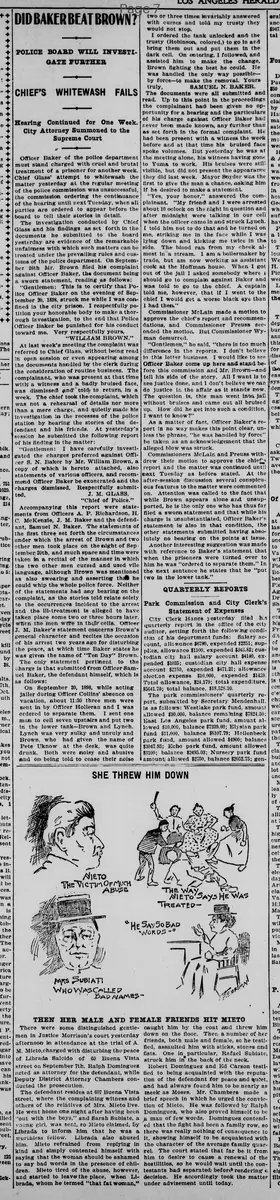
Officer Baker of the police department must stand charged with cruel and brutal treatment of a prisoner for another week. Chief Glass' attempt to whitewash the matter yesterday at the regular meeting of the police commission was unsuccessful, the commission ordering the continuance of the hearing until next Tuesday, when all parties are ordered to appear before the board to tell their stories in detail.
The investigation conducted by Chief Glass and his findings as set forth in the documents he submitted to the board yesterday are evidence of the remarkable unfairness with which such matters can be treated under the prevailing rules and customs of the police department. On September 26th Mr. Brown filed his complaint against Officer Baker, the document being a sworn statement, reading as follows:
"Gentlemen: This is to certify that Police Officer Baker on the evening of September 20, 1898, struck me while I was confined in the city prison. I respectfully petition your honorable body to make a thorough investigation, to the end that Police Officer Baker be punished for his conduct toward me. Very respectfully yours,
"WILLIAM BROWN."
At last week's meeting the complaint was referred to Chief Glass, without being read in open session or even appearing among the documents handled by the clerk during the consideration of routine business. The complainant, who was present at that time with a witness and a badly bruised face, was dismissed and told to return, in a week. The chief took the complaint, which was not a rehearsal of details nor more than a mere charge, and quietly made his investigation in the recesses of the police station by hearing the stories of the defendant and his friends. At yesterday's session he submitted the following report of his finding in the matter:
"Gentlemen: I have carefully investigated the charges preferred against Officer S. N. Baker by Mr. William Brown, a copy of which is hereto attached, also statements of various officers, and recommend Officer Baker be exonerated and the charges dismissed, Respectfully submitted,
J. M. GLASS,
"Chief of Police."
Accompanying this report were statements from Officers A. P. Richardson, H. C. McKenzie, J. M. Baker and the defendant, Samuel N. Baker. The statements of the first three set forth the circumstances under which the arrest of Brown and two other men took place on the night of September 20th, and much space and time were taken in a recital of the manner in which the two other men cursed and used vile language, although Brown was mentioned as also swearing and asserting that he could whip the whole police force. Neither of the statements had any bearing on the complaint, as the stories told relate solely to the occurrences incident to the arrest and the ill-treatment is alleged to have taken place some two or three hours later, when the men were in their cells. Officer J. M. Baker's statement concerns Brown's general character and recites the occasion of his arrest two years ago for disturbing the peace, at which time Baker states he was given the name of "Ten Day' Brown.
The only statement pertinent to the charge is that submitted from Officer Samuel Baker, the defendant himself, which is as follows:
On September 20, 1898, while acting jailer during Officer Collins' absence on vacation, about 11:30 three men were sent in by Officer Holleran and I was ordered to separate them. I sent one man to cell seven upstairs and put two in the lower tank-Brown and Lynch. Lynch was very sulky and unruly and Brown, who had given the name of Pete Uknow at the desk, was quite drunk. Both were noisy and abusive and on being told to cease their noise
two or three times invariably answered with curses and told my trusty they would not stop.
I ordered the tank unlocked and the trusty (Robinson, colored.) to go in and bring them out and put them in the dark cell. On entering. I followed, and assisted him to make the change, Brown fighting the best he could. He was handled the only way possible- by force-to make the removal. Yours truly,
SAMUEL N. BAKER.
The documents were all submitted and read. Up to this point in the proceedings the complainant had been given no opportunity for a hearing and the particulars of his charge against Officer Baker had never been made known, any further than as set forth in the formal complaint. He had been present with a witness the week before and at that time his bruised face spoke volumes. But yesterday he was at the meeting alone. his witness having gone to Yuma to work. His bruises were still visible. but did not present the appearance they did last week. Mayor Snyder was the first to give the man a chance, asking him if he desired to make a statement.
"Yes, your honor," answered the complainant. "My friend and I were arrested about 10 oclock on the night in question and after midnight were talking in our cell when the officer came in and struck Lynch. I told him not to do that and he turned on me, striking me in the face while I was lying down and kicking me twice in the side. The blood ran from my cheek almost in a stream. I am a boilermaker by trade, but am now working as assistant cook at the Hoffman house. When I got out of the jail I asked somebody where I should go to complain against Baker and was told to go to the chief. A captain told me, however. that if I went to the chief I would get a worse black eye than I had then."
Commissioner McLain made a motion to approve the chief's report and recommendations. and Commissioner Preuss seconded the motion. But Commissioner Wyman demurred.
"Gentlemen," he said, "there is too much difference in the reports. I don't believe in this letter business. I would like to see Officer Baker come up here and stand before this commission and Mr. Brown-and tell his side of the story. All I want is to see justice done, and I don't believe we can do justice in. the affair as it stands now. The question is, this man went into jail without bruises and came out all bruised up. How did he get into such a condition, I want to know?"
As a matter of fact, Officer Baker's report in no way makes this point clear, unless the phrase, "he was handled by force" be taken as an acknowledgement that the alleged blow was struck.
Commissioners McLain. and Preuss withdrew their motion to approve the chief' report and the matter was continued until next Tuesday as before stated. At the after-session discussion several conspicuous features to the matter were commented on. Attention was called to the fact that while Brown appears alone and unsupported, he is the only one who has thus far filed a sworn statement and that while his charge is unsubstantiated, Officer Baker's statement is also in that condition, the other statements submitted having absolutely no bearing on the points at issue. Another interesting suggestion was made with reference to Baker's statement that when the prisoners were turned over to him he was "ordered to separate them." In the next sentence he states that he "put two in the lower tank."
POLICE BOARD WILL INVESTIGATE FURTHER
CHIEF'S WHITEWASH FAILS
Hearing Continued for One Week.
City Attorney Summoned to the Supreme Court
Officer Baker of the police department must stand charged with cruel and brutal treatment of a prisoner for another week. Chief Glass' attempt to whitewash the matter yesterday at the regular meeting of the police commission was unsuccessful, the commission ordering the continuance of the hearing until next Tuesday, when all parties are ordered to appear before the board to tell their stories in detail.
The investigation conducted by Chief Glass and his findings as set forth in the documents he submitted to the board yesterday are evidence of the remarkable unfairness with which such matters can be treated under the prevailing rules and customs of the police department. On September 26th Mr. Brown filed his complaint against Officer Baker, the document being a sworn statement, reading as follows:
"Gentlemen: This is to certify that Police Officer Baker on the evening of September 20, 1898, struck me while I was confined in the city prison. I respectfully petition your honorable body to make a thorough investigation, to the end that Police Officer Baker be punished for his conduct toward me. Very respectfully yours,
"WILLIAM BROWN."
At last week's meeting the complaint was referred to Chief Glass, without being read in open session or even appearing among the documents handled by the clerk during the consideration of routine business. The complainant, who was present at that time with a witness and a badly bruised face, was dismissed and told to return, in a week. The chief took the complaint, which was not a rehearsal of details nor more than a mere charge, and quietly made his investigation in the recesses of the police station by hearing the stories of the defendant and his friends. At yesterday's session he submitted the following report of his finding in the matter:
"Gentlemen: I have carefully investigated the charges preferred against Officer S. N. Baker by Mr. William Brown, a copy of which is hereto attached, also statements of various officers, and recommend Officer Baker be exonerated and the charges dismissed, Respectfully submitted,
J. M. GLASS,
"Chief of Police."
Accompanying this report were statements from Officers A. P. Richardson, H. C. McKenzie, J. M. Baker and the defendant, Samuel N. Baker. The statements of the first three set forth the circumstances under which the arrest of Brown and two other men took place on the night of September 20th, and much space and time were taken in a recital of the manner in which the two other men cursed and used vile language, although Brown was mentioned as also swearing and asserting that he could whip the whole police force. Neither of the statements had any bearing on the complaint, as the stories told relate solely to the occurrences incident to the arrest and the ill-treatment is alleged to have taken place some two or three hours later, when the men were in their cells. Officer J. M. Baker's statement concerns Brown's general character and recites the occasion of his arrest two years ago for disturbing the peace, at which time Baker states he was given the name of "Ten Day' Brown.
The only statement pertinent to the charge is that submitted from Officer Samuel Baker, the defendant himself, which is as follows:
On September 20, 1898, while acting jailer during Officer Collins' absence on vacation, about 11:30 three men were sent in by Officer Holleran and I was ordered to separate them. I sent one man to cell seven upstairs and put two in the lower tank-Brown and Lynch. Lynch was very sulky and unruly and Brown, who had given the name of Pete Uknow at the desk, was quite drunk. Both were noisy and abusive and on being told to cease their noise
two or three times invariably answered with curses and told my trusty they would not stop.
I ordered the tank unlocked and the trusty (Robinson, colored.) to go in and bring them out and put them in the dark cell. On entering. I followed, and assisted him to make the change, Brown fighting the best he could. He was handled the only way possible- by force-to make the removal. Yours truly,
SAMUEL N. BAKER.
The documents were all submitted and read. Up to this point in the proceedings the complainant had been given no opportunity for a hearing and the particulars of his charge against Officer Baker had never been made known, any further than as set forth in the formal complaint. He had been present with a witness the week before and at that time his bruised face spoke volumes. But yesterday he was at the meeting alone. his witness having gone to Yuma to work. His bruises were still visible. but did not present the appearance they did last week. Mayor Snyder was the first to give the man a chance, asking him if he desired to make a statement.
"Yes, your honor," answered the complainant. "My friend and I were arrested about 10 oclock on the night in question and after midnight were talking in our cell when the officer came in and struck Lynch. I told him not to do that and he turned on me, striking me in the face while I was lying down and kicking me twice in the side. The blood ran from my cheek almost in a stream. I am a boilermaker by trade, but am now working as assistant cook at the Hoffman house. When I got out of the jail I asked somebody where I should go to complain against Baker and was told to go to the chief. A captain told me, however. that if I went to the chief I would get a worse black eye than I had then."
Commissioner McLain made a motion to approve the chief's report and recommendations. and Commissioner Preuss seconded the motion. But Commissioner Wyman demurred.
"Gentlemen," he said, "there is too much difference in the reports. I don't believe in this letter business. I would like to see Officer Baker come up here and stand before this commission and Mr. Brown-and tell his side of the story. All I want is to see justice done, and I don't believe we can do justice in. the affair as it stands now. The question is, this man went into jail without bruises and came out all bruised up. How did he get into such a condition, I want to know?"
As a matter of fact, Officer Baker's report in no way makes this point clear, unless the phrase, "he was handled by force" be taken as an acknowledgement that the alleged blow was struck.
Commissioners McLain. and Preuss withdrew their motion to approve the chief' report and the matter was continued until next Tuesday as before stated. At the after-session discussion several conspicuous features to the matter were commented on. Attention was called to the fact that while Brown appears alone and unsupported, he is the only one who has thus far filed a sworn statement and that while his charge is unsubstantiated, Officer Baker's statement is also in that condition, the other statements submitted having absolutely no bearing on the points at issue. Another interesting suggestion was made with reference to Baker's statement that when the prisoners were turned over to him he was "ordered to separate them." In the next sentence he states that he "put two in the lower tank."
What sub-type of article is it?
Crime Story
Historical Event
What themes does it cover?
Justice
Crime Punishment
What keywords are associated?
Police Brutality
Prisoner Assault
Police Investigation
Officer Exoneration
Commission Hearing
What entities or persons were involved?
William Brown
Samuel N. Baker
J. M. Glass
Where did it happen?
City Prison
Story Details
Key Persons
William Brown
Samuel N. Baker
J. M. Glass
Location
City Prison
Event Date
September 20, 1898
Story Details
Prisoner William Brown complains of brutal treatment by Officer Samuel N. Baker in jail. Chief Glass investigates privately and recommends exoneration, but the police commission rejects this and continues the hearing for a full investigation.