Thank you for visiting SNEWPapers!
Sign up free
Story
July 3, 1943
Kodiak Mirror
Kodiak, Alaska
What is this article about?
Newspaper article reports on the tragic fate of Mr. and Mrs. Charles Foster Jones, sole white residents of Attu Island, killed or captured during Japanese invasion in 1942. Includes a 1941 letter from Mrs. Jones to Mrs. Magnusen in Kodiak, describing their arrival, life on Attu, and concern for their dog Skippy left behind.
Clipping
OCR Quality
98%
Excellent
Full Text
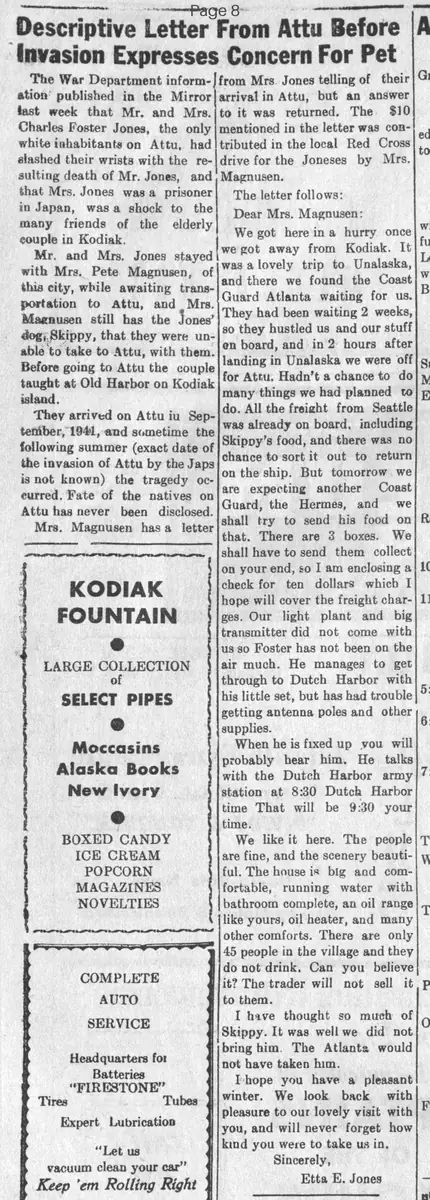
Descriptive Letter From Attu Before Invasion
Expresses Concern For Pet
The War Department information published in the Mirror last week that Mr. and Mrs. Charles Foster Jones, the only white inhabitants on Attu, had slashed their wrists with the resulting death of Mr. Jones, and that Mrs. Jones was a prisoner in Japan, was a shock to the many friends of the elderly couple in Kodiak.
Mr. and Mrs. Jones stayed with Mrs. Pete Magnusen, of this city, while awaiting transportation to Attu, and Mrs. Magnusen still has the Jones' dog, Skippy, that they were unable to take to Attu with them.
Before going to Attu the couple taught at Old Harbor on Kodiak island.
They arrived on Attu in September, 1941, and sometime the following summer (exact date of the invasion of Attu by the Japs is not known) the tragedy occurred. Fate of the natives on Attu has never been disclosed.
Mrs. Magnusen has a letter from Mrs. Jones telling of their arrival in Attu, but an answer to it was returned. The $10 mentioned in the letter was contributed in the local Red Cross drive for the Joneses by Mrs. Magnusen.
The letter follows:
Dear Mrs. Magnusen:
We got here in a hurry once we got away from Kodiak. It was a lovely trip to Unalaska, and there we found the Coast Guard Atlanta waiting for us.
They had been waiting 2 weeks, so they hustled us and our stuff on board, and in 2 hours after landing in Unalaska we were off for Attu. Hadn't a chance to do many things we had planned to do. All the freight from Seattle was already on board, including Skippy's food, and there was no chance to sort it out to return on the ship. But tomorrow we are expecting another Coast Guard, the Hermes, and we shall try to send his food on that. There are 3 boxes. We shall have to send them collect on your end, so I am enclosing a check for ten dollars which I hope will cover the freight charges.
Our light plant and big transmitter did not come with us so Foster has not been on the air much. He manages to get through to Dutch Harbor with his little set, but has had trouble getting antenna poles and other supplies.
When he is fixed up you will probably hear him. He talks with the Dutch Harbor army station at 8:30 Dutch Harbor time. That will be 9:30 your time.
We like it here. The people are fine, and the scenery beautiful. The house is big and comfortable, running water with bathroom complete, an oil range like yours, oil heater, and many other comforts. There are only 45 people in the village and they do not drink. Can you believe it? The trader will not sell it to them.
I have thought so much of Skippy. It was well we did not bring him. The Atlanta would not have taken him.
I hope you have a pleasant winter. We look back with pleasure to our lovely visit with you, and will never forget how kind you were to take us in.
Sincerely,
Etta E. Jones
Expresses Concern For Pet
The War Department information published in the Mirror last week that Mr. and Mrs. Charles Foster Jones, the only white inhabitants on Attu, had slashed their wrists with the resulting death of Mr. Jones, and that Mrs. Jones was a prisoner in Japan, was a shock to the many friends of the elderly couple in Kodiak.
Mr. and Mrs. Jones stayed with Mrs. Pete Magnusen, of this city, while awaiting transportation to Attu, and Mrs. Magnusen still has the Jones' dog, Skippy, that they were unable to take to Attu with them.
Before going to Attu the couple taught at Old Harbor on Kodiak island.
They arrived on Attu in September, 1941, and sometime the following summer (exact date of the invasion of Attu by the Japs is not known) the tragedy occurred. Fate of the natives on Attu has never been disclosed.
Mrs. Magnusen has a letter from Mrs. Jones telling of their arrival in Attu, but an answer to it was returned. The $10 mentioned in the letter was contributed in the local Red Cross drive for the Joneses by Mrs. Magnusen.
The letter follows:
Dear Mrs. Magnusen:
We got here in a hurry once we got away from Kodiak. It was a lovely trip to Unalaska, and there we found the Coast Guard Atlanta waiting for us.
They had been waiting 2 weeks, so they hustled us and our stuff on board, and in 2 hours after landing in Unalaska we were off for Attu. Hadn't a chance to do many things we had planned to do. All the freight from Seattle was already on board, including Skippy's food, and there was no chance to sort it out to return on the ship. But tomorrow we are expecting another Coast Guard, the Hermes, and we shall try to send his food on that. There are 3 boxes. We shall have to send them collect on your end, so I am enclosing a check for ten dollars which I hope will cover the freight charges.
Our light plant and big transmitter did not come with us so Foster has not been on the air much. He manages to get through to Dutch Harbor with his little set, but has had trouble getting antenna poles and other supplies.
When he is fixed up you will probably hear him. He talks with the Dutch Harbor army station at 8:30 Dutch Harbor time. That will be 9:30 your time.
We like it here. The people are fine, and the scenery beautiful. The house is big and comfortable, running water with bathroom complete, an oil range like yours, oil heater, and many other comforts. There are only 45 people in the village and they do not drink. Can you believe it? The trader will not sell it to them.
I have thought so much of Skippy. It was well we did not bring him. The Atlanta would not have taken him.
I hope you have a pleasant winter. We look back with pleasure to our lovely visit with you, and will never forget how kind you were to take us in.
Sincerely,
Etta E. Jones
What sub-type of article is it?
Biography
Historical Event
What themes does it cover?
Misfortune
Exploration
Family
What keywords are associated?
Attu Island
Japanese Invasion
World War Ii
Pet Dog
Missionaries
Kodiak
Unalaska
What entities or persons were involved?
Charles Foster Jones
Etta E. Jones
Mrs. Pete Magnusen
Skippy
Where did it happen?
Attu Island
Story Details
Key Persons
Charles Foster Jones
Etta E. Jones
Mrs. Pete Magnusen
Skippy
Location
Attu Island
Event Date
September 1941
Story Details
Mr. and Mrs. Jones, teachers from Kodiak, arrive on Attu in 1941 via Coast Guard ships; describe idyllic life and concern for dog Skippy left behind; later tragedy during Japanese invasion leads to Mr. Jones' suicide and Mrs. Jones' capture.