Thank you for visiting SNEWPapers!
Sign up free
Minneapolis Spokesman
Minneapolis, Hennepin County, Minnesota
What is this article about?
A September 1960 New York Times survey of Harlem's Black voters shows rising discontent with Democrats over civil rights failures, Southern violence, and local politics, potentially eroding traditional support for Kennedy in the upcoming election, though most still lean Democratic.
Merged-components note: Multi-part continuation of the N.Y. Times report on Harlem sentiment against Democrats, spanning page 1 (two segments) and page 4 (two segments).
Clippings
1 of 2
OCR Quality
Full Text
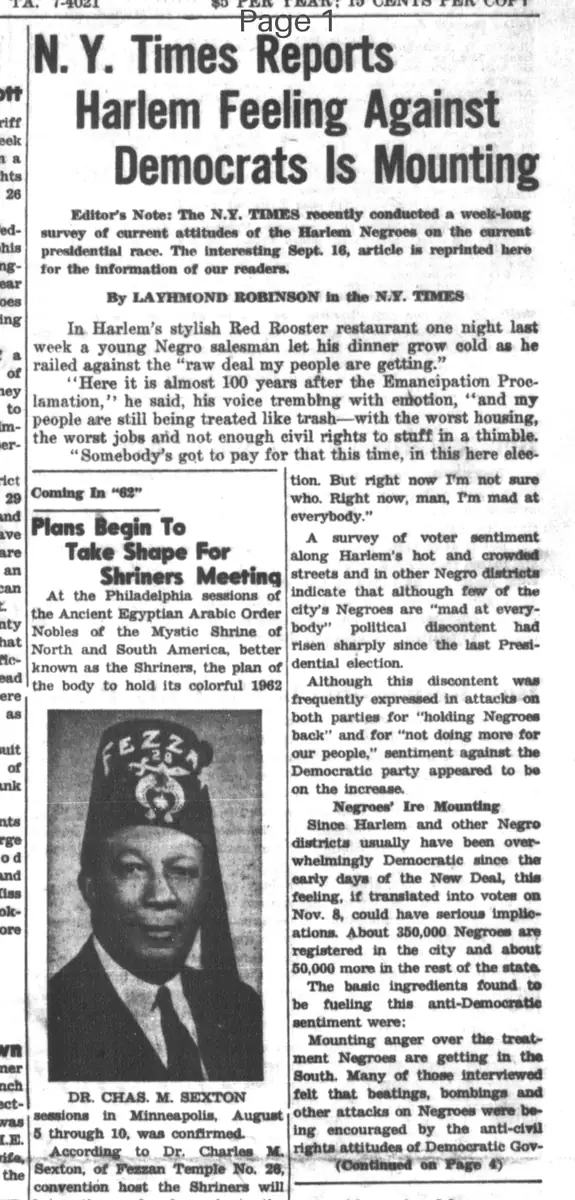
Editor's Note: The N.Y. TIMES recently conducted a week-long survey of current attitudes of the Harlem Negroes on the current presidential race. The interesting Sept. 16, article is reprinted here for the information of our readers.
By RAYMOND ROBINSON in the N.Y. TIMES
In Harlem's stylish Red Rooster restaurant one night last week a young Negro salesman let his dinner grow cold as he railed against the "raw deal my people are getting."
"Here it is almost 100 years after the Emancipation Proclamation,'' he said, his voice trembling with emotion, "and my people are still being treated like trash—with the worst housing, the worst jobs and not enough civil rights to stuff in a thimble.
"Somebody's got to pay for that this time, in this here election. But right now I'm not sure who. Right now, man, I'm mad at everybody."
A survey of voter sentiment along Harlem's hot and crowded streets and in other Negro districts indicate that although few of the city's Negroes are "mad at everybody" political discontent had risen sharply since the last Presidential election.
Although this discontent was frequently expressed in attacks on both parties for "holding Negroes back" and for "not doing more for our people," sentiment against the Democratic party appeared to be on the increase.
Negroes' Ire Mounting
Since Harlem and other Negro districts usually have been overwhelmingly Democratic since the early days of the New Deal, this feeling, if translated into votes on Nov. 8, could have serious implications. About 350,000 Negroes are registered in the city and about 50,000 more in the rest of the state.
The basic ingredients found to be fueling this anti-Democratic sentiment were:
Mounting anger over the treatment Negroes are getting in the South. Many of those interviewed felt that beatings, bombings and other attacks on Negroes were being encouraged by the anti-civil rights attitudes of Democratic Gov- (Continued on Page
N.Y. Times Reports
Harlem Dissatisfied
With Democrats
(Continued from Page 1)
Governors and other politicians in that area.
Growing resentment over the refusal of Congress, with its Democratic majorities, to pass effective civil rights legislation. Some of those interviewed said the Democratic nominee, Senator John F. Kennedy, could not deliver on civil rights because his party was controlled by Southerners. The almost solid Democratic vote to kill two civil rights bills in the recent short session seems to have intensified this feeling:
Lingering suspicions of the Democratic party locally. This is an outgrowth of the bitter intraparty struggle in 1958 and 1959 between Tammany Hall and the forces of Representative Adam Clayton Powell Jr. for political control of Harlem.
Mr. Powell won, and although he and Tammany have buried the hatchet, the regular organization's prestige is low in Harlem. Many Negro Democrats feel that Tammany sought to oust Mr. Powell from his Congressional seat because he was a Negro and would not "take orders."
Wagner Regime Under Fire
Frequent criticisms also were heard against the Wagner Administration over slum conditions and against former President Harry S. Truman for his statement that the Negro sit-in demonstrations in the South were "engineered by Communists."
"I can't remember a time when there was so much bitterness over the Democrats in Harlem," James Booker, a top political reporter for The Amsterdam News, said.
Like most of forty-four close observers of the Negro community interviewed during the survey, he said that "unless the Democrats can reverse this trend during the campaign they may find their usual whopping majorities sharply reduced."
None of these observers believed, however, that the Nixon-Lodge ticket, if the election were held today, could achieve a political miracle and win a majority of the city's Negro votes. Their view seemed to be borne out by street interviews with nearly 200 Negro voters in the city.
In 1956, President Eisenhower won nearly 40 per cent of the Negro vote in the city largely, many observers felt, because some Negro Democrats cast a protest vote against the Southern Democrats on the civil rights issue. This was the first significant penetration of the Negro vote by a Republican Presidential candidate in twenty years.
The Democrats' Appeal
The normal Democratic majorities run to about three out of four of all Negro votes in the city. It is the basic reason why Josiah Williams, a truck driver and many of his fellow Negroes who regard themselves as "working people" for the most part - will cast their ballots for Mr. Kennedy and Senator Lyndon B. Johnson.
Peering down from behind the wheel of his red Mack truck the other day, Mr. Williams said:
"I was a boy on a farm down South when Roosevelt gave us lights. Republicans never gave us nothing like that. All this labor legislation, unemployment compensation, all that stuff, Roosevelt gave us all that."
Mr. Kennedy's basic attraction to Negro voters is simply that "he's a Democrat," and carries the party banner; others like him for quite different reasons.
As put by Walter Petry Jr., a college teacher:
"Kennedy is more forward-looking than Nixon. I believe he'll be able to discipline the Southern conservatives in his party. I believe his religion makes him the underdog and will win sympathy for him."
'Old Fogies Like Ike'
From a brown-haired 26-year-old waitress in a Seventh Avenue restaurant:
"I think it's time we got in a young man like Kennedy and got rid of these old fogies like Ike. All he does is play golf anyway."
Some of those who said they would vote for Kennedy screwed up their faces at mention of his running mate, but seemed to feel as a Lenox Avenue pharmacist put it that "he's a bitter pill, being a Southerner, but I'll swallow him."
A Brooklyn barber said:
"I don't like Nixon or Kennedy. Both are second-rate. I think we've run out of Presidential candidates."
Another factor that may tend to hold down a protest vote against the Democrats is that many Negroes believe they have a stake in the Democratic party mechanism, in terms of political jobs, of political strength.
Gazing out over Harlem from his air-conditioned clubhouse window the other day, J. Raymond Jones, Democratic district leader and chief strategist of the Powell forces, spoke of this.
"Any protest vote would only divide the Negro, dissipate his political strength, his bargaining power with the people downtown. We are being seriously regarded in New York politics only because we are united. We must stay united, stay Democratic."
But A. Philip Randolph, respected patriarch of the Negro labor movement, disagreed:
"Negroes should support both parties, to stimulate both parties to compete for their vote. That way the Negro would get more from both parties. Neither party alone can deliver on civil rights and other essential legislation."
A Negro lawyer said:
"I voted for Stevenson last time but I've got to go with Nixon this time. We've been voting for the Democrats all this time and they should have done more for us. They talk about giving us housing. What housing? And jobs. What jobs? They just take our vote for granted nowadays."
Another who felt that the Democrats took the Negro vote for granted was Kenneth B. Clark, Associate Professor of Psychology at City College.
"The Negro has most to gain by keeping his vote independent, flexible, by not voting blindly out of habit," he said. "I believe the Negro has gotten as much as he can from blind allegiance to the Democratic party, which today is controlled by Southern Democrats and big city bosses who have no regard for the Negro."
A factor that seemed to be counteracting some of the growing anti-Democratic sentiment was the feeling, expressed by a significant number of those interviewed, that President Eisenhower had "dragged his feet" in enforcing the Supreme Court's 1954 school integration decision.
"I know Ike doesn't believe in that decision because he hasn't even said he's in favor of it," a quiet-spoken stenographer asserted.
One of the odd discoveries of the survey was that a significant number of Nixon supporters planned to vote for the Vice President despite their feeling that President Eisenhower had a poor record on civil rights.
These voters believed that Mr. Nixon had established a civil rights image separate and distinct from that of the President or the Republican party.
Court Decision Cited
This comment came from Kenneth Sherwood, a credit manager:
"Nixon showed an early interest in our problems. He long ago endorsed the Supreme Court decision. He has endorsed the sit-ins. He went to Ghana for its independence. He fought for a strong civil rights plank at the convention, and his friend, Attorney General (William P.) Rogers, is the best civil rights friend we ever had in that office."
Alexander Bethea, an employee of the Young Men's Christian Association, said:
"Ike's been a nothing President on this civil rights thing. The only thing he's done is stay out of the way of his Attorney General and let him go ahead with it. But I'm still voting for Nixon because a vote for Kennedy is a vote for the Dixiecrats. Our only hope is the Republicans on this thing and I like what Nixon's said and what he's done."
The survey showed that foreign affairs - a concern over which man "can handle the Russians" and "keep us out of war" - was emerging as a lively issue among Negro voters.
It was not only frequently mentioned but it also often took precedence over civil rights as the chief reason given by some potential voters for their preference for one candidate.
"I made up my mind quick because Nixon has more experience in foreign affairs," said Clinton McIntyre, a garage manager from Queens. "I like him on civil rights too, but primarily I think he's better qualified to handle the world situation than Kennedy is."
Interest In Foreign Affairs
Voters like Mr. Perry cited his feeling that "Kennedy would be more dynamic on the international scene" as one of his chief reasons for voting for him.
This interest by Negro voters in foreign affairs seems to have been sharpened by the emergence of the African nations on the world stage.
Up to now the religious issue has not kicked up much dust in Negro communities and most observers believed that it would not play a significant role in how Negroes vote.
Most of those interviewed in the street survey said that "as Negroes we can't afford to vote on the basis of a man's religion," or that "Kennedy's religion doesn't interest me."
Sitting on a red-leather couch in his Square Deal Republican Club the other night, Harold C. Burton, Roman Catholic and leader of the Twelfth Assembly District, said:
"I wouldn't want to see the campaign tarnished by this issue. I think we can do very well without these extraneous issues. It's too bad it ever came up."
Representative Powell, pastor of one of America's largest Baptist churches, has deplored the injection of religion into the campaign as "a revival of the Klan spirit."
Mr. Powell, who had attacked Mr. Kennedy's civil rights record earlier this year, has now come out in active support of him. His wariness of Mr. Kennedy seems to have been assuaged by the Democratic nominee's recent pledge to press for a strong civil rights package at the next session of Congress.
Noting in an article in The Nation this week that some Negroes have expressed concern over Mr. Kennedy's religion, Henry Lee Moon, vote analyst of the National Association for the Advancement of Colored People, wrote:
"How widespread and deep-seated the sentiment is, it is difficult to determine. But there's no denying it exists, despite the militant and effective role of the Catholic church in the desegregation struggle."
In the largely Protestant Negro community, it may yet emerge as a "sleeper" issue in the campaign.
What sub-type of article is it?
What themes does it cover?
What keywords are associated?
What entities or persons were involved?
Where did it happen?
Story Details
Key Persons
Location
Harlem, New York City
Event Date
September 1960
Story Details
A survey reveals increasing anti-Democratic sentiment among Harlem's Negro voters due to civil rights failures, Southern violence, congressional inaction, and local party struggles, though loyalty to the party and Kennedy's appeal persist amid concerns over foreign affairs and religion.