Thank you for visiting SNEWPapers!
Sign up free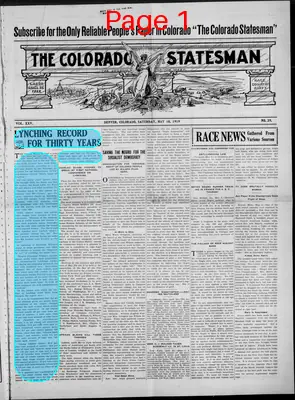
Story
May 10, 1919
The Colorado Statesman
Denver, Denver County, Colorado
What is this article about?
NAACP report details 3,224 lynchings in the US from 1889-1918, with 2,834 in the South. Georgia led with 386 victims. Most victims were Black men accused of various crimes, highlighting mob violence despite presidential appeals.
Clipping
OCR Quality
98%
Excellent
Full Text
LYNCHING
RECORD
FOR
THIRTY
YEARS
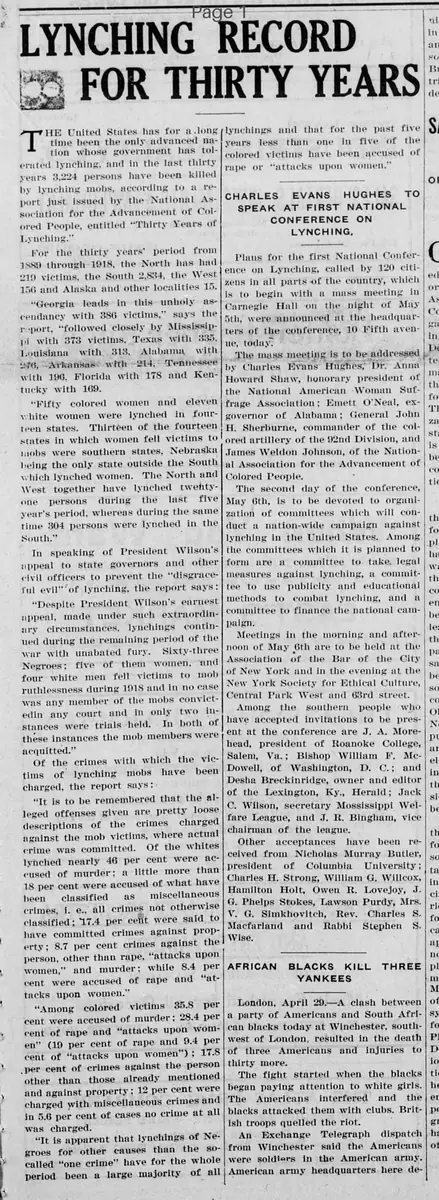
The United States has for a long time been the only advanced nation whose government has tolerated lynching, and in the last thirty years 3,224 persons have been killed by lynching mobs, according to a report just issued by the National Association for the Advancement of Colored People, entitled "Thirty Years of Lynching."
For the thirty years' period from 1889 through 1918, the North has had 219 victims, the South 2,834, the West 156 and Alaska and other localities 15.
"Georgia leads in this unholy ascendancy with 386 victims," says the report, "followed closely by Mississippi with 373 victims, Texas with 335, Louisiana with 313, Alabama with 276, Arkansas with 214, Tennessee with 196, Florida with 178 and Kentucky with 169."
"Fifty colored women and eleven white women were lynched in fourteen states. Thirteen of the fourteen states in which women fell victims to mobs were southern states, Nebraska being the only state outside the South which lynched women. The North and West together have lynched twenty-one persons during the last five years' period, whereas during the same time 304 persons were lynched in the South."
In speaking of President Wilson's appeal to state governors and other civil officers to prevent the "disgraceful evil" of lynching, the report says:
"Despite President Wilson's earnest appeal, made under such extraordinary circumstances, lynchings continued during the remaining period of the war with unabated fury. Sixty-three Negroes, five of them women, and four white men fell victims to mob ruthlessness during 1918 and in no case was any member of the mobs convicted in any court and in only two instances were trials held. In both of these instances the mob members were acquitted."
Of the crimes with which the victims of lynching mobs have been charged, the report says:
"It is to be remembered that the alleged offenses given are pretty loose descriptions of the crimes charged against the mob victims, where actual crime was committed. Of the whites lynched nearly 46 per cent were accused of murder; a little more than 18 per cent were accused of what have been classified as miscellaneous crimes, i.e., all crimes not otherwise classified; 17.4 per cent were said to have committed crimes against property; 8.7 per cent crimes against the person, other than rape, "attacks upon women," and murder; while 8.4 per cent were accused of rape and "attacks upon women."
"Among colored victims 35.8 per cent were accused of murder; 28.4 per cent of rape and attacks upon women (19 per cent of rape and 9.4 per cent of "attacks upon women"); 17.8 per cent of crimes against the person other than those already mentioned and against property; 12 per cent were charged with miscellaneous crimes and in 5.6 per cent of cases no crime at all was charged."
"It is apparent that lynchings of Negroes for other causes than the so-called "one crime" have for the whole period been a large majority of all lynchings and that for the past five years less than one in five of the colored victims have been accused of rape or "attacks upon women."
RECORD
FOR
THIRTY
YEARS
The United States has for a long time been the only advanced nation whose government has tolerated lynching, and in the last thirty years 3,224 persons have been killed by lynching mobs, according to a report just issued by the National Association for the Advancement of Colored People, entitled "Thirty Years of Lynching."
For the thirty years' period from 1889 through 1918, the North has had 219 victims, the South 2,834, the West 156 and Alaska and other localities 15.
"Georgia leads in this unholy ascendancy with 386 victims," says the report, "followed closely by Mississippi with 373 victims, Texas with 335, Louisiana with 313, Alabama with 276, Arkansas with 214, Tennessee with 196, Florida with 178 and Kentucky with 169."
"Fifty colored women and eleven white women were lynched in fourteen states. Thirteen of the fourteen states in which women fell victims to mobs were southern states, Nebraska being the only state outside the South which lynched women. The North and West together have lynched twenty-one persons during the last five years' period, whereas during the same time 304 persons were lynched in the South."
In speaking of President Wilson's appeal to state governors and other civil officers to prevent the "disgraceful evil" of lynching, the report says:
"Despite President Wilson's earnest appeal, made under such extraordinary circumstances, lynchings continued during the remaining period of the war with unabated fury. Sixty-three Negroes, five of them women, and four white men fell victims to mob ruthlessness during 1918 and in no case was any member of the mobs convicted in any court and in only two instances were trials held. In both of these instances the mob members were acquitted."
Of the crimes with which the victims of lynching mobs have been charged, the report says:
"It is to be remembered that the alleged offenses given are pretty loose descriptions of the crimes charged against the mob victims, where actual crime was committed. Of the whites lynched nearly 46 per cent were accused of murder; a little more than 18 per cent were accused of what have been classified as miscellaneous crimes, i.e., all crimes not otherwise classified; 17.4 per cent were said to have committed crimes against property; 8.7 per cent crimes against the person, other than rape, "attacks upon women," and murder; while 8.4 per cent were accused of rape and "attacks upon women."
"Among colored victims 35.8 per cent were accused of murder; 28.4 per cent of rape and attacks upon women (19 per cent of rape and 9.4 per cent of "attacks upon women"); 17.8 per cent of crimes against the person other than those already mentioned and against property; 12 per cent were charged with miscellaneous crimes and in 5.6 per cent of cases no crime at all was charged."
"It is apparent that lynchings of Negroes for other causes than the so-called "one crime" have for the whole period been a large majority of all lynchings and that for the past five years less than one in five of the colored victims have been accused of rape or "attacks upon women."
What sub-type of article is it?
Historical Event
What themes does it cover?
Crime Punishment
Tragedy
Misfortune
What keywords are associated?
Lynching
Naacp Report
Racial Violence
Mob Justice
Southern States
Crime Accusations
What entities or persons were involved?
President Wilson
Where did it happen?
United States
Story Details
Key Persons
President Wilson
Location
United States
Event Date
1889 Through 1918
Story Details
NAACP report documents 3,224 lynchings over 30 years, predominantly in the South, with breakdowns by region, state, gender, and alleged crimes; highlights failure of justice and continuation despite presidential intervention.