Thank you for visiting SNEWPapers!
Sign up free
Literary
December 6, 1843
The North Carolina Standard
Raleigh, Wake County, North Carolina
What is this article about?
An essay reflecting on John C. Calhoun's retirement from Congress, praising his rigorous style of political argumentation compared to Daniel Webster's eloquent debates, emphasizing Calhoun's logical intensity over emotional appeals.
Merged-components note: Merging filler text from page 1 with literary continuation on page 2, as it is a single essay on Mr. Calhoun's oratory from Hunt's Merchants' Magazine.
Clippings
1 of 2
OCR Quality
72%
Good
Full Text
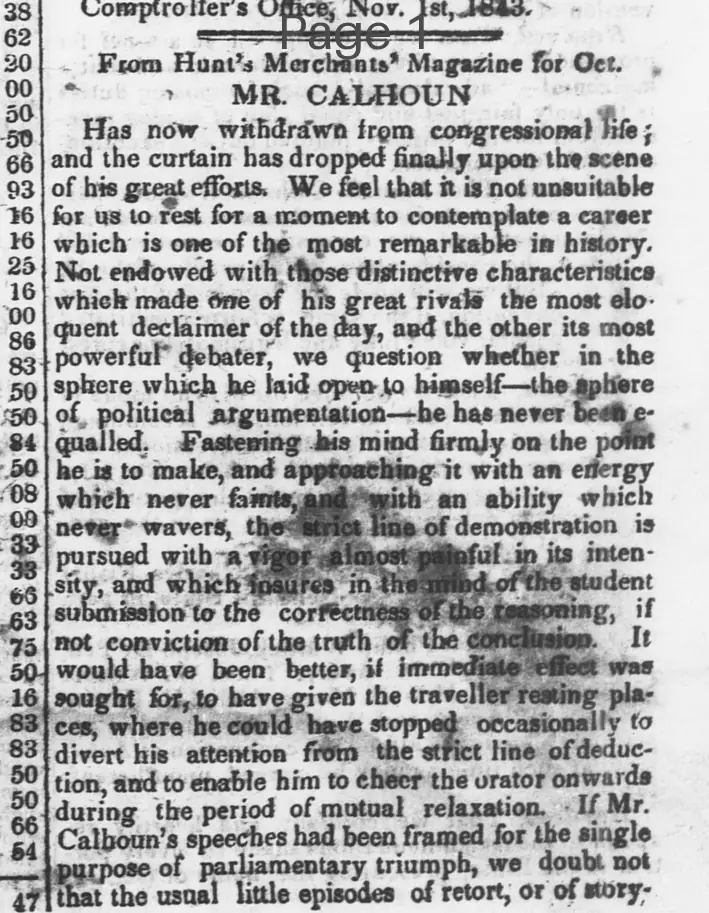
From Hunt's Merchants' Magazine for Oct.
Mr. Calhoun
Has now withdrawn from congressional life; and the curtain has dropped finally upon the scene of his great efforts. We feel that it is not unsuitable for us to rest for a moment to contemplate a career which is one of the most remarkable in history.
Not endowed with those distinctive characteristics which made one of his great rivals the most eloquent declaimer of the day, and the other its most powerful debater, we question whether in the sphere which he laid open to himself-the sphere of political argumentation—he has never been equalled. Fastening his mind firmly on the point he is to make, and approaching it with an energy which never faints, and with an ability which never wavers, the strict line of demonstration is pursued with a vigor almost painful in its intensity, and which insures in the mind of the student submission to the correctness of the reasoning, if not conviction of the truth of the conclusion. It would have been better, if immediate effect was sought for, to have given the traveller resting places, where he could have stopped occasionally to divert his attention from the strict line of deduction, and to enable him to cheer the orator onwards during the period of mutual relaxation. If Mr. Calhoun's speeches had been framed for the single end of telling, by which the attention of his hearers, refreshed from the parenthesis thus created, might have been more completely won, could have been successfully introduced. But it must be remembered that the neglect of imagery the freedom from personal controversy, the absence of appeals to the personal taste or the political prejudices of his hearers, the utter disuse of the engines of ridicule or sarcasm -it must be remembered, we say, that the freedom from unnecessary digression, and the earnest vigor with which the argument is pursued, tends to heighten, in the mind of the student, the conviction which the power of reasoning produces. We are sensible that we have been worked upon by no inferior appeals to our personal tastes or party associations, and that neither our sense of the ridiculous, nor our sense of the sublime, has been tampered with, in order that our reason should be betrayed. It must have been impossible to have listened to Mr. Webster's wonderful speeches during the debate-on Mr. Foot's resolution-it certainly is impossible to study them as reported—without rising with a deep sense of admiration for the splendid qualities which have there been introduced into action. We are carried away by the impetuous eloquence there displayed-the Mohawk onslaught,as Mr. Randolph called it; and we feel that same enthusiasm which we feel when we witness the Italian campaigns of Napoleon. We are made partisans at once by the feariessness of the attack; and as we witness the guns of the enemy turned against himself-as we observe the most fearful odds overcome,and see the weakest points in the whole field chosen, almost because they are the weakest, and then made impregnable, we enter into the conflict instinctively. without knowing any thing more than that we are enrolled under the standard of the eagle; and we take part in the triumphal procession, without feeling clear whether we are celebrating any thing more than the personal triumph of the chief. There are many who cannot read Mr. Webster's replies to Mr. Hayne without being thrilled with enthusiasm, and yet who, were they askedwhat conclusions had been left on their mind, would answer. like the grandfather in Southey's poem on thebattle of Blenheim—
"Whv, that I cannot tell," said be ;
"But 'twas a famous victory."
If the feelings of personal sympathy are called so frequently into play by Mr. Calhoun, it can be denied that the deficiency thus created is compensated by the interest which the argument itself arouses. There is a passion, it is true, but it is so well trained and kept under. that it serves like the steam in a well regulated machinery-it influences rather in the methodical and rapid action than in the wreaths of vapor which occasionally escape. There are no intervals for us to stop and cheer: no resting places by which we can get freshening; but we are carried onward in a mathematically straight to the place of destination. It is in this very freedom from digressions of all kinds that Mr. Calhoun's title to the honor of posterity will in a great degree rest; we have no doubt that in future periods. when passions and personal retort have lost their sway in the reader seeks to trace out not so much the private skirmishes of statesmen themselves as the general character of the measures in which they have struggled-the chaste and useful argumentation which distinguished him will place him on a level with the few great minds which have been able to instruct the reason, without seeking to please the fancy.
Mr. Calhoun
Has now withdrawn from congressional life; and the curtain has dropped finally upon the scene of his great efforts. We feel that it is not unsuitable for us to rest for a moment to contemplate a career which is one of the most remarkable in history.
Not endowed with those distinctive characteristics which made one of his great rivals the most eloquent declaimer of the day, and the other its most powerful debater, we question whether in the sphere which he laid open to himself-the sphere of political argumentation—he has never been equalled. Fastening his mind firmly on the point he is to make, and approaching it with an energy which never faints, and with an ability which never wavers, the strict line of demonstration is pursued with a vigor almost painful in its intensity, and which insures in the mind of the student submission to the correctness of the reasoning, if not conviction of the truth of the conclusion. It would have been better, if immediate effect was sought for, to have given the traveller resting places, where he could have stopped occasionally to divert his attention from the strict line of deduction, and to enable him to cheer the orator onwards during the period of mutual relaxation. If Mr. Calhoun's speeches had been framed for the single end of telling, by which the attention of his hearers, refreshed from the parenthesis thus created, might have been more completely won, could have been successfully introduced. But it must be remembered that the neglect of imagery the freedom from personal controversy, the absence of appeals to the personal taste or the political prejudices of his hearers, the utter disuse of the engines of ridicule or sarcasm -it must be remembered, we say, that the freedom from unnecessary digression, and the earnest vigor with which the argument is pursued, tends to heighten, in the mind of the student, the conviction which the power of reasoning produces. We are sensible that we have been worked upon by no inferior appeals to our personal tastes or party associations, and that neither our sense of the ridiculous, nor our sense of the sublime, has been tampered with, in order that our reason should be betrayed. It must have been impossible to have listened to Mr. Webster's wonderful speeches during the debate-on Mr. Foot's resolution-it certainly is impossible to study them as reported—without rising with a deep sense of admiration for the splendid qualities which have there been introduced into action. We are carried away by the impetuous eloquence there displayed-the Mohawk onslaught,as Mr. Randolph called it; and we feel that same enthusiasm which we feel when we witness the Italian campaigns of Napoleon. We are made partisans at once by the feariessness of the attack; and as we witness the guns of the enemy turned against himself-as we observe the most fearful odds overcome,and see the weakest points in the whole field chosen, almost because they are the weakest, and then made impregnable, we enter into the conflict instinctively. without knowing any thing more than that we are enrolled under the standard of the eagle; and we take part in the triumphal procession, without feeling clear whether we are celebrating any thing more than the personal triumph of the chief. There are many who cannot read Mr. Webster's replies to Mr. Hayne without being thrilled with enthusiasm, and yet who, were they askedwhat conclusions had been left on their mind, would answer. like the grandfather in Southey's poem on thebattle of Blenheim—
"Whv, that I cannot tell," said be ;
"But 'twas a famous victory."
If the feelings of personal sympathy are called so frequently into play by Mr. Calhoun, it can be denied that the deficiency thus created is compensated by the interest which the argument itself arouses. There is a passion, it is true, but it is so well trained and kept under. that it serves like the steam in a well regulated machinery-it influences rather in the methodical and rapid action than in the wreaths of vapor which occasionally escape. There are no intervals for us to stop and cheer: no resting places by which we can get freshening; but we are carried onward in a mathematically straight to the place of destination. It is in this very freedom from digressions of all kinds that Mr. Calhoun's title to the honor of posterity will in a great degree rest; we have no doubt that in future periods. when passions and personal retort have lost their sway in the reader seeks to trace out not so much the private skirmishes of statesmen themselves as the general character of the measures in which they have struggled-the chaste and useful argumentation which distinguished him will place him on a level with the few great minds which have been able to instruct the reason, without seeking to please the fancy.
What sub-type of article is it?
Essay
What themes does it cover?
Political
What keywords are associated?
Calhoun
Political Argumentation
Webster
Oratory
Congressional Debate
Reasoning
Eloquence
What entities or persons were involved?
From Hunt's Merchants' Magazine For Oct.
Literary Details
Title
Mr. Calhoun
Author
From Hunt's Merchants' Magazine For Oct.
Subject
Contemplation Of Calhoun's Congressional Career Upon His Withdrawal
Key Lines
"Whv, That I Cannot Tell," Said Be ; "But 'Twas A Famous Victory."