Thank you for visiting SNEWPapers!
Sign up free
Editorial
June 22, 1953
Trainman News
Indianapolis, Marion County, Indiana
What is this article about?
Editorial critiques Federal Judge Leon R. Yankwich's ruling allowing a Marine Court to arrest civilian attorney George E. Shibley for criticizing a court-martial. It warns of growing militarism in the US, eroding civilian control and Bill of Rights protections.
Clipping
OCR Quality
98%
Excellent
Full Text
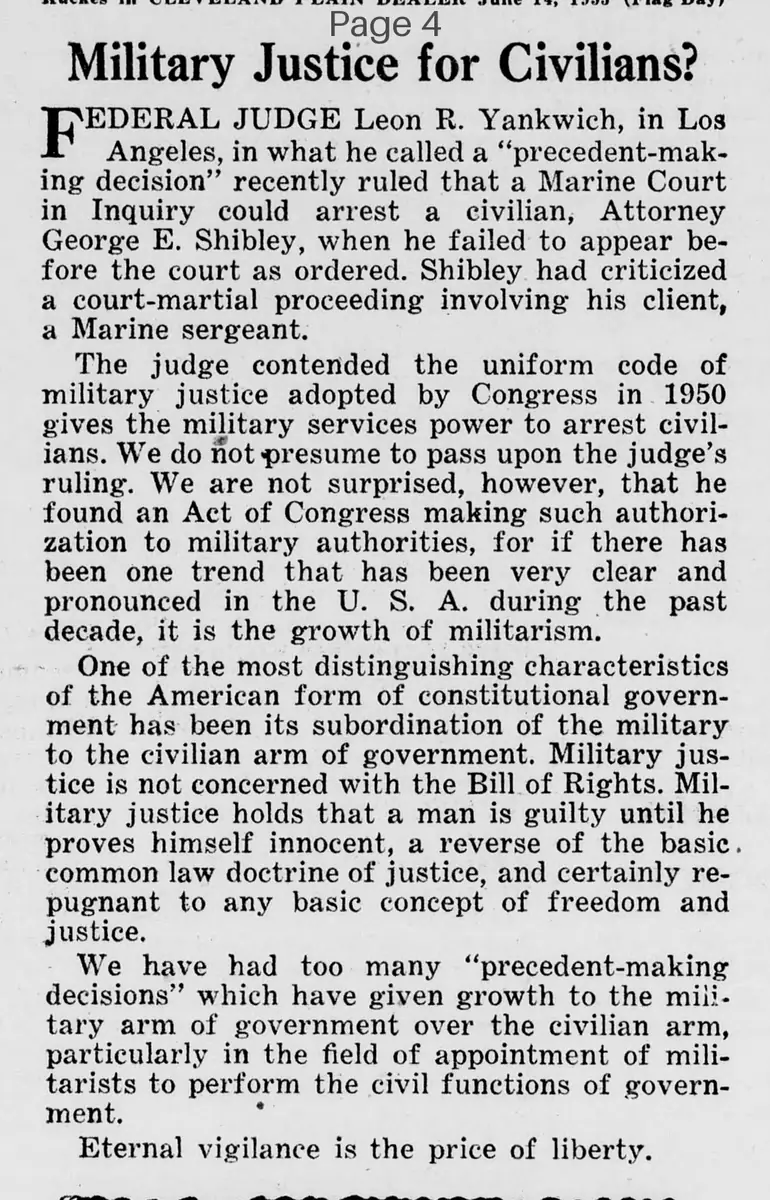
Military Justice for Civilians?
Federal Judge Leon R. Yankwich, in Los Angeles, in what he called a "precedent-making decision" recently ruled that a Marine Court in Inquiry could arrest a civilian, Attorney George E. Shibley, when he failed to appear before the court as ordered. Shibley had criticized a court-martial proceeding involving his client, a Marine sergeant.
The judge contended the uniform code of military justice adopted by Congress in 1950 gives the military services power to arrest civilians. We do not presume to pass upon the judge's ruling. We are not surprised, however, that he found an Act of Congress making such authorization to military authorities, for if there has been one trend that has been very clear and pronounced in the U. S. A. during the past decade, it is the growth of militarism.
One of the most distinguishing characteristics of the American form of constitutional government has been its subordination of the military to the civilian arm of government. Military justice is not concerned with the Bill of Rights. Military justice holds that a man is guilty until he proves himself innocent, a reverse of the basic common law doctrine of justice, and certainly repugnant to any basic concept of freedom and justice.
We have had too many "precedent-making decisions" which have given growth to the military arm of government over the civilian arm, particularly in the field of appointment of militarists to perform the civil functions of government.
Eternal vigilance is the price of liberty.
Federal Judge Leon R. Yankwich, in Los Angeles, in what he called a "precedent-making decision" recently ruled that a Marine Court in Inquiry could arrest a civilian, Attorney George E. Shibley, when he failed to appear before the court as ordered. Shibley had criticized a court-martial proceeding involving his client, a Marine sergeant.
The judge contended the uniform code of military justice adopted by Congress in 1950 gives the military services power to arrest civilians. We do not presume to pass upon the judge's ruling. We are not surprised, however, that he found an Act of Congress making such authorization to military authorities, for if there has been one trend that has been very clear and pronounced in the U. S. A. during the past decade, it is the growth of militarism.
One of the most distinguishing characteristics of the American form of constitutional government has been its subordination of the military to the civilian arm of government. Military justice is not concerned with the Bill of Rights. Military justice holds that a man is guilty until he proves himself innocent, a reverse of the basic common law doctrine of justice, and certainly repugnant to any basic concept of freedom and justice.
We have had too many "precedent-making decisions" which have given growth to the military arm of government over the civilian arm, particularly in the field of appointment of militarists to perform the civil functions of government.
Eternal vigilance is the price of liberty.
What sub-type of article is it?
Constitutional
Military Affairs
What keywords are associated?
Military Justice
Civilian Arrests
Militarism
Bill Of Rights
Constitutional Government
Precedent Making Decision
What entities or persons were involved?
Leon R. Yankwich
George E. Shibley
Marine Court In Inquiry
Congress
Editorial Details
Primary Topic
Military Justice Extending To Civilians
Stance / Tone
Critical Of Militarism And Military Overreach
Key Figures
Leon R. Yankwich
George E. Shibley
Marine Court In Inquiry
Congress
Key Arguments
Uniform Code Of Military Justice Allows Arrest Of Civilians
Growth Of Militarism In The Us Over The Past Decade
American Constitutional Government Subordinates Military To Civilian Authority
Military Justice Disregards Bill Of Rights And Presumes Guilt
Too Many Precedents Expanding Military Power Over Civilians