Thank you for visiting SNEWPapers!
Sign up free
The New Hampshire Gazette
Portsmouth, Rockingham County, New Hampshire
What is this article about?
President Washington transmits to Congress a report from Secretary of State Edmund Randolph detailing complaints of vexations and spoliations on U.S. commerce by belligerent powers (British, French, Spanish, Dutch) since the European War began, including captures, detentions, and trade restrictions affecting American trade.
Merged-components note: Presidential message and report on commerce spoliations under foreign powers; domestic policy context despite international subject; direct continuation across pages 2 and 3; relabeled from foreign_news to domestic_news for the second component.
Clippings
1 of 2
OCR Quality
Full Text
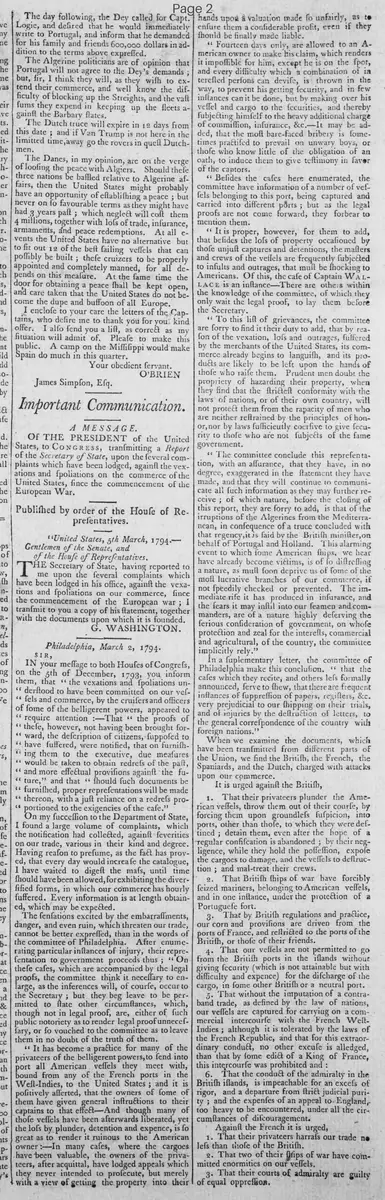
A MESSAGE.
Of THE PRESIDENT of the United States, to CONGRESS, transmitting a Report of the Secretary of State, upon the several complaints which have been lodged, against the vexations and spoliations on the commerce of the United States, since the commencement of the European War.
Published by order of the House of Representatives.
"United States, 5th March, 1794.—
Gentlemen of the Senate, and of the House of Representatives.
Such complaints as
have been lodged in his office, against the vexations and spoliations on our commerce, since the commencement of the European war; I transmit to you a copy of his statement, together with the documents upon which it is founded.
G. WASHINGTON."
Philadelphia, March 2, 1794:
SIR,
IN your message to both Houses of Congress, on the 5th of December, 1793, you inform them, that " the vexations and spoliations under stood to have been committed on our vessels and commerce, by the cruisers and officers of some of the belligerent powers, appeared to require attention :—That " the proofs of these, however, not having been brought forward, the description of citizens, supposed to have suffered, were notified, that on furnishing them to the executive, due measures would be taken to obtain redress of the past, and more effectual provisions against the future," and that " should such documents be furnished, proper representations will be made thereon, with a just reliance on a redress proportioned to the exigencies of the case."
On my succession to the Department of State, I found a large volume of complaints, which the notification had collected, against severities on our trade, various in their kind and degree. Having reason to presume, as the fact has proved, that every day would increase the catalogue, I have waited to digest the mass, until time should have been allowed, for exhibiting the diversified forms, in which our commerce has hourly suffered. Every information is at length obtained, which may be expected.
The sensations excited by the embarrassments, danger, and even ruin, which threaten our trade, cannot be better expressed, than in the words of the committee of Philadelphia. After enumerating particular instances of injury, their representation to government proceeds thus ; " On these cases, which are accompanied by the legal proofs, the committee think it necessary to enlarge, as the inferences will, of course, occur to the Secretary ; but they beg leave to be permitted to state other circumstances, which, though not in legal proof, are, either of such public notoriety as to render legal proof unnecessary, or so vouched to the committee as to leave them in no doubt of the truth of them.
" It has become a practice for many of the privateers of the belligerent powers,to send into port all American vessels they meet with, bound from any of the French ports in the West-Indies, to the United States ; and it is positively asserted, that the owners of some of them have given general instructions to their captains to that effect—And though many of those vessels have been afterwards liberated, yet the loss by plunder, detention and expence, is so great as to render it ruinous to the American owner: In many cases, where the cargoes have been valuable, the owners of the privateers, after acquittal, have lodged appeals which they never intended to prosecute, but merely with a view of getting the property into their hands upon a valuation made so unfairly, as to ensure them a considerable profit, even if they should be finally made liable.
" Fourteen days only, are allowed to an American owner to make his claim, which renders it impossible for him, except he is on the spot, and every difficulty which a combination of interested persons can devise, is thrown in the way, to prevent his getting security, and in few instances can it be done, but by making over his vessel and cargo to the securities, and thereby subjecting himself to the heavy additional charge of commission, insurance, &c. It may be added, that the most bare-faced bribery is sometimes practised to prevail on unwary boys, or those who know little of the obligation of an oath, to induce them to give testimony in favor of the captors.
" Besides the cases here enumerated, the committee have information of a number of vessels belonging to this port, being captured and carried into different ports ; but as the legal proofs are not come forward, they forbear to mention them.
" It is proper, however, for them to add, that besides the loss of property occasioned by those unjust captures and detentions, the masters and crews of the vessels are frequently subjected to insults and outrages, that must be shocking to Americans. Of this, the case of Captain WALLACE is an instance—There are others within the knowledge of the committee, of which they only wait the legal proof, to lay them before the Secretary.
" To this list of grievances, the committee are sorry to find it their duty to add, that by reason of the vexation, loss and outrages, suffered by the merchants of the United States, its commerce already begins to languish, and its products are likely to be left upon the hands of those who raise them. Prudent men doubt the propriety of hazarding their property, when they find that the strictest conformity with the laws of nations, or of their own country, will not protect them from the rapacity of men who are neither restrained by the principles of honor, nor by laws sufficiently coercive to give security to those who are not subjects of the same government.
" The committee conclude this representation, with an assurance, that they have, in no degree, exaggerated in the statement they have made, and that they will continue to communicate all such information as they may further receive ; of which nature, before the closing of this report, they are sorry to add, is that of the irruptions of the Algerines from the Mediterranean, in consequence of a truce concluded with that regency, it is said by the British minister, on behalf of Portugal and Holland. This alarming event to which some American ships, we hear have already become victims, is of so distressing a nature, as must soon deprive us of some of the most lucrative branches of our commerce, if not speedily checked or prevented. The immediate rise it has produced in insurance, and the fears it may instil into our seamen and commanders, are of a nature highly deserving the serious consideration of government, on whose protection and zeal for the interests, commercial and agricultural, of the country, the committee implicitly rely."
In a supplementary letter, the committee of Philadelphia make this conclusion. that the cases which they recite, and others less formally announced, serve to shew, that there are frequent instances of suppression of papers, registers, &c. very prejudicial to our shipping on their trials, and of injuries by the destruction of letters, to the general correspondence of the country with foreign nations.
When we examine the documents, which have been transmitted from different parts of the Union, we find the British, the French, the Spaniards, and the Dutch, charged with attacks upon our commerce.
It is urged against the British.
1. That their privateers plunder the American vessels, throw them out of their course, by forcing them upon groundless suspicion, into ports, other than those, to which they were destined ; detain them, even after the hope of a regular confiscation is abandoned ; by their negligence, while they hold the possession, expose the cargoes to damage, and the vessels to destruction ; and maltreat their crews.
2. That British ships of war have forcibly seized mariners, belonging to American vessels, and in one instance, under the protection of a Portuguese fort.
3. That by British regulations and practice, our corn and provisions are driven from the ports of France, and restricted to the ports of the British, or those of their friends.
4. That our vessels are not permitted to go from the British ports in the islands without giving security (which is not attainable but with difficulty and expence) for the discharge of the cargo, in some other British or a neutral port.
5. That without the imputation of a contraband trade, as defined by the law of nations, our vessels are captured for carrying on a commercial intercourse with the French West-Indies ; although it is tolerated by the laws of the French Republic, and that for this extraordinary conduct, no other excuse is alleged, than that by some edict of a King of France, this intercourse was prohibited and :
6. That the conduct of the admiralty in the British islands, is impeachable for an excess of rigor, and a departure from strict judicial purity ; and the expences of an appeal to England, too heavy to be encountered, under all the circumstances of discouragement.
Against the French it is urged,
1. That their privateers harass our trade no less than those of the British.
2. That two of their ships of war have committed enormities on our vessels.
3. That their courts of admiralty are guilty of equal oppression.
That besides these points of accusation, which are common to the French and British, the former have infringed the treaty between the United States and them, by subjecting to seizure and condemnation our vessels trading with their enemies in merchandise, which that treaty declares not to be contraband, and under circumstances not forbidden by the law of nations.
5. That a very detrimental embargo has been laid upon large numbers of American vessels in the French ports;* and,
6. That a contract with the French government for coin has been discharged in depreciated assignats.
Against the Spaniards the outrages of privateers are urged;
And against the Dutch, one condemnation in the admiralty is insisted to be unwarrantable.
Under this complication of mischief, which persecutes our commerce, I beg leave, Sir, to submit to your consideration, whether representations as far as facts may justify, ought not to be immediately pressed upon the foreign governments, in those of the preceding cases for which they are responsible.
Among these, I class, 1. The violences perpetrated by public ships of war. 2. Prohibitions or regulations inconsistent with the law of nations. 3. The improper conduct of courts. 4. Infractions of treaty. 5. The imposition of embargoes: and, 6. The breach of public contracts. How far a government is liable to redress the rapine of privateers, depends upon the peculiarities of the case.--It is incumbent upon it, however, to keep its courts freely open, and to secure an impartial hearing to the injured applicant. If the rules prescribed to privateers, be too loose, and opportunities of plunder or ill treatment be provoked from that cause, or from the prospect of impunity, it is impossible to be too strenuous in remonstrating against this formidable evil.
Thus, Sir, have I reduced to general heads, the particular complaints, without making any inquiry into the facts, beyond the allegations of the parties interested.
I will only add, that your message seems to promise to Congress some statement upon these subjects. I have the honor, Sir, to be, with the highest respect, Your most obedient servant.
EDMUND RANDOLPH.
The President of the United States.
True Copy,
GEO: TAYLOR, jr. C. C. D. S.
* There is reason to believe that the embargo was removed in December last, and the detention compensated by an order of the committee of Public Safety, in France.
What sub-type of article is it?
What keywords are associated?
What entities or persons were involved?
Where did it happen?
Domestic News Details
Primary Location
Philadelphia
Event Date
5th March, 1794
Key Persons
Outcome
complaints of commerce disruptions, potential ruin to trade, recommendations for representations to foreign governments; no specific deaths but mentions insults and outrages to crews.
Event Details
President Washington transmits Secretary Randolph's report to Congress on complaints against British, French, Spanish, and Dutch for vexations including privateer captures, detentions, plundering, trade restrictions, treaty infringements, and embargoes on U.S. vessels since the European War.