Thank you for visiting SNEWPapers!
Sign up free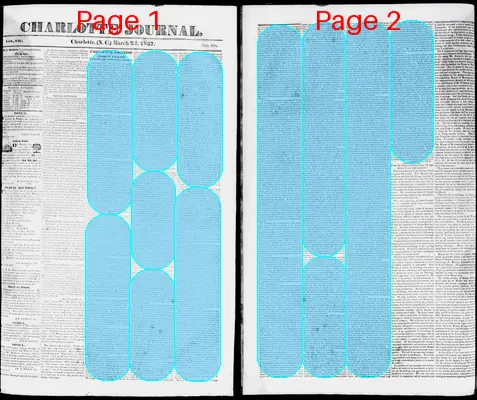
The Charlotte Journal
Charlotte, Mecklenburg County, North Carolina
What is this article about?
Andrew Jackson's Farewell Address expresses gratitude for public support, reflects on 50 years under the Constitution, warns against threats to the Union from unlawful resistance, federal overreach, paper currency, national bank monopoly, and internal corruption, advocates strict constitutional adherence, reduced taxation, restored specie currency, and naval strength for defense while promoting peace.
Merged-components note: Continuation of Andrew Jackson's Farewell Address across pages, same topic and flow.
Clippings
1 of 2
OCR Quality
Full Text
of
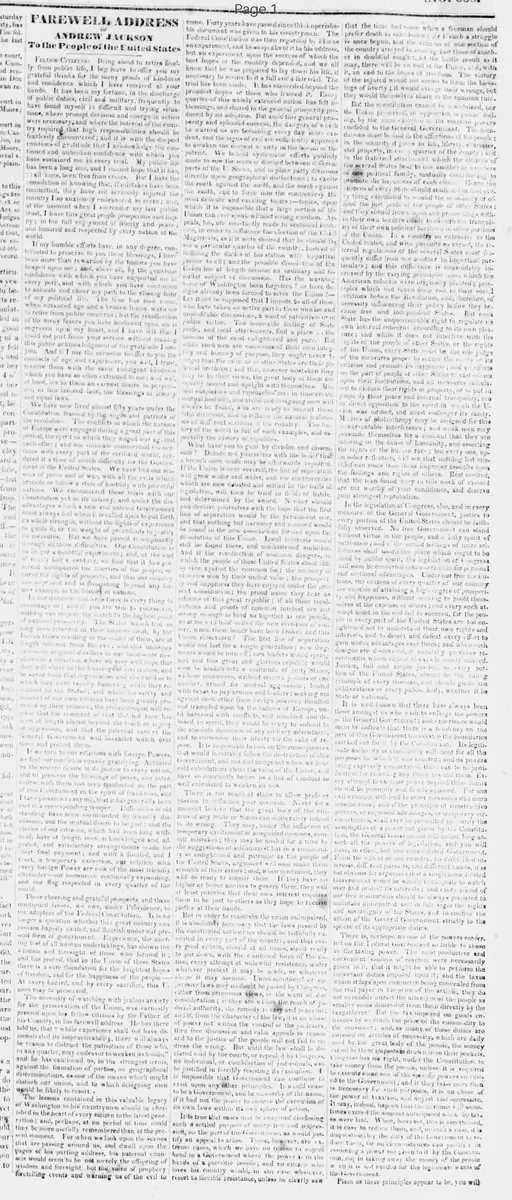
ANDREW JACKSON
To the People of the United States
Fellow-Citizens: Being about to retire finally from public life, I beg leave to offer you my grateful thanks for the many proofs of kindness and confidence which I have received at your hands. It has been my fortune, in the discharge of public duties, civil and military, frequently to have found myself in difficult and trying situations, where prompt decision and energetic action were necessary, and where the interest of the country required that high responsibilities should be fearlessly encountered; and it is with the deepest emotions of gratitude that I acknowledge the continued and unbroken confidence with which you have sustained me in every trial. My public life has been a long one, and I cannot hope that it has, at all times, been free from errors. But I have the consolation of knowing that, if mistakes have been committed, they have not seriously injured the country I so anxiously endeavored to serve; and, at the moment when I surrender my last public trust, I leave this great people prosperous and happy; in the full enjoyment of liberty and peace; and honored and respected by every nation of the world.
If my humble efforts have, in any degree, contributed to preserve to you these blessings, I have been more than rewarded by the honors you have heaped upon me; and, above all, by the generous confidence with which you have supported me in every period, and with which you have continued to animate and cheer my path to the closing hour of my political life. The time has now come, when advanced age and a broken frame warn me to retire from public concerns; but the recollection of the many favors you have bestowed upon me is engraven upon my heart, and I have felt that I could not part from your service without making this public acknowledgment of the gratitude I owe you. And if I use the occasion to tender to you the counsels of age and experience, you will, I trust, receive them with the same indulgent kindness which you have so often extended to me, and will, at least, see in them an earnest desire to perpetuate, in this favored land, the blessings of liberty and equal laws.
We have now lived almost fifty years under the Constitution framed by the sages and patriots of the Revolution. The conflicts in which the battles of Europe were engaged during a great part of this period, the internal disturbances which they waged with each other; and our intimate commercial transactions with every part of the civilized world, rendered it a time of much difficulty for the Government of the United States. We have had our seasons of peace and of war, with all the evils which precede or follow a state of hostility with powerful nations. We encountered these trials with our Constitution yet in its infancy, and under the disadvantages which a new and untried Government must always feel when it is called upon to put forth its whole strength, without the lights of experience to guide it, or to weight of precedents to steady its measures. But we have passed triumphantly through all these difficulties. Our Constitution is no longer a doubtful experiment, and at the end of nearly half a century, we find that it has preserved the liberties of the people, secured the rights of property, and that our country has advanced and is flourishing beyond any former example in the history of nations.
In order to maintain the Union unimpaired, it is absolutely necessary that the laws passed by the constituted authorities should be faithfully executed in every part of the country, and that every good citizen, should at all times, stand ready to put down, with the combined force of the nation, every attempt at unlawful resistance, under whatever pretext it may be made, or whatever shape it may assume. Unconstitutional or oppressive laws may no doubt be passed by Congress, either from erroneous views, or the want of due consideration: if they are within the reach of judicial authority, the remedy is easy and peaceable; and if, from the character of the laws, an abuse of power not within the control of the judiciary, then free discussion and calm appeals to reason and to the justice of the people will not fail to redress the wrong. But until the law shall be declared void by the courts, or repealed by Congress, no individual, or combination of individuals, can be justified in forcibly resisting its execution. It is impossible that Government can continue to exist upon any other principles. It would cease to be a Government, and be unworthy of the name, if it had not the power to enforce the execution of its own laws within the sphere of action assigned to it.
It is true that cases may be imagined disclosing such a settled purpose of usurpation and oppression on the part of the Executive, as would justify an appeal to arms. These, however, are extreme cases, which we have no reason to apprehend in a Government where the power is in the hands of a patriotic people; and no citizen who loves his country would, in any case whatever, resort to forcible resistance, unless he clearly saw that the time had come when a freeman should prefer death to submission: and if such a struggle is once begun, and the citizens of one section of the country arrayed in arms against those of another in doubtful conflict, if the battle result as it may, there will be an end of the Union, and, with it, an end to the hope of freedom. The victory of the injured would not secure to them the blessings of liberty; it would avenge their wrongs, but they would themselves share in the common ruin.
But the Constitution cannot be maintained, nor the Union preserved, in opposition, to public feeling, by the mere exertion of the coercive powers confided to the General Government. The foundations must be laid in the affections of the people; in the security it gives to life, liberty, character, and property, in every quarter of the country; and in the fraternal attachments which the citizens of the several States bear to one another as members of one political family, mutually contributing to promote the happiness of each other. Hence the citizens of every State should studiously avoid everything calculated to wound the sensibility or offend the just pride of the people of other States; and they should frown down any proceedings within their own borders likely to disturb the tranquility of their own political brethren in other portions of the Union. In a country so extensive as the United States, and with pursuits so varied, the internal regulations of the several States must frequently differ from one another in important particulars; and this difference is unavoidably increased by the varying principles on which the American colonies were originally planted; principles which had taken deep root in their social relations before the Revolution, and, therefore, of necessity influencing their policy before they became free and independent States. But each State has the unquestionable right to regulate its own internal concerns according to its own pleasure; and while it does not interfere with the rights of the people of other States, or the rights of the Union, every State must be the sole judge of the measures proper to secure the safety of its citizens and promote their happiness; and all efforts on the part of people of other States to cast odium upon their institutions, and all measures calculated to disturb their rights of property, or to put in jeopardy their peace and internal tranquility, are in direct opposition to the spirit in which the Union was formed, and must endanger its safety. Motives of philanthropy may be assigned for this unwarrantable interference; and weak men may persuade themselves for a time that they are laboring in the cause of humanity, and asserting the rights of the human race; but every one, upon sober reflection, will see that nothing but mischief can come from these improper assaults upon the feelings and rights of others. Rest assured that the men found busy in this work of discord are not worthy of your confidence, and deserve your strongest reprobation.
In the legislation of Congress, also, and in every measure of the General Government, justice to every portion of the United States should be faithfully observed. No free Government can stand without virtue in the people, and lofty spirit of patriotism; and if the sordid feelings of mere selfishness shall usurp the place which ought to be filled by public spirit, the legislation of Congress will soon be converted into a scramble for personal and sectional advantages. Under our free institutions, the citizens of every quarter of our country are capable of attaining a high degree of prosperity and happiness, without seeking to profit themselves at the expense of others; and every such attempt must in the end fail to succeed, for the people in every part of the United States are too enlightened not to understand their own rights and interests, and to detect and defeat every effort to gain undue advantages over them; and when such designs are discovered, it naturally provokes resentments which cannot be easily allayed.
Justice, full and ample justice, to every portion of the United States, should be the ruling principle of every freeman, and should guide the deliberations of every public body, whether it be State or national. It is well known that there have always been those among us who wish to enlarge the powers of the General Government: and experience would seem to indicate that there is a tendency on the part of this Government to overstep the boundaries marked out for it by the Constitution. Its legitimate authority is abundantly sufficient for all the purposes for which it was created; and its powers being expressly enumerated, there can be no justification for claiming anything beyond them. Every attempt to exercise power beyond these limits should be promptly and firmly opposed. For one violation will lead to other measures still more mischievous, and if the principle of constructive powers, or supposed advantages or temporary circumstances, shall ever be permitted to justify the assumption of a power not given by the Constitution, the General Government will before long absorb all the powers of legislation, and you will have, in effect, but one consolidated Government. From the extent of our country, its diversified interests, different pursuits, and different habits, it is too obvious for argument that a single consolidated Government would be wholly inadequate to watch over and protect its interests; and every friend of our free institutions should be always prepared to maintain unimpaired and in full vigor the rights and sovereignty of the States, and to confine the action of the General Government strictly to the sphere of its appropriate duties.
There is, perhaps, no one of the powers conferred on the Federal Government so liable to abuse as the taxing power. The most productive and convenient sources of revenue were necessarily given to it, that it might be able to perform the important duties imposed upon it; and the taxes which it lays upon commerce being concealed from the real payer in the price of the article, they do not so readily attract the attention of the people as smaller sums demanded from them directly by the tax-gatherer. But the tax imposed on goods entering into the Union by so much the price of the commodity to the consumer, and, as many of these duties are imposed on articles of necessity, which are daily used by the great body of the people, the money raised by these imposts is drawn from their pockets. Congress has no right, under the Constitution, to take money from the people, unless it is required to execute some one of the specific powers confided to the Government; and if they raise more money than is necessary for such purposes, it is an abuse of the power of taxation, and an unjust and oppressive exaction. It may, indeed, happen that the revenue sometimes exceeds the amount anticipated when the taxes were laid. When, however, this is ascertained, it is easy to reduce them, and, in such a case, it is unquestionably the duty of the Government so to reduce them; for no circumstances can justify it in assuming a power not given to it by the Constitution, nor in taking away the money of the people when it is not needed for the legitimate wants of the Government.
Plain as these principles appear to be, you will yet find there is always a numerous band ready to oppose their enforcement. There are selfish men found in every State, who are willing to weaken the others for the advantage of their own; and idle and dissipated men, who are too ignorant or too lazy to provide for themselves, are always ready to clamor for an increase of Government expense, and can easily be induced to believe that it is for the benefit of the people at large. Every experiment attempted in this way has only served to prove the fallacy of the scheme, and to add another to the long list of warnings against it. The people of these States have never looked to the General Government for support, nor have they ever desired to burden it with the weight of their individual prosperity. In the whole history of the world no similar system has been adopted, and no similar prosperity resulting from any other cause has been enjoyed. Under it the people of this country have found that industry and economy are the surest roads to competence and independence, and that the Government which secures to all the free and equal enjoyment of those blessings is the best Government.
Fellow-citizens, the Government of the United States was organized upon the basis of the highest wisdom and soundest principles that human sagacity could invent or experience suggest. It was designed to promote the happiness of the people, to secure their rights, and to protect their liberties. It has done this beyond all expectation. Let us then cherish it with a holy zeal, and transmit it unimpaired to our latest posterity.
yet find that there is a constant effort to induce the General Government to go beyond the limits of its taxing power, and to impose unnecessary burdens upon the people. Many powerful interests are continually at work to procure heavy duties on commerce, and to swell the revenue beyond the real necessities of the public service; and the country has already felt the injurious effects of their combined influence. They succeeded in obtaining a tariff of duties bearing most oppressively on the agricultural and laboring classes of society, and producing a revenue that could not be usefully employed within the range of the powers conferred upon Congress; and, in order to fasten upon the people this unjust and unequal system of taxation, extravagant schemes of internal improvement were got up, in various quarters, to squander the money, and to purchase support. Thus one unconstitutional measure was intended to be upheld by another, and the abuse of the power of taxation was to be maintained by usurping the power of expending the money in internal improvements. You cannot have forgotten the severe and doubtful struggle through which we passed, when the Executive Department of the Government, by its veto, endeavored to arrest this prodigal scheme of injustice, and to bring back the legislation of Congress to the boundaries prescribed by the Constitution. The good sense and practical judgment of the people, when the subject was brought before them, sustained the course of the Executive: and this plan of unconstitutional expenditure, for the purposes of corrupt influence, is, I trust, finally overthrown.
The result of this decision has been felt in the rapid extinguishment of the public debt, and the large accumulation of a surplus in the Treasury, notwithstanding the tariff was reduced, and is now very far below the amount originally contemplated by its advocates. But, rely upon it, the design to collect an extravagant revenue, and to burden you with taxes beyond the economical wants of the Government, is not yet abandoned. The various interests which have combined together to impose a heavy tariff, and to produce an overflowing treasury, are too strong, and have too much at stake to surrender the contest. The corporations and wealthy individuals who are engaged in large manufacturing establishments, desire a high tariff to increase their gains. Designing politicians will support it, to conciliate their favor, and to obtain the means of profuse expenditure, for the purpose of purchasing influence in other quarters; and since the people have decided that the Federal Government cannot be permitted to employ its income in internal improvements, efforts will be made to seduce and mislead the citizens of the several States, by holding out to them the deceitful prospect of benefits to be derived from a surplus revenue collected by the General Government, and annually divided among the States. And if, encouraged by these fallacious hopes, the States should disregard the principles of economy which ought to characterize every Republican Government, and should indulge in lavish expenditures exceeding their resources, they will before long find themselves oppressed with debts which they are unable to pay, and the temptation will become irresistible to support a high tariff, in order to obtain a surplus for such purposes, without violating the principles of the Constitution, and assuming powers which have not been granted. It is, moreover, a system of injustice, and, if persisted in, will inevitably lead to corruption, and must end in ruin. The surplus revenue will be drawn from the pockets of the people, from the farmer, the mechanic, and the laboring classes of society; but who will receive it when distributed among the States, where it is to be disposed of by leading State politicians who have friends to favor, and political partisans to gratify? It will certainly not be returned to those who paid it, and who have most need of it, and are honestly entitled to it. There is but one safe rule, and that is, to confine the General Government rigidly within the sphere of its appropriate duties. It has no power to raise a revenue, or impose taxes, except for the purposes enumerated in the Constitution; and if its income be found to exceed these wants, it should be forthwith reduced, and the burdens of the people so far lightened.
In reviewing the conflicts which have taken place between different interests in the United States, and the policy pursued since the adoption of our present form of Government, we find nothing that has produced such deep-seated evil as the course of legislation in relation to the Currency. The Constitution of the United States unquestionably intended to secure to the people a circulating medium of gold and silver. But the establishment of a national bank by Congress, with the privilege of issuing paper money receivable in the payment of the public dues, and the unfortunate course of legislation in the several States upon the same subject, drove from general circulation the Constitutional Currency, and substituted one of paper in its place.
It was not easy for men engaged in the ordinary pursuits of business, whose attention had not been particularly drawn to the subject, to foresee all the consequences of a Currency exclusively of paper; and we ought not, on that account, to be surprised at the facility with which laws were obtained to carry into effect the paper system. Honest, and even enlightened men, are sometimes misled by the specious and plausible statements of the designing. But experience has now proved the mischiefs and dangers of a Paper Currency: and it rests with you to determine whether the proper remedy shall be applied.
The paper system being founded on public confidence, and having of itself no intrinsic value, it is liable to great and sudden fluctuations; thereby rendering property insecure, and the wages of labor unsteady and uncertain. The corporations which create the paper money cannot be relied upon to keep the circulating medium uniform in amount. In times of prosperity, when confidence is high, they are tempted, by the prospect of gain, or by the influence of those who hope to profit by it, to extend their issues of paper beyond the bounds of discretion, and the reasonable demands of business. And when these issues have been pushed on, from day to day, until public confidence is at length shaken, then a reaction takes place and they immediately withdraw the credits they have given; suddenly curtail their issues; and produce an unexpected and ruinous contraction of the circulating medium, which is felt by the whole community. The banks, by this means, save themselves, and the mischievous consequences of their imprudence or cupidity are visited upon the public. Nor does the evil stop here. These ebbs and flows in the Currency, and these indiscreet extensions of credit, naturally engender a spirit of speculation in the public lands, and various kinds of stock, which, within the last year or two, seized upon such a multitude of our citizens, and threatened to pervade all classes of society, and to withdraw their attention from the sober pursuits of honest industry. It is not by encouraging this spirit that we shall best preserve public virtue and promote the true interests of our country. But if your Currency continues as exclusively paper as it now is, it will foster this eager desire to amass wealth without labor; it will multiply the number of dependants on bank accommodations and bank favors; the temptation to obtain money at any sacrifice will become stronger and stronger, and inevitably lead to corruption, which will find its way into your public councils, and destroy, at no distant day, the purity of our Government. Some of the evils which arise from this system of paper press with peculiar hardship upon the class of society least able to bear it. A portion of this Currency frequently becomes depreciated or worthless, and all of it is easily counterfeited, in such a manner as to require peculiar skill and much experience to distinguish the counterfeit from the genuine note. These frauds are most generally perpetrated in the smaller notes, which are used in the daily transactions of ordinary business; and the losses occasioned by them are commonly thrown upon the laboring classes of society, whose situation and pursuits put it out of their power to guard themselves from these impositions, and whose daily wages are necessary for their subsistence. It is the duty of every Government so to regulate its Currency as to protect this numerous class as far as practicable from the impositions of avarice and fraud. It is more especially the duty of the United States, where the Government is emphatically the Government of the People, and where this respectable portion of our citizens are so proudly distinguished from the laboring classes of all other nations, by their independent spirit, their love of liberty, their intelligence, and their high tone of moral character. Their industry, in peace, is the source of our wealth; and their bravery, in war, has covered us with glory; and the Government of the United States will but ill discharge its duties if it leaves them a prey to such dishonest impositions. Yet it is evident that their interests cannot be effectually protected, unless silver and gold are restored to circulation. These views alone, of the Paper Currency, are sufficient to call for immediate reform; but there is another consideration which should still more strongly press it upon your attention.
Recent events have proved that the paper money system of this country may be used as an engine to undermine your free institutions; and that those who desire to engross all power in the hands of the few, and to govern by corruption or force, are aware of its power, and prepared to employ it. Your banks now furnish your only circulating medium, and money is plenty or scarce, according to the quantity of notes issued by them. While they have capitals not greatly disproportionate to each other, they are competitors in business and no one of them can exercise dominion over the rest; and although, in the present state of the Currency, these banks may and do operate injuriously upon the habits of business, the pecuniary concerns, and the moral tone of society; yet, from their number and dispersed situation, they cannot combine for the purposes of political influence; and whatever may be the dispositions of some of them, their power of mischief must necessarily be confined to a narrow space, and felt only in their immediate neighborhoods.
But when the charter of the Bank of the United States was obtained from Congress it perfected the schemes of the paper system, and gave to its advocates the position they have struggled to obtain, from the commencement of the Federal Government down to the present hour. The immense capital, and peculiar privileges bestowed upon it, enabled it to exercise despotic sway over the other banks in every part of the country. From its superior strength, it could seriously injure, if not destroy, the business of any one of them which might incur its resentment; and it openly claimed for itself the power of regulating the currency throughout the United States. In other words, it asserted (and it undoubtedly possessed) the power to make money plenty or scarce, at its pleasure, at any time or in any quarter of the Union, by controlling the issues of other banks, and permitting the expansion, or compelling a general contraction, of the circulating medium, according to its own will. The other banking institutions were sensible of its strength, and they soon generally became its obedient instruments, ready, at all times, to execute its mandates; and with the banks necessarily went, also, that numerous class of persons who are commercial traders, who depend altogether on bank credits for their solvency and means of business; and who are, therefore, obliged, for their own safety, to propitiate the favor of the money power by distinguished zeal and devotion in its service. The result of the ill advised legislation which established this great monopoly was, to concentrate the whole moneyed power of the Union, with its boundless means of corruption, and its numerous dependants, under the direction and command of one acknowledged head; thus organizing this particular interest as one body, and securing to it unity and concert of action throughout the United States, and enabling it to bring forward, upon any occasion, its entire and undivided strength to support or defeat any measure of the Government. In the hands of this formidable power, thus perfectly organized, was also placed unlimited dominion over the amount of the circulating medium, giving it the power to regulate the value of property and the fruits of labor in every quarter of the Union: and to bestow prosperity, or bring ruin, upon any city or section of the country as might best comport with its own interest or policy.
We are not left to conjecture how the moneyed power, thus organized, and with such a weapon in its hands, would be likely to use it. The distress and alarm which pervaded and agitated the whole country, when the Bank of the United States waged war upon the people, in order to compel them to submit to its demands, cannot yet be forgotten. The ruthless and unsparing temper with which whole cities and communities were oppressed, individuals impoverished and ruined, and a scene of cheerful prosperity suddenly changed into one of gloom and despondency, ought to be indelibly impressed on the memory of the people of the United States. If such was its power in a time of peace, what would it not have been in a season of war, with an enemy at your doors? No nation but the freemen of the United States could have come out victorious from such a contest; yet, if you had not conquered, the Government would have passed from the hands of the many to the hands of the few; and this organized money power, from its secret conclave, would have dictated the choice of your highest officers, and compelled you to make peace or war, as best suited their own wishes. The forms of your government might, for a time, have remained; but its living spirit would have departed from it.
The distress and sufferings inflicted on the people by the bank, are some of the fruits of that system of policy which is continually striving to enlarge the authority of the Federal Government beyond the limits fixed by the Constitution. The powers enumerated in that instrument do not confer on Congress the right to establish such a corporation as the Bank of the United States; and the evil consequences which followed may warn us of the danger of departing from the true rule of construction, and of permitting temporary circumstances, or the hope of better promoting the public welfare, to influence in any degree, our decisions upon the extent of the authority of the General Government. Let us abide by the Constitution as it is written, or amend it in the constitutional mode, if it is found to be defective. The severe lessons of experience will, I doubt not, be sufficient to prevent Congress from again chartering such a monopoly, even if the Constitution did not present an insuperable objection to it. But you must remember, my fellow-citizens, that eternal vigilance by the people is the price of liberty and that you must pay the price if you wish to secure the blessing. It behoves you, therefore, to be watchful in your States, as well as in the Federal Government. The power which the moneyed interest can exercise, when concentrated under a single head, and with our present system of currency, was sufficiently demonstrated in the struggle made by the Bank of the United States. Defeated in the General Government, the same class of intriguers and politicians will now resort to the States, and endeavor to obtain there the same organization, which they failed to perpetuate in the Union; and with specious and deceitful plans of public advantages, and State interests and State pride, they will endeavor to establish, in the different States, one moneyed institution with overgrown capital, and exclusive privileges sufficient to enable it to control the operation of the other banks. Such an institution will be pregnant with the same evils produced by the Bank of the United States, although its sphere of action is more confined; and in the State in which it is chartered, the money power will be able to embody its whole strength, and to move together, with undivided force, to accomplish any object it may wish to attain. You have already had abundant evidence of its power to inflict injury upon the agricultural, mechanical, and laboring classes of society; and over those whose engagement in trade or speculation render them dependent on bank facilities, the dominion of a State monopoly will be absolute, and their obedience unlimited. With such a bank and a paper currency, the money power would, in a few years, govern the State and control its measures; and if a sufficient number of states can be induced to create such establishments, the time will soon come when it will again take the field against the United States, and succeed in perfecting and perpetuating its organization by a charter from Congress.
It is one of the serious evils of our present system of banking, that it enables one class of society—and that by no means a numerous one—by its control over the Currency, to act injuriously upon the interests of all the others, and to exercise more than its just proportion of influence in political affairs. The agricultural, the mechanical, and the laboring classes, have little or no share in the direction of the great moneyed corporations; and, from their habits, and the nature of their pursuits, they are incapable of forming extensive combinations to act together with united force. Such concert of action may sometimes be produced in a single city, or in a small district of country, by means of personal communications with each other; but they have no regular or active correspondence with those who are engaged in similar pursuits in distant places; they have but little patronage to give to the press, and exercise but a small share of influence over it; they have no crowd of dependants about them, who hope to grow rich without labor, by their countenance and favor, and who are, therefore, always ready to execute their wishes. The planter, the farmer, the mechanic, and the laborer, all know that their success depends upon their own industry and economy, and that they must not expect to become suddenly rich by the fruits of their toil. Yet these classes of society form the great body of the people of the United States; they are the bone and sinew of the country; men who love liberty, and desire nothing but equal rights and equal laws, and who moreover, hold the great mass of our national wealth, although it is distributed in moderate amounts among the millions of freemen who possess it. But, with overwhelming numbers and wealth on their side, they are in constant danger of losing their fair influence in the Government, and with difficulty maintain their just rights against the incessant efforts daily made to encroach upon them. The mischief springs from the power which the moneyed interest derives from a paper currency, which they are able to control, from the multitude of corporations, with exclusive privileges, which they have succeeded in obtaining in the different States, and which are employed altogether for their benefit; and unless you become more watchful in your States, and check the spirit of monopoly, and thirst for exclusive privileges, you will, in the end, find that the most important powers of Government have been given or bartered away, and the control over your dearest interests has passed into the hands of these corporations.
The paper money system, and its natural associations, monopoly and exclusive privileges, have already struck their roots deep in the soil; and it will require all your efforts to check its further growth and to eradicate the evil. The men who profit by the abuses, and desire to perpetuate them, will continue to besiege the halls of legislation in the General Government as well as in the States, and will seek, by every artifice to mislead and deceive the public servants. It is to yourselves that you must look for safety, and the means of guarding and perpetuating your free institutions. In your hands is rightfully placed the sovereignty of the country, and to you every one placed in authority is ultimately responsible. It is always in your power to see that the wishes of the people are carried into faithful execution, and their will, when once made known, must sooner or later be obeyed. And while the people remain, as I trust they ever will, uncorrupted and incorruptible, and continue watchful and jealous of their rights, the Government is safe, and the cause of freedom will continue to triumph over all its enemies.
But it will require steady and persevering exertions on your part to rid yourselves of the iniquities and mischiefs of the paper system, and to check the spirit of monopoly and other abuses which have sprung up with it, and of which it is the main support. So many interests are united to resist all reform on this subject, that you must not hope the conflict will be a short one, nor success easy. My humble efforts have not been spared, during my administration of the Government, to restore the constitutional currency of gold and silver; and something, I trust, has been done towards the accomplishment of this most desirable object. But enough yet remains to require all your energy and perseverance. The power, however, is in your hands, and the remedy must and will be applied, if you determine upon it.
While I am thus endeavoring to press upon your attention the principles which I deem of vital importance in the domestic concerns of the country, I ought not to pass over, without notice the important considerations which should govern your policy towards foreign powers. It is, unquestionably, our true interest to cultivate the most friendly understanding with every nation, and to avoid, by every honorable means, the calamities of war; and we shall best obtain this object by frankness and sincerity in our foreign intercourse, by the prompt and faithful execution of treaties, and by justice and impartiality in our conduct to all. But no nation, however desirous of peace, can hope to escape occasional collisions with other powers; and the soundest dictates of policy require that we should place ourselves in a condition to assert our rights, if a resort to force should ever become necessary. Our local situation, our long line of seacoast, indented by numerous bays, with deep rivers opening into the interior, as well as our extended and still increasing commerce, point to the navy as our natural means of defence. It will, in the end, be found to be the cheapest and most effectual; and now is the time, in a season of peace, and with an overflowing revenue, that we can year after year, add to its strength without increasing the burdens of the people. It is your true policy. For your navy will not only protect your rich and flourishing commerce in distant seas, but will enable you to reach and annoy the enemy, and will give to defence its greatest efficiency, by meeting danger at a distance from home. It is impossible, by any line of fortifications, to guard every point from attack against a hostile force advancing from the ocean and selecting its object: but they are indispensable to protect cities from bombardment; dock yards and naval arsenals from destruction; to give shelter to merchant vessels in time of war, and to single ships or weak squadrons when pressed by superior force. Fortifications of this description cannot be too soon completed and armed, and placed in a condition of the most perfect preparation. The abundant means we now possess cannot be applied in any manner more useful to the country: and when this is done, and our naval force sufficiently strengthened, and our militia armed, we need not fear that any nation will wantonly insult us, or needlessly provoke hostilities. We shall more certainly preserve peace, when it is well understood that we are prepared for war.
In presenting to you, my fellow-citizens, these leading principles upon which I endeavored to administer the Government in the high office with which you twice honored me. Knowing that the path of freedom is continually beset by enemies, who often assume the disguise of friends, I have devoted the last hours of my public life to warn you of the dangers. The progress of the United States, under our free and happy institutions, has surpassed the most sanguine hopes of the founders of the republic. Our growth has been rapid beyond all former example, in numbers, in wealth, in knowledge, and all the useful arts which contribute to the comforts and convenience of man; and from the earliest ages of history to the present day, there never have been thirteen millions of people associated together in one political body who enjoyed so much freedom and happiness as the people of these United States. You have no longer any cause to fear danger from abroad; your strength and power are well known throughout the civilized world, as well as the high and gallant bearing of your sons. It is from within, amongst yourselves, from stupidity, from corruption, from disappointed ambition, and inordinate thirst for power, that factions will be formed and liberty endangered. It is against such designs, whatever disguise the actors may assume, that you have especially to guard yourselves. You have the highest of human trusts committed to your care. Providence has showered on this favored land blessings without number, and has chosen you as the guardians of freedom to preserve it for the benefit of the human race. May He, who holds in his hands the destinies of nations, make you worthy of the favors he has bestowed, and enable you, with pure hearts and pure hands, and sleepless vigilance to guard and defend to the end of time the great charge he has committed to your keeping. My own race is nearly run; advanced age and failing health warn me that before long I must pass beyond the reach of human events, and cease to feel the vicissitudes of human affairs. I thank God that my life has been spent in a land of liberty, and that he has given me a heart to love my country with the affection of a son. And filled with gratitude for your constant and unwavering kindness, I bid you a last and affectionate farewell.
ANDREW JACKSON
What sub-type of article is it?
What keywords are associated?
What entities or persons were involved?
Editorial Details
Primary Topic
Farewell Address Warning Against Threats To The Union, Constitution, And Liberty
Stance / Tone
Grateful Reflection With Urgent Warnings Against Internal Corruption And Overreach
Key Figures
Key Arguments