Thank you for visiting SNEWPapers!
Sign up free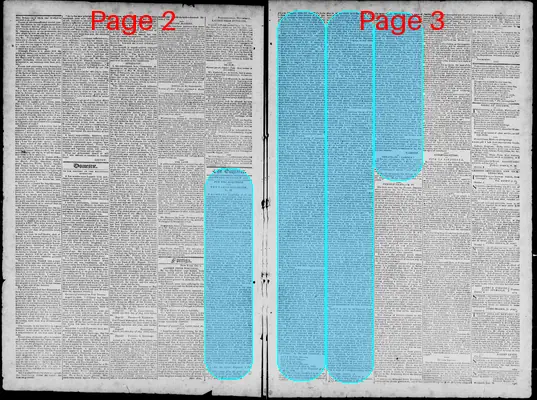
The Enquirer
Richmond, Henrico County, Virginia
What is this article about?
In this third installment, 'Camden' critiques the U.S. Supreme Court's decision in Fletcher v. Peck, arguing it was based on a feigned case designed to validate the corrupt 1795 Georgia Yazoo land sale. The author contends the Court ignored bribery in the legislature, misapplied contract law to statutes, and failed to uphold judicial integrity.
Merged-components note: Continuation of the same editorial series 'THE YAZOO DECISION No. III' by 'CAMDEN', spanning pages in reading order.
Clippings
1 of 2
OCR Quality
Full Text
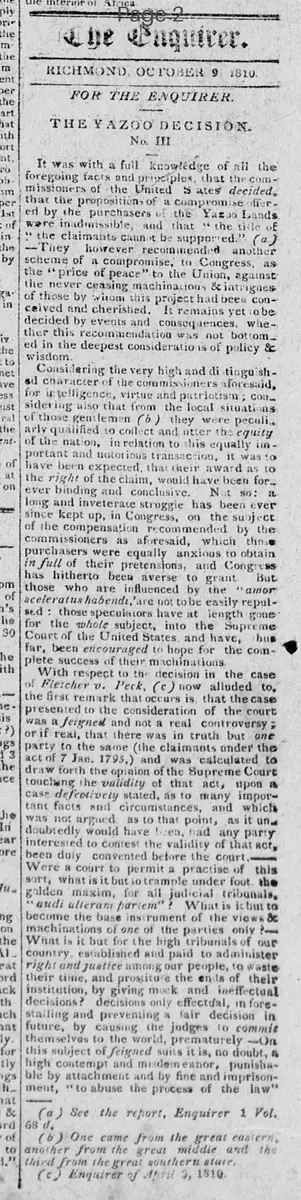
RICHMOND, OCTOBER 9 1810.
FOR THE ENQUIRER.
THE YAZOO DECISION.
No. III
It was with a full knowledge of all the foregoing facts and principles, that the commissioners of the United States decided, that the propositions of a compromise offered by the purchasers of the Yazoo Lands were inadmissible, and that "the title of the claimants cannot be supported." (a)—They however recommended another scheme of a compromise, to Congress, as the "price of peace" to the Union, against the never ceasing machinations & intrigues of those by whom this project had been conceived and cherished. It remains yet to be decided by events and consequences, whether this recommendation was not bottomed in the deepest considerations of policy & wisdom.
Considering the very high and distinguished character of the commissioners aforesaid, for intelligence, virtue and patriotism; considering also that from the local situations of those gentlemen (b) they were peculiarly qualified to collect and utter the equity of the nation, in relation to his equally important and notorious transaction, it was to have been expected, that their award as to the right of the claim, would have been for ever binding and conclusive.
Not so: a long and inveterate struggle has been ever since kept up, in Congress, on the subject of the compensation recommended by the commissioners as aforesaid, which those purchasers were equally anxious to obtain in full of their pretensions, and Congress has hitherto been averse to grant. But those who are influenced by the "animus sceleratus habendi," are not to be easily repulsed: those speculators have at length gone for the whole subject, into the Supreme Court of the United States and have, thus far, been encouraged to hope for the complete success of their machinations.
With respect to the decision in the case of Fletcher v. Peck, (c) now alluded to, the first remark that occurs is, that the case presented to the consideration of the court was a feigned and not a real controversy; or if real, that there was in truth but one party to the same (the claimants under the act of 7 Jan. 1795.) and was calculated to draw forth the opinion of the Supreme Court touching the validity of that act, upon a case defectively stated, as to many important facts and circumstances, and which was not argued as to that point, as it undoubtedly would have been, had any party interested to contest the validity of that act, been duly convened before the court.—
Were a court to permit a practise of this sort, what is it but to trample under foot, the golden maxim, for all judicial tribunals, "audi alteram partem"? What is it but to become the base instrument of the views & machinations of one of the parties only?—What is it but for the high tribunals of our country, established and paid to administer right and justice among our people, to waste their time, and prostitute the ends of their institution, by giving mock and ineffectual decisions? decisions only effectual, in forestalling and preventing a fair decision in future, by causing the judges to commit themselves to the world, prematurely—On this subject of feigned suits it is, no doubt, a high contempt and misdemeanor, punishable by attachment and by fine and imprisonment, "to abuse the process of the law"
to "impose upon the court"(e)-to forge writs or other deceits of the like "kind, tending to impose upon the court" (f) or, in fine, to "do any thing which demonstrates a gross want of that regard and respect which when once the courts of justice are deprived of, their authority, (so necessary to the good order of the state) is entirely lost among the people." (g)
(a) See the report, Enquirer 1 Vol. 68.
(b) One came from the great eastern another from the great middle and the third from the great southern state.
(c) Enquirer of April 3. 1810
Judge Johnson, in delivering his opinion in the case of Fletcher v. Peck, expressed himself in the following terms:- "I have been very unwilling to proceed to the decision of this cause at all. It appears to me to bear strong evidence, upon the face of it, of being a mere feigned case. It is our duty to decide on the rights, but not on the speculations of parties. My confidence, however, in the respectable gentlemen who have been engaged for the parties, has induced me to abandon my scruples, in the belief that they would never consent to impose a mere feigned case upon this court."(h)--Considering the delicacy which that gentleman might have deemed it proper for him to observe on this occasion, there can be no stronger averment that, in his judgment, the case in question was a mere feigned case, calculated to try, not the rights, but further the views and speculations of the parties to the project.--
It was too much to require that judge to sustain alone the whole odium, possibly resulting from making this objection, (I mean with these speculators, and their adherents, for it would have canonized him with the public) in this he ought, undoubtedly, to have been supported by the court itself.
According to my humble apprehension, if that high tribunal had received from the most humble individual, the least gleam of information, that a fraud of this kind had been practised upon it, it ought to have paused, and instantly have caused the proper enquiry to be instituted; and a fortiori, when one of the most respectable members of the bench had lodged the information, (if I may so express myself) and when the counsels concerned in the cause, and to whom the judge had made a delicate appeal upon the subject, did not deign to say to the court, that his suspicions and belief were entirely unfounded! -Whether these proceedings do not, on "the face of them," bear strong evidence of being a mere feigned case," I will now briefly enquire.
The action was an action of covenant, brought by Fletcher against Jno. Peck, on several covenants contained in a deed, whereby the latter conveyed to the former, certain lands, part of a large purchase made by James Gunn and others, from the Legislature of the State of Georgia, in the year 1795 (i) As most men who purchase lands, and especially those who make large and advantageous speculations therein, prefer getting a sure and indefeasible title to the lands themselves, rather than damages for the loss thereof, we may reasonably conclude that it was Fletcher's wish, if he really existed, (as it was undoubtedly his interest,) to have the validity of the purchase, under the act of Jan. 1795, established: So also this was undoubtedly the wish and interest of Peck; for I presume he is the same John Peck, who appears in the offer of a compromise to the commissioners of the United States before mentioned, to be a principal shareholder in the New England Mississippi Land Company, which indeed is fully admitted by his late MANIFESTO to the people of the United States, predicated upon the decision in question; and having sold to FLETCHER, only a "PART" of his land, he undoubtedly wished his title to the residue, to be established. Both the parties, therefore, wishing the same thing, (the establishment of the validity of the act of Jan. 1795,) it is entirely immaterial, whether FLETCHER WAS merely an IDEAL person, foisted in upon the court, to accomplish that end, or a REAL plaintiff, Whether real or ideal, there WAS, SUBSTANTIALLY, but one party before the court, (at least as to the point of the validity of the act of Jan. 1795,) and he wished the establishment of its validity, and was interested in making such a statement only, in the pleadings, as would effectuate that wish: There was no person before the court, interested to contest the validity of the act of 1795, to take care of the interests of the state of Georgia, or of the United States claiming under it, to insert the REAL FACTS of the case in the pleadings, and to rely upon the necessary points by counsel.--True, to this plan of proceeding, it will be found that the breach assigned upon the third covenant in the deed, (which is the most material) has exceedingly SOFTENED and MITIGATED the actual facts and circumstances of the transaction, That covenant is, that all the title which the state of Georgia ever had to the land in question, had been legally conveyed to JOHN PECK
The breach of this covenant, assigned by this pl'tff, or pretended pl'tff, is not, (as the fact is,) that "all" the members of the legislature who voted in favor of the act, except one, were actually, at the time of voting, bribed & corrupted for their votes, by being then actually shareholders in the purchase : it only states, in the milder terms that the original grantees from the state of Georgia, promised and assured "divers members of the legislature." that if the act passed, they "should have" a share of the lands purchased, by reason of which "promises" the said members were "unduly influenced," to pass the said act. Nothing can be more clear, than that this statement is exceedingly softened down, from the truth of the case, as developed in the documents already referred to (k), in almost all the material circumstances; and that it is such a statement only, as the defendant himself, under the guise of a feigned plaintiff, or as a plaintiff interested to lose the cause, would have made : it did not bring before the court, the strong and naked facts of the case The plea to this second count, thus whittled down to suit the views of the party, and the only party to the controversy, and yet to purport to embrace and draw forth from the court, its opinion on the great question of the validity of the act of January 1795, avers, and only avers, that neither the defendant Peck, nor Greenleaf who purchased from the original grantees, nor any mesne grantee between them, had any notice of the said "promises" to the members of the Georgia Legislature, until after the "purchase" by the said Greenleaf; the plea is wholly silent as to the actual payment of the purchase money, prior to the receipt of notice of the fraud, and yet judgment is given in favor of the said plea, upon a Demurrer !! Having had occasion to touch this subject of the necessity of averring and proving the actual payment of the purchase money, in my first number, I shall only now add, that I am at a loss to reconcile the decision of the supreme court, on this point, with the established doctrines of the English Courts and of the Supreme Court of the state of Virginia, as laid down in the cases then cited,
In delivering the opinion of the court upon the Demurrer to this plea, the Chief Justice seems to doubt, how far a court could, in any case, take notice of the "particular motives or inducements" operating on "the members of the Supreme sovereign power of a state" in the formation of a contract. Softly, if you please. Mr Chief Justice ! : the Georgia legislature of 1795, was not the "Supreme Sovereign power of the state." nor did it only act under the slight "motives and inducements," which the court, (chiming in with the defendant-plaintiff in this cause,) are pleased to ascribe to it. It was only an ordinary and limited legislature, acting under the influence of the grossest bribery and corruption : and even admitting that, on these pleadings, the court could not judicially know of the corruption I have detailed, in any stronger light than the parties have been pleased to state it, how came the court to forget that this was merely an ordinary legislature ?- This term "legislature," which is found everywhere in the pleadings themselves, ex vi termini means a limited & deputed authority, and must be taken, totally to exclude the idea, (in the American governments at least,) of the "supreme sovereign power" of the state
In the decision in question, the act of 7th January 1795, is everywhere considered as a contract, and not as an ordinary and repealable statute. It is also decided in the same case, that being a contract, it is not repealable by a succeeding legislature : if to this we add, (with the Supreme court,) that no fraud or corruption attending this "contract," in its origin or consummation, can let in a court of justice, to declare it void, what is it but to say, that a fraudulent legislative contract defies all remedy whatever, and that as the hands of both the judiciary and legislature are tied up from interfering in the case, a party who can succeed in corrupting a legislature, is free to run away with the plunder?! I have already said, in the first number, and that from high authority, that "fraud or covin within judgment of law, vacate every kind of contract." In order to sustain the opinion of the Supreme court on this point, we must either say, contrary to what they themselves have decided, that the act of January 1795 is no contract, or that a legislative contract stands, in this country, on higher ground, on account of the omnipotence of the legislature, than in England, which is contrary to the fact: but even in England where the omnipotence of Parliament is the admitted doctrine, if the parliament sometimes makes contracts, and if "fraud or covin vacates every kind of contracts," it follows that legislative contracts, in that country, (as I contend they do in this,) must submit to this just test of all contracts.
The Supreme Court then proceeds to say that the solemn question of the corruption of the Georgia legislature, cannot be brought "incidentally" before the Court, in a controversy between two individuals, respecting a part of the land sold by it and that "it would be indecent in the extreme, upon a private contract between two individuals, to enter into an enquiry into the corruption of the sovereign power of the state." The first answer I will give to this position, is, by repeating that this is not the act of a "sovereign," but of a subordinate power; and that as the question of corruption, goes to the bottom of the act, under which the parties profess to claim in this instance; it is a question presented directly & unavoidably, and not "incidentally," for the decision of the Court : As to the point of "indecency," it requires rather more consideration.
In the case of DaCosta v Jones (l) it was held, that although voluntary wagers which lead to indecent evidence, or disclosures contra bonos mores, shall not be sustained in a Court of justice, yet that the indecency of evidence is no objection, where it becomes necessary for the decision of a civil or criminal right ; and that wherever a question arises upon a real matter of right, although the interest of third persons, not parties thereto, may be affected, it shall nevertheless be tried. Applying this principle to the case of a limited and corrupted legislature, in a Government founded upon virtue, and where the people have a superior right to know of even the perfidy and baseness of their agents, it will certainly lose none of its force: In that case the right of the individual which gives rise to the introduction of such evidence, and that of the community at large, are the same.--But if, in the case put by the Supreme Court, it be indecent in the extreme, to enter into the enquiry stated, how came the court not only to enquire but actually to decide, that "the lands granted by the Act of 7 Jan. 1795, vested absolutely in James Gunn and others"?; a question nohow necessary to be decided, on the ground of defence set up in the case before us, which is that of being an innocent purchaser of the land, without notice!
Again it is said by the Supreme Court, that if the title be plainly deduced from a legislative act, which the legislature might constitutionally pass, if the act be clothed with all the requisite forms of a law, a court sitting as a Court of Law, cannot sustain a suit brought by one individual, founded on the allegation that the act is a nullity; in consequence of the impure motives which influenced certain members of the legislature, which passed the law."—This homage of the Supreme Court to the "requisite forms" of the act, proves too much: It proves that form, and no substance, is the order of the day with them : It would equally go to sustain the Acts of the Virginia Assembly passed in the year 1676, (for they had all the "requisite forms.") which were passed under the violence and duress of Bacon's rebellion, and at the point of his bayonets; but which, for that cause, were repealed, (legislative contracts and all.) as soon as that state of violence was removed (m).---There can be no essential difference as to the defect of free will, (the sine qua non of all contracts,) whether it be produced by the actual presentation of a bayonet, or by a state of corruption having entirely the same effect. While we are in quest of substance, there is no essential difference between the cases -But this act which is thus subscribed to by the judges, in deference to its "requisite forms," is also to be such an one as the legislature might "constitutionally" pass. While we are on the subject of the Constitution of Georgia, (or indeed of any other free Country,) is not the present a case which that constitution never contemplated ?; of a legislature being compelled to pass an act by military force, or what is equal thereto, by coercion arising from the foulest and most abominable corruption. Are not the great principles of moral justice a part of every free constitution in the universe? And is it not one of those principles, that a contract in order to be binding, must be freely and voluntarily entered into?--it is further said by the said Court, that a law "constitutionally passed" cannot be declared a nullity, in "a Court of law," in consequence of the "impure motives" which influenced certain members of the legislature which passed it.-Merely remarking, again, en passant, how the actual facts of this case are again softened, by the court, in using the terms certain members instead of the majority of the legislature, and in substituting impure motives for the grossest bribery and corruption, I must deny my assent to the first part of the position 'If the nullity of the act is enquireable into at all, in any Court, and between any parties, (which seems admitted by this position.) it is undoubtedly so enquireable into, between two individuals, if the case involves a real matter of right. What has been already said upon the subject of indecency of evidence, is conclusive upon this point. It is also enquireable into, in 'a Court of Law.' We are told by high authority that 'whether a transaction is fair or fraudulent is often a question of law : 'tis often the judgment of the law, upon facts and intents'(n )-Again it is said, that "Courts of Equity and of law, have a concurrent jurisdiction to suppress and relieve against frauds, but that the interposition of the former is often necessary to give more complete redress"(o )
It is believed that these authorities are complete to shew, that the jurisdiction of the Courts of Equity are concurrent with and auxiliary to, that of the law Courts, in the point in question, and that the former acts not in exclusion of the latter.
Such are some of the errors and inconsistencies into which the Supreme Court has suffered itself to be betrayed, in giving the decision in question ; a brief review and recapitulation of which, is reserved for my 5th and last number.
CAMDEN.
ERRATA-IN "CAMDEN."
In No. 1st.--2d column, line 35 for "shown" read "shown"--2d column, l. 49 for "inconjuncta" read "inconsueta"-2d column-note (h) for "Co.rep 80"-read "3d Co rep. 80".
3d column-l 6-for "conversant" read "conversant"-3d column-l 49-for "ever" read "even."
In No. 2d-1st column, line 36 from the bottom for "spectator"-insert "speculator"-- 2d column-l. 78-for "supenor" insert "supreme."
(d) 4 Bl. Com. 224 -
(e) 2 Hawk. 146--
(f) Ibid 154 --
(g) 4 Bl. Com. 285.-
(h) Enquirer of April 6, 1810.
(i) See the case in the Enquirer of the 3d April, 1810.
(k) The evidence contained in those documents was taken by order of the state of Georgia, and under its immediate superintendence.
(l) Com. reports 734
(m) Virg. laws old Code p. 7.
(n) 1 Burr 474-Slader v. Demattos.
(o) Ibid 96---Crisp v. Enyon.
What sub-type of article is it?
What keywords are associated?
What entities or persons were involved?
Editorial Details
Primary Topic
Critique Of Supreme Court Decision In Fletcher V. Peck On Yazoo Lands
Stance / Tone
Strongly Critical Of The Decision As Based On Feigned Case And Ignoring Corruption
Key Figures
Key Arguments