Thank you for visiting SNEWPapers!
Sign up free
Foreign News
June 23, 1788
The Daily Advertiser
New York, New York County, New York
What is this article about?
In the British House of Commons, Mr. Sheridan criticizes Mr. Hastings' abilities and conduct as Governor-General of India, portraying him as embodying the flawed, mercantile policy of the East India Company, which mixes empire with trade in absurd ways.
Clipping
OCR Quality
98%
Excellent
Full Text
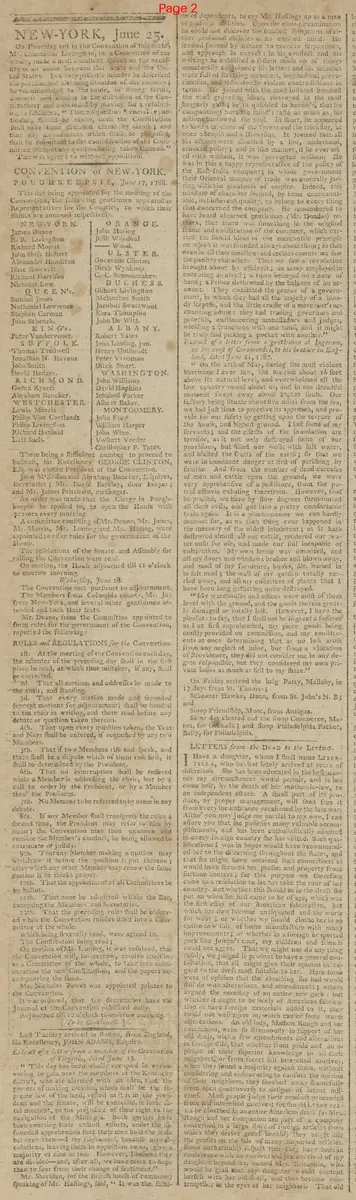
Mr. Sheridan, in the British house of commons, speaking of Mr. Hastings, said, "It was the fashion of dependents, to cry Mr. Hastings up as a man of profound abilities. Upon the closest examination he could not discover the smallest symptoms of either profound abilities or an excited mind. He seemed formed by nature to move in serpentine, and approach in curves: in his conduct and his writings he exhibited a system made up of things unnaturally conjoined; his letters and his minutes were full of strutting meanness, bombastical prevication, and ridiculously violent contradictions in terms. He joined with the most inflated bombast the most groveling ideas, conveyed in the most beggarly garb; he so quibbled in heroics, that his compositions hurt the mind's taste as much as his actions harrowed the soul. In short, he appeared to have a mixture of the tyrant and the trickster, at once a Scapin and a Dionysius. It seemed that all his actions were directed by a low, underhand, crooked policy; and in like manner, if he ever acted with wisdom, it was perverted wisdom. He was in this a happy representative of the policy of the East-India company; in whose government their Oriental manner of trade was eternally jarring with the greatness of empire. Indeed, this mixture of character seemed, by some unaccountable, but inherent quality, to belong to every thing that concerned the company. He remembered to have heard a learned gentleman (Mr. Dundas) remark, that there was something in the original frame and constitution of the company, which carried the sordid ideas of the mercantile principle on which it was founded always about them; so that even in all their measures and achievements we saw the paltry character. Thus we saw a revolution brought about by affidavit; an army employed in executing an arrest; a town besieged on a note of hand; a Prince dethroned by the balance of an account. They exhibited the genius of a government, in which they had all the majesty of a bloody sceptre, and the little traffic of a merchant's accounting house: they had trading governors and generals, auctioneering ambassadors and judges, wielding a truncheon with one hand, and it might be truly said picking a pocket with another."
What sub-type of article is it?
Colonial Affairs
Political
What keywords are associated?
Sheridan Speech
Hastings Criticism
East India Company
Colonial Policy
British Parliament
What entities or persons were involved?
Mr. Sheridan
Mr. Hastings
Mr. Dundas
Where did it happen?
East India
Foreign News Details
Primary Location
East India
Key Persons
Mr. Sheridan
Mr. Hastings
Mr. Dundas
Event Details
Mr. Sheridan delivers a speech in the British House of Commons criticizing Mr. Hastings' character, abilities, and actions as representative of the East India Company's flawed policy that mixes trade with imperial governance, citing examples of absurd administrative practices.