Thank you for visiting SNEWPapers!
Sign up free
The New Hampshire Gazette
Portsmouth, Rockingham County, New Hampshire
What is this article about?
Editorial analysis from Washington Monitor on US relations with France and Britain, critiquing Napoleon's Berlin Decree and British Orders in Council for disrupting neutral trade, advocating the US embargo as a wise measure amid expectations of political upheaval.
Clipping
OCR Quality
Full Text
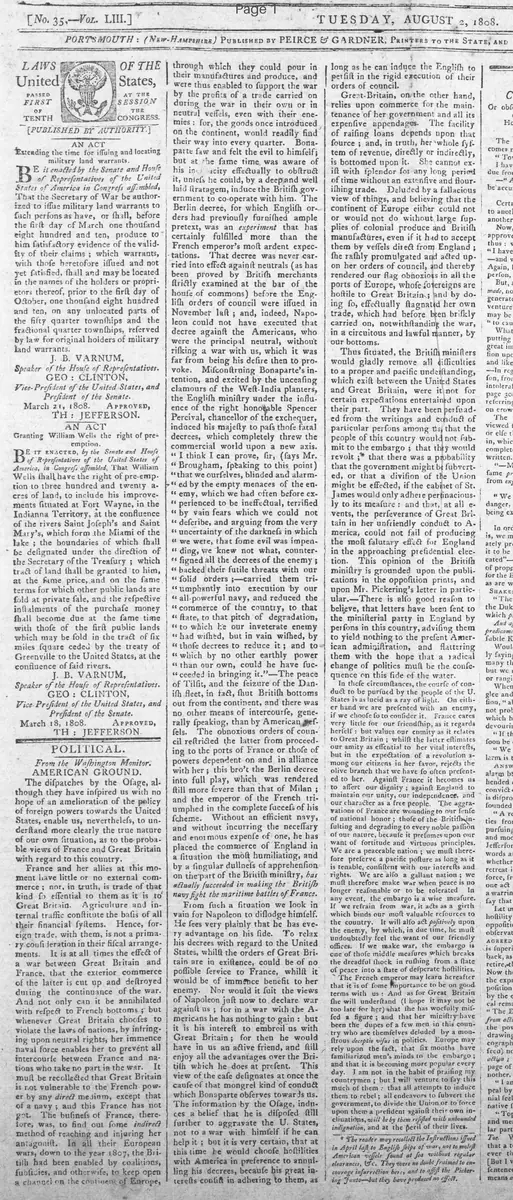
From the Washington Monitor.
AMERICAN GROUND.
The dispatches by the Osage, although they have inspired us with no hope of an amelioration of the policy of foreign powers towards the United States, enable us, nevertheless, to understand more clearly the true nature of our own situation, as to the probable views of France and Great Britain with regard to this country.
France and her allies at this moment have little or no external commerce; nor, in truth, is trade of that kind so essential to them as it is to Great Britain. Agriculture and internal traffic constitute the basis of all their financial systems. Hence, foreign trade, with them, is not a primary consideration in their fiscal arrangements. It is at all times the effect of a war between Great Britain and France, that the exterior commerce of the latter is cut up and destroyed during the continuance of the war. And not only can it be annihilated with respect to French bottoms; but whenever Great Britain chooses to violate the laws of nations, by infringing upon neutral rights, her immense naval force enables her to prevent all intercourse between France and nations who take no part in the war. It must be recollected that Great Britain is not vulnerable to the French power by any direct medium, except that of a navy; and this France has not got. The business of France, therefore, was, to find out some indirect method of reaching and injuring her antagonist. In all their European wars, down to the year 1807, the British had been enabled by coalitions, subsidies, and otherwise, to keep open a channel on the continent of Europe, through which they could pour in their manufactures and produce, and were thus enabled to support the war by the profits of a trade carried on during the war in their own or in neutral vessels, even with their enemies: for, the goods once introduced on the continent, would readily find their way into every quarter. Bonaparte saw and felt the evil to himself; but at the same time was aware of his incapacity effectually to obstruct it, unless he could, by a deep and well laid stratagem, induce the British government to co-operate with him. The Berlin decree, for which English orders had previously furnished ample pretext, was an experiment that has certainly fulfilled more than the French emperor's most ardent expectations. That decree was never carried into effect against neutrals (as has been proved by British merchants strictly examined at the bar of the house of commons) before the English orders of council were issued in November last: and, indeed, Napoleon could not have executed that decree against the Americans, who were the principal neutral, without risking a war with us, which it was far from being his desire then to provoke. Misconstruing Bonaparte's intention, and excited by the unceasing clamours of the West-India planters, the English ministry under the influence of the right honorable Spencer Percival, chancellor of the exchequer, induced his majesty to pass those fatal decrees, which completely threw the commercial world upon a new axis.
"I think I can prove, sir, (says Mr. Brougham, speaking to this point) that we ourselves, blinded and alarmed by the empty menaces of the enemy, which we had often before experienced to be ineffectual, terrified by vain fears which we could not describe, and arguing from the very uncertainty of the darkness in which we were, that some evil was impending, we knew not what, counter-signed all the decrees of the enemy; backed their futile threats with our solid orders;—carried them triumphantly into execution by our all-powerful navy, and reduced the commerce of the country, to that state, to that pitch of degradation, to which he our inveterate enemy had wished, but in vain wished, by those decrees to reduce it: and to which by no other earthly power than our own, could he have succeeded in bringing it."
The peace of Tilsit, and the seizure of the Danish fleet, in fact, shut British bottoms out from the continent, and there was no other means of intercourse, generally speaking, than by American vessels. The obnoxious orders of council restricted the latter from proceeding to the ports of France or those of powers dependent on and in alliance with her; this brought the Berlin decree into full play, which was rendered still more severe than that of Milan; and the emperor of the French triumphed in the complete success of his scheme. Without an efficient navy, and without incurring the necessary and enormous expense of one, he has placed the commerce of England in a situation the most humiliating, and by a singular dullness of apprehension on the part of the British ministry, has actually succeeded in making the British navy fight the maritime battles of France.
From such a situation we look in vain for Napoleon to dislodge himself. He sees very plainly that he has every advantage on his side. To relax his decrees with regard to the United States, whilst the orders of Great Britain are in existence, could be of no possible service to France, whilst it would be of immense benefit to her enemy. Nor would it suit the views of Napoleon just now to declare war against us; for in a war with the Americans he has nothing to gain: but it is his interest to embroil us with Great Britain: for then he would have in us an active friend, and still enjoy all the advantages over the British which he does at present. This view of the case designates at once the cause of that mongrel kind of conduct which Bonaparte observes towards us. The information by the Osage, induces a belief that he is disposed still further to aggravate the U. States, not to a war with himself if he can help it; but it is very certain, that at this time he would choose hostilities with America in preference to annulling his decrees, because his great interests consist in adhering to them, as long as he can induce the English to persist in the rigid execution of their orders of council.
Great-Britain, on the other hand, relies upon commerce for the maintenance of her government and all its expensive appendages. The facility of raising loans depends upon that source; and, in truth, her whole system of revenue, directly or indirectly, is bottomed upon it. She cannot exist with splendor for any long period of time without an extensive and flourishing trade. Deluded by a fallacious view of things, and believing that the continent of Europe either could not or would not do without large supplies of colonial produce and British manufactures, even if it had to accept them by vessels direct from England; she rashly promulgated and acted upon her orders of council, and thereby rendered our flag obnoxious in all the ports of Europe, whose sovereigns are hostile to Great Britain; and by doing so, effectually stagnated her own trade, which had before been briskly carried on, notwithstanding the war, in a circuitous and lawful manner, by our bottoms.
Thus situated, the British ministers would gladly remove all difficulties to a proper and pacific understanding, which exist between the United States and Great Britain, were it not for certain expectations entertained upon their part. They have been persuaded from the writings and conduct of particular persons among us, that the people of this country would not submit to the embargo; that they would revolt;* that there was a probability that the government might be subverted, or that a division of the Union might be effected, if the cabinet of St. James would only adhere pertinaciously to its measures: and that, at all events, the perseverance of Great Britain in her unfriendly conduct to America, could not fail of producing the most salutary effect for England in the approaching presidential election. This opinion of the British ministry is grounded upon the publications in the opposition prints, and upon Mr. Pickering's letter in particular.—There is also good reason to believe, that letters have been sent to the ministerial party in England by persons in this country, advising them to yield nothing to the present American administration, and flattering them with the hope that a radical change of politics must be the consequence on this side of the water.
In these circumstances, the course of conduct to be pursued by the people of the U. States is as lucid as a ray of light. On either hand we are presented with an enemy, if we choose so to consider it. France cares very little for our friendship, as it regards herself: but values our enmity as it relates to Great Britain; whilst the latter estimates our amity as essential to her vital interests, but in the expectation of a revolution among our citizens in her favor, rejects the olive branch that we have so often presented to her. Against France it becomes us to assert our dignity; against England to maintain our unity, our independence, and our character as a free people. The aggravations of France are wounding to our sense of national honor; those of the British insulting and degrading to every noble passion of our nature, because it presumes upon our want of fortitude and virtuous principles.
We are a peaceable nation; we must therefore preserve a pacific posture as long as it is tenable, consistent with our interests and rights. We are also a gallant nation; we must therefore make war when peace is no longer reasonable or to be tolerated. In any event, the embargo is a wise measure. If we refrain from war, it acts as a girdle which binds our most valuable resources to the country. It will also act positively upon the enemy, by which, in due time, he must undoubtedly feel the want of our friendly offices. If we make war, the embargo is one of those middle measures which breaks the dreadful shock in rushing from a state of peace into a state of desperate hostilities.
The French emperor may learn hereafter that it is of some importance to be on good terms with us: And as for Great Britain she will understand (I hope it may not be too late for her) that she has woefully miscalculated; and that her ministry have been the dupes of a few men in this country who are themselves deluded by a monstrous deception visus in politics. Europe may rely upon the fact, that six months have familiarized men's minds to the embargo; and that it is becoming more popular every day. I am not in the habit of praising my countrymen; but I will venture to say this much of them: that all attempts to induce them to rebel; all endeavors to subvert the government, to divide the Union, or to force upon them a president against their own inclinations, will be by them resisted with unbounded indignation, and at the peril of their lives.
* The reader may recollect the Instructions issued in April last to English ships of war, not to molest American vessels found at sea without regular clearances, &c. They were no doubt framed to encourage insurrection here, and to assist the Pickering Faction—but they have produced no effect.
What sub-type of article is it?
What keywords are associated?
What entities or persons were involved?
Where did it happen?
Foreign News Details
Primary Location
France And Great Britain
Event Date
As Of Dispatches By The Osage, Referencing 1807 And November Last
Key Persons
Outcome
stagnation of british commerce, success of french continental blockade via berlin decree and milan decree, us embargo gaining popularity and resisting subversion attempts
Event Details
Analysis of French and British policies disrupting US neutral trade through Berlin Decree and Orders in Council, Napoleon's strategy to indirectly harm Britain using US as neutral intermediary, British expectations of US political upheaval, advocacy for maintaining embargo and national unity.