Thank you for visiting SNEWPapers!
Sign up free
The Sun
New York, New York County, New York
What is this article about?
The Taiping Rebellion in China ends with the capture of Nankin on July 19, aided by foreign (mainly English) forces including Col. Gordon. Rebel leaders are captured or killed, Heavenly King commits suicide. The event opens Nankin to French commerce, benefiting Britain and the US, amid reports of Chinese barbarities.
Clipping
OCR Quality
Full Text
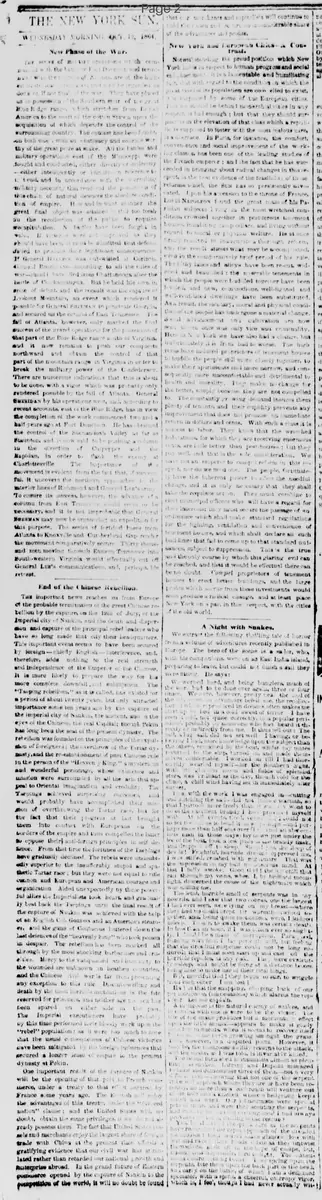
The important news reaches us from Europe of the probable termination of the great Chinese rebellion by the capture, on the 19th of July, of the Imperial city of Nankin, and the death and dispersion and capture of the principal rebel leaders who have so long made that city their headquarters.
This important event seems to have been secured by foreign—chiefly English—interference, and, therefore, adds nothing to the real strength and independence of the Emperor of the Chinese.
It is more likely to prepare the way for his more complete downfall and subjugation. The Taeping rebellion, as it is called, has existed for a period of about twenty years. Lately attracted importance some ten years ago by the capture of the imperial city of Nankin, the ancient, and in the eyes of the Chinese, the real Capital: though Pekin has long been the seat of the present dynasty. The rebellion was founded on the principles of the expulsion of foreigners; the overthrow of the Tartar dynasty, and the re-establishment of pure Chinese rule in the person of the "Heavenly King," a mysterious and wonderful personage, whose existence and mission were surrounded by all the arts that appeal to Oriental imagination and credulity. The Taepings achieved surprising feats and would probably have succeeded in their mission of overthrowing the Manchu race, but for the fact that their progress at last brought them into contact with Europeans on the borders of the empire and thus compelled the latter to oppose their anti-foreign principles in self-defense. From that time the fortunes of the Taepings have gradually declined. The rebels were undoubtedly superior to the insufferably stupid and arrogant Tartar race: but they were not equal to rifle cannon and European and American courage and organization. Aided unexpectedly by these powerful allies the Imperialists took heart and gradually drove back the Taepings until the final result of the capture of Nankin was achieved with the help of an English Col. Gordon and an American steamer, and the guns of Confucius' temple lowered the last defences of the "heavenly king" who took poison in despair. The rebellion has been marked all through by the most shocking barbarities and cruelties. Mercy to the vanquished and humanity to the wounded are unknown in heathen countries, and the Chinese civil war is far from being any exception to this rule. Devilling and death by the most horrible mutilations is the fate reserved for prisoners, and neither sex nor age had been spared on either side in the past.
The Imperial executioners have probably by this time performed their bloody work upon the rebels' population: as it will be too much to hope that the usual consequences of Chinese victories have been mitigated by those foreign influences that secured a longer season of empire to the present dynasty at Pekin.
One important result of the capture of Nankin will be the opening of that port to French commerce, under a treaty to that effect signed by France some years ago. The British will enjoy the advantages of this treaty, since the most favored nation clause; and the United States will no doubt obtain the same privileges if we do not already possess them. The fact that United States vessels and merchants enjoy the largest share of free trade with China at the present time gives gratifying evidence that our civil war has stimulated rather than retarded our national growth and enterprise abroad. In the grand future of Eastern commerce opened by the capture of Nankin to the competition of the world, it will no doubt be found with that U.S. and capital's will continue to hold a considerable share of the advantages in trade.
What sub-type of article is it?
What keywords are associated?
What entities or persons were involved?
Where did it happen?
Foreign News Details
Primary Location
Nankin
Event Date
19th Of July
Key Persons
Outcome
capture of nankin, death and dispersion and capture of principal rebel leaders, heavenly king took poison in despair, opening of nankin to french commerce benefiting britain and united states
Event Details
The Taiping rebellion, lasting about twenty years, ends with the foreign-aided capture of Nankin on July 19, leading to the defeat of rebels superior to Imperialists but overcome by European and American forces including Col. Gordon and an American steamer. The rebellion involved anti-foreign principles, overthrow of Tartar dynasty, shocking barbarities, and now results in probable mass executions.