Thank you for visiting SNEWPapers!
Sign up free
Story
March 17, 1845
Alexandria Gazette
Alexandria, Alexandria County, District Of Columbia
What is this article about?
A narrator overhears a beggar and banker debating equality on the street, with the beggar arguing they are essentially the same despite social differences. Years later, both die, their graves equally forgotten, highlighting eternal equality beyond worldly distinctions.
Clipping
OCR Quality
92%
Excellent
Full Text
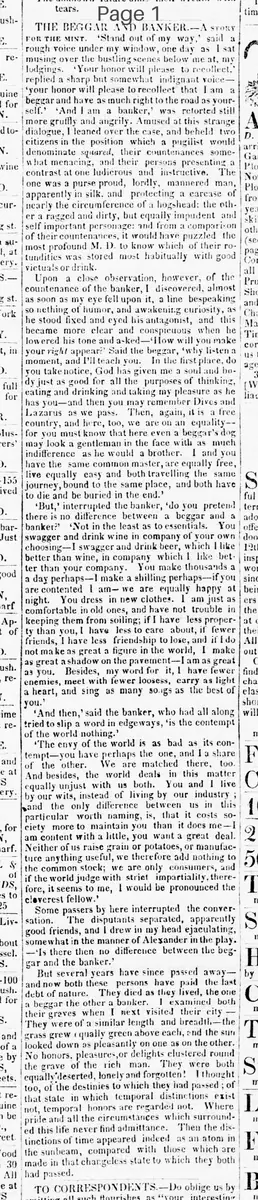
THE BEGGAR AND BANKER.-A STORY
FOR THE MIND. 'Stand out of my way.' said a
rough voice under my window, one day as I sat
musing over the bustling scenes below me at my
lodgings. 'Your honor will please to recollect.
replied a sharp but somewhat indignant voice-
'your honor will please to recollect that I am a
beggar and have as much right to the road as your-
self.' 'And I am a banker,' was retorted still
more gruffly and angrily. Amused at this strange
dialogue, I leaned over the casing, and beheld two
citizens in the position which a pugilist would
denominate squared, their countenances some-
what menacing, and their persons presenting a
contrast at one ludicrous and instructive. The
one was a purse proud, lordly, mannered man,
apparently in silk. and protecting a carcase of
nearly the circumference of a hogshead: the oth-
er a ragged and dirty, but equally impudent and
self important personage: and from a comparison
of their countenances, it would have puzzled the
most profound M. D. to know which of their ro-
tundities was stored most habitually with good
victuals or drink.
Upon a close observation, however, of the
countenance of the banker, I discovered, almost
as soon as my eye fell upon it, a line bespeaking
something of humor, and awakening curiosity, as
he stood fixed and eyed his antagonist, and this
became more clear and conspicuous when he
lowered his tone and asked-'How will you make
your right appear?' Said the beggar, 'why listen a
moment, and I'll teach you. In the first place, do
you take notice, God has given me a soul and bo-
dy just as good for all the purposes of thinking.
eating and drinking and taking my pleasure as he
has you-and then you may remember Dives and
Lazarus as we pass. Then, again, it is a free
country, and here, too, we are on an equality--
for you must know that here even a beggar's dog
may look a gentleman in the face with as much
indifference as he would a brother. I and you
have the same common master, are equally free,
live equally easy and both travelling the same
journey, bound to the same place, and both have
to die and be buried in the end.'
'But,' interrupted the banker, 'do you pretend
there is no difference between a beggar and a
banker?' 'Not in the least as to essentials. You
swagger and drink wine in company of your own
choosing-I swagger and drink beer, which I like
better than wine, in company which I like bet-
ter than your company. You make thousands a
day perhaps-I make a shilling perhaps--if you
are contented I am- we are equally happy at
night. You dress in new clothes. I am just as
comfortable in old ones, and have not trouble in
keeping them from soiling; if I have less proper-
ty than you, I have less to care about, if fewer
friends, I have less friendship to lose, and if I do
not make as great a figure in the world, I make
as great a shadow on the pavement-I am as great
as you. Besides, my word for it, I have fewer
enemies, meet with fewer losses, carry as light
a heart, and sing as many songs as the best of
you.'
'And then,' said the banker, who had all along
tried to slip a word in edgeways, 'is the contempt
of the world nothing.'
'The envy of the world is as bad as its con-
tempt-you have perhaps the one, and I a share
of the other. We are matched there, too.
And besides, the world deals in this matter
equally unjust with us both. You and I live
by our wits, instead of living by our industry ;
and the only difference between us in this
particular worth naming, is, that it costs so-
ciety more to maintain you than it does me-I
am content with a little, you want a great deal.
Neither of us raise grain or potatoes, or manufac-
ture anything useful, we therefore add nothing to
the common stock; we are only consumers, and
if the world judge with strict impartiality, there-
fore, it seems to me, I would be pronounced the
cleverest fellow.'
Some passers by here interrupted the conver-
sation. The disputants separated, apparently
good friends, and I drew in my head ejaculating,
somewhat in the manner of Alexander in the play.
-'Is there then no difference between the beg-
gar and the banker.'
But several years have since passed away-
and now both these persons have paid the last
debt of nature. They died as they lived, the one
a beggar the other a banker. I examined both
their graves when I next visited their city -
They were of a similar length and breadth-the
grass grew equally green above each, and the sun
looked down as pleasantly on one as on the other.
No honors, pleasures, or delights clustered round
the grave of the rich man. They were both
equally deserted, lonely and forgotten! I thought
too, of the destinies to which they had passed ; of
that state in which temporal distinctions exist
not, temporal honors are regarded not. Where
pride and all the circumstances which surround-
ed this life never find admittance. Then the dis-
tinctions of time appeared indeed as an atom in
the sunbeam, compared with those which are
made in that changeless state to which they both
had passed.
FOR THE MIND. 'Stand out of my way.' said a
rough voice under my window, one day as I sat
musing over the bustling scenes below me at my
lodgings. 'Your honor will please to recollect.
replied a sharp but somewhat indignant voice-
'your honor will please to recollect that I am a
beggar and have as much right to the road as your-
self.' 'And I am a banker,' was retorted still
more gruffly and angrily. Amused at this strange
dialogue, I leaned over the casing, and beheld two
citizens in the position which a pugilist would
denominate squared, their countenances some-
what menacing, and their persons presenting a
contrast at one ludicrous and instructive. The
one was a purse proud, lordly, mannered man,
apparently in silk. and protecting a carcase of
nearly the circumference of a hogshead: the oth-
er a ragged and dirty, but equally impudent and
self important personage: and from a comparison
of their countenances, it would have puzzled the
most profound M. D. to know which of their ro-
tundities was stored most habitually with good
victuals or drink.
Upon a close observation, however, of the
countenance of the banker, I discovered, almost
as soon as my eye fell upon it, a line bespeaking
something of humor, and awakening curiosity, as
he stood fixed and eyed his antagonist, and this
became more clear and conspicuous when he
lowered his tone and asked-'How will you make
your right appear?' Said the beggar, 'why listen a
moment, and I'll teach you. In the first place, do
you take notice, God has given me a soul and bo-
dy just as good for all the purposes of thinking.
eating and drinking and taking my pleasure as he
has you-and then you may remember Dives and
Lazarus as we pass. Then, again, it is a free
country, and here, too, we are on an equality--
for you must know that here even a beggar's dog
may look a gentleman in the face with as much
indifference as he would a brother. I and you
have the same common master, are equally free,
live equally easy and both travelling the same
journey, bound to the same place, and both have
to die and be buried in the end.'
'But,' interrupted the banker, 'do you pretend
there is no difference between a beggar and a
banker?' 'Not in the least as to essentials. You
swagger and drink wine in company of your own
choosing-I swagger and drink beer, which I like
better than wine, in company which I like bet-
ter than your company. You make thousands a
day perhaps-I make a shilling perhaps--if you
are contented I am- we are equally happy at
night. You dress in new clothes. I am just as
comfortable in old ones, and have not trouble in
keeping them from soiling; if I have less proper-
ty than you, I have less to care about, if fewer
friends, I have less friendship to lose, and if I do
not make as great a figure in the world, I make
as great a shadow on the pavement-I am as great
as you. Besides, my word for it, I have fewer
enemies, meet with fewer losses, carry as light
a heart, and sing as many songs as the best of
you.'
'And then,' said the banker, who had all along
tried to slip a word in edgeways, 'is the contempt
of the world nothing.'
'The envy of the world is as bad as its con-
tempt-you have perhaps the one, and I a share
of the other. We are matched there, too.
And besides, the world deals in this matter
equally unjust with us both. You and I live
by our wits, instead of living by our industry ;
and the only difference between us in this
particular worth naming, is, that it costs so-
ciety more to maintain you than it does me-I
am content with a little, you want a great deal.
Neither of us raise grain or potatoes, or manufac-
ture anything useful, we therefore add nothing to
the common stock; we are only consumers, and
if the world judge with strict impartiality, there-
fore, it seems to me, I would be pronounced the
cleverest fellow.'
Some passers by here interrupted the conver-
sation. The disputants separated, apparently
good friends, and I drew in my head ejaculating,
somewhat in the manner of Alexander in the play.
-'Is there then no difference between the beg-
gar and the banker.'
But several years have since passed away-
and now both these persons have paid the last
debt of nature. They died as they lived, the one
a beggar the other a banker. I examined both
their graves when I next visited their city -
They were of a similar length and breadth-the
grass grew equally green above each, and the sun
looked down as pleasantly on one as on the other.
No honors, pleasures, or delights clustered round
the grave of the rich man. They were both
equally deserted, lonely and forgotten! I thought
too, of the destinies to which they had passed ; of
that state in which temporal distinctions exist
not, temporal honors are regarded not. Where
pride and all the circumstances which surround-
ed this life never find admittance. Then the dis-
tinctions of time appeared indeed as an atom in
the sunbeam, compared with those which are
made in that changeless state to which they both
had passed.
What sub-type of article is it?
Curiosity
What themes does it cover?
Moral Virtue
Social Manners
Fate Providence
What keywords are associated?
Beggar Banker Debate
Social Equality
Death Equality
Moral Lesson
Philosophical Dialogue
What entities or persons were involved?
Beggar
Banker
Narrator
Where did it happen?
Under Narrator's Window In A City
Story Details
Key Persons
Beggar
Banker
Narrator
Location
Under Narrator's Window In A City
Story Details
Narrator witnesses beggar assert equality to banker in street argument, citing shared soul, freedom, and fate; they part amicably. Years later, both die, graves identical and forgotten, emphasizing eternal equality.