Thank you for visiting SNEWPapers!
Sign up free
Editorial
March 19, 1849
The New York Herald
New York, New York County, New York
What is this article about?
The editorial analyzes the emerging strategy of President Taylor's administration, highlighting Secretary Clayton's dominant role in appointments to conciliate key congressional figures like Webster and Benton, aiming to build a lasting Whig dynasty by incorporating elements of the defeated democracy, while cautioning on potential cabinet errors.
Clipping
OCR Quality
98%
Excellent
Full Text
The New Administration—The Mystery Unfolded.
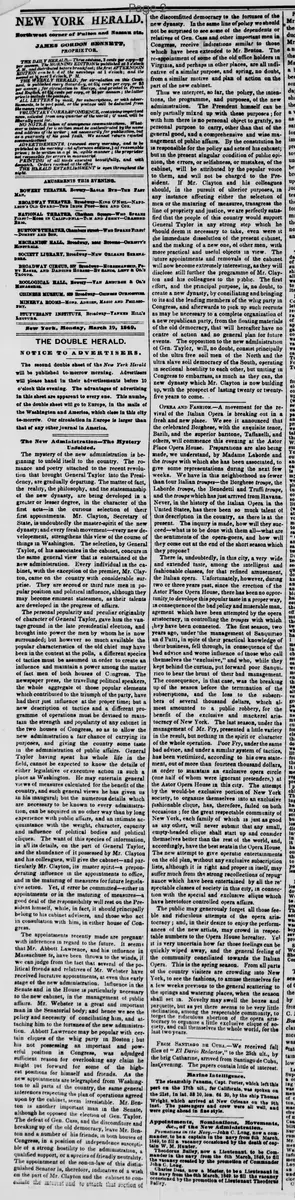
The mystery of the new administration is beginning to unfold itself to the country. The romance and poetry attached to the recent revolution that brought General Taylor into the Presidency, are gradually departing. The matter of fact, the reality, the philosophy, and the statesmanship of the new dynasty, are being developed in a greater or lesser degree, in the character of the first acts—in the curious selection of their first appointments. Mr. Clayton, Secretary of State, is undoubtedly the master-spirit of the new dynasty; and every fresh movement—every new development, strengthens this view of the course of things in Washington. The selection, by General Taylor, of his associates in the cabinet, concurs in the same general view that is entertained of the new administration. Every individual in the cabinet, with the exception of the premier, Mr. Clayton, came on the country with considerable surprise. They are second or third rate men in popular position and political influence, although they may become eminent statesmen, as their talents are developed in the progress of affairs.
The personal popularity and peculiar originality of character of General Taylor, gave him the vantage ground in the late presidential election, and brought into power the men by whom he is now surrounded; but however so much available the popular characteristics of the old chief may have been in the contest at the polls, a different species of tactics must be assumed in order to create an influence and maintain a power among the matter of fact men of both houses of Congress. The newspaper press, the travelling political speakers, the whole aggregate of those popular elements which contributed to the triumph of the party, have had their just influence at the proper time; but a new description of tactics and a different programme of operations must be devised to maintain the strength and popularity of any cabinet in the two houses of Congress, so as to allow the new administration a fair chance of carrying its purposes, and giving the country some taste in the administration of public affairs. General Taylor having spent his whole life in the field, cannot be expected to know the details of either legislative or executive action in such a place as Washington. He may entertain general views of measures calculated for the benefit of the country, and such general views he has given us in his inaugural; but the numerous details which are necessary to be known to every administration, can be acquired in no other way than by long experience with public affairs, and an intimate acquaintance with the weight, character, capacity and influence of political bodies and political cliques. The want of this species of information, in all its details, on the part of General Taylor, and the abundance of it possessed by Mr. Clayton and his colleagues, will give the cabinet—and particularly Mr. Clayton, its master spirit—a preponderating influence in the appointments to office, and in the maturing of measures for future legislative action. Yet, if error be committed—either in appointments or in the maturing of measures—a good deal of the responsibility will rest on the President himself, while, in fact, it should principally belong to his cabinet advisers, and those who act in consultation with him, in either house of Congress.
The appointments recently made are pregnant with inferences in regard to the future. It seems that Mr. Abbott Lawrence, and his influence in Massachusetts, have been thrown to the winds, if we can judge from the fact that several of the political friends and relatives of Mr. Webster have received lucrative appointments, at even this early stage of the new administration. Influence in the Senate and in the House is particularly necessary to the new cabinet, in the management of public affairs. Mr. Webster is a great and important man in the Senatorial body; and hence we see the policy and necessity of conciliating him, and attaching him to the fortunes of the new administration. Abbott Lawrence may be popular with certain cliques of the whig party in Boston; but his not possessing an important and powerful position in Congress, was adjudged sufficient reason for overlooking any claim he might put forward for some of the highest positions for himself and friends. As the new appointments are telegraphed from Washington to all parts of the country, the same general inferences respecting the plan of operations agreed upon by the cabinet, seem irresistible. Mr. Benton is another important man in the Senate, although he opposed the election of Gen. Taylor. The defeat of Gen. Cass, and the discomfiture and breaking up of the old democracy, leave Mr. Benton and a number of his friends, in both houses of Congress, in a position of independence susceptible of a strong hostility to the administration, a qualified support, or a species of friendly neutrality. The appointment of the son-in-law of this distinguished Senator is, therefore, indicative of a wish on the part of Mr. Clayton and the cabinet to conciliate the interest and to attach that section of the discomfited democracy to the fortunes of the new dynasty. In the same line of policy we should not be surprised to see some of the dependents or relatives of Gen. Cass and other important men in Congress, receive indications similar to those which have been extended to Mr. Benton. The re-appointment of some of the old office holders in Virginia, and perhaps in other places, are all indicative of a similar purpose, and spring, no doubt, from a similar motive and plan of action on the part of the new cabinet.
Thus we interpret, so far, the policy, the intentions, the programme, and purposes, of the new administration. The President himself can be only partially mixed up with these purposes; for with him there is no personal object to gratify, no personal purpose to carry, other than that of the general good, and a comprehensive and wise management of public affairs. By the constitution he is responsible for the policy and acts of his cabinet; but in the present singular condition of public opinion, the errors, or selfishness, or mistakes, of the cabinet, will be attributed by the popular voice to them, and will not be charged to the President. If Mr. Clayton and his colleagues should, in the pursuit of ulterior purposes, in any instance affecting either the selection of men or the maturing of measures, transgress the line of propriety and justice, we are perfectly satisfied that the people of this country would support General Taylor in any strong step which he should deem it necessary to take, even were it the immediate dissolution of the present cabinet, and the making of a new one, of other men, with more practical and useful objects in view. The future appointments and removals of the cabinet will now become extremely interesting, as they will disclose still further the programme of Mr. Clayton and his colleagues to the public. The first effort, and the principal purpose, is, no doubt, to create a new dynasty, by conciliating and bringing to its aid the leading members of the whig party in Congress, and afterwards to pick up such recruits as may be necessary to a complete organization of a new republican party, from the floating materials of the old democracy, that will hereafter have no centre of action and no general plan for future events. The opposition to the new administration of Gen. Taylor, will, no doubt, consist principally of the ultra free soil men of the North and the ultra slave soil democracy of the South, operating in sectional hostility to each other, but uniting in Congress to embarrass, as much as they can, the new dynasty which Mr. Clayton is now building up, with the prospect of lasting twenty or twenty-five years to come.
The mystery of the new administration is beginning to unfold itself to the country. The romance and poetry attached to the recent revolution that brought General Taylor into the Presidency, are gradually departing. The matter of fact, the reality, the philosophy, and the statesmanship of the new dynasty, are being developed in a greater or lesser degree, in the character of the first acts—in the curious selection of their first appointments. Mr. Clayton, Secretary of State, is undoubtedly the master-spirit of the new dynasty; and every fresh movement—every new development, strengthens this view of the course of things in Washington. The selection, by General Taylor, of his associates in the cabinet, concurs in the same general view that is entertained of the new administration. Every individual in the cabinet, with the exception of the premier, Mr. Clayton, came on the country with considerable surprise. They are second or third rate men in popular position and political influence, although they may become eminent statesmen, as their talents are developed in the progress of affairs.
The personal popularity and peculiar originality of character of General Taylor, gave him the vantage ground in the late presidential election, and brought into power the men by whom he is now surrounded; but however so much available the popular characteristics of the old chief may have been in the contest at the polls, a different species of tactics must be assumed in order to create an influence and maintain a power among the matter of fact men of both houses of Congress. The newspaper press, the travelling political speakers, the whole aggregate of those popular elements which contributed to the triumph of the party, have had their just influence at the proper time; but a new description of tactics and a different programme of operations must be devised to maintain the strength and popularity of any cabinet in the two houses of Congress, so as to allow the new administration a fair chance of carrying its purposes, and giving the country some taste in the administration of public affairs. General Taylor having spent his whole life in the field, cannot be expected to know the details of either legislative or executive action in such a place as Washington. He may entertain general views of measures calculated for the benefit of the country, and such general views he has given us in his inaugural; but the numerous details which are necessary to be known to every administration, can be acquired in no other way than by long experience with public affairs, and an intimate acquaintance with the weight, character, capacity and influence of political bodies and political cliques. The want of this species of information, in all its details, on the part of General Taylor, and the abundance of it possessed by Mr. Clayton and his colleagues, will give the cabinet—and particularly Mr. Clayton, its master spirit—a preponderating influence in the appointments to office, and in the maturing of measures for future legislative action. Yet, if error be committed—either in appointments or in the maturing of measures—a good deal of the responsibility will rest on the President himself, while, in fact, it should principally belong to his cabinet advisers, and those who act in consultation with him, in either house of Congress.
The appointments recently made are pregnant with inferences in regard to the future. It seems that Mr. Abbott Lawrence, and his influence in Massachusetts, have been thrown to the winds, if we can judge from the fact that several of the political friends and relatives of Mr. Webster have received lucrative appointments, at even this early stage of the new administration. Influence in the Senate and in the House is particularly necessary to the new cabinet, in the management of public affairs. Mr. Webster is a great and important man in the Senatorial body; and hence we see the policy and necessity of conciliating him, and attaching him to the fortunes of the new administration. Abbott Lawrence may be popular with certain cliques of the whig party in Boston; but his not possessing an important and powerful position in Congress, was adjudged sufficient reason for overlooking any claim he might put forward for some of the highest positions for himself and friends. As the new appointments are telegraphed from Washington to all parts of the country, the same general inferences respecting the plan of operations agreed upon by the cabinet, seem irresistible. Mr. Benton is another important man in the Senate, although he opposed the election of Gen. Taylor. The defeat of Gen. Cass, and the discomfiture and breaking up of the old democracy, leave Mr. Benton and a number of his friends, in both houses of Congress, in a position of independence susceptible of a strong hostility to the administration, a qualified support, or a species of friendly neutrality. The appointment of the son-in-law of this distinguished Senator is, therefore, indicative of a wish on the part of Mr. Clayton and the cabinet to conciliate the interest and to attach that section of the discomfited democracy to the fortunes of the new dynasty. In the same line of policy we should not be surprised to see some of the dependents or relatives of Gen. Cass and other important men in Congress, receive indications similar to those which have been extended to Mr. Benton. The re-appointment of some of the old office holders in Virginia, and perhaps in other places, are all indicative of a similar purpose, and spring, no doubt, from a similar motive and plan of action on the part of the new cabinet.
Thus we interpret, so far, the policy, the intentions, the programme, and purposes, of the new administration. The President himself can be only partially mixed up with these purposes; for with him there is no personal object to gratify, no personal purpose to carry, other than that of the general good, and a comprehensive and wise management of public affairs. By the constitution he is responsible for the policy and acts of his cabinet; but in the present singular condition of public opinion, the errors, or selfishness, or mistakes, of the cabinet, will be attributed by the popular voice to them, and will not be charged to the President. If Mr. Clayton and his colleagues should, in the pursuit of ulterior purposes, in any instance affecting either the selection of men or the maturing of measures, transgress the line of propriety and justice, we are perfectly satisfied that the people of this country would support General Taylor in any strong step which he should deem it necessary to take, even were it the immediate dissolution of the present cabinet, and the making of a new one, of other men, with more practical and useful objects in view. The future appointments and removals of the cabinet will now become extremely interesting, as they will disclose still further the programme of Mr. Clayton and his colleagues to the public. The first effort, and the principal purpose, is, no doubt, to create a new dynasty, by conciliating and bringing to its aid the leading members of the whig party in Congress, and afterwards to pick up such recruits as may be necessary to a complete organization of a new republican party, from the floating materials of the old democracy, that will hereafter have no centre of action and no general plan for future events. The opposition to the new administration of Gen. Taylor, will, no doubt, consist principally of the ultra free soil men of the North and the ultra slave soil democracy of the South, operating in sectional hostility to each other, but uniting in Congress to embarrass, as much as they can, the new dynasty which Mr. Clayton is now building up, with the prospect of lasting twenty or twenty-five years to come.
What sub-type of article is it?
Partisan Politics
What keywords are associated?
Taylor Administration
Cabinet Appointments
Political Strategy
Congressional Influence
Whig Party
Democracy Reconciliation
Clayton Influence
What entities or persons were involved?
General Taylor
Mr. Clayton
Mr. Webster
Abbott Lawrence
Mr. Benton
Gen. Cass
Editorial Details
Primary Topic
Analysis Of The New Taylor Administration's Cabinet Appointments And Political Strategy
Stance / Tone
Analytical And Cautionary, Supportive Of Taylor But Wary Of Clayton's Influence
Key Figures
General Taylor
Mr. Clayton
Mr. Webster
Abbott Lawrence
Mr. Benton
Gen. Cass
Key Arguments
The Mystery Of The New Administration Is Unfolding Through Its Appointments, With Clayton As The Master Spirit.
Cabinet Members Are Second Or Third Rate In Popularity But May Prove Capable.
Taylor's Military Background Limits His Knowledge Of Legislative Details, Giving Influence To Clayton And Cabinet.
Appointments To Webster's Friends Indicate Policy To Conciliate Senate Influence.
Appointment Of Benton's Son In Law Aims To Attach Discomfited Democrats To The Administration.
The Administration Seeks To Build A New Dynasty By Conciliating Whigs And Recruiting From Old Democracy.
Opposition Will Come From Ultra Free Soil North And Ultra Slave Soil South.