Thank you for visiting SNEWPapers!
Sign up free
The Arkansas Advocate
Little Rock, Pulaski County, Arkansas
What is this article about?
Proceedings of the Arkansas Territorial Legislature from October 14-19, 1835, covering petitions for divorces, memorials for roads and infrastructure, county establishments, bills on gaming, taxes, and administrations, and a majority report advocating for a constitutional convention for statehood admission to the Union.
Merged-components note: These components form a continuous report on the General Assembly proceedings, including the adoption and full text of the joint committee report on state government; relabeling 'story' components to 'domestic_news' as they are legislative news coverage.
Clippings
1 of 3
OCR Quality
Full Text
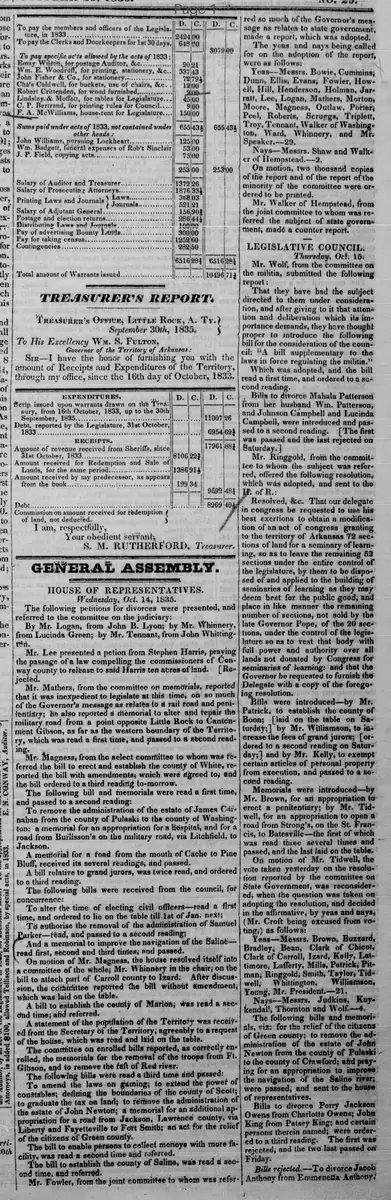
HOUSE OF REPRESENTATIVES.
Wednesday, Oct. 14, 1835.
The following petitions for divorces were presented, and referred to the committee on the judiciary:
By Mr. Logan, from John B. Lyon; by Mr. Whinnery, from Lucinda Green; by Mr. Tennant, from John Whittington.
Mr. Lee presented a petition from Stephen Harris, praying the passage of a law compelling the commissioners of Conway county to release to said Harris ten acres of land. [Rejected.]
Mr. Mathers, from the committee on memorials, reported that it was inexpedient to legislate at this time, on so much of the Governor's message as relates to a rail road and penitentiary; he also reported a memorial to alter and repair the military road from a point opposite Little Rock to Cantonment Gibson, as far as the western boundary of the Territory, which was read a first time, and passed to a second reading.
Mr. Magness, from the select committee to whom was referred the bill to erect and establish the county of White, reported the bill with amendments; which were agreed to, and the bill ordered to a third reading to-morrow.
The following bill and memorials were read a first time, and passed to a second reading:
To remove the administration of the estate of James Carnahan from the county of Pulaski to the county of Washington: a memorial for an appropriation for a hospital, and for a road from Burrisson's on the military road, via Litchfield, to Jackson.
A memorial for a road from the mouth of Cache to Pine Bluff, received its several readings; and passed.
A bill relative to grand jurors, was twice read, and ordered to a third reading.
The following bills were received from the council, for concurrence:
To alter the time of electing civil officers—read a first time, and ordered to lie on the table till 1st of Jan. next;
To authorise the removal of the administration of Samuel Parker—read, and passed to a second reading;
And a memorial to improve the navigation of the Saline—read first, second and third times; and passed.
On motion of Mr. Magness, the house resolved itself into a committee of the whole; Mr. Whinnery in the chair; on the bill to attach part of Carroll county to Izard: After discussion, the committee reported the bill without amendment; which was laid on the table.
A bill to establish the county of Marion; was read a second time, and referred.
A statement of the population of the Territory was received from the Secretary of the Territory; agreeably to a request of the house, which was read and laid on the table.
The committee on enrolled bills reported, as correctly enrolled, the memorials for the removal of the troops from Ft. Gibson, and to remove the fort of Red river.
The following bills were read a third time and passed:
To amend the laws on gaming; to extend the power of constables; defining the boundaries of the county of Scott; to graduate the tax on land; to remove the administration of the estate of John Newton; a memorial for an additional appropriation for a road from Jackson, Lawrence county, via Liberty and Fayetteville to Fort Smith; an act for the relief of the citizens of Green county.
The bill to enable persons to collect moneys with more facility, was read a second time and referred.
The bill to establish the county of Saline, was read a second time, and referred.
Mr. Fowler, from the joint committee to whom was referred so much of the Governor's message as relates to state government; made a report, which was adopted.
The yeas and nays being called for on the adoption of the report, were as follows:
Yeas—Messrs. Bowie, Cummins Dunn, Ellis, Evans, Fowler, Howell, Hill, Henderson, Holman, Jarratt, Lee, Logan, Mathers, Morton, Moore, Magness, Outlaw, Porter Peel, Roberts, Scruggs, Triplett, Troy, Tennant, Walker of Washington, Ward, Whinnery, and Mr. Speaker.—29.
Nays—Messrs. Shaw and Walker of Hempstead.—2.
On motion, two thousand copies of the report and of the report of the minority of the committee were ordered to be printed.
Mr. Walker of Hempstead, from the joint committee to whom was referred the subject of state government, made a counter report.
LEGISLATIVE COUNCIL.
Thursday, Oct. 15.
Mr. Wolf, from the committee on the militia, submitted the following report:
That they have had the subject directed to them under consideration, and after giving to it that attention and deliberation which its importance demands, they have thought proper to introduce the following bill for the consideration of the council: "A bill supplementary to the laws in force regulating the militia."
Which was adopted, and the bill read a first time, and ordered to a second reading.
Bills to divorce Mahala Patterson from her husband Wm. Patterson, and Johnson Campbell and Lucinda Campbell, were introduced and passed to a second reading. The first was passed and the last rejected on Saturday.
Mr. Ringgold, from the committee to whom the subject was referred, offered the following resolution, which was adopted, and sent to the H. of R.:
Resolved, &c. That our delegate in congress be requested to use his best exertions to obtain a modification of an act of congress granting to the territory of Arkansas 72 sections of land for a seminary of learning, so as to leave the remaining 52 sections under the entire control of the legislature, by them to be disposed of and applied to the building of seminaries of learning as they may deem best for the public good; and place in like manner the remaining number of sections, not sold by the late Governor Pope, of the 20 sections, under the control of the legislature so as to vest that body with full power and authority over all lands not donated by Congress for seminaries of learning: and that the Governor be requested to furnish the Delegate with a copy of the foregoing resolution.
Bills were introduced by Mr. Patrick, to establish the county of Boon; laid on the table on Saturday; by Mr. Williamson, to increase the fees of grand jurors; ordered to a second reading on Saturday; and by Mr. Kelly, to exempt certain articles of personal property from execution, and passed to a second reading.
Memorials were introduced by Mr. Brown, for an appropriation to erect a penitentiary; by Mr. Tidwell, for an appropriation to open a road from Strong's, on the St. Francis, to Batesville—the first of which was read three several times and passed; and the last laid on the table.
On motion of Mr. Tidwell, the vote taken yesterday on the resolution reported by the committee on State Government, was reconsidered: when the question was taken on adopting the resolution, and decided in the affirmative, by yeas and nays, (Mr. Critt being excused from voting;) as follows:
Yeas—Messrs. Brown, Buzzard. Bradley, Bean, Clark of Chicot, Clark of Carroll, Izard, Kelly, Lattimore, Lafferty, Mills, Patrick, Pitman, Ringgold, Smith, Taylor, Tidwell, Whittington, Williamson, Young; Mr. President. 21.
Nays—Messrs. Judkins, Kuykendall, Thornton and Wolf.—4.
The following bills and memorials, viz: for the relief of the citizens of Green county; to remove the administration of the estate of John Newton from the county of Pulaski to the county of Crawford; and praying an appropriation to improve the navigation of the Saline river; were passed, and sent to the house of representatives.
Bills to divorce Perry Jackson Owens from Charlotte Owens; John King from Patsey King; and certain persons therein named; were ordered to a third reading. The first was rejected; and the two last passed on Friday.
Bills rejected.—To divorce Jacob Anthony from Emmenetta Anthony and David Campbell from Sarah Campbell: to exempt certain species of property from taxation; to regulate certain estray laws. The bill supplementary to the several laws now in force limiting the jurisdiction of justices of the peace, was read a second time and laid on the table--rejected on Saturday.]
The bills to elect county treasurer; and supplementary to the several laws on the government of justices of the peace; were read a third time, passed, and sent to the H. of R.
The bills, to establish the Bank of Arkansas, and for the change of venue in certain cases, were read a second time and committed.
The bill to regulate the sale of real and personal property, was read a second time, and laid on the table--rejected on Saturday.]
The bills, to prevent the abatement of suits brought by unmarried women; and to authorise Creed Taylor to make certain titles, were read a second time, and ordered to a third reading--and were passed on Friday.]
HOUSE OF REPRESENTATIVES.
Mr. Cummins presented a petition from sundry citizens, for the establishment of a county to be called Morgan county. Laid on the table.
The committee on counties and county lines, to whom was referred the petition of sundry citizens of Crawford county, for the establishment of the county lines of said county, reported that they deemed it unnecessary to legislate on the subject at this time, and asked to be discharged from the further consideration of the subject.
The memorial for a road from the seat of government of the State of Missouri to Little Rock, was read, and ordered to a second reading.
Bills rejected.--To amend the law concerning conveyances; amendatory to the road law; concerning descents and distributions; and to authorize Wm. Ellis to build a toll-bridge over Point Remove Bayou.
LEGISLATIVE COUNCIL.
Friday Oct. 16.
Memorials were introduced--by Mr. Clark of Chicot, for an appropriation to open a road from the mouth of Arkansas, by Columbia, to the Louisiana line; and by Mr. Smith, for an appropriation to open roads from the mouths of Arkansas and White rivers to Post of Arkansas, which received their several readings, passed, and were sent to the H. of R.
Mr. Thornton introduced a bill to divorce Elizabeth Willis and Arthur Willis, which passed to a second reading--[and was rejected on Saturday.]
The bill, concerning runaway slaves, was ordered to a third reading--and passed on Saturday.]
The bill to divorce Rachel Mason and Thomas Mason, was rejected--yeas 14, nays 13.
The bills, from the H. of R.--authorizing Isaiah D. Rose to erect and keep a toll-bridge across Big Piney; and authorizing David Rorer to resign the administration on the estate of Samson Gray; and memorials, for a road from Pine Bluffs to Mouth of Cache, and for completing the road from Jackson to Fort Smith--received their several readings and passed.
The bills, from the H. of R.--to establish the county of Scott, and to amend the several laws now in force on the subject of gaming--were read a first time; and the first was laid on the table and the latter referred.
The bills, from the H. of R.--to extend the jurisdiction of constables; and to graduate the tax on lands and for other purposes--were read and ordered to a second reading--and read a 2d time and committed on Saturday.
The bills, amendatory to the attachment laws [passed on Saturday;] to change the venue in certain cases; and to establish the Bank of Arkansas--were considered in committee of the whole--and the 1st was ordered to a 3d reading, the 2d was referred; and on the last, the committee requested leave to sit again.
The bill, divorcing Lucretia and Jonathan Clark, was read a third time and passed.
HOUSE OF REPRESENTATIVES.
The following bills were read, and passed to a second reading:
To divorce John and Sally Whittington; more effectually to punish forgery; to secure the property of females; defining the duties and regulating the fees of county surveyors; a memorial for a road from Arkansas Post to mouth of White river; for a road from Matthew Moss', on the Ouachita, to Fort Towson; for a road from the Mouth of Arkansas and White rivers to the Louisiana line; for a penitentiary in the Territory of Arkansas; for a road from Little Rock to Fort Gibson.
The following bills were read a second time, and ordered to a third reading:
To establish the county of Marion; to remove the administration of the estate of Samuel Parker: to remove the administration of the estate of James Carnahan; to authorize the administrators of Rich'd Searcy to complete titles; a memorial for building a hospital in Arkansas, to legitimatize Wm. Estill; for a road from Little Rock to Jefferson City, in Missouri.
The following bills and petitions were presented and referred:
Petition of Sally Hale, for a divorce; of Reuben Malpass, for a divorce; an act appointing commissioners to build a court-house and jail at Columbia, Chicot county: appointing commissioners to locate the seat of justice in Monroe county; an act concerning appeals; for the election of county treasurers; to amend the road law; concerning grand jurors.
Mr. Mathers, from the committee to whom was referred the petition of Stephen Harris, reported that the county of Conway has no title to the lands petitioned for, and that it is inexpedient to legislate on the subject. Adopted.
The committee on enrolments reported the memorial to remove obstructions from Bayou Bartholomew, as being correctly enrolled.
A memorial for a road from Jackson, Lawrence county, to Fort Smith, was read a first time and laid on the table.
The resolution from the Council, instructing the Delegate relative to the seventy-two sections, was adopted.
The act to authorize Isaac Hughes to build a toll-bridge across Big Piney creek, was laid on the table.
Bills passed.--To establish the county of White: an act concerning conveyances; to amend the law on descents and distributions; a memorial for a road from Burleson's, on the military road, to Jackson.
LEGISLATIVE COUNCIL.
Saturday, Oct. 17, 1835.
Mr. Clark of Chicot, from the committee on memorials, reported the propriety of memorializing Congress on the following subjects, viz: For appropriations to improve the navigation of White and St. Francis, and the Washita and Little Missouri rivers: to connect the bayou Bartholomew with the Mississippi by a canal; to repair the road from Little Rock to Logan's, and up the north side of the Arkansas to Cane Hill and Fayetteville: to open a road from Batesville, via Van Buren C. H. to the road from Little Rock to Fort Gibson; to complete the road from Columbia to Little Rock; and for the passage of laws to prevent the location of forty-acre pre-emptions not held by pre-emption, and for extending the right of pre-emption.
The following memorials were presented, received their several readings and passed: By Mr. Izard, for a road from Helena to Mouth of Cache; to remove the obstructions in White and St. Francis rivers; for a road from Helena to Jackson: by Mr. Clark of Chicot, for completing the road from Columbia to Little Rock; by Mr. Brown, for a fortification on our western frontier; by Mr. Lafferty, to extend the U. S. Road leading from Batesville.
Mr. Judkins from the committee to whom was referred the bill to change the venue in certain cases, reported the same without amendment, and the bill was made the order of the day for Tuesday.
Mr. Izard, from the committee to whom was referred the bill supplementary to the several laws now in force relative to administrators, reported the same with several amendments, which were adopted, and the bill was committed.
Mr. Judkins introduced a bill to divorce Louisa B. Trent and Thomas Trent, which was read and ordered to a 2d reading.
Mr. Judkins presented the petition of Abner Stuart, praying for divorce, which was referred.
Mr. Bean introduced a memorial, praying for an appropriation to open a road from the south-west corner of Missouri through this Territory, which was referred.
Mr. Tidwell presented a petition from sundry citizens of Jackson county, praying to be released from certain obligations therein named, which was read and referred.
Mr. Brown, from the committee to whom was referred the bill, to change the manner of assessing and collecting taxes, reported the same with amendments, which report was adopted.
Mr. Young introduced a bill, to define the boundary lines of Jefferson county, which was read and ordered to a 2d reading.
Mr. Brown, from the committee to whom was referred the bill, from the H. of R., on the subject of gaming, reported the same with amendments; when the bill was committed.
On motion of Mr. Whittington, a select committee was appointed, to inquire into the expediency of memorializing Congress for an appropriation to open a road from Fort Towson, via Hot Springs, to intersect the road from Columbia to Little Rock, at Pine Bluffs.
The bill, supplementary to the laws in force regulating the militia, was read a 2d time and ordered to a 3d reading.
Mr. Lafferty introduced a bill, to establish the boundary line of Van Buren county, which was referred.
The resolution, from the H. of R., fixing on the 3d of November as the day on which the Legislature will adjourn, and declaring that no new bills shall be introduced after next Monday week [26th inst.,] was concurred in.
HOUSE OF REPRESENTATIVES.
The committee on enrollments reported the following acts as correctly enrolled:
To remove the administration of the estate of John Newton; to authorize the administrators of Isaac Ward to sell real estate; for the relief of the citizens of Green county; a memorial to improve the navigation of Saline river.
The following bills were received from the Council, for concurrence:
To divorce certain persons [rejected]; to authorize Creed Taylor to make certain titles [rejected]; and an act to prevent the abatement of suits brought by unmarried women, which was read a first time, and ordered to a second reading.
The following bills were read, and ordered to a second reading:
Appointing commissioners to build a court-house and jail at Columbia, Chicot county; to punish accessories to the crime of murder; defining the duties and extending the jurisdiction of justices of the peace; memorial for a floating claim to settlers on the 16th section.
Bills rejected.--To facilitate the collection of money out of the hands of certain persons; to elect commissioners to locate the seat of justice of Monroe county.
A memorial for an appropriation to open a road from Jackson, Lawrence county, to Strong's, in St. Francis county, was ordered to a third reading.
The bill to compel the county court of Crawford to make allowance to the persons engaged in guarding Wm. Butler, was made the order of the day for Tuesday.
The bill to establish the county of Marion, was passed the name being changed to Searcy.
LEGISLATIVE COUNCIL.
Monday, Oct. 19.
The following bills and memorials were read a first time and passed to a second reading--a bill to dissolve the bonds of matrimony between Abraham Stewart and Tabitha Stewart, alias Tabitha Foster, reported by Mr. Judkins; a bill to appoint commissioners to locate the seat of justice of Miller county, introduced by Mr. Lattemore; a bill to punish accessories to the crime of murder, introduced by Mr. Brown.
From the house of representatives--an act concerning conveyances; an act to erect and establish the county of White; an act to erect and establish the county of Searcy; an act supplementary to the laws of descent and distribution.
The following bills and memorials were passed--a memorial for an appropriation to improve the navigation of Washita and Little Missouri rivers; a memorial from the H. of R. for a road from Burleson's to Jackson; an act from the H. R. to amend the laws on the subject of gaming.
The following bill was read a second time and ordered to a third reading--to divorce Louisa C. Trent and Thomas Trent.
The following bills were committed to select committees--a bill to define the boundaries of Jefferson county, to Messrs. Young, Smith, and Mills; a bill supplementary to the laws regulating the militia, to Messrs. Wolf, Clark of Chicot, and Brown; a bill supplementary to the laws relative to administrations, to Messrs. Brown, Ringgold, Tidwell and Williamson; a bill to change the mode of assessing and collecting taxes, to Messrs. Izard, Brown, and Croft.
The following bills were committed to committee of the whole, and made the order of the day for to-morrow--a bill changing the mode of selecting grand jurors; the bill to change the manner of assessing and collecting taxes in this Territory.
Adjourned.
HOUSE OF REPRESENTATIVES.
Mr. Magness presented a petition from sundry citizens of Izard county, which was referred to a select committee of Messrs. Magness, Roberts and Ward.
Mr. Fowler, from the joint committee, to whom was referred so much of the Governor's message as relates to state government, reported a bill, to be entitled, an act for the election of members to a convention to form a constitution and system of government for the People of Arkansas, preparatory to their admission into the Union as a State. Mr. Whinnery moved to dispense with the rules of the house, in order to read said bill a second time, which was negatived. Mr. Walker, of Hempstead, offered the following amendment to the bill, which was negatived, viz: "strike out all that part apportioning the representation from the various counties, and introduce in lieu thereof that the representation in the convention shall be the same as that in the present legislature, including members of both houses, and they shall be elected in the same manner as they now are"--and the bill was read a first time, and passed to a second reading.
A memorial from the council, for an appropriation to remove the obstructions to the navigation of the Washita and Little Missouri rivers, was read a first time, and passed to a second reading.
The following bills and memorials were received from the council, viz:
A bill to divorce Matilda Patterson, which was read a first time. Mr. Seay moved to lay the bill on the table, which was negatived; and the bill was referred to a select committee of Messrs. Outlaw, Seay and Triplett.
A bill, to be entitled, an act amendatory to the attachment laws--read a first time, and passed to a second reading.
A bill concerning runaway slaves--read a first time, and passed to a second reading.
A memorial for a fortification on the western boundary of Arkansas--read a first time, and referred to a select committee of Messrs. Walker, of Washington, Evans and Roberts.
A memorial to the President of the U. S. praying a certain person to examine certain rivers--read a first time, and passed to a second reading.
A memorial for a road from Helena to Jackson, Mo.--read a first time, and passed to a second reading.
A memorial for a road from Columbia, Chicot co. to Little Rock, ditto.
A memorial for a road from Helena to the mouth of Cache, ditto.
And a memorial for an appropriation to remove the obstructions to the navigation of St. Francis and White rivers, ditto.
Mr. Triplett introduced a bill, to be entitled, an act to authorize certain suits to be tried in the supreme court--which was read a first time, and on motion of Mr. Walker, of Hempstead, the rules of the house were dispensed with, and the bill was read a second time, and ordered to be engrossed and read a third time to-morrow.
Mr. Walker, of Washington, from a select committee, reported a bill to dissolve the bonds of matrimony between John C. Hale and Sarah Hale, which was read a first time and passed to a second reading.
Mr. Mathers, from a standing committee reported the following memorials--a memorial praying an additional allowance to surveyors, for surveying certain lands; and for the appointment of an engineer to view Little Red river; which were severally read a first time, and passed to a second reading.
Mr. Ellis introduced a memorial calling the attention of Congress to the petition of Henry M. Shreve, which was read a first time, and on motion of Mr. Ellis, the rules were dispensed with, the memorial was read a second and third time, and passed.
Mr. Peel offered an amendment to the rules of the house, which was adopted, and on motion of Mr. Outlaw, it was ordered that one hundred copies of the rules, including said amendment and the joint rules, be printed for the use of the house.
A bill to legitimatize William Estill, was read a third time, and the question being, shall the bill pass, Mr. Fowler called for the yeas and nays, which were as follows:
Yeas--Messrs. Cummins, Dunn, Ellis, Howell, Hill, Holman, Lee, Logan, Mathers, Morton, Magness, Outlaw, Porter, Roberts, Seay, Shaw, Scruggs, Triplett, Troy, Walker of Hempstead, Walker of Washington, Ward, Whinnery and Mr. Speaker.--24.
Nays.--Messrs. Evans, Fowler, Moore, Peel, Stallings and Tennant.--6. And so the bill passed.
On motion of Mr. Morton, the bill laid on the table on a previous day was taken up and read a third time, and on motion of Mr. Fowler the said bill was laid on the table.
The following bills and memorials were read a second time, and passed to a third reading, viz:
A memorial for a road from the mouth of Arkansas to the Louisiana line; for opening a road from Columbia, Chicot county, to Washington, Hempstead county; for building a penitentiary in Arkansas; a bill to elect commissioners to build a court house and jail at Columbia, Chicot county.
The following bills and memorials were read a third time and passed, viz:
An act to authorize the administrators of Richard Searcy, dec. with the will annexed to complete titles; an act to remove the administration of Samuel Parker, dec.; a memorial for a road from Little Rock to Jefferson city: an act to remove the administration of James Carnahan, dec.; a memorial for an appropriation to erect a hospital on the Mississippi; to open a road from the Ouachita to Fort Towson,
A bill to dissolve the bonds of matrimony between John Whittington and Sally his wife, was read a second time, and referred to a select committee of Messrs. Cummins, Walker of Washington, and Scruggs.
The following bills were ordered to be engrossed for a third reading to-morrow:
An act to amend the law on the subject of forgery, an act to secure the property of females.
A bill to be entitled an act regulating and defining the duties of county surveyor, was read a second time, and committed to a committee of the whole, and made the order of the day for to-morrow.
A memorial for a road from the mouth of Arkansas to the Post of Arkansas, was read a second time, and referred to a select committee of Messrs. Lee, Magness and Fowler.
REPORT.
The following is the Report (omitted last week.) of the Majority of the Joint Committee on State Government:
The joint committee, to whom was referred so much of the Governor's Message as relates to State Government, beg leave to report:
That they have had under consideration the subject referred to them, as connected with the wishes and instructions of the people of Arkansas, recently expressed at the polls and otherwise. In the investigation of the subject, two prominent points presented themselves to your committee--the right and the expediency of immediate admission into the Union, "as a sovereign, free, and independent State." As to the latter, although a branch of the subject upon which many of our most intelligent citizens differ, as motives of interest or patriotism, whether misguided or properly directed, prompt, your committee are of the opinion that, whether viewed as a matter of pecuniary loss or gain, or as one in which the natural feelings of self-respect and capability of self-government are more intimately blended, the case is not materially varied. The great and continuous influx of wealth and population, the recent unparalleled increase of the sales of public lands, as well as the accumulation and concentration within our borders of other fit and permanent subjects of taxation, the better prospect of establishing, under a State Government, a permanent system of revenue laws, and other institutions calculated to advance the prosperity of the country, free from the influence, direct or indirect, of those higher powers, who now frequently have no immediate interest in the welfare of the people, and are in no case directly responsible to them--the legitimate source of all power, connected with other important subjects, are entitled to great weight and high consideration. In opposition to these, it may be urged that appropriations by the General Government for the convenience and improvement of our country, after we throw off the chrysalis and assume the character and powers of a State, will cease to be made. But in the opinion of your committee, those bountiful donations and expenditures will not be materially affected by the change. Nearly all the subjects of expenditure, from the United States' treasury, in Arkansas, upon examination, are found to be, in a military point of view, and otherwise, such as the constituted authorities of the Union, by the settled rule of construction, would pronounce national--highways and navigable streams, connecting important points of defence to the republic; and under a State Government, with a representation in Congress, would be more likely increased than diminished. Farther, the pacification and quiet of a people, is one of the indispensable bases to the prosperity and happiness of their country. The restless spirit of men, born free, who, for a time, in order to carry into effect, in a becoming manner, the constitutional stipulations of their common country, have submitted to the curtailment of a portion of their inherent privileges, when awakened to a sense of their rights by their condition and numbers, and resolved to claim the stand to which they believe themselves entitled, according to the evidence of every age and country, will continue to agitate a question so vitally important to them, until it meets with a final and satisfactory adjustment. It is further believed, that Arkansas, without subjecting herself to the censure of an unjust assumption, according to her numbers, although situated on the frontier, contains as much moral worth and intellectual capability of self-government as any portion of that great confederacy, the proudest privilege of whose people is to be called American citizens.-- In every view, then, that your committee have taken of the expediency of the measure, they are irresistibly brought to the conclusion, that the resources of the country are fully equal to the undertaking, and that in such a course the prosperity and happiness of the whole people would be advanced in an eminent degree.
In relation to the right of Arkansas, with her present population, to admission into the Union, upon an equal footing with the original States, your committee, after a deliberate and calm investigation of the subject are equally clear and satisfied with the propriety of their conclusion. Without resorting to the abstract and unchangeable principle, founded in nature, and indelibly incorporated in the American code, by our fathers, in the war of independence, that all men are born free and equal, and are by nature sovereign and entitled to self-government, they find ample guaranties in written stipulations for the right which the people of this Territory now claim. Then, without relinquishing the former, they are, for the present, willing to rely upon the latter, as furnishing a sufficient safeguard to the liberties of their constituents, while the Congress of the United States retains its high character for justice and uniform respect to the rights of man. That it was the intention of the people of the original States, who created the Federal Constitution, to permit an increase of the number of States, is evident from a clause in the constitution itself, declaring that "new States may be admitted by the Congress into this Union;" and conclusively established by the admission of many "new States" under that Constitution. In addition to this general provision in the Constitution, there is a special guaranty to this Territory, as constituting at that time a part of ancient Louisiana, found in the treaty--and treaties, by the Constitution, are declared to be "the supreme law of the land" --ceding that province of France to the United States, under the auspices of Mr. Jefferson, then President of the U. States and Napoleon Bonaparte, then first Consul of the French Republic. This treaty was made A. D. 1803, and many of "the inhabitants of the ceded Territory" then were, and now, together with their descendants still are, citizens of this Territory. The third article of the treaty is as follows:-- "The inhabitants of the ceded Territory shall be incorporated in the Union of the United States, and admitted as soon as possible, according to the principles of the federal constitution, to the enjoyment of all the rights, advantages, and immunities of citizens of the United States: and in the mean time they shall be maintained and protected in the free enjoyment of their liberty property, and the religion which they profess." But it has been urged that this guaranty extends only to those who were then inhabitants of the Territory, and not to those who have become inhabitants since the ratification of the treaty: and further, that as to the then inhabitants, the treaty stipulations have already been fully complied with. As it regards the last, we would only ask, by way of example and illustration, how can any people enjoy "all the rights, advantages, and immunities, of citizens of the United States," unless they have a vote in the election of their Chief Magistrate, and can be heard by their Senators and Representatives on the floor of Congress? Here, then, are the most vital privileges of citizens of the United States, with many others of like character, denied to those ancient inhabitants who still reside in our Territory. Your committee do not contend, as has been erroneously supposed by some, that the Legislative Council and House of Representatives can act as the agent of France to require the performance of the pledge in the treaty towards the French inhabitants of that day; nor are they disposed to assent, on the other hand, to the equally absurd doctrine that they are but the deputy of Congress; but that they are the Representative of the whole people of Arkansas, whether French or American, in their sovereign capacity, as well as in the one delegated to the people by their own consent in the organic law, and competent, under the instructions of their constituents, to do any act for the welfare of the people, not inconsistent with the constitution of the United States. The French inhabitants of this country have their rights secured under the treaty; and citizens of the United States, who have migrated hither, under the invitation and guaranty of the treaty, have acquired thereby all the rights therein secured to the French citizens, in addition to their own, inherited from their ancestors and securely guarded by the Federal Constitution. Territorial governments, as connected with that of the United States, are necessarily, in their nature, as also declared by the acts of Congress organizing them "temporary," and only designed to protect the liberty, property and lives of inhabitants of communities, until they acquire sufficient consequence and numbers properly to avail themselves of their right to admission into the Union as States. This right, your committee believe may be exercised by Territory, situated as Arkansas is, and under the same stipulations on the part of the United States, whenever its population is equal the ratio of representation in the Congress of the Union. With that number of citizens—and Arkansas has more—she, in the opinion of your committee, has a clearly defined right to demand admission into the Union; and Congress, as the agent of the people of the several States, is under a concurrent obligation to fulfil their constitutional and treaty stipulations, and in justice bound to grant admission whenever it is thus demanded. It is also true, that, should the United States be unjust, they have the power to exclude us from the benefits of the Federal Constitution; but the exercise of arbitrary power, uncoupled with right, by a mighty people, to crush the native and absolute rights, insisted on in a respectful and legitimate manner, of a younger and kindred community, not yet attained to the bone and gristle of manhood, would present a spectacle of injustice not to be apprehended from a government whose faith has never been violated or pledged in vain. Your committee, after viewing every prominent aspect which the subject of admission seems to present, cannot but look upon the main point as clear and disrobed of the involving mists which sophistry, at the first glance, seems to have thrown around it—as a matter of right, under the constitution and laws, on the part of the Territory; and as one of concurrent obligation, under the same, on the part of the United States:—and as a matter of interest, according to the fundamental principles of American liberty, equally desirable and important to both.
Territories, as now understood, being unknown to the Federal Constitution, and innate sovereignty always residing in the people, it is believed that all acts of Congress, organizing "temporary" governments over them, have been predicated upon the request of the people therein, and beneficently extended to them by Congress, from the necessity of the case, for the protection of the people until they became fully prepared for a participation in the national benefits; and not for the purpose of curbing their rightful powers or divesting them of the inestimable inheritance of their fathers—the power to resume their entire sovereignty, at will.—
The doctrine, that any direct action of the representatives of the people, to recommend or call a convention of the people themselves, preparatory to admission, would be an infringement upon the constituted authorities of the country, and a violation of duty, appears, in the opinion of your committee, to be founded in error; and that according to the organic law itself, as representatives of the people, the object of the Territorial government being "temporary," to prepare us for a higher destiny, they can take any preparatory step towards our final admission; and under the instructions of the people, in their sovereign capacity, can legitimately do any act for the completion of an object so devoutly wished and universally desired. It is not in our present situation considered desirable that the Territorial government should be superseded by any act of the people, until the ratification of their acts in convention be obtained from Congress; but that the present institutions should remain in full force until the vital and all-absorbing question shall have been finally adjusted. Good order and the happiness of society require it.
That Congress must make a transfer or endowment of sovereignty to the people of this Territory, before they can advance a single step towards the perfection of this great object, your committee are by no means prepared to admit. Such an admission, in their opinion, would make them not only dependents in name, but vassals in fact. Such a being as a free-man cannot exist where there are no slaves. The citizens of Arkansas are free men, and most of them descendants of those who, sixty years since, battled for freedom against the assumed "divine right" of sovereignty in kings.—
The principle was then settled, that sovereignty resides in the people—that there is its native seat—and that none shall take it away, or exercise it, but by their permission. The positive exercise of sovereignty, by the people of this Territory, has, for a time, been voluntarily put in a state of abeyance or suspension by themselves, in order to preserve the harmonious action of the government and laws, under assurances, guarded by the National faith, that, at the time fixed by the constitution, they should resume it again, and exercise it as it belonged to them in the states of their former residence or birth, without obstruction or hindrance from the authorities of Congress.
That time, it is believed, by your committee, has arrived; and the people of Arkansas now have, subject to the Constitution of the United States, their own destiny in their own hands. Sovereignty by us is now understood to be a different thing from that which it was supposed to be under the feudal system, where the vassal was transferred with the domain as a fixture to the soil, or now said to be under the vain system of European "legitimacy." Opinions upon the exercise and transfer of sovereign power, derived from the ancient barbarians through the British and Norman nobility, have long been exploded on this side of the Atlantic. It now neither resides in a figure, nor is it transferable to any portion of the people on earth, by any power which is itself delegated and limited by the people.
It is in the main fixed; and although portions of it may be temporarily delegated or suspended, it is always subject to be resumed and again exercised in its plenitude by its native possessors—the people. In all matters, your committee wish to express a fixed willingness to be governed by constitutional law; but in this case, where the constitution has not prescribed rules for the preparatory formation of a new state, but only for its "admission" into the Union, your committee definitely claim, for the people of this Territory, all the necessary powers and attributes of sovereignty proper to prepare them for their "admission."
If the builders of the constitution had seen the necessity of nurturing the "new states," by a colonial code of laws, they would, in that instrument, most certainly have prescribed the basis or fundamental principles for such a system; but those sages well knew that colonial government, at best, was but ameliorated slavery, and, in respect to the rights of the citizens, refrained from prescribing any rule of action to the new community, leaving them wholly untrammelled to select their own time and manner of admission. To admit the principle, that a Territory could not make the first proposition in the matter, even were the right to sovereignty in her people, and her right to admission doubted, would be an extension of the inability in communities to make contracts and stipulations for their security and for the improvement of their political condition, not heretofore known to exist. Even a slave has the right to stipulate with his master for his freedom, and to propose the terms upon which he wishes it granted. A community then, possessing many acknowledged political rights and powers, would surely have the power and right to treat for more, without first imploring the higher power for an endowment of sovereignty to enable her to make a valid contract. Arkansas, then, as a political community, organized under the supervision of Congress, even were there no constitutional or written guaranties in her favor, would have the right to form a constitution and present herself as a candidate for admission among the other states; though in this case they would have the political power to reject her. In ours, as it exists, they have no right to reject us—possessing only the naked power without right, which it is not presumed would be exercised to our prejudice under the eye and with a full knowledge of all the Nation's pledges on that subject. Your committee fully admit, that the weight of precedent, if precedent in such a case be entitled to weight, points to a mode somewhat different from the one designed to be proposed in this case, but those precedents have been produced from circumstances, variant from ours—the people in those cases, preferring a different mode themselves. In the mode alluded to, Congress have passed acts, as your committee believe, by the request of the people thereof, authorizing territories to form constitutions, and fixing the ratio of representation in the people's convention for that purpose. But that acts of Congress have been passed for that purpose, where the people were willing to abide by that mode, does not prove that no other manner can be legal or correct; nor do those acts of Congress fixing the representation of the people in the convention, matters which of right belong exclusively to the people themselves, argue much in favor of the doctrine that Congress, which is but a delegated power itself, must first confer upon the people sovereignty, or their acts would be void.—
For Congress to prescribe how many members should sit in our Convention, and which counties should elect them, as done in several cases of the other "new States," would be an unjust curtailment of the most cherished rights of the people. This, whether one mode or the other be pursued, is one of the exclusive rights reserved to the people, and which can be lawfully exercised by no other power, unless by their consent. Nevertheless, in the opinion of your committee, the true construction of the entire subject is resolved into this, that the first proposition or "admission" into the Union, may be properly made either by Arkansas or the United States; that Congress may pass a law declaring her willingness that Arkansas may form a Constitution and become a State, which, when Arkansas assents to, the matter is complete; or, that Arkansas may, of her own will, form a Constitution and apply for admission, which, when approved of by Congress, becomes of equal validity; and that, in either case, Arkansas becomes legally and constitutionally one of the U. S. of America.
In conclusion, being assured by the Executive, that "any action of the Legislature, tending to urge upon Congress our final admission, in the speediest manner, shall receive" his "decided support," and that he now feels it to be his "duty to forward this important object, by all the means competent to be used by the Executive power of this Territory;" and there being now no further room to doubt as to the preponderance of "the tide of popular opinion in favor of a State Government," the people having already "willed it," your committee are decidedly of the opinion, that a prompt and speedy action on this all-absorbing question, is highly expedient and proper. All of which is respectfully submitted, together with the following resolution
Resolved, That the Report of the Joint Committee, to whom was referred so much of the Governor's Message as relates to the subject of State Government, be concurred in; and that this General Assembly, in the most speedy manner, prescribe a time and mode for the organization of a Convention to frame a Constitution and system of Government for the people of Arkansas, preparatory to their admission into the Union as one of the United States of America; and that the whole subject be again referred to said Committee, with instructions to report, as early as practicable, to the House of Representatives, by Bill or otherwise, conforming to this resolution.
What sub-type of article is it?
What keywords are associated?
What entities or persons were involved?
Where did it happen?
Domestic News Details
Primary Location
Arkansas Territory
Event Date
October 14 19, 1835
Key Persons
Outcome
numerous bills passed including county establishments (white, searcy, scott), road memorials, divorce petitions granted or rejected, gaming law amendments, tax graduations; majority report on statehood adopted urging constitutional convention; various memorials to congress for appropriations and improvements.
Event Details
The Arkansas Territorial General Assembly convened in sessions of the House of Representatives and Legislative Council, presenting and debating petitions for divorces, bills to establish new counties, memorials for road constructions and repairs across various routes, appropriations for hospitals, penitentiaries, and river navigations, reports on state government advocating immediate admission to the Union via constitutional convention, and actions on militia, gaming, taxes, estates, and other local laws.