Thank you for visiting SNEWPapers!
Sign up free
Portland Gazette, And Maine Advertiser
Portland, Cumberland County, Maine
What is this article about?
Official bulletins confirm allied victories in Spain and Russian successes against French invaders, including Bagration's junction with main army after victories at Romanow and Mohilow, repulses at Dunaburg, Alexander's call for defense, levies, Bonaparte's Moscow intent, possible Vitebsk battle, Macdonald's defeat near Mittau, and treaty ratification with Porte releasing Russian troops.
Clipping
OCR Quality
Full Text
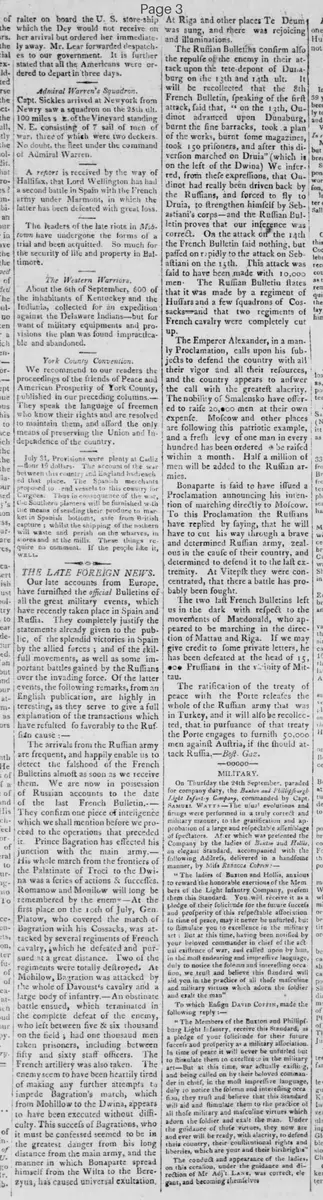
Our late accounts from Europe, have furnished the official Bulletins of all the great military events, which have recently taken place in Spain and Russia. They completely justify the statements already given to the public. of the splendid victories in Spain by the allied forces; and of the skilful movements, as well as some important battles gained by the Russians over the invading force. Of the latter events, the following remarks, from an English publication, are highly interesting, as they serve to give a full explanation of the transactions which have resulted so favorably to the Russian cause:—
The arrivals from the Russian army are frequent, and happily enable us to detect the falsehood of the French Bulletins almost as soon as we receive them. We are now in possession of Russian accounts to the date of the last French Bulletin.—They confirm one piece of intelligence which we shall mention before we proceed to the operations that preceded it. Prince Bagration has effected his junction with the main army.—His whole march from the frontiers of the Palatinate of Troci to the Dwina was a series of actions & successes. Romanow and Mohilow will long be remembered by the enemy—At the first place on the 10th of July, Gen. Platow, who covered the march of Bagration with his Cossacks, was attacked by several regiments of French cavalry, which he defeated and pursued at a great distance. Two of the regiments were totally destroyed. At Mohilow, Bagration was attacked by the whole of Davoust's cavalry and a large body of infantry.—An obstinate battle ensued, which terminated in the complete defeat of the enemy, who left between five & six thousand on the field: had one thousand men taken prisoners, including between fifty and sixty staff officers. The French artillery was also taken. The enemy seem to have been heartily tired of making any further attempts to impede Bagration's march, which from Mohilow to the Dwina, appears to have been executed without difficulty. This success of Bagration's, who it must be confessed seemed to be in the greatest danger from his long distance from the main army, and the manner in which Bonaparte spread himself from the Wilta to the Berezyua, has caused universal exultation.
At Riga and other places Te Deum was sung, and there was rejoicing and illuminations. The Russian Bulletins confirm also the repulse of the enemy in their attack upon the tete-de-pont of Dunaburg on the 12th and 14th ult. It will be recollected that the 8th French Bulletin, speaking of the first attack, said that, "on the 13th, Oudinot advanced upon Dunaburg, burnt the fine barracks, took a plan of the works, burnt some magazines, took 150 prisoners, and after this diversion marched on Druia" (which is on the left of the Dwina) We inferred, from these expressions, that Oudinot had really been driven back by the Russians, and forced to fly to Druia, to strengthen himself by Sebastiani's corps—and the Russian Bulletin proves that our inference was correct. On the attack on the 14th the French Bulletin said nothing, but passed on rapidly to the attack on Sebastiani on the 15th. This attack was said to have been made with 10,000 men. The Russian Bulletin states that it was made by a regiment of Hussars and a few squadrons of Cossacks and that two regiments of French cavalry were completely cut up.
The Emperor Alexander, in a manly Proclamation, calls upon his subjects to defend the country with all their vigor and all their resources, and the country appears to answer the call with the greatest alacrity. The nobility of Smolensko have offered to raise 20,000 men at their own expense. Moscow and other places are following this patriotic example, and a fresh levy of one man in every hundred has been ordered to be raised within a month. Half a million of men will be added to the Russian armies.
Bonaparte is said to have issued a Proclamation announcing his intention of marching directly to Moscow. To this Proclamation the Russians have replied by saying, that he will have to cut his way through a brave and determined Russian army, zealous in the cause of their country, and determined to defend it to the last extremity. At Vitebsk they were concentrated, that there a battle has probably been fought.
The two last French Bulletins left us in the dark with respect to the movements of Macdonald, who appeared to be marching in the direction of Mittau and Riga. If we may give credit to some private letters, he has been defeated at the head of 15,000 Prussians in the vicinity of Mittau.
The ratification of the treaty of peace with the Porte releases the whole of the Russian army that was in Turkey, and it will also be recollected, that in pursuance of that treaty the Porte engages to furnish 50,000 men against Austria, if she should attack Russia.—Bot. Gaz.
What sub-type of article is it?
What keywords are associated?
What entities or persons were involved?
Where did it happen?
Foreign News Details
Primary Location
Russia
Event Date
July 1812
Key Persons
Outcome
at romanow on 10th july: two french cavalry regiments totally destroyed. at mohilow: french defeat with 5-6 thousand left on field, 1000 prisoners including 50-60 staff officers, french artillery taken. at dunaburg tete-de-pont on 12th and 14th ult.: french repulsed, oudinot driven back, two french cavalry regiments cut up. macdonald defeated with 15,000 prussians near mittau. russian army from turkey released; porte to furnish 50,000 men against austria if needed. russian levies: 20,000 from smolensko nobility, one in every hundred within a month adding half a million men.
Event Details
Late accounts from Europe provide official bulletins on military events in Spain and Russia, justifying public statements of allied victories in Spain and Russian successes. Russian accounts to date of last French bulletin confirm Bagration's junction with main army after series of actions from Palatinate of Troci to Dwina, including defeat of French cavalry at Romanow on 10th July by Platow's Cossacks, and obstinate battle at Mohilow against Davoust's forces ending in French defeat. March from Mohilow to Dwina unhindered. Repulse of French attacks on Dunaburg tete-de-pont on 12th and 14th ult., contradicting French bulletins. Emperor Alexander's proclamation calls for vigorous defense; nobility of Smolensko offers 20,000 men at own expense, Moscow and others follow, fresh levy of one in hundred to add half million men. Bonaparte proclaims march to Moscow; Russians vow to defend. Russians concentrated at Vitebsk, probable battle fought. Macdonald marching toward Mittau and Riga, defeated per private letters with 15,000 Prussians near Mittau. Ratification of peace treaty with Porte releases Russian army from Turkey; Porte engages to furnish 50,000 men against Austria if she attacks Russia.