Thank you for visiting SNEWPapers!
Sign up free
The Detroit Times
Detroit, Wayne County, Michigan
What is this article about?
In Panama, a US business agent recounts Nicaraguan President Zelaya's greed in demanding extra bribes for a land concession, revealing corruption in government dealings amid US animosity toward Zelaya.
Clipping
OCR Quality
Full Text
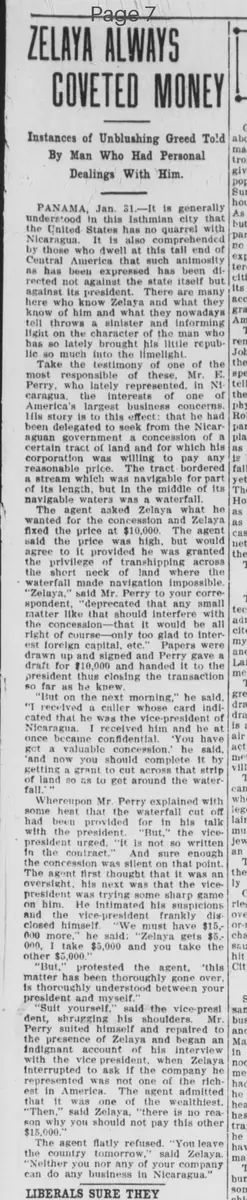
COVETED MONEY
Instances of Unblushing Greed Told
By
Man Who Had Personal
Dealings With Him.
PANAMA, Jan. 31.—It is generally
understood in this Isthmian city that
the United States has no quarrel with
Nicaragua. It is also comprehended
by those who dwell at this tail end of
Central America that such animosity
as has been expressed has been di-
rected not against the state itself but
against its president. There are many
here who know Zelaya and what they
know of him and what they nowadays
tell throws a sinister and informing
light on the character of the man who
has so lately brought his little repub-
lic so much into the limelight.
Take the testimony of one of the
most responsible of these. Mr. E.
Perry, who lately represented, in Ni-
caragua, the interests of one of
America's largest business concerns.
His story is to this effect: that he had
been delegated to seek from the Nicar-
aguan government a concession of a
certain tract of land and for which his
corporation was willing to pay any
reasonable price. The tract bordered
a stream which was navigable for part
of its length, but in the middle of its
navigable waters was a waterfall.
The agent asked Zelaya what he
wanted for the concession and Zelaya
fixed the price at $10,000. The agent
said the price was high, but would
agree to it provided he was granted
the privilege of transshipping across
the short neck of land where the
waterfall made navigation impossible.
"Zelaya," said Mr. Perry to your corre-
spondent, "deprecated that any small
matter like that should interfere with
the concession—that it would be all
right of course—only too glad to inter-
est foreign capital, etc." Papers were
drawn up and signed and Perry gave a
draft for $10,000 and handed it to the
president thus closing the transaction
so far as he knew.
"But on the next morning," he said,
"I received a caller whose card indi-
cated that he was the vice-president of
Nicaragua. I received him and he at
once became confidential. 'You have
got a valuable concession,' he said.
'and now you should complete it by
getting a grant to cut across that strip
of land so as to get around the water-
fall."
Whereupon Mr. Perry explained with
some heat that the waterfall cut off
had been provided for in his talk
with the president. "But," the vice-
president urged, "it is not so written
in the contract." And sure enough
the concession was silent on that point.
The agent first thought that it was an
oversight. his next was that the vice-
president was trying some sharp game
on him. He intimated his suspicions
and the vice-president frankly dis-
closed himself. "We must have $15,-
000 more," he said. "Zelaya gets $5,-
000. I take $5,000 and you take the
other $5,000."
"But," protested the agent, "this
matter has been thoroughly gone over.
is thoroughly understood between your
president and myself."
"Suit yourself," said the vice-presi-
dent, shrugging his shoulders. Mr.
Perry suited himself and repaired to
the presence of Zelaya and began an
indignant account of his interview
with the vice president, when Zelaya
interrupted to ask if the company he
represented was not one of the rich-
est in America. The agent admitted
that it was one of the wealthiest.
"Then," said Zelaya, "there is no rea-
son why you should not pay this other
$15,000."
The agent flatly refused. "You leave
the country tomorrow," said Zelaya.
"Neither you nor any of your company
can do any business in Nicaragua."
What sub-type of article is it?
What keywords are associated?
What entities or persons were involved?
Where did it happen?
Foreign News Details
Primary Location
Nicaragua
Key Persons
Outcome
the agent refused the additional $15,000 bribe and was ordered to leave nicaragua, barring his company from future business there.
Event Details
Mr. E. Perry, representing a major US business, sought a land concession in Nicaragua. Zelaya agreed for $10,000, assuring transshipping rights around a waterfall. The next day, the vice-president demanded $15,000 more for the omitted clause, offering to split it with Zelaya. Perry confronted Zelaya, who insisted on payment due to the company's wealth, then threatened expulsion upon refusal.