Thank you for visiting SNEWPapers!
Sign up free
Edwardsville Spectator
Edwardsville, Madison County, Illinois
What is this article about?
Report from Smyrna's Oriental Spectator (June 29) on Grecian War: Egyptian troops mutiny in Cyprus; Mahomet Ali's flotilla captures Greek vessels; Athens citadel surrenders; spy executed in Smyrna; Acre Pacha in revolt; Turkish troops assemble for Morea. Detailed account of Greek fire ships destroying Ottoman flagship at Scios (June 18), killing over 2,000, leading to island massacre. American frigate Constitution arrives amid tensions.
Clipping
OCR Quality
Full Text
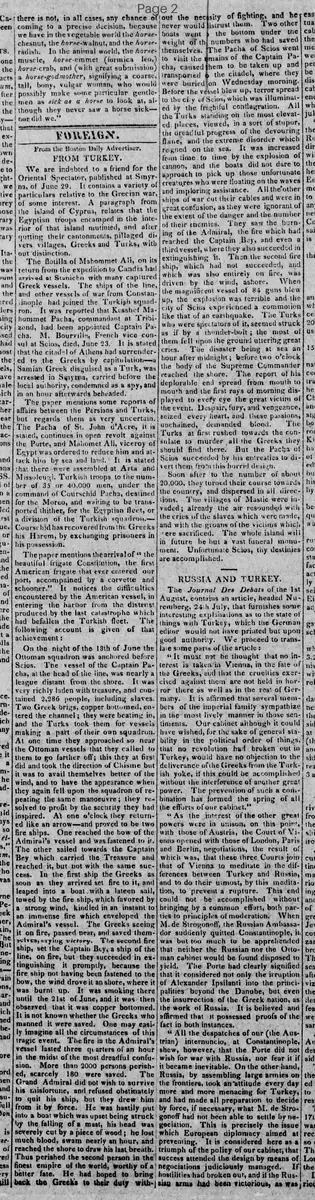
From the Boston Daily Advertiser.
FROM TURKEY.
We are indebted to a friend for the Oriental Spectator, published at Smyrna, of June 29. It contains a variety of particulars relative to the Grecian war, of some interest. A paragraph from the island of Cyprus, relates that the Egyptian troops encamped in the interior of that island mutinied, and after quitting their cantonments, pillaged divers villages, Greeks and Turks, without distinction.
The flotilla of Mahommet Ali, on its return from the expedition to Candia had arrived at Stanicho with many captured Greek vessels. The ships of the line, and other vessels of war from Constantinople had joined the Turkish squadron. It was reported that Kesshef Mahommet Pacha, commandant at Trebizond, had been appointed Captain Pacha. M. Bourvilie, French vice consul at Scios, died, June 23. It is stated that the citadel of Athens had surrendered to the Greeks by capitulation—a Samian Greek disguised as a Turk, was arrested in Smyrna, carried before the local authority, condemned as a spy, and in an hour afterwards beheaded.
The paper mentions some reports of affairs between the Persians and Turks, but regards them as very uncertain. The Pacha of St. John d'Acre, it is stated, continues in open revolt against the Porte, and Mahomet Ali, viceroy of Egypt was ordered to reduce him and attack him by sea and land. It is stated that there were assembled at Arta and Missolonghi, Turkish troops to the number of 35 or 40,000 men, under the command of Courschid Pacha, destined for the Morea, and waiting to be transported thither, for the Egyptian fleet, or a division of the Turkish squadron.—Courschid has recovered from the Greeks his Harem, by exchanging prisoners in his possession.
The paper mentions the arrival of "the beautiful frigate Constitution, the first American frigate that ever entered our port, accompanied by a corvette and schooner." It notices the difficulties encountered by the American vessel, in entering the harbor from the distrust produced by the last catastrophe which had befallen the Turkish fleet. The following account is given of that achievement:
On the night of the 18th of June the Ottoman squadron was anchored before Scios. The vessel of the Captain Pacha, at the head of the line, was nearly a league distant from the shore. It was very richly laden with treasure, and contained 2,286 people, including slaves. Two Greek brigs, copper bottomed, entered the channel; they were beating in, and the Turks took them for vessels making a part of their own squadron. At one time they approached so near the Ottoman vessels that they called to them to go farther off; this they at first did and took the direction of Chios but it was to avail themselves better of the wind, and to have the appearance when they again fell upon the squadron of repeating the same manoeuvre; they resolved to profit by the security they had inspired. At one o'clock they returned like an arrow—and proved to be two fire ships. One reached the bow of the Admiral's vessel and was fastened to it. The other sailed towards the Captain Bey which carried the Treasure and reached it, but not with the same success. In the first ship the Greeks as soon as they arrived set fire to it, and leaped into a boat with a lateen sail, towed by the fire ship, which favored by a strong wind, kindled in an instant to an immense fire which enveloped the Admiral's vessel. The Greeks seeing it on fire, passed near, and saved themselves, crying victory. The second fire ship, set the Captain Bey, a ship of the line, on fire, but they succeeded in extinguishing it promptly, because the fire ship not having been fastened to the bow, the wind drove it on shore, where it was burnt up. It was smoking there until the 21st of June, and it was then observed that it was copper bottomed. It is not known whether the Greeks who manned it were saved. One may easily imagine all the circumstances of this tragic event. The fire in the Admiral's vessel lasted three quarters of an hour in the midst of the most dreadful confusion. More than 2000 persons perished, scarcely 180 were saved. The Grand Admiral did not wish to survive his misfortune, and refused obstinately to quit his ship, but they drew him from it by force. He was hastily put into a boat which was upset being struck by the falling of a mast, his head was severely cut by a piece of wood; he lost much blood, swam nearly an hour, and reached the shore to draw his last breath. Thus perished the second person in the finest empire of the world, worthy of a better fate. He had hoped to bring back the Greeks to their duty without the necessity of fighting, and he never would distrust them. Two other boats went to the bottom under the weight of the numbers who had saved themselves. The Pacha of Scios went to visit the remains of the Captain Pacha, caused them to be taken up and transported to the citadel, where they were buried on Wednesday morning.
Before the vessel blew up, terror spread to the city of Scios, which was illuminated by the frightful conflagration. All the Turks standing on the most elevated places, viewed, in a sort of stupor, the dreadful progress of the devouring flame, and the extreme disorder which reigned on the sea. It was increased from time to time by the explosion of cannon, and the boats did not dare to approach to pick up those unfortunate creatures who were floating on the waves and imploring assistance. All the other ships of war cut their cables and were in great confusion, as they were ignorant of the extent of the danger and the number of their enemies. They saw the burning of the Admiral, the fire which had reached the Captain Bey, and even a third vessel, where they also succeeded in extinguishing it. Then the second fire ship, which had not succeeded, and which was also entirely on fire, was driven by the wind, ashore. When the magnificent vessel of 84 guns blew up, the explosion was terrible and the city of Scios experienced a commotion like that of an earthquake. The Turks who were spectators of it, seemed struck as if by a thunder-bolt: the most of them fell upon the ground uttering great cries. The disaster being at sea an hour after midnight; before two o'clock the body of the Supreme Commander reached the shore. The report of his deplorable end spread from mouth to mouth and the first rays of morning displayed to every eye the great victim of the event. Despair, fury, and vengeance, seized every heart, and these passions, unchained, demanded blood. The Turks at first rushed towards the consulate to murder all the Greeks they should find there. But the Pacha of Scios succeeded by his entreaties to divert them from this horrid design. Soon after to the number of about 20,000, they turned their course towards the country, and dispersed in all directions. The villages of Mastiç were invaded; already the air resounded with the cries of the slaves which were made, and with the groans of the victims which were sacrificed. The whole island will in future be but a vast funeral monument. Unfortunate Scios, thy destinies are accomplished.
What sub-type of article is it?
What keywords are associated?
What entities or persons were involved?
Where did it happen?
Foreign News Details
Primary Location
Scios (Chios)
Event Date
June 18 To June 29
Key Persons
Outcome
over 2,000 perished in the ottoman flagship fire; captain pacha drowned; subsequent massacre and pillaging across chios island by 20,000 turks; athens citadel surrendered to greeks; egyptian troops mutinied and pillaged in cyprus.
Event Details
The Oriental Spectator of Smyrna (June 29) reports on the Grecian War: Egyptian troops mutinied in Cyprus and pillaged villages; Mahomet Ali's flotilla returned from Candia with captured Greek vessels; Turkish warships joined the squadron; new Captain Pacha appointed; French vice consul at Scios died June 23; Athens citadel surrendered by capitulation; a disguised Greek spy beheaded in Smyrna. Uncertain reports of Persian-Turkish affairs. Acre Pacha in revolt, Mahomet Ali ordered to subdue him. 35-40,000 Turkish troops under Courschid Pacha at Arta and Missolonghi awaiting transport to Morea; Courschid recovered his harem via prisoner exchange. American frigate Constitution arrived at Smyrna. Detailed account of June 18 night attack: Two Greek fire ships destroyed Ottoman flagship (84 guns, 2,286 aboard) off Scios, killing over 2,000 including Captain Pacha who drowned; partial success on another ship; led to panic, explosion, and vengeful massacre on Chios island.