Thank you for visiting SNEWPapers!
Sign up free
American Watchman And Delaware Advertiser
Wilmington, New Castle County, Delaware
What is this article about?
A letter to the Watchman critiques the Woolens Bill, arguing its tiered ad valorem duties on imported woolens oppress the poor more than the rich by charging higher effective rates on cheaper fabrics. It proposes duties on actual value instead and supports the American System without harming the poor. Signed Lucullus.
Merged-components note: The tables provide examples within the letter to the editor discussing the woolens bill.
Clipping
OCR Quality
Full Text
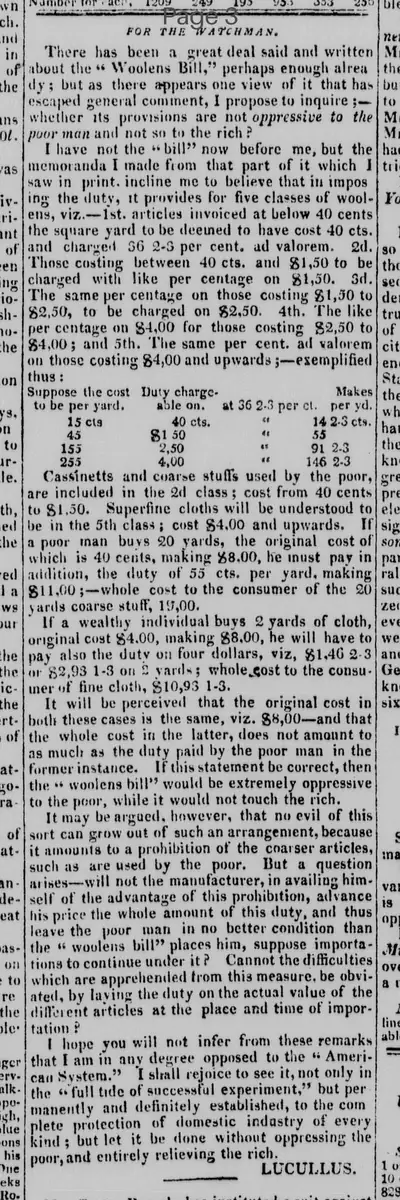
| Suppose the cost to be per yard, | Duty charge-able on, | at 36 2-3 per ct. | Makes per yd. |
| 15 cts | 40 cts. | 44 | 14 2-3 cts |
| 45 | 81 50 | 44 | 55 |
| 155 | 2,50 | 44 | 91 2-3 |
| 255 | 4,00 | 44 | 146 2-3 |
FOR THE WATCHMAN.
There has been a great deal said and written about the "Woolens Bill," perhaps enough already; but as there appears one view of it that has escaped general comment, I propose to inquire;-- whether its provisions are not oppressive to the poor man and not so to the rich?
I have not the "bill" now before me, but the memoranda I made from that part of it which I saw in print, incline me to believe that in imposing the duty, it provides for five classes of woolens, viz.--1st. articles invoiced at below 40 cents the square yard to be deemed to have cost 40 cts. and charged 36 2-3 per cent. ad valorem. 2d. Those costing between 40 cts. and $1.50 to be charged with like per centage on $1.50. 3d. The same per centage on those costing $1.50 to $2.50, to be charged on $2.50. 4th. The like per centage on $4.00 for those costing $2.50 to $4.00; and 5th. The same per cent. ad valorem on those costing $4.00 and upwards;--exemplified thus:
Cassinetts and coarse stuffs used by the poor, are included in the 2d class; cost from 40 cents to $1.50. Superfine cloths will be understood to be in the 5th class; cost $4.00 and upwards. If a poor man buys 20 yards, the original cost of which is 40 cents, making $8.00, he must pay in addition, the duty of 55 cts. per yard, making $11.00;--whole cost to the consumer of the 20 yards coarse stuff, $19.00.
If a wealthy individual buys 2 yards of cloth, original cost $4.00, making $8.00, he will have to pay also the duty on four dollars, viz, $1.46 2/3 or $2.93 1/3 on 2 yards; whole cost to the consumer of fine cloth, $10.93 1/3.
It will be perceived that the original cost in both these cases is the same, viz. $8.00--and that the whole cost in the latter, does not amount to as much as the duty paid by the poor man in the former instance. If this statement be correct, then the "woolens bill" would be extremely oppressive to the poor, while it would not touch the rich.
It may be argued, however, that no evil of this sort can grow out of such an arrangement, because it amounts to a prohibition of the coarser articles, such as are used by the poor. But a question arises--will not the manufacturer, in availing himself of the advantage of this prohibition, advance his price the whole amount of this duty, and thus leave the poor man in no better condition than the "woolens bill" places him, suppose importations to continue under it? Cannot the difficulties which are apprehended from this measure, be obviated, by laying the duty on the actual value of the different articles at the place and time of importation?
I hope you will not infer from these remarks that I am in any degree opposed to the "American System." I shall rejoice to see it, not only in the "full tide of successful experiment," but permanently and definitely established, to the complete protection of domestic industry of every kind; but let it be done without oppressing the poor, and entirely relieving the rich.
LUCULLUS.
What sub-type of article is it?
What themes does it cover?
What keywords are associated?
What entities or persons were involved?
Letter to Editor Details
Author
Lucullus
Recipient
For The Watchman
Main Argument
the woolens bill imposes tiered duties that disproportionately burden the poor by charging higher effective rates on cheaper woolens, while the rich pay less relative to value; duties should be based on actual import value to avoid oppressing the poor.
Notable Details