Thank you for visiting SNEWPapers!
Sign up free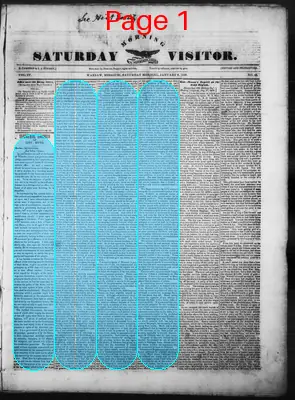
Story
January 6, 1849
Saturday Morning Visitor
Warsaw, Benton County, Missouri
What is this article about?
Inaugural address by Missouri Governor King, expressing gratitude for election, outlining principles of limited federal government, strict constitutional construction, support for education, internal improvements, and state prosperity while invoking divine guidance.
Clipping
OCR Quality
95%
Excellent
Full Text
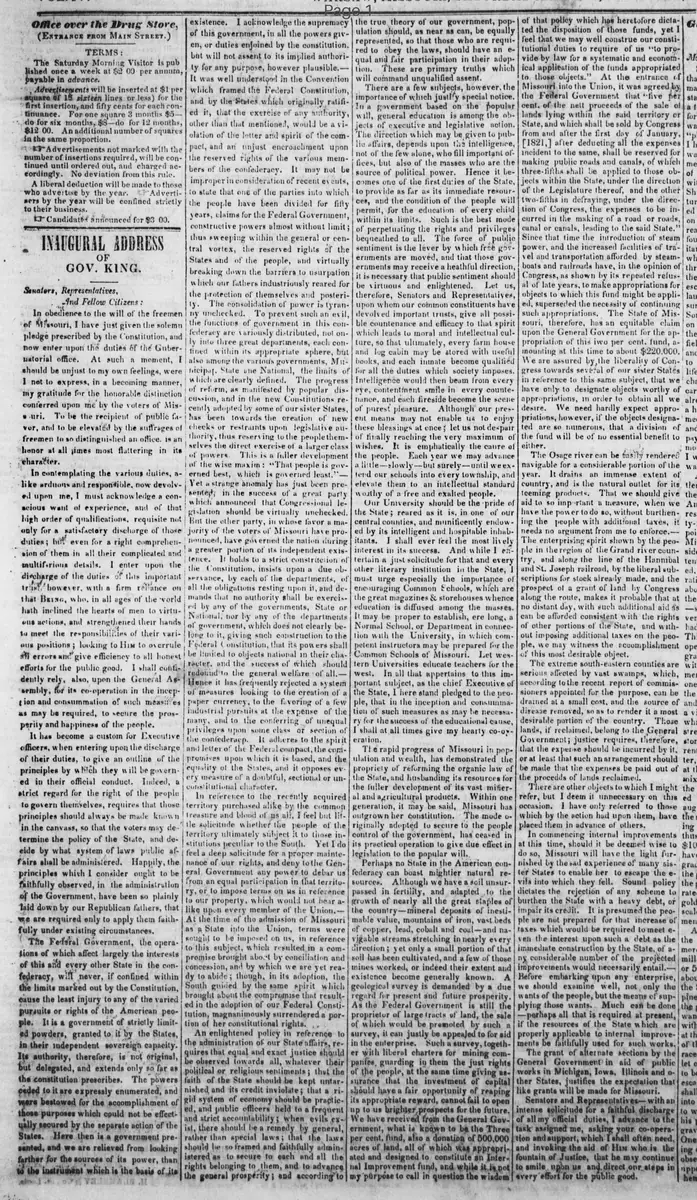
INAUGURAL ADDRESS
OF
GOV. KING.
Senators, Representatives,
And Fellow Citizens:
In obedience to the will of the freemen of Missouri, I have just given the solemn pledge prescribed by the Constitution, and now enter upon the duties of the Gubernatorial office. At such a moment, I should be unjust to my own feelings, were I not to express, in a becoming manner, my gratitude for the honorable distinction conferred upon me by the voters of Missouri. To be the recipient of public favor, and to be elevated by the suffrages of freemen to so distinguished an office, is an honor at all times most flattering in its character.
In contemplating the various duties, alike arduous and responsible, now devolved upon me, I must acknowledge a conscious want of experience, and of that high order of qualifications requisite not only for a satisfactory discharge of those duties; but even for a right comprehension of them in all their complicated and multifarious details. I enter upon the discharge of the duties of this important trust, however, with a firm reliance on that Being, who, in all ages of the world hath inclined the hearts of men to virtuous action, and strengthened their hands to meet the responsibilities of their various positions; looking to Him to overrule all errors and give efficiency to all honest efforts for the public good. I shall confidently rely, also, upon the General Assembly, for its co-operation in the inception and consummation of such measures as may be required, to secure the prosperity and happiness of the people.
It has become a custom for Executive officers, when entering upon the discharge of their duties, to give an outline of the principles by which they will be governed in their official conduct. Indeed, a strict regard for the right of the people to govern themselves, requires that those principles should always be made known in the canvass, so that the voters may determine the policy of the State, and decide by what system of laws public affairs shall be administered. Happily, the principles which I consider ought to be faithfully observed, in the administration of the Government, have been so plainly laid down by our Republican fathers, that we are required only to apply them faithfully under existing circumstances.
The Federal Government, the operations of which affect largely the interests of this and every other State in the confederacy, will never, if confined within the limits marked out by the Constitution, cause the least injury to any of the varied pursuits or rights of the American people. It is a government of strictly limited powers, granted to it by the States, in their independent sovereign capacity. Its authority, therefore, is not original, but delegated, and extends only so far as the constitution prescribes. The powers ceded to it are expressly enumerated, and were bestowed for the accomplishment of those purposes which could not be effectually secured by the separate action of the States. Here then is a government presented, and we are relieved from looking farther for the sources of its power, than to the instrument which is the basis of its empire.
existence. I acknowledge the supremacy of this government, in all the powers given, or duties enjoined by the constitution. but will not assent to its implied authority for any purpose, however plausible.
It was well understood in the Convention which framed the Federal Constitution, and by the States which originally ratified it, that the exercise of any authority other than that mentioned, would be a violation of the letter and spirit of the compact, and an unjust encroachment upon the reserved rights of the various members of the confederacy. It may not be improper in consideration of recent events, to state that one of the parties into which the people have been divided for fifty years, claims for the Federal Government, constructive powers almost without limit thus sweeping within the general or central vortex, the reserved rights of the States and of the people, and virtually breaking down the barriers to usurpation which our fathers industriously reared for the protection of themselves and posterity. The consolidation of power is tyranny unchecked. To prevent such an evil, the functions of government in this confederacy are variously distributed, not only into three great departments, each confined within its appropriate sphere, but also among the various governments, Municipal, State and National, the limits of which are clearly defined. The progress of reform, as manifested by popular discussion, and in the new Constitutions recently adopted by some of our sister States, has been towards the creation of new checks or restraints upon legislative authority, thus reserving to the people themselves the direct exercise of a larger class of powers. This is a fuller development of the wise maxim: "That people is governed best, which is governed least."
Yet a strange anomaly has just been presented; in the success of a great party which announced that Congressional legislation should be virtually unchecked.
But the other party, in whose favor a majority of the voters of Missouri have pronounced, have governed the nation during a greater portion of its independent existence. It holds to a strict construction of the Constitution, insists upon a due observance, by each of the departments, of all the obligations resting upon it, and demands that no authority shall be exercised by any of the governments, State or National, nor by any of the departments of government, which does not clearly belong to it, giving such construction to the Federal Constitution, that its powers shall be limited to objects national in their character, and the success of which should redound to the general welfare of all.
Hence it has frequently rejected a system of measures looking to the creation of a paper currency, to the favoring of a few industrial pursuits at the expense of the many, and to the conferring of unequal privileges upon some class or section of the confederacy. It adheres to the spirit and letter of the Federal compact, the compromises upon which it is based, and the equality of the States, and it opposes every measure of a doubtful, sectional or unconstitutional character.
In reference to the recently acquired territory purchased alike by the common treasure and blood of us all, I feel but little solicitude whether the people of the territory ultimately subject it to those institutions peculiar to the South. Yet I do feel a deep solicitude for a proper maintenance of our rights, and deny to the General Government any power to debar us from an equal participation in that territory, or to impose terms on us in reference to our property, which would not bear alike upon every member of the Union.
At the time of the admission of Missouri as a State into the Union, terms were sought to be imposed on us, in reference to this subject, which resulted in a compromise brought about by conciliation and concession, and by which we are yet ready to abide; though, in its adoption, the South guided by the same spirit which brought about the compromise that resulted in the adoption of our Federal Constitution, magnanimously surrendered a portion of her constitutional rights.
An enlightened policy in reference to the administration of our State affairs, requires that equal and exact justice should be observed towards all, whatever their political or religious sentiments; that the faith of the State should be kept untarnished and its credit inviolate; that a rigid system of economy should be practiced, and public officers held to a frequent and strict accountability; when evils exist, there should be a remedy by general, rather than special laws; that the laws should be so framed and faithfully administered as to secure to each and all the rights belonging to them, and to advance the general prosperity; and according to the true theory of our government, population should, as near as can, be equally represented, so that those who are required to obey the laws, should have an equal and fair participation in their adoption. These are primary truths which will command unqualified assent.
There are a few subjects, however, the importance of which justify special notice. In a government based on the popular will, general education is among the objects of executive and legislative action. The direction which may be given to public affairs, depends upon the intelligence, not of the few alone, who fill important offices, but also of the masses who are the source of political power. Hence it becomes one of the first duties of the State, to provide as far as its immediate resources, and the condition of the people will permit, for the education of every child within its limits. Such is the best mode of perpetuating the rights and privileges bequeathed to us all. The force of public sentiment is the lever by which free governments are moved, and that those governments may receive a healthful direction it is necessary that public sentiment should be virtuous and enlightened. Let us, therefore, Senators and Representatives, upon whom our common constituents have devolved important trusts, give all possible countenance and efficacy to that spirit which leads to moral and intellectual culture, so that ultimately, every farm house and log cabin may be stored with useful books, and each inmate become qualified for all the duties which society imposes. Intelligence would then beam from every eye, contentment smile in every countenance, and each fireside become the scene of purest pleasure. Although our present means may not enable us to enjoy these blessings at once; let us not despair of finally reaching the very maximum of wishes. It is emphatically the cause of the people. Each year we may advance a little--slowly--but surely--until we extend our schools into every township, and elevate them to an intellectual standard worthy of a free and exalted people.
Our University should be the pride of the State; reared as it is, in one of our central counties, and munificently endowed by its intelligent and hospitable inhabitants. I shall ever feel the most lively interest in its success. And while I entertain a just solicitude for that and every other literary institution in the State, I must urge especially the importance of encouraging Common Schools, which are the great magazines & storehouses whence education is diffused among the masses.
It may be proper to establish, ere long, a Normal School, or Department in connection with the University, in which competent instructors may be prepared for the Common Schools of Missouri. Let western Universities educate teachers for the west. In all that appertains to this important subject, as the chief Executive of the State, I here stand pledged to the people, that in the inception and consummation of such measures as may be necessary for the success of the educational cause, I shall at all times give my hearty co-operation.
The rapid progress of Missouri in population and wealth, has demonstrated the propriety of reforming the organic law of the State, and husbanding its resources for the fuller development of its vast mineral and agricultural products. Within one generation, it may be said, Missouri has outgrown her constitution. The mode originally adopted to secure to the people control of the government, has ceased in its practical operation to give due effect in legislation to the popular will.
Perhaps no State in the American confederacy can boast mightier natural resources. Although we have a soil unsurpassed in fertility, and adapted to the growth of nearly all the great staples of the country--mineral deposits of inestimable value, mountains of iron, vast beds of copper, lead, cobalt and coal--and navigable streams stretching in nearly every direction; yet only a small portion of that soil has been cultivated, and a few of those mines worked, or indeed their extent and existence become generally known. A geological survey is demanded by a due regard for present and future prosperity.
As the Federal Government is still the proprietor of large tracts of land, the sale of which would be promoted by such a survey, it can justly be appealed to for aid in the enterprise. Such a survey, together with liberal charters for mining companies, guarding in them the just rights of the people, at the same time giving assurance that the investment of capital should have a fair opportunity of reaping its appropriate reward, cannot fail to open up to us brighter prospects for the future.
We have received from the General Government, what is known to be the Three per cent. fund, also a donation of 500,000 acres of land, all of which was appropriated and designed to constitute an Internal Improvement fund, and while it is not my purpose to call in question the wisdom of that policy which has heretofore dictated the disposition of those funds, yet I feel that we may well construe our constitutional duties to require of us "to provide by law for a systematic and economical application of the funds appropriated to those objects." At the entrance of Missouri into the Union, it was agreed by the Federal Government that "five per cent. of the nett proceeds of the sale of lands lying within the said territory or State, and which shall be sold by Congress from and after the first day of January, [1821,] after deducting all the expenses incident to the same, shall be reserved for making public roads and canals, of which three-fifths shall be applied to those objects within the State, under the direction of the Legislature thereof, and the other two-fifths in defraying, under the direction of Congress, the expenses to be incurred in the making of a road or roads canal or canals, leading to the said State." Since that time the introduction of steam power, and the increased facilities of travel and transportation afforded by steamboats and railroads have, in the opinion of Congress, as shown by its repeated refusal of late years, to make appropriations for objects to which this fund might be applied, superseded the necessity of continuing such appropriations. The State of Missouri, therefore, has an equitable claim upon the General Government for the appropriation of this two per cent. fund, amounting at this time to about $220,000.
We are assured by the liberality of Congress towards several of our sister States in reference to this same subject, that we have only to designate objects worthy of appropriations, in order to obtain all we desire. We need hardly expect appropriations, however, if the objects designated are so numerous, that a division of the fund will be of no essential benefit to either.
The Osage river can be easily rendered navigable for a considerable portion of the year. It drains an immense extent of country, and is the natural outlet for its teeming products. That we should give aid to so important a measure, when we have the power to do so, without burdening the people with additional taxes, it needs no argument from me to enforce.
The enterprising spirit shown by the people in the region of the Grand river country, and along the line of the Hannibal and St. Joseph railroad, by the liberal subscriptions for stock already made, and the prospect of a grant of land by Congress along the route, makes it probable that at no distant day, with such additional aid as can be afforded consistent with the rights of other portions of the State, and without imposing additional taxes on the people, we may witness the accomplishment of this most desirable object.
The extreme south-eastern counties are seriously affected by vast swamps, which, according to the recent report of commissioners appointed for the purpose, can be drained at a small cost, and the source of disease removed, so as to render it a most desirable portion of the country. Those lands, if reclaimed, belong to the General Government; justice requires, therefore, that the expense should be incurred by it, or at least that such an arrangement should be made that the expenses be paid out of the proceeds of lands reclaimed.
There are other objects to which I might refer, but I deem it unnecessary on this occasion. I have only referred to those which by the action had upon them, have placed them in advance of others.
In commencing internal improvements at this time, should it be deemed wise to do so, Missouri will have the light furnished by the sad experience of many sister States to enable her to escape the evils into which they fell. Sound policy dictates the rejection of any scheme to burden the State with a heavy debt, or impair its credit. It is presumed the people are not prepared for that increase of taxes which would be required to meet even the interest upon such a debt as the immediate construction by the State, of any considerable number of the projected improvements would necessarily entail.
Before embarking upon any enterprise, we should examine well, not only the wants of the people, but the means of supplying those wants. Much can be done--perhaps all that is required at present, if the resources of the State which are properly applicable to internal improvements be faithfully used for such works. The grant of alternate sections by the General Government in aid of public works in Michigan, Iowa, Illinois and other States, justifies the expectation that like grants will be made for Missouri.
Senators and Representatives--with an intense solicitude for a faithful discharge of all my official duties, I advance to the task assigned me, asking your co-operation and support, which I shall often need, and invoking the aid of Him who is the fountain of Justice, that he may continue to smile upon us and direct our steps in every effort for the public good.
OF
GOV. KING.
Senators, Representatives,
And Fellow Citizens:
In obedience to the will of the freemen of Missouri, I have just given the solemn pledge prescribed by the Constitution, and now enter upon the duties of the Gubernatorial office. At such a moment, I should be unjust to my own feelings, were I not to express, in a becoming manner, my gratitude for the honorable distinction conferred upon me by the voters of Missouri. To be the recipient of public favor, and to be elevated by the suffrages of freemen to so distinguished an office, is an honor at all times most flattering in its character.
In contemplating the various duties, alike arduous and responsible, now devolved upon me, I must acknowledge a conscious want of experience, and of that high order of qualifications requisite not only for a satisfactory discharge of those duties; but even for a right comprehension of them in all their complicated and multifarious details. I enter upon the discharge of the duties of this important trust, however, with a firm reliance on that Being, who, in all ages of the world hath inclined the hearts of men to virtuous action, and strengthened their hands to meet the responsibilities of their various positions; looking to Him to overrule all errors and give efficiency to all honest efforts for the public good. I shall confidently rely, also, upon the General Assembly, for its co-operation in the inception and consummation of such measures as may be required, to secure the prosperity and happiness of the people.
It has become a custom for Executive officers, when entering upon the discharge of their duties, to give an outline of the principles by which they will be governed in their official conduct. Indeed, a strict regard for the right of the people to govern themselves, requires that those principles should always be made known in the canvass, so that the voters may determine the policy of the State, and decide by what system of laws public affairs shall be administered. Happily, the principles which I consider ought to be faithfully observed, in the administration of the Government, have been so plainly laid down by our Republican fathers, that we are required only to apply them faithfully under existing circumstances.
The Federal Government, the operations of which affect largely the interests of this and every other State in the confederacy, will never, if confined within the limits marked out by the Constitution, cause the least injury to any of the varied pursuits or rights of the American people. It is a government of strictly limited powers, granted to it by the States, in their independent sovereign capacity. Its authority, therefore, is not original, but delegated, and extends only so far as the constitution prescribes. The powers ceded to it are expressly enumerated, and were bestowed for the accomplishment of those purposes which could not be effectually secured by the separate action of the States. Here then is a government presented, and we are relieved from looking farther for the sources of its power, than to the instrument which is the basis of its empire.
existence. I acknowledge the supremacy of this government, in all the powers given, or duties enjoined by the constitution. but will not assent to its implied authority for any purpose, however plausible.
It was well understood in the Convention which framed the Federal Constitution, and by the States which originally ratified it, that the exercise of any authority other than that mentioned, would be a violation of the letter and spirit of the compact, and an unjust encroachment upon the reserved rights of the various members of the confederacy. It may not be improper in consideration of recent events, to state that one of the parties into which the people have been divided for fifty years, claims for the Federal Government, constructive powers almost without limit thus sweeping within the general or central vortex, the reserved rights of the States and of the people, and virtually breaking down the barriers to usurpation which our fathers industriously reared for the protection of themselves and posterity. The consolidation of power is tyranny unchecked. To prevent such an evil, the functions of government in this confederacy are variously distributed, not only into three great departments, each confined within its appropriate sphere, but also among the various governments, Municipal, State and National, the limits of which are clearly defined. The progress of reform, as manifested by popular discussion, and in the new Constitutions recently adopted by some of our sister States, has been towards the creation of new checks or restraints upon legislative authority, thus reserving to the people themselves the direct exercise of a larger class of powers. This is a fuller development of the wise maxim: "That people is governed best, which is governed least."
Yet a strange anomaly has just been presented; in the success of a great party which announced that Congressional legislation should be virtually unchecked.
But the other party, in whose favor a majority of the voters of Missouri have pronounced, have governed the nation during a greater portion of its independent existence. It holds to a strict construction of the Constitution, insists upon a due observance, by each of the departments, of all the obligations resting upon it, and demands that no authority shall be exercised by any of the governments, State or National, nor by any of the departments of government, which does not clearly belong to it, giving such construction to the Federal Constitution, that its powers shall be limited to objects national in their character, and the success of which should redound to the general welfare of all.
Hence it has frequently rejected a system of measures looking to the creation of a paper currency, to the favoring of a few industrial pursuits at the expense of the many, and to the conferring of unequal privileges upon some class or section of the confederacy. It adheres to the spirit and letter of the Federal compact, the compromises upon which it is based, and the equality of the States, and it opposes every measure of a doubtful, sectional or unconstitutional character.
In reference to the recently acquired territory purchased alike by the common treasure and blood of us all, I feel but little solicitude whether the people of the territory ultimately subject it to those institutions peculiar to the South. Yet I do feel a deep solicitude for a proper maintenance of our rights, and deny to the General Government any power to debar us from an equal participation in that territory, or to impose terms on us in reference to our property, which would not bear alike upon every member of the Union.
At the time of the admission of Missouri as a State into the Union, terms were sought to be imposed on us, in reference to this subject, which resulted in a compromise brought about by conciliation and concession, and by which we are yet ready to abide; though, in its adoption, the South guided by the same spirit which brought about the compromise that resulted in the adoption of our Federal Constitution, magnanimously surrendered a portion of her constitutional rights.
An enlightened policy in reference to the administration of our State affairs, requires that equal and exact justice should be observed towards all, whatever their political or religious sentiments; that the faith of the State should be kept untarnished and its credit inviolate; that a rigid system of economy should be practiced, and public officers held to a frequent and strict accountability; when evils exist, there should be a remedy by general, rather than special laws; that the laws should be so framed and faithfully administered as to secure to each and all the rights belonging to them, and to advance the general prosperity; and according to the true theory of our government, population should, as near as can, be equally represented, so that those who are required to obey the laws, should have an equal and fair participation in their adoption. These are primary truths which will command unqualified assent.
There are a few subjects, however, the importance of which justify special notice. In a government based on the popular will, general education is among the objects of executive and legislative action. The direction which may be given to public affairs, depends upon the intelligence, not of the few alone, who fill important offices, but also of the masses who are the source of political power. Hence it becomes one of the first duties of the State, to provide as far as its immediate resources, and the condition of the people will permit, for the education of every child within its limits. Such is the best mode of perpetuating the rights and privileges bequeathed to us all. The force of public sentiment is the lever by which free governments are moved, and that those governments may receive a healthful direction it is necessary that public sentiment should be virtuous and enlightened. Let us, therefore, Senators and Representatives, upon whom our common constituents have devolved important trusts, give all possible countenance and efficacy to that spirit which leads to moral and intellectual culture, so that ultimately, every farm house and log cabin may be stored with useful books, and each inmate become qualified for all the duties which society imposes. Intelligence would then beam from every eye, contentment smile in every countenance, and each fireside become the scene of purest pleasure. Although our present means may not enable us to enjoy these blessings at once; let us not despair of finally reaching the very maximum of wishes. It is emphatically the cause of the people. Each year we may advance a little--slowly--but surely--until we extend our schools into every township, and elevate them to an intellectual standard worthy of a free and exalted people.
Our University should be the pride of the State; reared as it is, in one of our central counties, and munificently endowed by its intelligent and hospitable inhabitants. I shall ever feel the most lively interest in its success. And while I entertain a just solicitude for that and every other literary institution in the State, I must urge especially the importance of encouraging Common Schools, which are the great magazines & storehouses whence education is diffused among the masses.
It may be proper to establish, ere long, a Normal School, or Department in connection with the University, in which competent instructors may be prepared for the Common Schools of Missouri. Let western Universities educate teachers for the west. In all that appertains to this important subject, as the chief Executive of the State, I here stand pledged to the people, that in the inception and consummation of such measures as may be necessary for the success of the educational cause, I shall at all times give my hearty co-operation.
The rapid progress of Missouri in population and wealth, has demonstrated the propriety of reforming the organic law of the State, and husbanding its resources for the fuller development of its vast mineral and agricultural products. Within one generation, it may be said, Missouri has outgrown her constitution. The mode originally adopted to secure to the people control of the government, has ceased in its practical operation to give due effect in legislation to the popular will.
Perhaps no State in the American confederacy can boast mightier natural resources. Although we have a soil unsurpassed in fertility, and adapted to the growth of nearly all the great staples of the country--mineral deposits of inestimable value, mountains of iron, vast beds of copper, lead, cobalt and coal--and navigable streams stretching in nearly every direction; yet only a small portion of that soil has been cultivated, and a few of those mines worked, or indeed their extent and existence become generally known. A geological survey is demanded by a due regard for present and future prosperity.
As the Federal Government is still the proprietor of large tracts of land, the sale of which would be promoted by such a survey, it can justly be appealed to for aid in the enterprise. Such a survey, together with liberal charters for mining companies, guarding in them the just rights of the people, at the same time giving assurance that the investment of capital should have a fair opportunity of reaping its appropriate reward, cannot fail to open up to us brighter prospects for the future.
We have received from the General Government, what is known to be the Three per cent. fund, also a donation of 500,000 acres of land, all of which was appropriated and designed to constitute an Internal Improvement fund, and while it is not my purpose to call in question the wisdom of that policy which has heretofore dictated the disposition of those funds, yet I feel that we may well construe our constitutional duties to require of us "to provide by law for a systematic and economical application of the funds appropriated to those objects." At the entrance of Missouri into the Union, it was agreed by the Federal Government that "five per cent. of the nett proceeds of the sale of lands lying within the said territory or State, and which shall be sold by Congress from and after the first day of January, [1821,] after deducting all the expenses incident to the same, shall be reserved for making public roads and canals, of which three-fifths shall be applied to those objects within the State, under the direction of the Legislature thereof, and the other two-fifths in defraying, under the direction of Congress, the expenses to be incurred in the making of a road or roads canal or canals, leading to the said State." Since that time the introduction of steam power, and the increased facilities of travel and transportation afforded by steamboats and railroads have, in the opinion of Congress, as shown by its repeated refusal of late years, to make appropriations for objects to which this fund might be applied, superseded the necessity of continuing such appropriations. The State of Missouri, therefore, has an equitable claim upon the General Government for the appropriation of this two per cent. fund, amounting at this time to about $220,000.
We are assured by the liberality of Congress towards several of our sister States in reference to this same subject, that we have only to designate objects worthy of appropriations, in order to obtain all we desire. We need hardly expect appropriations, however, if the objects designated are so numerous, that a division of the fund will be of no essential benefit to either.
The Osage river can be easily rendered navigable for a considerable portion of the year. It drains an immense extent of country, and is the natural outlet for its teeming products. That we should give aid to so important a measure, when we have the power to do so, without burdening the people with additional taxes, it needs no argument from me to enforce.
The enterprising spirit shown by the people in the region of the Grand river country, and along the line of the Hannibal and St. Joseph railroad, by the liberal subscriptions for stock already made, and the prospect of a grant of land by Congress along the route, makes it probable that at no distant day, with such additional aid as can be afforded consistent with the rights of other portions of the State, and without imposing additional taxes on the people, we may witness the accomplishment of this most desirable object.
The extreme south-eastern counties are seriously affected by vast swamps, which, according to the recent report of commissioners appointed for the purpose, can be drained at a small cost, and the source of disease removed, so as to render it a most desirable portion of the country. Those lands, if reclaimed, belong to the General Government; justice requires, therefore, that the expense should be incurred by it, or at least that such an arrangement should be made that the expenses be paid out of the proceeds of lands reclaimed.
There are other objects to which I might refer, but I deem it unnecessary on this occasion. I have only referred to those which by the action had upon them, have placed them in advance of others.
In commencing internal improvements at this time, should it be deemed wise to do so, Missouri will have the light furnished by the sad experience of many sister States to enable her to escape the evils into which they fell. Sound policy dictates the rejection of any scheme to burden the State with a heavy debt, or impair its credit. It is presumed the people are not prepared for that increase of taxes which would be required to meet even the interest upon such a debt as the immediate construction by the State, of any considerable number of the projected improvements would necessarily entail.
Before embarking upon any enterprise, we should examine well, not only the wants of the people, but the means of supplying those wants. Much can be done--perhaps all that is required at present, if the resources of the State which are properly applicable to internal improvements be faithfully used for such works. The grant of alternate sections by the General Government in aid of public works in Michigan, Iowa, Illinois and other States, justifies the expectation that like grants will be made for Missouri.
Senators and Representatives--with an intense solicitude for a faithful discharge of all my official duties, I advance to the task assigned me, asking your co-operation and support, which I shall often need, and invoking the aid of Him who is the fountain of Justice, that he may continue to smile upon us and direct our steps in every effort for the public good.
What sub-type of article is it?
Inaugural Address
Political Speech
What themes does it cover?
Justice
Moral Virtue
Providence Divine
What keywords are associated?
Inaugural Address
Missouri Governor
Constitutional Principles
Education Reform
Internal Improvements
Federal Government
State Resources
What entities or persons were involved?
Gov. King
Where did it happen?
Missouri
Story Details
Key Persons
Gov. King
Location
Missouri
Story Details
Governor King delivers his inaugural address, pledging adherence to constitutional principles, limited federal powers, support for education including common schools and university, geological survey, internal improvements like river navigation and railroads, while emphasizing economy, justice, and divine guidance for state prosperity.