Thank you for visiting SNEWPapers!
Sign up free
The Daily Advertiser
New York, New York County, New York
What is this article about?
The French King has published a new code of criminal laws emphasizing humanity, originating from M. de Calonne. Key articles abolish harsh trial practices, ensure fair verdicts, require majorities for convictions, delay executions except in sedition cases, and mandate printed decrees.
Clipping
OCR Quality
Full Text
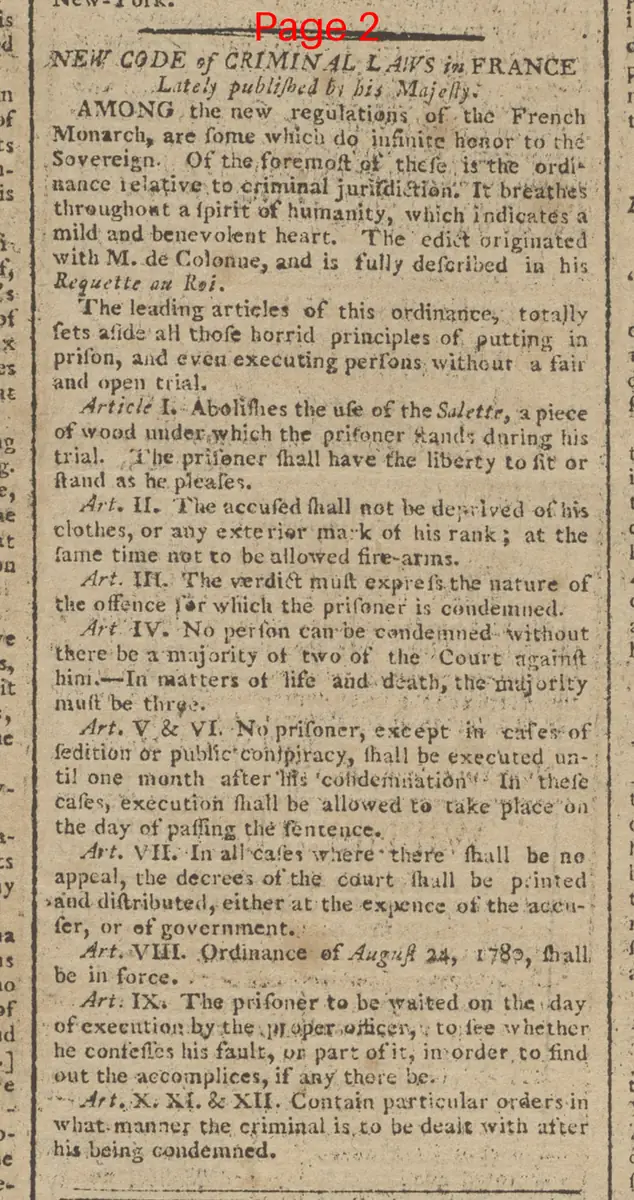
Lately published by his Majesty.
AMONG the new regulations of the French Monarch, are some which do infinite honor to the Sovereign. Of the foremost of these is the ordinance relative to criminal jurisdiction. It breathes throughout a spirit of humanity, which indicates a mild and benevolent heart. The edict originated with M. de Calonne, and is fully described in his Remonstrance au Roi.
The leading articles of this ordinance, totally sets aside all those horrid principles of putting in prison, and even executing persons without a fair and open trial.
Article I. Abolishes the use of the Salette, a piece of wood under which the prisoner stands during his trial. The prisoner shall have the liberty to sit or stand as he pleases.
Art. II. The accused shall not be deprived of his clothes, or any exterior mark of his rank; at the same time not to be allowed fire-arms.
Art. III. The verdict must express the nature of the offence of which the prisoner is condemned.
Art IV. No person can be condemned without there be a majority of two of the Court against him. -In matters of life and death, the majority must be three.
Art. V & VI. No prisoner, except in cases of sedition or public conspiracy, shall be executed until one month after his condemnation"- In these cases, execution shall be allowed to take place on the day of passing the sentence.
Art. VII. In all cases where there shall be no appeal, the decrees of the court shall be printed and distributed, either at the expense of the accuser, or of government.
Art. VIII. Ordinance of August 24, 1780, Shall be in force.
Art. IX. The prisoner to be waited on the day of execution by the proper officers, to see whether he confesses his fault, or part of it, in order to find out the accomplices, if any there be. ;
Art. X. XI. & XII. Contain particular orders in what manner the criminal is to be dealt with after his being condemned.
What sub-type of article is it?
What keywords are associated?
What entities or persons were involved?
Where did it happen?
Foreign News Details
Primary Location
France
Event Date
Lately Published
Key Persons
Outcome
abolition of harsh trial practices including the salette, preservation of accused's rank and clothing, requirements for majority verdicts, delayed executions except in sedition cases, printed decrees, and enforcement of 1780 ordinance.
Event Details
The French Monarch has issued a new ordinance on criminal jurisdiction, originating from M. de Calonne's Remonstrance au Roi, which promotes humanity by eliminating unfair imprisonment and executions without trial. It includes articles abolishing the Salette, allowing the accused to sit or stand, preserving clothes and rank, specifying verdict details, requiring court majorities for condemnation, delaying executions by one month except in sedition, mandating printed decrees, enforcing the August 24, 1780 ordinance, requiring confession checks on execution day, and detailing post-condemnation procedures.