Thank you for visiting SNEWPapers!
Sign up free
Literary
April 25, 1833
Herald Of The Times
Newport, Newport County, Rhode Island
What is this article about?
Narrative from Frazer's Magazine about Mary Fenwick, a virtuous farmer's daughter from Berwick-upon-Tweed, who travels to London to forgive her unfaithful fiancé, Richard Mansel, showcasing female sensibility, moral principles, and magnanimity despite his betrayal.
Clipping
OCR Quality
98%
Excellent
Full Text
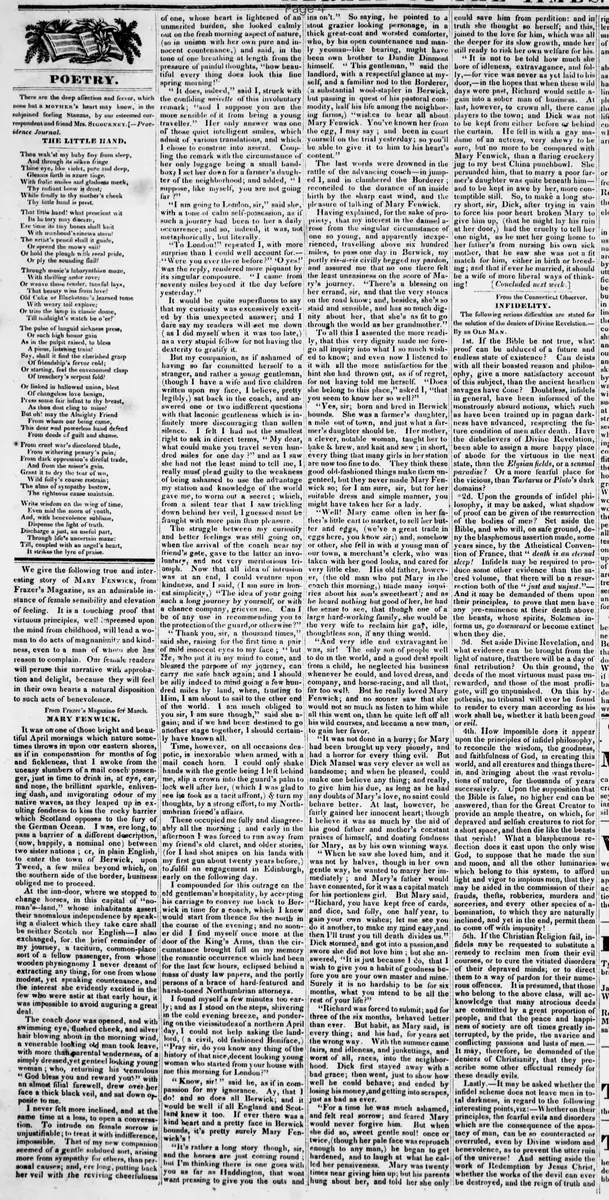
We give the following true and interesting story of Mary Fenwick, from Frazer's Magazine, as an admirable instance of female sensibility and elevation of feeling. It is a touching proof that virtuous principles, well impressed upon the mind from childhood, will lead a woman to do acts of magnanimity and kindness, even to a man of whom she has reason to complain. Our female readers will peruse this narrative with approbation and delight, because they will feel in their own hearts a natural disposition to such acts of benevolence.
From Frazer's Magazine for March.
MARY FENWICK.
It was on one of those bright and beautiful April mornings which nature sometimes throws in upon our eastern shores, as if in compensation for months of fog and fickleness, that I awoke from the uneasy slumbers of a mail coach passenger, just in time to drink in, at eye, ear, and nose, the brilliant sparkle, enlivening dash, and invigorating odour of my native waves, as they leaped up in exulting fondness to kiss the rocky barrier which Scotland opposes to the fury of the German Ocean. I was, ere long, to pass a barrier of a different description, (now, happily, a nominal one) between two sister nations; or, in plain English, to enter the town of Berwick, upon Tweed, a few miles beyond which, on the southern side of the border, business obliged me to proceed.
At the inn-door, where we stopped to change horses, in this capital of no-man's-land, whose inhabitants assert their anomalous independence by speaking a dialect which they take care shall be neither Scotch nor English—I also exchanged, for the brief remainder of my journey, a taciturn, common-place sort of a fellow passenger, from whose wooden physiognomy I never dreamt of extracting any thing, for one from whose modest, yet speaking countenance, and the interest she evidently excited in the few who were astir at that early hour, it was impossible to avoid auguring a great deal.
The coach door was opened, and with swimming eye, flushed cheek, and silver hair blowing about in the morning wind, a venerable looking old man took leave, with more than parental tenderness, of a simply dressed, yet genteel looking young woman; who, returning his tremulous "God bless you and reward you!" with an almost filial farewell, drew over her face a thick black veil, and sat down opposite to me.
I never felt more inclined, and at the same time at a loss, to open a conversation. To intrude on female sorrow is unjustifiable; to treat it with indifference, impossible. That of my new companion seemed of a gentle subdued sort, arising more from sympathy for others, than personal causes; and, ere long, putting back her veil with the reviving cheerfulness of one, whose heart is lightened of an unmerited burden, she looked calmly out on the fresh morning aspect of nature, (so in unison with her own pure and innocent countenance,) and said, in the tone of one breathing at length from the pressure of painful thoughts, "how beautiful every thing does look this fine spring morning!"
"It does, indeed," said I, struck with the confiding naivete of this involuntary remark; "and I suppose you are the more sensible of it from being a young traveller." Her only answer was one of those quiet intelligent smiles, which admit of various translations, and which I chose to construe into assent. Coupling the remark with the circumstance of her only luggage being a small band-box I set her down for a farmer's daughter of the neighborhood; and added, "I suppose, like myself, you are not going far?"
"I am going to London, sir," said she, with a tone of calm self-possession, as if such a journey had been to her a daily occurrence; and so, indeed, it was, not metaphorically, but literally.
"To London!" repeated I, with more surprise than I could well account for.-- "Were you ever there before?" "O yes!" was the reply, rendered more piquant by its singular composure. "I came from seventy miles beyond it the day before yesterday."
It would be quite superfluous to say that my curiosity was excessively excited by this unexpected answer; and I dare say my readers will set me down (as I did myself when it was too late,) as a very stupid fellow for not having the dexterity to gratify it.
But my companion, as if ashamed of having so far committed herself to a stranger, and rather a young gentleman, (though I have a wife and five children written upon my face, I believe, pretty legibly,) sat back in the coach, and answered one or two indifferent questions with that laconic gentleness which is infinitely more discouraging than sullen silence. I felt I had not the smallest right to ask in direct terms, "My dear, what could make you travel seven hundred miles for one day?" and as I saw she had not the least mind to tell me, I really must plead guilty to the weakness of being ashamed to use the advantage my station and knowledge of the world gave me, to worm out a secret; which, from a silent tear that I saw trickling down behind her veil, I guessed must be fraught with more pain than pleasure.
The struggle between my curiosity and better feelings was still going on, when the arrival of the coach near my friend's gate, gave to the latter an involuntary, and not very meritorious triumph. "Now that all idea of intrusion was at an end, I could venture upon kindness, and I said, (I am sure in honest simplicity,) "The idea of your going such a long journey by yourself, or with a chance company, grieves me. Can I be of any use in recommending you to the protection of the guard, or otherwise?"
"Thank you, sir, a thousand times," said she, raising for the first time a pair of mild innocent eyes to my face; "but He, who put it in my mind to come, and blessed the purpose of my journey, can carry me safe back again; and I should be silly indeed to mind going a few hundred miles by land, when, trusting to Him, I am about to sail to the other end of the world. I am much obliged to you sir, I am sure though," said she again; and if we had been destined to go another stage together, I should certainly have known all.
Time, however, on all occasions despotic, is inexorable when armed with a mail-coach horn. I could only shake hands with the gentle being I left behind me, slip a crown into the guard's palm to look well after her, (which I was glad to see he took as a tacit affront,) and turn my thoughts, by a strong effort, to my Northumbrian friend's affairs.
These occupied me fully and disagreeably all the morning; and early in the afternoon I was forced to run away from my friend's old claret, and older stories, (for I had shot snipes on his lands with my first gun about twenty years before,) to fulfil an engagement in Edinburgh, early on the following day.
I compounded for this outrage on the old gentleman's hospitality, by accepting his carriage to convey me back to Berwick in time for a coach, which I knew would start from thence for the north in the course of the evening; and no sooner did I find myself once more at the door of the King's Arms, than the circumstance brought full on my memory the romantic occurrence which I had been for the last few hours, eclipsed behind a mass of dusty law papers, and the portly persons of a brace of hard-featured and harsh-toned Northumbrian attorneys.
I found myself a few minutes too early; and as I stood on the steps, shivering in the cold evening breeze, and pondering on the vicissitudes of a northern April day, I could not help asking the landlord, (a civil, old fashioned Boniface,) "Pray sir, do you know any thing of the history of that nice, decent looking young woman who started from your house with me this morning for London?"
"Know, sir!" said he, as if in compassion for my ignorance. "Ay, that I do! and so does all Berwick; and it would be well if all England and Scotland knew it too. If ever there was a kind heart and a pretty face in Berwick bounds, it's pretty surely Mary Fenwick's!"
"It's rather a long story though, sir and the horses are just coming round; but I'm thinking there is one goes with you as far as Haddington, that won't want pressing to give you the outs and ins on't." So saying, he pointed to a stout grazier looking personage, in a thick great-coat and worsted comforter, who, by his open countenance and manly yeoman-like bearing, might have been own brother to Dandie Dinmont himself. "This gentleman," said the landlord, with a respectful glance at myself, and a familiar nod to the Borderer, (a substantial wool-stapler in Berwick, but passing in quest of his pastoral commodity, half his life among the neighboring farms,) "wishes to hear all about Mary Fenwick. You've known her from the egg, I may say; and been in court yourself on the trial yesterday; so you'll be able to give it to him to his heart's content."
The last words were drowned in the rattle of the advancing coach—in jumped I, and in clambered the Borderer; reconciled to the durance of an inside birth by the sharp east wind, and the pleasure of talking of Mary Fenwick.
Having explained, for the sake of propriety, that my interest in the damsel arose from the singular circumstance of one so young, and apparently inexperienced, travelling above six hundred miles, to pass one day in Berwick, my portly vis-a-vis civilly begged my pardon, and assured me that no one there felt the least uneasiness on the score of Mary's journey. "There's a blessing on her errand, sir, and that the very stones on the road know; and, besides, she's so staid and sensible, and has so much dignity about her, that she's as fit to go through the world as her grandmother."
To all this I assented the more readily, that this very dignity made me forego all inquiry into what I so much wished to know; and even now I listened to it with all the more satisfaction for the hint she had thrown out, as if of regret for not having told me herself. "Does she belong to this place," asked I, "that you seem to know her so well?"
"Yes, sir; born and bred in Berwick bounds.' She was a farmer's daughter, a mile out of town, and just what a farmer's daughter should be. Her mother, a clever, notable woman, taught her to bake & brew, and knit and sew; in short, every thing that many girls in her station are now too fine to do. They think these good old-fashioned things make them ungenteel, but they never made Mary Fenwick so; for I am sure, sir, but for her suitable dress and simple manner, you might have taken her for a lady.
"Well! Mary came often in her father's little cart to market, to sell her butter and eggs, (we've a great trade in eggs here, you know sir;) and somehow or other, she fell in with a young man of our town, a merchant's clerk, who was taken with her good looks, and cared for very little else. His old father, however, (the old man who put Mary in the coach this morning,) made many inquiries about his son's sweetheart; and as he heard nothing but good of her, he had the sense to see, that through one of a large hard-working family, she would be the very wife to reclaim his gay, idle, thoughtless son, if any thing would.
"And very idle and extravagant he was, sir! The only son of people well to do in the world, and a good deal spoilt from a child, he neglected his business whenever he could, and loved dress, and company, and horse-racing, and all that, far too well. But he really loved Mary Fenwick; and no sooner saw that she would not so much as listen to him while all this went on, than he quite left off all his wild courses, and became a new man, to gain her favor.
"It was not done in a hurry; or Mary had been brought up very piously, and had a horror for every thing evil. But Dick Mansel was very clever as well as handsome; and when he pleased, could make one believe any thing; and really, to give him his due, as long as he had any doubts of Mary's love, no saint could behave better. At last, however, he fairly gained her innocent heart; though I believe it was as much by the aid of his good father and mother's constant praises of himself, and doating fondness for Mary, as by his own winning ways.
"When he saw she loved him, and it was not by halves, though in her own gentle way, he wanted to marry her immediately; and Mary's father would have consented, for it was a capital match for his portionless girl. But Mary said, "Richard, you have kept free of cards, and dice, and folly, one half year, to gain your own wishes; let me see you do it another, to make my mind easy, and then I'll trust you till death divides us."
Dick stormed, and got into a passion, and swore she did not love him; but she answered, "It is just because I do, that I wish to give you a habit of goodness before you are your own master and mine: Surely it is no hardship to be for six months, what you intend to be all the rest of your life?"
"Richard was forced to submit; and for three of the six months, behaved better than ever. But habit, as Mary said, is every thing; and his had, for years set the wrong way. With the summer came fairs, and idleness, and junkettings, and worst of all, races, into the neighborhood. Dick first stayed away with a bad grace; then went, just to show how well he could behave; and ended by losing his money, and getting into scrapes, just as bad as ever.
"For a time he was much ashamed, and felt real sorrow; and feared Mary would never forgive him. But when she did so, sweet gentle soul! once or twice, (though her pale face was reproach enough to any man,) he began to get hardened, and to laugh at what he called her pensiveness. Mary was twenty times near giving him up; but his parents hung about her, and told her she only could save him from perdition: and in truth she thought so herself; and this, joined to the love for him, which was all the deeper for its slow growth, made her still ready to risk her own welfare for his.
"It is not to be told how much she bore of idleness, extravagance, and folly,--for vice was never as yet laid to his door,--in the hopes that when these wild days were past, Richard would settle again into a sober man of business. At last, however, to crown all, there came players to the town; and Dick was not to be kept from either before or behind the curtain. He fell in with a gay dame of an actress, very showy to be sure, but no more to be compared with Mary Fenwick, than a flaring crockery jug to my best China punchbowl. She persuaded him, that to marry a poor farmer's daughter was quite beneath him—and to be kept in awe by her, more contemptible still. So, to make a long story short, sir, Dick, after trying in vain to force his poor heart broken Mary to give him up, (that he might lay his ruin at her door,) had the cruelty to tell her one night, as he met her going home to her father's from nursing his own sick mother, that he saw she was not a fit match for him, either in birth or breeding; and that if ever he married, it should be a wife of more liberal ways of thinking!
[Concluded next week.]
From Frazer's Magazine for March.
MARY FENWICK.
It was on one of those bright and beautiful April mornings which nature sometimes throws in upon our eastern shores, as if in compensation for months of fog and fickleness, that I awoke from the uneasy slumbers of a mail coach passenger, just in time to drink in, at eye, ear, and nose, the brilliant sparkle, enlivening dash, and invigorating odour of my native waves, as they leaped up in exulting fondness to kiss the rocky barrier which Scotland opposes to the fury of the German Ocean. I was, ere long, to pass a barrier of a different description, (now, happily, a nominal one) between two sister nations; or, in plain English, to enter the town of Berwick, upon Tweed, a few miles beyond which, on the southern side of the border, business obliged me to proceed.
At the inn-door, where we stopped to change horses, in this capital of no-man's-land, whose inhabitants assert their anomalous independence by speaking a dialect which they take care shall be neither Scotch nor English—I also exchanged, for the brief remainder of my journey, a taciturn, common-place sort of a fellow passenger, from whose wooden physiognomy I never dreamt of extracting any thing, for one from whose modest, yet speaking countenance, and the interest she evidently excited in the few who were astir at that early hour, it was impossible to avoid auguring a great deal.
The coach door was opened, and with swimming eye, flushed cheek, and silver hair blowing about in the morning wind, a venerable looking old man took leave, with more than parental tenderness, of a simply dressed, yet genteel looking young woman; who, returning his tremulous "God bless you and reward you!" with an almost filial farewell, drew over her face a thick black veil, and sat down opposite to me.
I never felt more inclined, and at the same time at a loss, to open a conversation. To intrude on female sorrow is unjustifiable; to treat it with indifference, impossible. That of my new companion seemed of a gentle subdued sort, arising more from sympathy for others, than personal causes; and, ere long, putting back her veil with the reviving cheerfulness of one, whose heart is lightened of an unmerited burden, she looked calmly out on the fresh morning aspect of nature, (so in unison with her own pure and innocent countenance,) and said, in the tone of one breathing at length from the pressure of painful thoughts, "how beautiful every thing does look this fine spring morning!"
"It does, indeed," said I, struck with the confiding naivete of this involuntary remark; "and I suppose you are the more sensible of it from being a young traveller." Her only answer was one of those quiet intelligent smiles, which admit of various translations, and which I chose to construe into assent. Coupling the remark with the circumstance of her only luggage being a small band-box I set her down for a farmer's daughter of the neighborhood; and added, "I suppose, like myself, you are not going far?"
"I am going to London, sir," said she, with a tone of calm self-possession, as if such a journey had been to her a daily occurrence; and so, indeed, it was, not metaphorically, but literally.
"To London!" repeated I, with more surprise than I could well account for.-- "Were you ever there before?" "O yes!" was the reply, rendered more piquant by its singular composure. "I came from seventy miles beyond it the day before yesterday."
It would be quite superfluous to say that my curiosity was excessively excited by this unexpected answer; and I dare say my readers will set me down (as I did myself when it was too late,) as a very stupid fellow for not having the dexterity to gratify it.
But my companion, as if ashamed of having so far committed herself to a stranger, and rather a young gentleman, (though I have a wife and five children written upon my face, I believe, pretty legibly,) sat back in the coach, and answered one or two indifferent questions with that laconic gentleness which is infinitely more discouraging than sullen silence. I felt I had not the smallest right to ask in direct terms, "My dear, what could make you travel seven hundred miles for one day?" and as I saw she had not the least mind to tell me, I really must plead guilty to the weakness of being ashamed to use the advantage my station and knowledge of the world gave me, to worm out a secret; which, from a silent tear that I saw trickling down behind her veil, I guessed must be fraught with more pain than pleasure.
The struggle between my curiosity and better feelings was still going on, when the arrival of the coach near my friend's gate, gave to the latter an involuntary, and not very meritorious triumph. "Now that all idea of intrusion was at an end, I could venture upon kindness, and I said, (I am sure in honest simplicity,) "The idea of your going such a long journey by yourself, or with a chance company, grieves me. Can I be of any use in recommending you to the protection of the guard, or otherwise?"
"Thank you, sir, a thousand times," said she, raising for the first time a pair of mild innocent eyes to my face; "but He, who put it in my mind to come, and blessed the purpose of my journey, can carry me safe back again; and I should be silly indeed to mind going a few hundred miles by land, when, trusting to Him, I am about to sail to the other end of the world. I am much obliged to you sir, I am sure though," said she again; and if we had been destined to go another stage together, I should certainly have known all.
Time, however, on all occasions despotic, is inexorable when armed with a mail-coach horn. I could only shake hands with the gentle being I left behind me, slip a crown into the guard's palm to look well after her, (which I was glad to see he took as a tacit affront,) and turn my thoughts, by a strong effort, to my Northumbrian friend's affairs.
These occupied me fully and disagreeably all the morning; and early in the afternoon I was forced to run away from my friend's old claret, and older stories, (for I had shot snipes on his lands with my first gun about twenty years before,) to fulfil an engagement in Edinburgh, early on the following day.
I compounded for this outrage on the old gentleman's hospitality, by accepting his carriage to convey me back to Berwick in time for a coach, which I knew would start from thence for the north in the course of the evening; and no sooner did I find myself once more at the door of the King's Arms, than the circumstance brought full on my memory the romantic occurrence which I had been for the last few hours, eclipsed behind a mass of dusty law papers, and the portly persons of a brace of hard-featured and harsh-toned Northumbrian attorneys.
I found myself a few minutes too early; and as I stood on the steps, shivering in the cold evening breeze, and pondering on the vicissitudes of a northern April day, I could not help asking the landlord, (a civil, old fashioned Boniface,) "Pray sir, do you know any thing of the history of that nice, decent looking young woman who started from your house with me this morning for London?"
"Know, sir!" said he, as if in compassion for my ignorance. "Ay, that I do! and so does all Berwick; and it would be well if all England and Scotland knew it too. If ever there was a kind heart and a pretty face in Berwick bounds, it's pretty surely Mary Fenwick's!"
"It's rather a long story though, sir and the horses are just coming round; but I'm thinking there is one goes with you as far as Haddington, that won't want pressing to give you the outs and ins on't." So saying, he pointed to a stout grazier looking personage, in a thick great-coat and worsted comforter, who, by his open countenance and manly yeoman-like bearing, might have been own brother to Dandie Dinmont himself. "This gentleman," said the landlord, with a respectful glance at myself, and a familiar nod to the Borderer, (a substantial wool-stapler in Berwick, but passing in quest of his pastoral commodity, half his life among the neighboring farms,) "wishes to hear all about Mary Fenwick. You've known her from the egg, I may say; and been in court yourself on the trial yesterday; so you'll be able to give it to him to his heart's content."
The last words were drowned in the rattle of the advancing coach—in jumped I, and in clambered the Borderer; reconciled to the durance of an inside birth by the sharp east wind, and the pleasure of talking of Mary Fenwick.
Having explained, for the sake of propriety, that my interest in the damsel arose from the singular circumstance of one so young, and apparently inexperienced, travelling above six hundred miles, to pass one day in Berwick, my portly vis-a-vis civilly begged my pardon, and assured me that no one there felt the least uneasiness on the score of Mary's journey. "There's a blessing on her errand, sir, and that the very stones on the road know; and, besides, she's so staid and sensible, and has so much dignity about her, that she's as fit to go through the world as her grandmother."
To all this I assented the more readily, that this very dignity made me forego all inquiry into what I so much wished to know; and even now I listened to it with all the more satisfaction for the hint she had thrown out, as if of regret for not having told me herself. "Does she belong to this place," asked I, "that you seem to know her so well?"
"Yes, sir; born and bred in Berwick bounds.' She was a farmer's daughter, a mile out of town, and just what a farmer's daughter should be. Her mother, a clever, notable woman, taught her to bake & brew, and knit and sew; in short, every thing that many girls in her station are now too fine to do. They think these good old-fashioned things make them ungenteel, but they never made Mary Fenwick so; for I am sure, sir, but for her suitable dress and simple manner, you might have taken her for a lady.
"Well! Mary came often in her father's little cart to market, to sell her butter and eggs, (we've a great trade in eggs here, you know sir;) and somehow or other, she fell in with a young man of our town, a merchant's clerk, who was taken with her good looks, and cared for very little else. His old father, however, (the old man who put Mary in the coach this morning,) made many inquiries about his son's sweetheart; and as he heard nothing but good of her, he had the sense to see, that through one of a large hard-working family, she would be the very wife to reclaim his gay, idle, thoughtless son, if any thing would.
"And very idle and extravagant he was, sir! The only son of people well to do in the world, and a good deal spoilt from a child, he neglected his business whenever he could, and loved dress, and company, and horse-racing, and all that, far too well. But he really loved Mary Fenwick; and no sooner saw that she would not so much as listen to him while all this went on, than he quite left off all his wild courses, and became a new man, to gain her favor.
"It was not done in a hurry; or Mary had been brought up very piously, and had a horror for every thing evil. But Dick Mansel was very clever as well as handsome; and when he pleased, could make one believe any thing; and really, to give him his due, as long as he had any doubts of Mary's love, no saint could behave better. At last, however, he fairly gained her innocent heart; though I believe it was as much by the aid of his good father and mother's constant praises of himself, and doating fondness for Mary, as by his own winning ways.
"When he saw she loved him, and it was not by halves, though in her own gentle way, he wanted to marry her immediately; and Mary's father would have consented, for it was a capital match for his portionless girl. But Mary said, "Richard, you have kept free of cards, and dice, and folly, one half year, to gain your own wishes; let me see you do it another, to make my mind easy, and then I'll trust you till death divides us."
Dick stormed, and got into a passion, and swore she did not love him; but she answered, "It is just because I do, that I wish to give you a habit of goodness before you are your own master and mine: Surely it is no hardship to be for six months, what you intend to be all the rest of your life?"
"Richard was forced to submit; and for three of the six months, behaved better than ever. But habit, as Mary said, is every thing; and his had, for years set the wrong way. With the summer came fairs, and idleness, and junkettings, and worst of all, races, into the neighborhood. Dick first stayed away with a bad grace; then went, just to show how well he could behave; and ended by losing his money, and getting into scrapes, just as bad as ever.
"For a time he was much ashamed, and felt real sorrow; and feared Mary would never forgive him. But when she did so, sweet gentle soul! once or twice, (though her pale face was reproach enough to any man,) he began to get hardened, and to laugh at what he called her pensiveness. Mary was twenty times near giving him up; but his parents hung about her, and told her she only could save him from perdition: and in truth she thought so herself; and this, joined to the love for him, which was all the deeper for its slow growth, made her still ready to risk her own welfare for his.
"It is not to be told how much she bore of idleness, extravagance, and folly,--for vice was never as yet laid to his door,--in the hopes that when these wild days were past, Richard would settle again into a sober man of business. At last, however, to crown all, there came players to the town; and Dick was not to be kept from either before or behind the curtain. He fell in with a gay dame of an actress, very showy to be sure, but no more to be compared with Mary Fenwick, than a flaring crockery jug to my best China punchbowl. She persuaded him, that to marry a poor farmer's daughter was quite beneath him—and to be kept in awe by her, more contemptible still. So, to make a long story short, sir, Dick, after trying in vain to force his poor heart broken Mary to give him up, (that he might lay his ruin at her door,) had the cruelty to tell her one night, as he met her going home to her father's from nursing his own sick mother, that he saw she was not a fit match for him, either in birth or breeding; and that if ever he married, it should be a wife of more liberal ways of thinking!
[Concluded next week.]
What sub-type of article is it?
Prose Fiction
What themes does it cover?
Moral Virtue
Love Romance
Social Manners
What keywords are associated?
Mary Fenwick
Female Sensibility
Virtuous Principles
Unfaithful Fiance
Berwick Upon Tweed
Moral Forgiveness
Love And Reform
Literary Details
Title
Mary Fenwick.
Subject
Instance Of Female Sensibility And Elevation Of Feeling
Key Lines
"Richard, You Have Kept Free Of Cards, And Dice, And Folly, One Half Year, To Gain Your Own Wishes; Let Me See You Do It Another, To Make My Mind Easy, And Then I'll Trust You Till Death Divides Us."
"It Is Just Because I Do, That I Wish To Give You A Habit Of Goodness Before You Are Your Own Master And Mine: Surely It Is No Hardship To Be For Six Months, What You Intend To Be All The Rest Of Your Life?"
She Persuaded Him, That To Marry A Poor Farmer's Daughter Was Quite Beneath Him—And To Be Kept In Awe By Her, More Contemptible Still.
"There's A Blessing On Her Errand, Sir, And That The Very Stones On The Road Know; And, Besides, She's So Staid And Sensible, And Has So Much Dignity About Her, That She's As Fit To Go Through The World As Her Grandmother."